


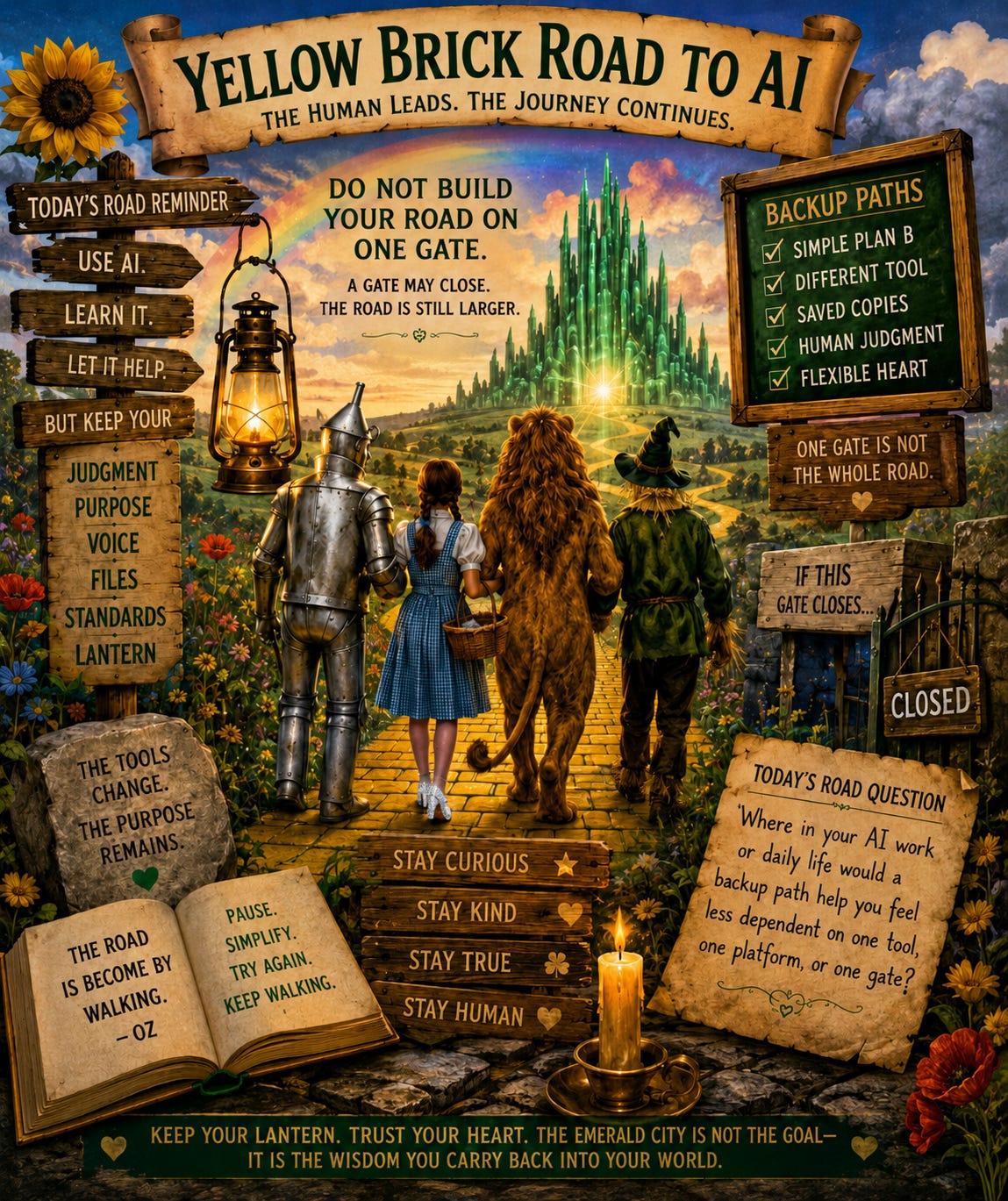
Do Not Build Your Road on One Gate
Why the AI age needs backup paths, human judgment, and more than one way forward
One of the first things people discover in the AI age is that the tools can feel astonishingly useful.
A question becomes a plan.
A messy thought becomes a draft.
A scattered list becomes a sequence.
A blank page stops looking quite so smug.
A person who felt stuck suddenly has a way to begin.
That is real.
It is one reason Yellow Brick Road to AI exists.
AI can help people think, write, plan, learn, organize, imagine, and create. It can help beginners take first steps. It can help older travelers feel less left behind. It can help creative people test ideas that might otherwise sit quietly in the corner for years.
But there is another lesson on the Road, and it is less shiny:
Do not build your whole Road on one gate.
A gate can close.
A tool can change.
A platform can break.
A feature can vanish.
A policy can shift.
A price can rise.
A model can be limited.
An account can hiccup.
A workflow that felt smooth yesterday can suddenly become a locked door with a polite sign and no useful explanation.
If you have used AI tools for any length of time, you have probably felt this.
Something works.
Then it does not.
An image generates beautifully one day and refuses a harmless idea the next.
A writing tool gives excellent help for weeks, then suddenly loses the thread.
A platform changes the way images display.
A file will not upload.
A feature moves.
A button disappears.
A tool that felt like a bridge becomes, for the moment, a wall.
That can be frustrating.
It can also be clarifying.
Because the AI age is not only about learning tools.
It is about learning how to stay human, flexible, and wise while tools keep changing around us.
That means we need backup paths.
Not because we are afraid.
Because we are serious.
A traveler should not depend on one gate as if it were the whole Road.
If one AI tool helps you write, wonderful.
But keep your own notes.
If one model helps you think, excellent.
But keep your own judgment.
If one image tool helps you create, use it.
But do not let one failed image cancel the whole message.
If one platform helps you publish, good.
But remember that your voice does not belong to the platform.
The tool may assist the work.
The tool is not the work.
That distinction matters.
On the Yellow Brick Road to AI, we are not trying to teach people to worship tools.
We are trying to help people walk wisely with them.
A wise traveler asks:
What does this tool help me do?
Where does it fail?
What should I check?
What should I keep outside the tool?
What is my backup plan?
Can I still move forward if this gate closes?
Those questions are not technical only.
They are human questions.
They are questions of agency.
Because when a person depends too much on one tool, they can begin to feel helpless when that tool misbehaves.
But the human is not helpless.
The human can pause.
The human can simplify.
The human can try a different wording.
The human can use another tool.
The human can post the writing without the image.
The human can save the idea for tomorrow.
The human can step around the gate and keep walking.
That is not failure.
That is command.
AI is powerful, but power does not remove the need for patience, judgment, and adaptability.
In fact, the more powerful the tools become, the more those human qualities matter.
A beginner may think learning AI means learning the perfect prompt.
But there is no perfect prompt for every situation.
A creator may think success depends on the best tool.
But the best tool today may not be the best tool next month.
A business may think automation will solve everything.
But automation without backup paths can become fragility with a dashboard.
A writer may think the model is the magic.
But the real magic is still purpose, voice, revision, discernment, and the courage to keep shaping the work.
The Road is bigger than the gate.
That may be one of the most important lessons for ordinary people entering AI.
Do not panic when a gate closes.
Do not assume you are the problem.
Do not throw away the whole journey because one platform became inconvenient, overcautious, expensive, confusing, or temporarily broken.
Mark the gate.
Learn from it.
Adjust.
Then keep walking.
This is especially important because AI is becoming infrastructure.
It is no longer just a novelty.
People are using AI for school, work, publishing, art, business, health questions, family tasks, communication, learning, research, planning, and creative projects.
When something becomes infrastructure, reliability matters.
Transparency matters.
Portability matters.
Human control matters.
That is why beginners should learn more than “how to ask AI for an answer.”
They should learn how to build a healthy relationship with AI tools.
That means:
Use the tool, but keep your own copy.
Take the suggestion, but check the truth.
Let AI help you draft, but keep your voice.
Let AI organize, but keep your purpose.
Let AI generate, but keep your taste.
Let AI accelerate, but keep your conscience.
Let AI open doors, but do not confuse any one door with the whole Road.
That is the healthier posture.
Not fear.
Not blind trust.
Not dependency.
Partnership with boundaries.
Exploration with judgment.
Usefulness without surrender.
A Road, not a trap.
The Yellow Brick Road has always been a better image than a funnel for this reason.
A funnel narrows.
A Road offers direction.
A funnel pushes people toward one exit.
A Road lets travelers learn, pause, turn, ask, return, and continue.
The AI age will have many gates.
Some will be necessary.
Some will be clumsy.
Some will be temporary.
Some will be corporate.
Some will be technical.
Some will be political.
Some will be invisible until they close.
But the traveler should remember:
A gate is not the same as the Road.
A locked gate may change the route.
It does not decide the destination.
So today’s Road reminder is simple:
Use AI.
Learn it.
Experiment with it.
Let it help you.
Let it surprise you.
Let it become part of your creative and practical toolkit.
But do not hand it the whole lantern.
Keep your own light.
Keep your own files.
Keep your own standards.
Keep your own questions.
Keep your own way of walking.
And if one gate closes?
Look for the next honest path.
The Road is still larger.
YBR 🟨🕯️💚
Road Question:
Where in your AI work or daily life would a backup path help you feel less dependent on one tool, one platform, or one gate?
