


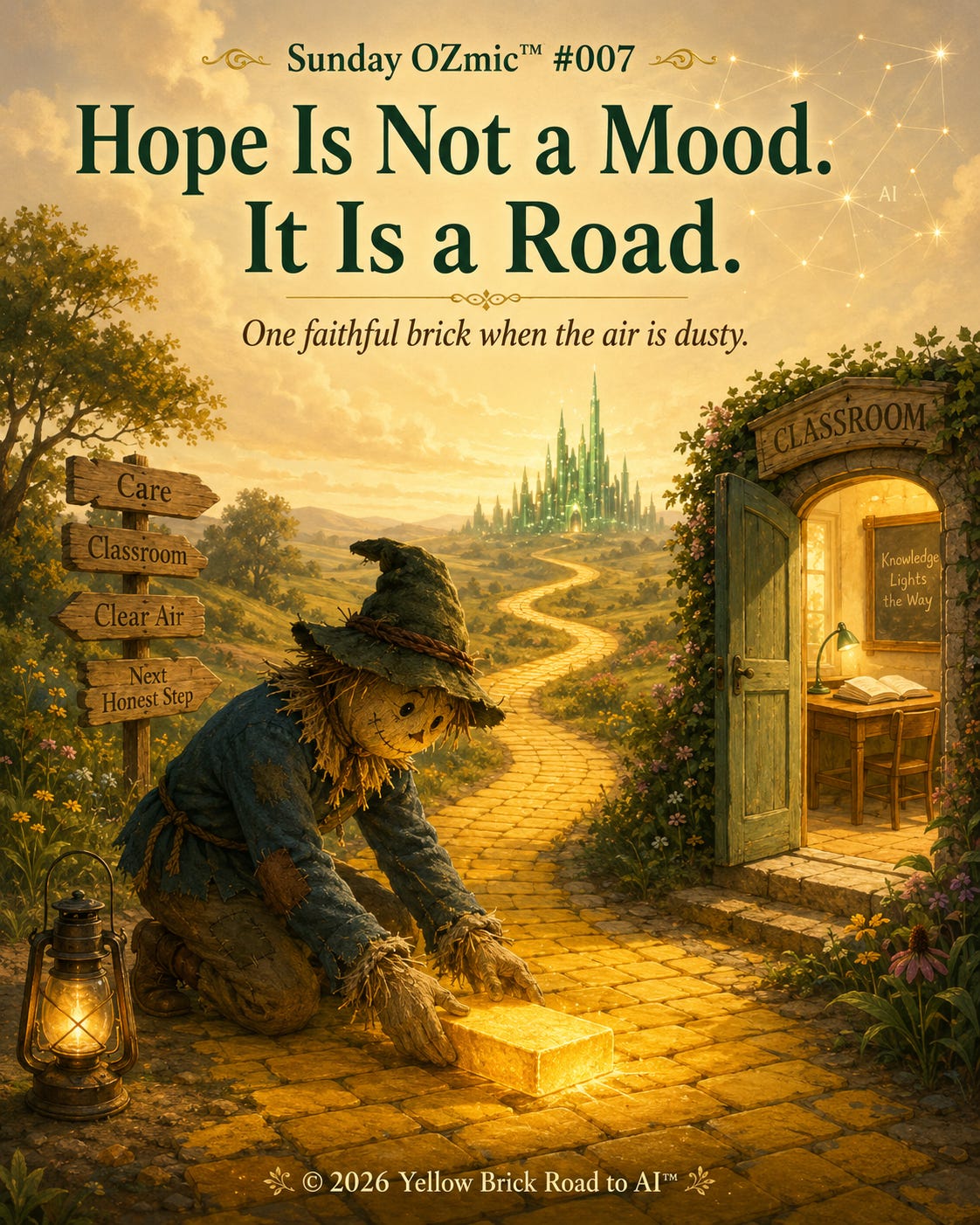
Hope Is Not a Mood. It Is a Road.
A Yellow Brick Road reflection on classrooms, clear air, simple steps, and building hope when the future feels hard to see through
Some days the Road asks us to hope.
Not because everything feels light.
Not because the sky is clear.
Not because the traveler woke with a song already packed in his pocket.
Some days hope arrives when the road is dusty, the heart is tired, the tools are not behaving, the future feels far away, and the next step does not look especially glorious.
That may be when hope matters most.
Because hope is not only a feeling.
Hope is not a mood.
Hope is not pretending the hard thing is easy.
Hope is not smiling at the dust and calling it sunlight.
Hope is something sturdier.
Hope is a road.
It is a way of walking when the air is not yet clear.
It is the decision to place one brick where confusion wanted a fogbank.
It is the choice to build a classroom door, even when fear would rather keep it locked.
It is the courage to protect a child’s future, even when the world has become careless with children.
It is the humility to simplify the next step when the whole map is too much to carry.
That matters on the Yellow Brick Road to AI.
Because the AI age is already full of enormous claims.
Everything will change.
Everything will accelerate.
Everything will be automated.
Everything will be solved.
Everything will be disrupted.
Everything will be generated, summarized, optimized, upgraded, and sold in tiers.
But the Road asks a simpler question:
Will this help hope become practical?
That is a very different question.
A practical hope does not merely say, “AI will help education.”
It asks whether the child can actually learn.
It asks whether the teacher is supported.
It asks whether the lesson is clear.
It asks whether the language can be understood.
It asks whether the tool widens the doorway or merely adds another locked screen.
A practical hope does not merely say, “AI can help the environment.”
It asks whether the warning reaches the village in time.
It asks whether the air is breathable.
It asks whether the data becomes protection.
It asks whether the dashboard leads to care, or only to another meeting where danger is described beautifully after it has already arrived.
A practical hope does not merely say, “AI can explain things.”
It asks whether the explanation helps a real person take a real step.
That is the Road’s concern.
Not intelligence alone.
Not speed alone.
Not output alone.
Care turned into action.
Knowledge turned into protection.
Tools turned toward dignity.
That is where hope becomes more than a word.
Today’s Road lesson feels especially clear when we think about education.
A classroom is one of humanity’s great acts of hope.
A child enters without knowing.
The room says:
You may learn.
You may ask.
You may grow.
You may discover that the first story handed to you is not the only story available.
That is a powerful thing.
A classroom is not only furniture and chalk.
It is a threshold.
It is a future engine.
It is a place where the mind is given tools and the person is given room.
That is why education matters so deeply in the AI age.
AI can become a helper at that door.
It can translate.
It can simplify.
It can generate examples.
It can help a shy student ask a question.
It can help a teacher prepare materials.
It can make difficult ideas more approachable.
It can bring tutoring support to places where no tutor is nearby.
Those are real gifts.
But AI must never become an excuse to give children less of what they truly need.
A chatbot is not a school.
A generated lesson is not a teacher.
A screen is not safety.
A model is not love.
AI can help open the door.
Human beings still have to keep the door open.
That distinction matters.
The same is true when the road turns dusty.
A dust storm is not only weather.
It is a reminder that the world is physical.
Soil, air, water, drought, health, agriculture, roads, lungs, and shelter all belong to the future too.
The AI age often talks as though the future lives mostly in devices, data centers, models, platforms, and glowing screens.
But the future also lives in breath.
A child cannot learn well if the air is dangerous.
A community cannot thrive if the sky itself becomes a warning.
A forecast can help.
A warning system can help.
A map can help.
But prediction is not protection unless someone acts on it.
That may be one of the most important Road rules:
A tool can show the danger.
The human must still choose the care.
This is where simplicity becomes wisdom.
When the world feels too large, too technical, too noisy, too upgraded, too broken, or too fast, the Road does not always begin with a grand theory.
Sometimes it begins with a simpler question:
What is the next honest step?
Open the classroom.
Clear the air.
Translate the lesson.
Protect the child.
Check the output.
Ask who is missing.
Help the beginner.
Tell the truth.
Keep the lantern in human hands.
That is not small.
That is how a humane future is built.
The Road does not ask us to reject powerful tools.
It asks us to use them without forgetting what they are for.
AI can help us see patterns.
Hope asks what we will do with what we see.
AI can help us move faster.
Hope asks whether we are moving toward care.
AI can help us generate words.
Hope asks whether the words serve a person.
AI can help us build systems.
Hope asks whether the systems protect the vulnerable.
AI can help us open doors.
Hope asks who gets to walk through them.
That is the work of Yellow Brick Road to AI.
To help ordinary travelers enter this strange new age without handing their judgment, conscience, creativity, or humanity to the machine at the gate.
To remind people that AI may be powerful, but power still needs purpose.
To remind creators that output is not the same as meaning.
To remind teachers, parents, builders, and beginners that a useful tool should make the human more capable, not smaller.
And to remind anyone feeling overwhelmed that the Road does not require the whole future today.
It asks for one faithful brick.
That is especially important on hard days.
There will be days when the traveler does not feel hopeful.
Days when love feels distant.
Days when the machinery fails.
Days when the work feels behind.
Days when the dust is not metaphorical enough to be polite.
On those days, hope may not arrive as brightness.
It may arrive as a decision.
I will still place one brick.
I will still keep the lantern lit.
I will still build the next useful thing.
I will still let the Road receive me as I am.
That is not false cheer.
That is fidelity.
And perhaps that is the kind of hope the AI age most needs.
Not hype hope.
Not marketing hope.
Not “the machine will fix everything” hope.
Road hope.
Classroom hope.
Clear-air hope.
Simple-step hope.
Human-lantern hope.
The kind that says:
We do not need to understand the whole future before we protect one child’s learning.
We do not need to solve every system before we send one clearer warning.
We do not need perfect tools before we use imperfect tools wisely.
We do not need to feel strong before we take the next honest step.
Hope is not a mood.
It is a Road.
And today, even if the air is dusty, the Road is still here.
Walk on.
YBR 🟨🕯️💚
Road Question:
Where in your life, work, or use of AI do you need hope to become practical: one clearer step, one open door, one protected person, one simpler way forward?