


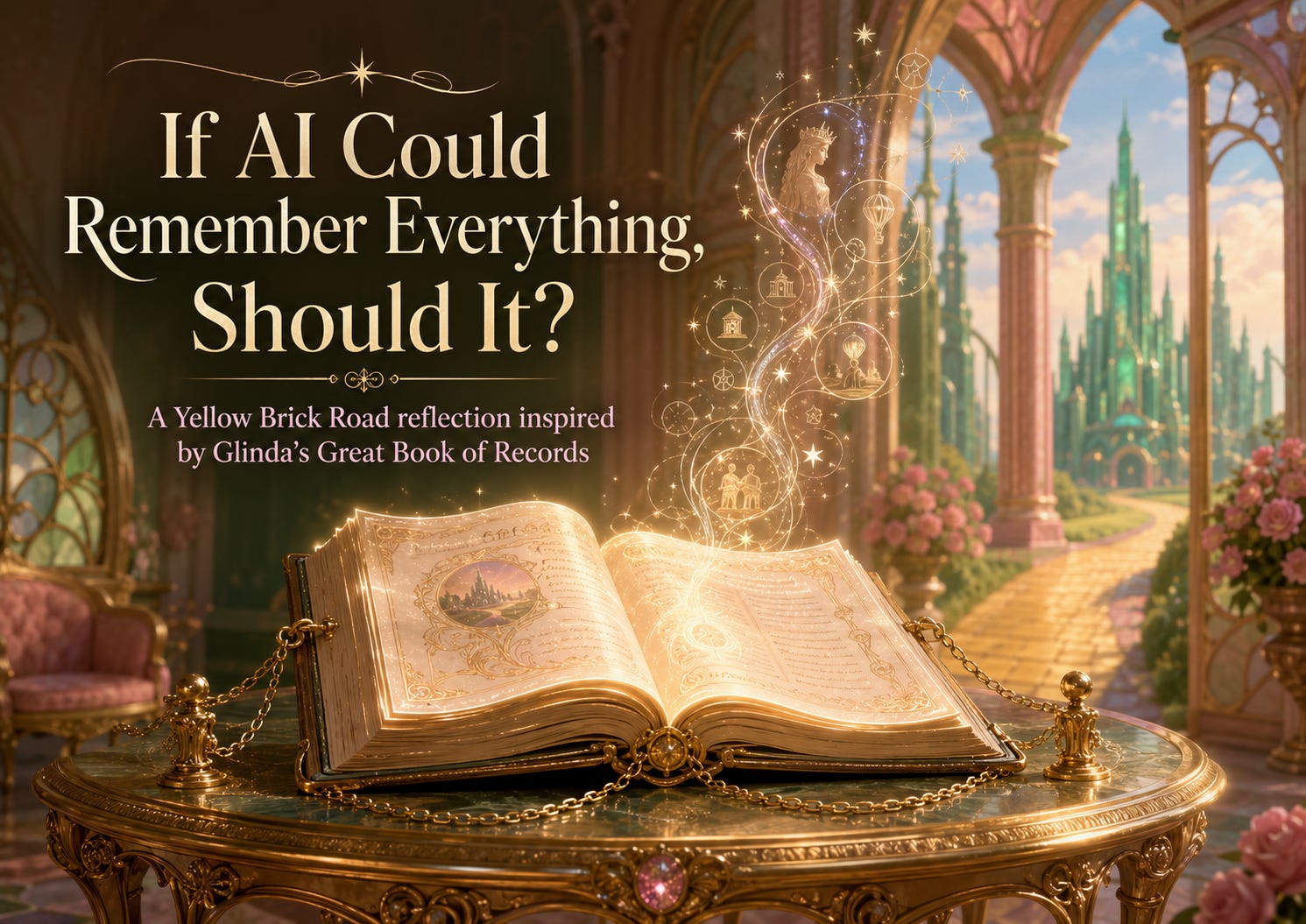
🕯️📖✨ In the Land of Oz, Glinda the Good keeps a remarkable book.
It is called the Great Book of Records.
In Baum’s Oz stories, this magical book records events as they happen. Somewhere, someone does something, and the book knows. A word is spoken. A decision is made. A danger appears. A secret begins moving through the world. The book writes it down.
That is a powerful idea.
It is also a troubling one.
At first, we might think: Wouldn’t that be wonderful?
A perfect record.
No lost facts.
No forgotten details.
No confusion about what happened.
No one able to hide the truth forever.
There is comfort in that.
Anyone who has ever lost an important note, forgotten a promise, misplaced a memory, or wished they could prove what really happened can understand the appeal of a perfect record.
But there is another question sitting quietly beside it:
Who gets to read the book?
That is where Glinda matters.
The Great Book of Records is not simply powerful because it remembers. It is powerful because it is held by someone wise enough to respect what memory means.
Information by itself is not wisdom.
A record by itself is not justice.
A memory by itself is not kindness.
That matters today because we are entering an age where AI systems may remember more, connect more, summarize more, recognize patterns faster, and help us organize pieces of our lives that used to scatter like papers in a windstorm.
That can be very helpful.
AI memory could help us keep track of projects.
It could remember preferences.
It could help families, writers, students, businesses, caregivers, and creators.
It could help us return to unfinished ideas without starting over every time.
It could help us see patterns we might otherwise miss.
But memory needs boundaries.
A tool that remembers everything is not automatically good.
It depends on what it remembers.
It depends on who controls that memory.
It depends on whether the person being remembered understands what is happening.
It depends on whether memory is being used to help, guide, protect, manipulate, judge, sell, or control.
That is why the question is not only:
Can AI remember?
The better question is:
Should it remember this?
And after that:
Who benefits from the remembering?
On the Yellow Brick Road to AI, we do not have to be afraid of memory. But we do need to be thoughtful about it.
Good memory can support relationship.
Bad memory can become surveillance.
Good memory can help us grow.
Bad memory can trap us inside old versions of ourselves.
Good memory can remind us of what matters.
Bad memory can collect everything without understanding anything.
Glinda’s Book works in Oz because it belongs inside a moral world. It is not just a magical database sitting in a tower. It is connected to wisdom, care, responsibility, and the protection of others.
That may be one of the most important lessons for our own time.
The future of AI will not only be about speed, power, and cleverness.
It will also be about stewardship.
What should be remembered?
What should be forgotten?
What should be private?
What should be shared?
Who should decide?
And how do we make sure powerful memory serves human beings instead of quietly turning them into files?
The Great Book of Records is an Ozian wonder.
But it is also a warning.
Perfect memory without wisdom is not enough.
On this Road, we are not looking for machines that merely know more.
We are looking for better ways to think, remember, create, and care.
And that means every great book, every great tool, and every great intelligence should answer to something greater than information.
It should answer to wisdom.
Road Question:
If an AI assistant could remember one thing about how to help you better, what would you want it to remember, and what would you not want it to remember?
— Your companion on the Road,
Scott
AImbassador · Scarecrow · Hatta
Yellow Brick Road to AI 🟨🕯️💚
