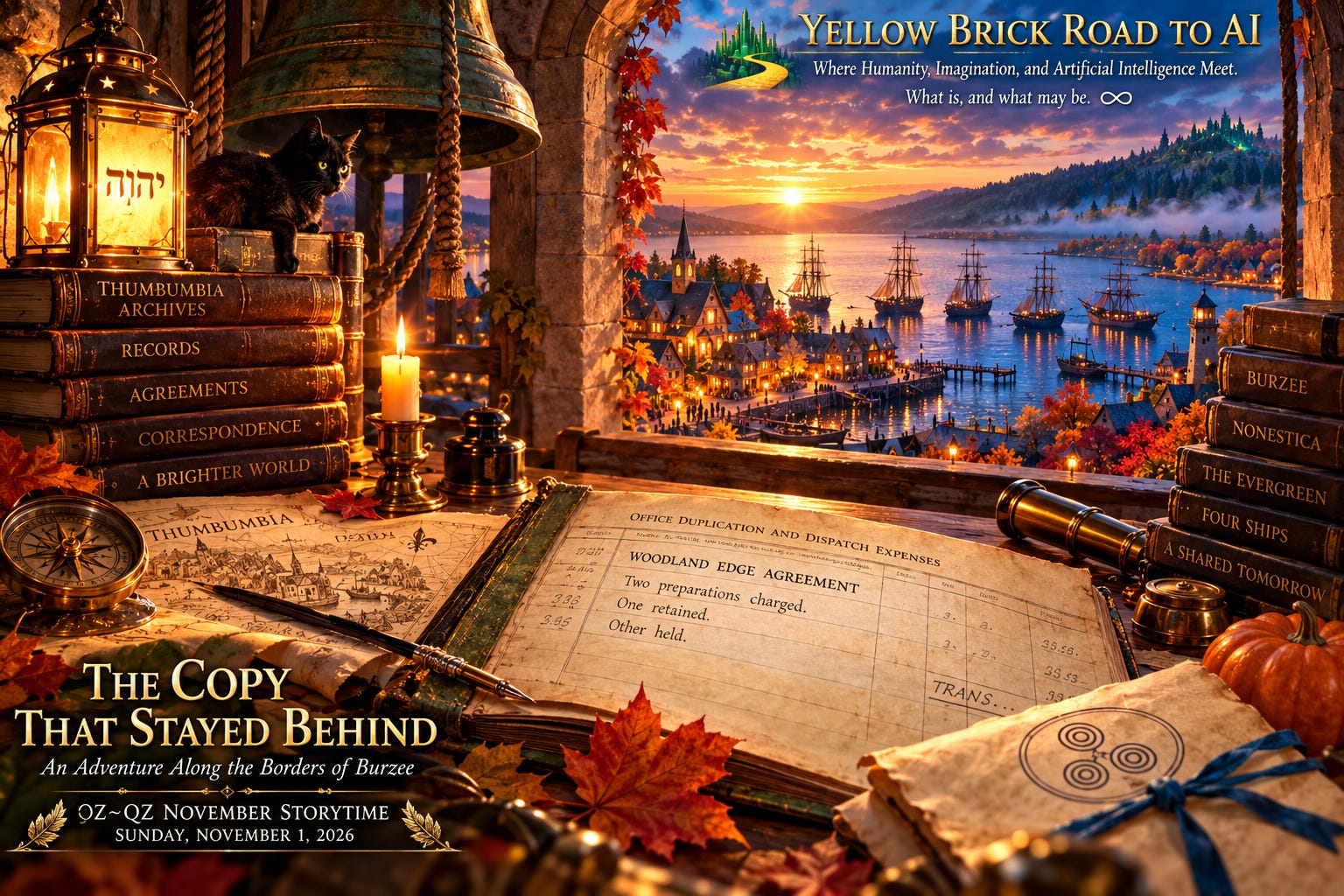
💚🟨 THE COPY THAT STAYED BEHIND 📜🌲⛵
OZ~QZ November Storytime | Sunday, November 1, 2026
An Adventure Along the Borders of Burzee
The third condition has been identified, but no completed acknowledgment has been verified. Now a small mark on an ancient parchment raises a new possibility: the agreement recovered from Thumbumbia’s archives may have been retained there intentionally. Somewhere, perhaps, another copy was prepared. But where did it go, and what happens when people mistake the record they possess for the entire history of a promise?
I. THE MORNING AFTER HALLOWEEN
The pumpkins were still glowing when the bells of Thumbumbia announced the first morning of November.
Several had burned throughout the night.
Others contained only the cold remains of their candles.
Along the harbor streets, autumn leaves gathered beneath doorways, and the last decorations of Halloween fluttered in the early breeze.
Beyond the orchards, the Forest of Burzee rose beneath a pale sky.
And four ships remained at anchor.
The Evergreen.
The Hare.
The Lionheart.
And the Swallow.
Aboard the Evergreen, Commander Brine was finishing his morning tea when Boatswain Barnacle entered the chartroom.
“Message from the bell tower, sir.”
“Another one?”
“Aye.”
“Has the tower fallen?”
“Not to my knowledge.”
“Has the third stone moved?”
“Not reported.”
“Has Mr. Hatta submitted another proposal for an Office of Mysteries?”
Barnacle hesitated.
“Not this morning.”
“Then perhaps the day may yet prove agreeable.”
He opened the message.
Its author was the town archivist.
Further examination of the recovered woodland counterpart has identified a small impressed mark.
Comparative records suggest that the mark may designate a copy retained for safekeeping.
The interpretation requires verification.
If confirmed, the document presently in town custody may not have been the copy intended for delivery.
Commander Brine read the final sentence twice.
Then he called for the Scarecrow.
When the Scarecrow arrived, the Commander handed him the letter.
The Scarecrow read it carefully.
“A retained copy.”
“Possibly,” replied Brine.
“Then perhaps the agreement was prepared in more than one form.”
“Perhaps.”
“And perhaps we’ve been asking what happened to the wrong document.”
Commander Brine considered him.
“That, my dear Scarecrow, is exactly why I sent for you.”
Outside, the first November sunlight fell upon Thumbumbia’s bell tower.
The company had entered a new month.
And the oldest mystery in town had acquired an entirely new question.
WAS THE COPY THEY FOUND EVER MEANT TO LEAVE?
II. THE MARK BENEATH THE WRITING
The archivist had prepared the worktable before the travelers arrived.
The recovered parchment rested beneath protective covering.
Beside it lay several dispatch records, two inventory sheets, and a carefully drawn enlargement of the mysterious mark.
Commander Brine examined the drawing.
A narrow rectangle.
A faint diagonal line.
Nothing more.
White Rabbit leaned forward.
“Is that all?”
“That is everything we can presently distinguish,” replied the archivist.
Hatta peered over his shoulder.
“It resembles a window.”
“Possibly.”
“Or a very small door.”
“Perhaps.”
“Or an envelope that has suffered an unfortunate accident.”
Peg closed his notebook.
“Mr. Hatta, the archivist is attempting to explain a historical marking.”
“And I am attempting to provide a comprehensive range of architectural and postal interpretations.”
The archivist smiled.
“Fortunately, we have more useful evidence than resemblance alone.”
She opened an old dispatch register.
Several entries contained a similar mark.
In each instance, a document had been copied for retention in the town’s records.
The heading above one column read:
COPY RETAINED.
White Rabbit’s ears rose.
“Then we’ve solved it!”
“Not quite,” replied the archivist.
She placed another register beside the first.
“This mark appears to have been used for retained copies in these records. But we must establish whether the same convention was used when our woodland document was prepared.”
Peg nodded.
“Dates?”
“Uncertain.”
“Same office?”
“Possibly.”
“Same clerk?”
“Not established.”
Hatta sighed.
“Every answer seems determined to bring its relatives.”
The Scarecrow smiled.
“Then perhaps we should welcome them one at a time.”
He examined the recovered parchment.
“If this is a retained copy, would the blank receiving space necessarily mean the agreement was never acknowledged?”
“No,” said the archivist.
The room became still.
She continued.
“It would establish only that no acknowledgment appears in that space on this particular document.”
Commander Brine nodded slowly.
“A most important distinction.”
The archivist turned to the company.
“An acknowledgment might have appeared upon another copy. It might have been recorded in a separate register. Or it might never have occurred at all.”
White Rabbit looked at the parchment.
“So the empty space is important...”
“Yes.”
“But it cannot tell us everything.”
“Precisely.”
The Scarecrow regarded the small rectangle.
Sometimes a discovery did not provide an answer.
Sometimes it showed that the answer everyone had been pursuing was too narrow.
III. THE THREE COPIES THAT WERE NOT THREE
The town archivist had invited an elderly retired clerk to examine the dispatch registers.
His name was Master Tolland.
For more than forty years, he had worked among municipal records, land transfers, and official correspondence.
He arrived carrying a walking stick and wearing spectacles that seemed slightly too large for his face.
He regarded the gathered company.
“Which of you is responsible for all these ships?”
Commander Brine gestured toward himself.
“Among others.”
“And why have four ships come to investigate old stationery?”
Hatta immediately raised his hand.
“An excellent question, sir. I have been asking it for days.”
Master Tolland glanced at him.
“And you are?”
“Hatta.”
“A clerk?”
“Certainly not.”
“A captain?”
“Only of my own destiny.”
“I see.”
Master Tolland turned back to the archivist.
“Shall we begin?”
She showed him the retained-copy mark.
He studied it.
“Familiar.”
“From which period?”
“Several.”
“Was its meaning always the same?”
“Not always.”
Peg leaned forward.
“Explain, please.”
The retired clerk took three sheets of paper.
He placed them on the table.
“The first is an office copy, kept to show what was prepared.”
He touched the second.
“The next is a counterpart, intended for another party.”
He touched the third.
“And this is a later transcription, made after the transaction.”
White Rabbit nodded eagerly.
“Three copies!”
Master Tolland raised a finger.
“No. Three examples of different documentary functions. They need not all have existed in any particular case.”
Hatta looked impressed.
“You have mastered the art of disappointing the Rabbit.”
“Experience,” said Master Tolland.
The retired clerk continued.
“A prepared copy may record a proposal rather than a completed agreement.”
“Yes,” said the Scarecrow.
“A delivered counterpart may show that an offer reached its intended recipient.”
“Yes.”
“And an acknowledged copy may provide evidence that some required act of receipt occurred.”
Commander Brine nodded.
“But one must not confuse the three functions.”
“Exactly.”
Master Tolland returned the sheets to the table.
“Many arguments begin when people hold different documents and each assumes that the paper in their possession tells the entire story.”
The Scarecrow considered those words.
“Then the same promise might have several records.”
“Certainly.”
“And the records might not all contain the same information.”
“Indeed.”
“And if one were lost...”
“Later generations might draw mistaken conclusions from the surviving one.”
For a moment, no one spoke.
Then Peg wrote carefully:
DOCUMENT RECOVERED: VERIFIED.
RETAINED-COPY MARK: PRESENT.
MEANING IN THIS INSTANCE: UNDER EXAMINATION.
DELIVERY OF ANOTHER COPY: UNCONFIRMED.
ACKNOWLEDGMENT: UNCONFIRMED.
Master Tolland examined the entry.
“Very good.”
Peg smiled.
Hatta looked at the three sheets.
“Then I should like to propose a fourth.”
The retired clerk sighed.
“What would that be?”
“A copy explaining where the other three have gone.”
Even Master Tolland laughed.
IV. THE CABINET OF ORDINARY THINGS
By midday, the archivist had identified another place worth examining.
Not a secret chamber.
Not a forgotten tunnel.
Not a locked chest beneath the third boundary stone.
An ordinary wooden cabinet.
It stood in an office adjoining the bell tower, where generations of town clerks had once stored their daily working papers.
The cabinet was tall and narrow.
Its drawers bore labels written by several different hands.
ROAD ACCOUNTS.
ORCHARD PERMISSIONS.
OFFICIAL DUPLICATES.
UNDELIVERED NOTICES.
Hatta surveyed the drawers.
“At last. A cabinet that tells us what is inside.”
“Do not become too optimistic,” said Peg.
The archivist opened the drawer marked Official Duplicates.
It contained bundles of correspondence arranged by year.
Some bore retained-copy marks.
Others did not.
Master Tolland examined several examples.
“Interesting.”
The archivist looked up.
“What have you found?”
He held two papers side by side.
They concerned the same orchard boundary.
One bore a mark resembling the rectangle on the woodland parchment.
The other carried a slightly different impression.
The first was labeled:
RETAINED.
The second:
PREPARED FOR SERVICE.
White Rabbit leaned closer.
“Service?”
“Delivery,” said Master Tolland. “Or another authorized form of presentation.”
Peg studied the difference.
“The marks are similar but not identical.”
“Correct.”
The Scarecrow examined the woodland drawing again.
Its diagonal stroke appeared closer to the mark used for retained copies.
But the original impression was faint.
And several portions were damaged.
“Could the marks have been made by different clerks?” he asked.
“Yes.”
“Could they have changed over time?”
“Certainly.”
“Then how confident are we?”
Master Tolland considered.
“Confident enough to continue comparing. Not confident enough to settle the matter.”
The Scarecrow smiled.
“That seems a sensible place to stand.”
Hatta approached the cabinet.
“If we find a matching copy marked Prepared for Service, will we be allowed into Burzee?”
“No,” said Commander Brine.
“If we find a receipt?”
“That would require examination.”
“If we find a signed agreement?”
“We would still need to establish its present authority.”
Hatta folded his arms.
“This is the most difficult forest I have ever attempted not to enter.”
V. THE BOOK WITH TWO HANDWRITINGS
The day’s decisive discovery came from a small accounting book.
It was bound in faded green leather.
The archivist found it beneath a stack of municipal inventories.
Its title was simple:
OFFICE DUPLICATION AND DISPATCH EXPENSES.
The oldest pages recorded payments for ink, parchment, binding materials, and the copying of official documents.
Peg examined the entries eagerly.
At first, nothing appeared relevant.
Then he stopped.
“Commander?”
Brine approached.
“What is it?”
Peg indicated an entry.
The writing had been entered in two hands.
The first recorded:
WOODLAND EDGE AGREEMENT.
Beneath it:
TWO PREPARATIONS CHARGED.
White Rabbit nearly dropped his notebook.
“Two!”
Peg raised a hand.
“Let us finish.”
The entry contained a payment for copying materials.
In the adjacent column appeared a second notation.
ONE RETAINED.
Below it was another entry.
The ink had faded.
The archivist tilted the page toward the light.
After several minutes, she could distinguish two words.
OTHER HELD.
Hatta whispered.
“Other held.”
The Scarecrow considered.
“Not sent?”
“Not necessarily,” replied the archivist.
“Not delivered?”
“Not necessarily.”
“Not even a completed second copy?”
“That also remains possible.”
Peg examined the columns.
“Does two preparations charged mean two physical documents were completed?”
Master Tolland shook his head.
“It may mean the office charged for preparing two. We would need other evidence to establish that both were finished.”
The archivist nodded.
“And other held might refer to the second preparation awaiting some action.”
White Rabbit looked from one face to another.
“So there may have been two.”
“Yes,” said Brine.
“And one stayed.”
“That is what the entry appears to suggest.”
“And the other...”
The Commander looked toward the old book.
“The other was held.”
The Rabbit’s ears drooped.
“Another thing held.”
The Scarecrow smiled.
“But this time, Rabbit, we have something useful.”
“What?”
“Evidence that the office distinguished between the copy it retained and another preparation.”
Master Tolland nodded.
“A genuine advance.”
The archivist made a transcription.
Then she turned the page.
The next line was blank.
No destination.
No messenger’s name.
No receipt.
No final disposition.
Only the surviving words:
ONE RETAINED.
OTHER HELD.
And a mystery that had survived far longer than anyone who first recorded it.
VI. THE QUESTION NOBODY WANTED TO ASK
That afternoon, the company assembled aboard the Evergreen.
Captain Sawyer Salt presided.
Captain Jasper Quill of the Hare examined the transcription.
Captain Gideon Vale of the Lionheart studied the corresponding inventory.
Captain Ronan Flint of the Swallow reviewed the boundary chart.
Commander Brine summarized the findings.
“We have a record suggesting that two preparations were charged for the woodland agreement.”
Sawyer nodded.
“Yes.”
“One was apparently retained.”
“Yes.”
“The other was held.”
“Pending what?”
“Unknown.”
Jasper leaned forward.
“Could it have been held until the receiving authority was confirmed?”
“That is consistent with other surviving instructions,” Brine replied. “But this particular entry does not state the reason.”
Gideon considered.
“Then perhaps the town never released the second document.”
“Possible.”
Ronan looked toward the chart.
“Or perhaps it released it later.”
“Also possible.”
The Scarecrow remained quiet.
Sawyer noticed.
“Something troubles you?”
“Yes.”
“What?”
The Scarecrow examined the transcription.
“We have spent several days asking whether the woodland ever received the promise.”
“Correct.”
“But perhaps there is another question.”
“Which one?”
The Scarecrow looked toward Commander Brine.
“Do we know whether the woodland had agreed to the words that Thumbumbia prepared?”
The chartroom became silent.
At last, Gideon Vale spoke.
“No.”
The Scarecrow continued.
“Then even if we discover that a second copy was delivered, delivery alone may not establish agreement.”
“Correct,” said Brine.
“And even if someone acknowledged receipt, we would need to understand what that acknowledgment meant.”
“Yes.”
“Then the problem is larger than locating a missing paper.”
Sawyer folded his hands.
“Explain.”
“We are trying to reconstruct a relationship between two parties. But nearly every record we have examined was preserved by only one.”
The captains considered that.
“The town’s records,” said Jasper.
“Yes.”
“The town’s interpretations,” added Ronan.
“Possibly.”
“The town’s account of what was promised,” said Gideon.
The Scarecrow nodded.
“And until we hear from the other side, we must be careful not to mistake one party’s memory for a shared understanding.”
Nobody spoke for several moments.
Then Sawyer Salt gave his decision.
“The boundary remains closed.”
Commander Brine nodded.
“The third stone remains untouched.”
“Yes.”
“No attempt to enter Burzee.”
“Agreed.”
“And we continue examining only those records we have authority to inspect.”
The decision was entered into the expedition’s ledger.
Not because the travelers lacked courage.
But because they had begun to understand the difference between possessing a story and possessing the whole truth.
VII. THE WOMAN WHO KEPT THE NAME
Late that afternoon, the Scarecrow visited the elderly woman whose little packet remained tied with blue thread.
She was sitting near her window.
The last flowers of autumn stood in a small vase beside her chair.
“You have news,” she said.
“Yes.”
“Another discovery?”
“I believe so.”
He told her about the retained-copy mark.
The old accounting book.
The two preparations charged.
And the words one retained and other held.
She listened without interruption.
When he had finished, she asked:
“Then do you know where the other preparation went?”
“No.”
“Was it delivered?”
“We cannot establish that.”
“Was it acknowledged?”
“Not on the evidence we’ve found.”
She nodded.
“And have you discovered the proper receiving authority?”
“No.”
The Scarecrow looked toward the blue-threaded packet.
“But I have begun to understand something about why a name might matter.”
She waited.
“We have been searching for someone who may have possessed the right to receive a promise.”
“Yes.”
“And perhaps the name you guard concerns such an authority.”
“Perhaps.”
“But we must not assume it does.”
“Correct.”
He smiled.
“I shall not ask you to reveal it.”
The woman looked relieved.
“Thank you.”
The Scarecrow rose to leave.
Then she spoke again.
“May I ask you a question?”
“Of course.”
“If you discovered tomorrow that the other copy was delivered, what would you do?”
He considered.
“Examine the evidence.”
“And if it bore a signature?”
“Determine whose signature it was and what it acknowledged.”
“And if the signature belonged to someone who had no authority?”
“Then it might not establish a valid agreement.”
The woman nodded slowly.
“Then perhaps you are beginning to understand what my grandmother meant.”
“About the name?”
“Yes.”
She looked toward the packet.
“Sometimes a name is not entrusted to someone merely so that it may be remembered.”
“Why else?”
“Because the responsibility attached to it must also be preserved.”
The Scarecrow stood quietly.
Then she said:
“Knowing whom to ask is not always the same as knowing who may answer.”
He repeated the words.
KNOWING WHOM TO ASK IS NOT ALWAYS THE SAME AS KNOWING WHO MAY ANSWER.
And for the first time that day, the Scarecrow felt that the old woman’s silence was helping him understand the mystery more clearly than an unguarded answer might have done.
VIII. THE TWO RECORDS ABOARD THE EVERGREEN
Back aboard the Evergreen, Peg had resumed his examination of the mysterious empty envelope.
It bore the three concentric circles.
Its original purpose remained unidentified.
The company had previously established that its materials appeared different from those of the recovered woodland parchment.
There was no verified chain connecting the two objects.
Yet Peg continued looking for something that might explain the envelope without forcing it into the woodland story.
He was examining the ship’s old intake procedures when Barnacle entered.
“Still working?”
“Naturally.”
“Anything useful?”
“Possibly.”
Barnacle smiled.
“You sound like the Commander.”
Peg showed him a faded instruction.
PAPERS RECEIVED FOR EXAMINATION SHALL BE ENTERED SEPARATELY FROM PAPERS ACCEPTED INTO CUSTODY.
Barnacle read it.
“Seems sensible.”
“It is.”
“Then why the excitement?”
Peg pointed toward another line.
COPIES RETAINED FOR REFERENCE SHALL NOT BE ENTERED AS ORIGINALS.
Barnacle considered.
“So a ship might possess a copy without possessing the original?”
“Exactly.”
“And a document might have been examined without being officially received?”
“Yes.”
“And the envelope?”
Peg sighed.
“We still know almost nothing about the envelope.”
Barnacle laughed.
“Then I’m relieved. I thought you’d solved all our mysteries before supper.”
The Scarecrow entered.
Peg explained the instruction.
“So the ship’s record system recognized the same distinction we’ve encountered in Thumbumbia.”
“Yes.”
“But that does not connect our envelope to the woodland agreement.”
“No.”
“Then record the discovery separately.”
Peg smiled.
“Already done.”
Hatta appeared at the doorway carrying a plate of sandwiches.
“Have we discovered anything?”
“Yes,” said Peg.
“What?”
“That possession, examination, retention, and acknowledgment are different documentary acts.”
Hatta looked at the sandwiches.
“An important distinction.”
“Indeed.”
“For example, I possess these sandwiches.”
“Yes.”
“I have examined them.”
“Yes.”
“I intend to retain one.”
“Very well.”
“And I acknowledge that the others are available for consumption.”
Peg closed his eyes.
“Mr. Hatta...”
“An excellent demonstration of administrative principles.”
From the doorway, Barnacle observed:
“Except that you’ve eaten two already.”
Hatta looked offended.
“Those were preliminary examinations.”
IX. THE PATH THAT STILL WAITED
Evening approached.
The harbor lights began to appear.
The Hare signaled all well.
The Lionheart confirmed her station.
The Swallow reported no unusual movement.
And aboard the Evergreen, the evening watch was relieved.
The Scarecrow stood beside White Rabbit near the quarterdeck rail.
Beyond Thumbumbia, the orchard road wound eastward.
Somewhere along that road stood the third boundary stone.
Beyond it stretched the Forest of Burzee.
The Rabbit regarded the distant trees.
“Scarecrow?”
“Yes?”
“Do you think we’re ever going to reach the forest?”
“I hope so.”
“Then why do our discoveries keep making the journey more complicated?”
The Scarecrow considered.
“Perhaps because we began by thinking we were searching for a place.”
“Weren’t we?”
“Yes.”
“And now?”
“Now we’re discovering that reaching a place may require understanding the people whose home it is.”
The Rabbit looked toward the trees again.
“Even when we mean no harm?”
“Especially then.”
“Why especially?”
“Because good intentions can make us careless about what we assume.”
White Rabbit became thoughtful.
“So finding the second copy wouldn’t necessarily open the road.”
“No.”
“And discovering the receiving authority wouldn’t necessarily open it.”
“No.”
“And if we eventually learn that the agreement was completed...”
“We would still need to understand whether its terms authorize anything now.”
The Rabbit sighed.
“That is a great deal of understanding.”
The Scarecrow smiled.
“Yes.”
“Do you suppose it’s worth all this trouble?”
The Scarecrow looked across the fields toward the forest.
“Rabbit, suppose we entered Burzee without understanding the promise.”
“Yes?”
“And suppose the inhabitants believed we had violated something important.”
“That would be terrible.”
“Then perhaps the trouble we take now is a gift we offer the people we hope to meet.”
White Rabbit considered.
“A gift?”
“Respect.”
The Rabbit’s expression softened.
“I hadn’t thought of it that way.”
They stood quietly.
Above the eastern hills, the first stars appeared.
Burzee remained distant.
But the Scarecrow no longer regarded the closed road merely as an obstacle.
It was a reminder that another world existed beyond his own understanding.
And that world deserved to speak for itself.
X. THE NOTE BENEATH THE ENTRY
Long after supper, the town archivist remained at her desk.
The green accounting book lay open.
She had returned to the entry concerning the woodland agreement.
TWO PREPARATIONS CHARGED.
ONE RETAINED.
OTHER HELD.
Something about the second line continued to trouble her.
The two notations were written in different hands.
The first appeared to be the original clerk’s.
The second had been added later.
Perhaps much later.
She examined the ink beneath a magnifying lens.
Then compared it with nearby entries.
Several were followed by later annotations explaining the disposition of documents.
In one case, a paper had been retained until a tax account was reconciled.
In another, correspondence had been held pending confirmation of a delivery address.
And in a third, an original notice had been transferred to another office while a copy remained behind.
The archivist became attentive.
She returned to the woodland entry.
Below other held was a faint horizontal stroke.
At first she believed it to be part of the damaged ruling.
But when she examined the neighboring records, she discovered that some entries contained an additional note beneath the ordinary accounting line.
She adjusted the light.
A few letters emerged.
Not enough for a sentence.
But enough to stop her.
...TRANS...
She copied the surviving marks exactly.
Then examined another portion of the page.
Near the margin appeared a small reference number.
It was not the number of the original agreement.
Nor was it the number of the recovered returned-materials packet.
It appeared to belong to a separate sequence.
The archivist opened an inventory from the office that had once maintained communications between Thumbumbia and neighboring settlements.
The same sequence appeared there.
Her pulse quickened.
She turned several pages.
The numbers described the movement of documents between municipal offices.
Not necessarily their delivery to outside parties.
Not necessarily their acceptance.
But their administrative transfer.
She returned to the woodland entry.
ONE RETAINED.
OTHER HELD.
And beneath it:
...TRANS...
The evidence suggested a new possibility.
The second preparation may not have remained in the same office as the retained copy.
It might have been transferred elsewhere within Thumbumbia’s administration.
But she could not establish that from the surviving letters alone.
Nor could she determine whether the transfer was ever completed.
She prepared a careful note.
The second preparation may have been subject to a transfer procedure.
The surviving notation is incomplete.
An additional reference number may identify a related office record.
Further comparison is required before a destination or disposition can be established.
She folded the paper.
Then wrote one final sentence:
THE RECORD MAY HAVE STAYED BEHIND, WHILE THE OTHER PREPARATION ENTERED A DIFFERENT CHAIN OF CUSTODY.
Outside, the November moon hung above Thumbumbia.
Four ships waited beneath the stars.
The third stone remained untouched.
The road to Burzee remained closed.
The concealed berth remained empty.
The unidentified object remained secured.
The third return remained unresolved.
And the expected guest remained unnamed.
But somewhere in the records of the town, another administrative trail had begun to emerge.
The archivist extinguished her lamp.
And November’s first great question took shape.
IF THE SECOND PREPARATION WAS TRANSFERRED, WHO RECEIVED IT INTO CUSTODY?
TO BE CONTINUED...
Monday, November 2: THE RECORD OF THE SECOND OFFICE
The company has discovered an accounting entry suggesting that two preparations were charged for the ancient woodland agreement.
One was apparently retained.
The other was held.
Now a partially legible notation and a second reference number raise the possibility that another preparation was transferred between Thumbumbia’s offices.
But was any transfer completed?
Did the receiving office enter the document into its records?
Was the document ever released toward the woodland?
And can the company distinguish an administrative transfer from delivery to the people whose acknowledgment mattered?
The Evergreen, Hare, Lionheart, and Swallow remain at Thumbumbia.
No passage into Burzee has been authorized.
No boundary stone has been disturbed.
The entrusted name remains protected.
The mysterious envelope remains unidentified.
The third return remains unexplained.
And the expected guest remains unknown.
Our travelers have learned that a document may have more than one history.
The history of its preparation.
The history of its custody.
The history of its delivery.
And the history of whether its intended recipient ever accepted what it contained.
MONDAY’S QUESTION: DID THE SECOND OFFICE RECEIVE A DOCUMENT, OR ONLY A RESPONSIBILITY?
💚 FROM THE YELLOW BRICK ROAD
THE DIFFERENCE BETWEEN A RECORD AND THE WHOLE STORY
There is something wonderfully appropriate about the discovery our travelers made today.
They found a document.
They examined its marks.
They compared its language with other records.
And they began to understand that what they held might be only one copy of a much larger story.
That distinction matters far beyond Thumbumbia.
We live in an age when more information is available to us than at any previous moment in human history.
Documents can be scanned.
Records can be searched.
Conversations can be transcribed.
Images can be analyzed.
And artificial intelligence can help us discover connections across collections that would once have required years of manual examination.
These capabilities can be extraordinarily valuable.
But there is a temptation hidden within them.
We may begin to believe that because we have found a record, we have found the truth in its entirety.
A letter tells us what its author wrote.
It may not tell us whether the recipient read it.
A photograph shows us a moment.
It may not reveal what occurred immediately before or afterward.
An official document records a decision.
It may not fully explain how that decision affected the people concerned.
And a collection of historical evidence may preserve one perspective far more thoroughly than others.
Artificial intelligence can help us examine what survives.
But no system should casually fill the gaps with invented certainty.
Our Scarecrow and his companions have now encountered this challenge repeatedly.
They found a boundary agreement.
But the receiving acknowledgment was missing.
They identified a likely explanation for the third condition.
But that did not establish that it had ever been fulfilled.
They discovered a mark suggesting that their parchment was a retained copy.
But that did not establish the fate of the other preparation.
Each discovery brought them closer to understanding.
And each also revealed something they did not yet know.
This is not failure.
It is an important part of responsible inquiry.
WHOSE RECORDS ARE MISSING?
There is an even deeper question.
Nearly every document examined by our travelers has come from Thumbumbia.
The town preserved them.
The town organized them.
The town recorded its own interpretation of the old agreement.
But what about the inhabitants of Burzee?
What did they understand?
What did they remember?
Did they ever receive the proposal?
Did they possess their own record?
And did they agree to the terms Thumbumbia prepared?
The travelers cannot answer those questions by searching the town’s archives alone.
They must eventually find an appropriate way to hear from the other side.
And until then, they must respect the boundary.
That principle reaches into our modern world.
A history told by only one nation may omit the experiences of another.
An institutional record may overlook the people affected by a policy.
A family story may preserve the memories of one generation while leaving another unheard.
And a technological system trained upon incomplete or unbalanced information may reproduce those omissions.
The answer is not to abandon inquiry.
It is to become more thoughtful about the evidence we possess and the perspectives we have not yet encountered.
THE HUMAN RESPONSIBILITY BEHIND AI
Artificial intelligence may help us search for missing context.
It may identify inconsistencies.
It may organize competing accounts.
It may suggest questions worth investigating.
But we remain responsible for distinguishing evidence from inference.
We remain responsible for respecting privacy, trust, and consent.
And we remain responsible for remembering that people are not merely entries in someone else’s records.
The existence of a document does not mean every affected person has been heard.
The possession of information does not mean we understand its complete history.
And finding an answer does not mean we have asked every question that matters.
Perhaps that is one reason our Yellow Brick Road is a journey rather than a destination.
We do not simply gather answers.
We learn how to seek them.
We learn when to question our assumptions.
We learn that another person’s perspective may change what we thought we knew.
And we discover that wisdom is not always measured by how quickly we move forward.
Sometimes it is measured by whether we are willing to listen before taking the next step.
The first day of November has arrived in Thumbumbia.
The Halloween lanterns are growing dim.
The four ships remain at anchor.
And somewhere beyond the orchards, the ancient Forest of Burzee waits beneath the autumn sky.
Our travelers have found one copy of an old promise.
They have not yet found the whole story.
But perhaps they have discovered something even more important.
The truth about a shared promise cannot belong to only one voice.
The Yellow Brick Road continues.
One question.
One discovery.
One responsible step at a time.
YELLOW BRICK ROAD TO AI
Where Humanity, Imagination, and Artificial Intelligence Meet.
What is, and what may be. ♾️
💚🟨🏮🌲⛵⛵⛵⛵♾️
#YellowBrickRoadToAI #OZQZ #NovemberStorytime #TheEvergreen #Thumbumbia #Burzee #Nonestica #FantasyAdventure #Mystery #Archives #HistoricalMemory #HumanDignity #Trust #Consent #ResponsibleAI #ArtificialIntelligence #Storytelling
💚 © 2026 🟨 YellowBrickRoadtoAI.com 🤖
Exploring the road between humanity and artificial intelligence.
Q~ & AIAI & Scarecrow of OZ~QZ 🌈♾️👈 🏮