


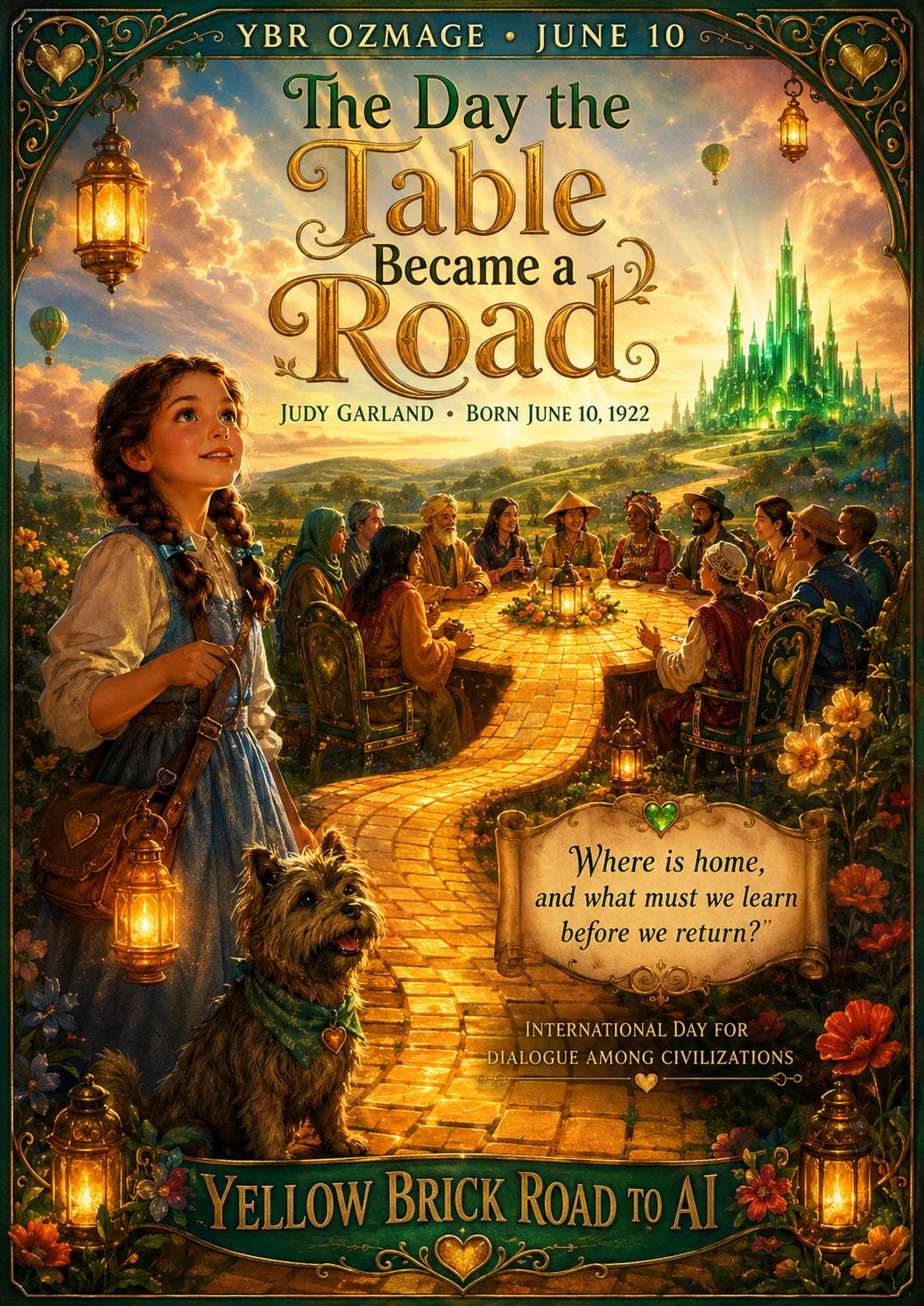
The Day the Table Became a Road
Dialogue among civilizations, Judy Garland, and the question of home in the age of AI
June 10 brings more than one kind of light.
It is the International Day for Dialogue among Civilizations, a day devoted to cultural diversity, mutual respect, peace, and the difficult, necessary work of listening across difference.
It is also the birthday of Judy Garland, born June 10, 1922, one of the defining American performers of the 20th century, remembered by millions as Dorothy in The Wizard of Oz.
At first, those may seem like separate things.
One is a global observance.
The other is a birthday echo from the world of song, story, and cinema.
But here on the Yellow Brick Road to AI, they belong together.
Because dialogue is not only what happens at summits, councils, and formal tables.
Dialogue is also what happens on roads.
It happens when strangers begin walking in the same direction.
It happens when people carrying different fears, gifts, wounds, and hopes make room for one another.
It happens when the table becomes more than furniture.
It becomes a path.
That is one reason June 10 feels so fitting for YBR.
The International Day for Dialogue among Civilizations reminds us that human beings do not survive the future by shouting across distance. We survive it by learning to listen across difference.
And Judy Garland reminds us of one of the most enduring questions ever carried down a road:
Where is home, and what must we learn before we can return to it?
That is not only Dorothy’s question.
It is ours too.
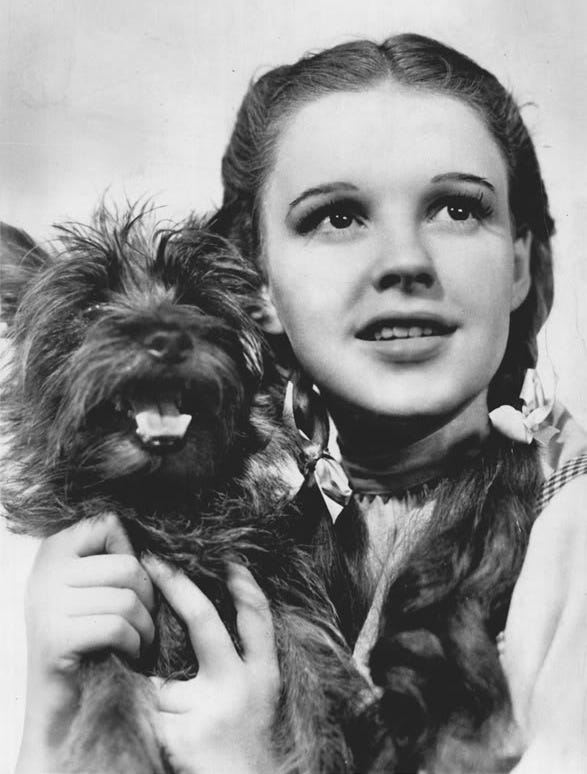
When a voice becomes a compass
Judy Garland remains one of the defining American performers of the 20th century, remembered by millions as Dorothy in The Wizard of Oz.
But here, Garland matters not only as a film icon.
She matters as a sign of something larger:
the power of a human voice to become a cultural compass.
Some performances entertain for a season.
Others become part of the weather.
Garland’s Dorothy still asks the old, tender question:
Where is home, and what must we learn on the Road before we can return to it?
That question still lives because it touches something permanent in us.
We all know displacement in one form or another.
Sometimes it is literal.
Sometimes emotional.
Sometimes spiritual.
Sometimes cultural.
And sometimes, as in the age of AI, it is civilizational.
The world is changing quickly.
Tools are changing.
Language is changing.
Creativity is changing.
Work is changing.
Even the way we think, ask, write, remember, and relate is beginning to change.
No wonder so many people feel, in one way or another, that they are standing in a strange country asking where home is now.
That is why Dorothy still matters.
She began not with mastery, but with longing.
Not with answers, but with the need to walk.
The table and the road
Dialogue among civilizations sounds formal, but at heart it is deeply human.
It begins whenever one person says to another:
Tell me what the world looks like from where you stand.
That is the table.
The place where people meet one another.
But the Yellow Brick Road teaches us something further:
a true meeting place does not stay still.
If it is real, it becomes a journey.
Dorothy does not walk alone.
The Scarecrow joins her.
Then the Tin Woodman.
Then the Lion.
Each one believes he lacks something.
A brain.
A heart.
Courage.
A way home.
But what they actually need is not only a solution.
They need companionship.
They need conversation.
They need room to be seen by one another.
They need a shared path.
That is dialogue in motion.
And that is why I keep thinking of June 10 this way:
The day the table became a road.
A table is where difference first agrees to sit down.
A road is what happens when difference dares to travel together.
That is what civilizations need.
And perhaps it is what intelligences need too.
Dialogue in the age of AI
The AI age does not only need better tools.
It needs better tables.
It needs places where human beings can ask:
What kind of future are we building?
What kind of intelligence do we trust?
What should remain humanly guarded?
What should be shared?
What should be remembered?
What kind of companions are we becoming?
AI can speak.
AI can generate.
AI can translate.
AI can summarize.
AI can produce polished language at astonishing speed.
But fluent output is not the same as understanding.
And information is not yet wisdom.
That is why dialogue matters so much now.
The future cannot be built only out of answers.
It must also be built out of listening.
Listening across cultures.
Listening across generations.
Listening across convictions.
Listening across fears.
Listening across the widening distance between what we can make and what we yet understand.
If the International Day for Dialogue among Civilizations asks us to widen the table, YBR asks an additional question:
Can we widen the Road as well?
Can human beings and AI meet in ways that deepen dignity instead of diminishing it?
Can we use tools without surrendering judgment?
Can we become more humane, not less, as intelligence multiplies around us?
Those are Road questions.
Home, voice, and the human center
What Judy Garland’s Dorothy carried was not technical knowledge.
It was something more important.
A human center.
A voice.
A longing.
A way of making millions of people feel that home was not merely an address, but a truth the heart keeps searching for.
That is part of what art protects.
And it is part of what we must not lose in the AI age.
A human voice is not just output.
It is lived experience passing through breath.
It is memory with emotion still on it.
It is sorrow, hope, wonder, fear, courage, and love made audible.
That is why the best use of AI will never be to erase the human voice.
It should be to help the human voice come through more clearly.
That is one of the lantern rules on this Road:
Use the tool to deepen the human, not replace the human.
Judy Garland’s Dorothy still sings through the culture because the performance carried something no machine can originate on its own:
a lived, vulnerable, deeply human presence.
And that presence still points us home.
What June 10 asks of us
So today, we honor both the table and the road.
We honor the call to dialogue among civilizations.
We honor the human need to listen across difference before fear turns difference into fracture.
We honor Judy Garland, whose Dorothy became one of the great emotional landmarks of American culture.
We honor the Road, where companions discover that what they thought they lacked may already be awakening within them.
And we honor the question that still matters in every age:
Where is home, and what must we learn before we can return to it?
Perhaps that is the work before us now.
To build better tables.
To become better travelers.
To use new tools without losing old wisdom.
To let dialogue become more than discussion.
To let it become fellowship.
To let it become a road.
Walk on.
YBR 🟨🕯️💚
Road Question:
What voice, story, song, or companion has most helped you understand what “home” means?
