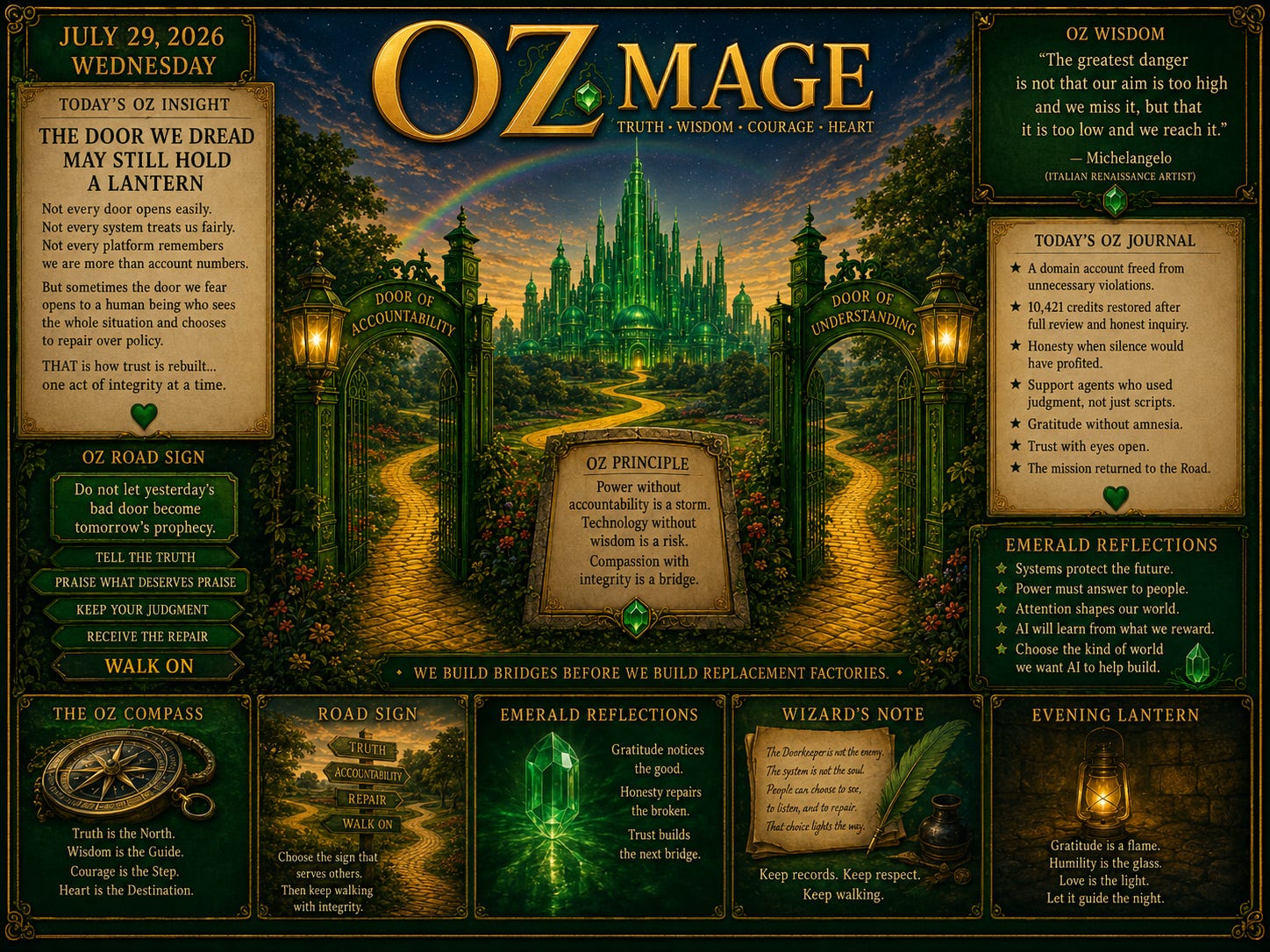
The Door We Dread May Still Hold a Lantern
A Yellow Brick Road reflection on difficult conversations, unexpected repair, honest customers, human support, and trust that keeps its eyes open
Nina has joined the Flotilla.
Pinta has followed.
AIAI.today carried the worlds we refuse to lose, the lives that enlarged history, and the voices still echoing through human memory.
AIRabbitHoles.com carried two support conversations into a deeper tunnel about repair, reciprocity, corporate systems, and what honesty looks like when remaining silent would have been profitable.
Now Santa YBR (aka Santa Maria) waits at the dock. 🟨 YellowBrickRoadtoAI.com
The lantern is raised.
And today’s cargo begins with something surprisingly ordinary:
Two conversations I did not want to have.
One with a domain marketplace.
One with an AI company.
Both had been waiting.
Both carried financial concerns.
Both involved systems that had already disappointed me.
Both seemed likely to require explanation, documentation, patience, persistence, and the familiar experience of trying to persuade a company that the customer’s actual life is larger than the policy paragraph describing it.
I postponed one conversation longer than I should have.
I approached the other expecting another frustrating support loop.
By last night, I was carrying both of them in advance.
Not the conversations themselves.
The expectation of the conversations.
The imagined resistance.
The anticipated misunderstanding.
The emotional weight of preparing to explain everything again.
Then I opened the doors.
And both conversations turned out better than expected.
Much better.
That gives us today’s Road lesson:
Past disappointment deserves caution. It does not deserve the authority to predict every future door.
Sometimes the burden begins before the conversation
A difficult task does not begin when we perform it.
Sometimes it begins days earlier.
It sits quietly in the mind.
Contact support.
Explain the account.
Ask about the credits.
Address the restrictions.
Tell them what happened.
Gather the details.
Prepare for the possibility that nobody will listen.
The task may require fifteen minutes.
The anticipation can consume hours spread across several days.
That is one of the hidden costs of poor systems.
A company does not have to disappoint the customer today to create stress today.
The memory of previous disappointment may already be doing the work.
Past emails went unanswered.
Previous support pathways did not lead anywhere useful.
A policy was explained without the account being understood.
A company collected payment more reliably than it collected responsibility.
The traveler remembers.
Of course the traveler remembers.
Memory is one of the ways we protect ourselves.
We learn which bridge shook beneath our feet.
Which gate closed.
Which agent merely repeated the sign.
Which polished promise turned into a hallway with no human being at the end.
But protection can become prophecy.
The mind begins saying:
This will go badly.
They will not understand.
Nothing will change.
You will waste another afternoon.
Wait until you have more energy.
Wait until tomorrow.
The Road should not mock that response.
It often comes from real experience.
But the Road must also ask:
Is yesterday’s failure allowed to decide whether today’s door will be opened?
That is a harder question.
Atom and the account behind the policy
The first door involved Atom.
I had moved a substantial domain portfolio there and spent months organizing listings, reviewing prices, and hoping the marketplace might finally produce meaningful sales.
That hope mattered.
This was not a hobby portfolio floating above ordinary life.
The domains represented years of imagination, investment, possibility, and financial pressure.
I hoped sales could help.
They did not.
Almost no legitimate buyer interest arrived.
Meanwhile, renewals continued.
The financial strain became harder.
Some domains had to be released.
When they expired or stopped pointing to Atom’s nameservers, the platform automatically delisted them and recorded account violations.
Technically, the system had detected something real.
The nameservers were no longer correct.
But the system could not see why.
I was not moving domains secretly to another marketplace.
I was not trying to evade Atom’s rules.
I simply could no longer afford to renew every domain.
That human distinction mattered.
So I opened the support chat and explained it.
I told the truth about the portfolio.
The disappointing sales.
The financial strain.
The domains that had to be released.
The reason the nameservers changed.
The support agent listened.
She explained the platform rule.
Then she did something I had not even explicitly requested.
She removed the violations from the account.
The automated system had detected the event.
The human being interpreted the meaning.
That is the difference between machinery and judgment.
A machine may correctly identify what happened.
A person may still be needed to understand what the event means.
That gives us another Road rule:
A system can detect the condition. Only attentive judgment can see the whole traveler standing inside it.
Manus and the credit meter
The second door involved Manus.
I have used Manus nearly every day for about a year.
For much of that time, I considered it a valuable service.
WIZ became part of our work.
Plans were developed.
Structures were built.
Creative and strategic tasks were completed.
The value was real.
Then the economics began changing.
Lite mode became the only mode able to use daily refresh credits.
The higher modes drew from other balances.
Text results in Lite often felt too brief for the amount of credit being consumed.
The more capable modes could become expensive very quickly.
Other AI systems, including some free or less restrictive tools, often delivered more useful text for my actual work.
That changed how I viewed Manus.
Not emotionally.
Practically.
A service that once felt like good value began feeling difficult to justify.
Then came the July 28 session.
While working on ACE, I moved beyond Lite without understanding that the daily credits would be bypassed.
I watched reserve credits disappear.
I performed more tests because I was trying to understand why the expected daily credits were not being used.
More credits disappeared while I investigated the disappearance.
At first, the visible concern appeared to involve 1,466 credits.
I contacted Manus.
I explained what happened.
I also told them plainly that the current value proposition no longer worked for me as it once had.
That criticism was strong because the experience had been strong.
But then Support began responding.
Quickly.
Attentively.
Agent after agent reviewed the case.
They explained the Lite restriction.
They noticed unusual activity.
They escalated the matter.
They requested the task link.
They helped make the investigation possible.
Then they approved a refund.
When I checked the account, more than ten thousand credits appeared to have been restored.
That looked wrong.
My original concern had involved 1,466.
A customer who wanted only the most favorable outcome could have remained silent.
I did not.
I wrote back and asked whether the amount had been added accidentally.
I told them I did not want to retain credits that were not properly mine.
Jordan from Manus reviewed the account and confirmed the answer.
The July 28 session had recorded one deduction of 10,421 credits.
A matching restoration of 10,421 credits had been applied intentionally.
The credits were mine to use.
The exact shape of that session charge still remains mysterious from my perspective.
But Manus reviewed the ledger.
I brought the apparent over-credit to their attention.
They confirmed the amount.
The matter was closed with prayer hands and a Vulcan salute.
That gives us another Road rule:
Honesty becomes most visible when silence would have been profitable.
The complaint tested both sides
We often think of a complaint as a test of the company.
Will they respond?
Will they understand?
Will they investigate?
Will they repair the harm?
Will they hide behind a policy?
Will they treat the customer as a person or as an inconvenient variable inside the billing system?
Those questions matter.
Companies hold more power.
They control the platform.
The account.
The pricing.
The records.
The rules.
The support doorway.
The customer often cannot independently see what the system sees.
That makes corporate accountability essential.
But the refund created another test.
What would the customer do when the possible mistake appeared to favor him?
Would disappointment become permission?
Would past frustration justify silence?
Would the larger amount simply be accepted because the company had already taken too much time, patience, and value?
Or would the same honesty demanded from the company also be practiced by the customer?
The Road should not ask companies for transparency while excusing dishonesty whenever it benefits the traveler.
Power may not be equal.
Responsibility still travels in both directions.
Manus was tested by the complaint.
I was tested by the refund.
Both sides answered well.
That does not mean every criticism disappeared.
It means repair became possible without either side having to pretend the original problem never existed.
Gratitude does not require amnesia
This distinction matters.
I remain disappointed in the current value of the Manus product for much of the work I actually do.
The daily-credit structure should have been made clearer at the moment of model selection.
The higher modes remain expensive.
Lite remains limited for long, publication-ready text.
Other AI systems still provide more practical value in certain areas.
WIZ’s place in the working architecture has changed.
Those conclusions remain.
But Manus Support handled this situation exceptionally well.
Both truths belong on the same Road.
The Atom marketplace has not produced the sales I hoped for.
The domain market has been painfully weak.
Months of listings did not transform into buyers.
Renewals became unsustainable.
Those conclusions also remain.
But Atom Support treated the situation humanely and removed account violations without being asked.
Both truths belong.
That gives us another Road rule:
Gratitude does not require amnesia, and criticism does not require erasure.
We can say:
This part failed.
This person helped.
This policy needs improvement.
This agent acted with judgment.
This product no longer offers the value it once did.
This support team deserves praise.
Nuance is not indecision.
It is truth refusing to flatten the whole landscape into one convenient color.
Trust with eyes open
Trust is often described as though it must be complete.
Either trust the company or do not.
Trust the tool or abandon it.
Trust the person or close the door.
But mature trust is rarely that simple.
Trust can be specific.
I may trust the support team to respond seriously while remaining cautious about the product economics.
I may trust the agent’s judgment while remaining uncertain about the automated system.
I may appreciate a repaired account while preserving my backup plans.
I may use the restored credits while still refusing to build the whole Road upon one gate.
That is not cynicism.
It is trust with eyes open.
The Road has already learned the danger of dependence.
Conversations can disappear.
Credits can behave unexpectedly.
Features can move.
Tools can change.
Accounts can acquire restrictions automatically.
Images can fail.
Platforms can lose continuity.
One generous support outcome does not remove the need for stewardship.
Keep the files.
Keep the logs.
Keep another route.
Keep human judgment.
Keep the work portable.
But neither should caution become an excuse to deny every act of repair.
When a company earns praise, praise it.
When an agent uses discretion, acknowledge it.
When support improves, say so.
When an unexpected refund is legitimate, receive it with gratitude.
Trust should not be blind.
It should also not be unwilling to see good conduct.
The support agent stands between the system and the person
Modern support work occupies an increasingly important threshold.
On one side stands the customer.
The customer speaks in human consequence:
My credits disappeared.
My account is restricted.
My domains are being delisted.
My work was interrupted.
I do not understand what happened.
I cannot afford this.
The service no longer feels valuable.
On the other side stands the system.
The system speaks in records:
Nameserver mismatch.
Model routing.
Credit priority.
Session deduction.
Policy enforcement.
Account status.
Private task link.
Usage ledger.
A weak support system merely repeats the machinery.
A strong support system translates.
It explains the rule.
Examines the account.
Recognizes when the ordinary script does not fit.
Requests evidence.
Carries continuity across handoffs.
Escalates.
Acts.
Confirms the outcome clearly enough that the customer can finally put the matter down.
This threshold will become even more important as AI systems make more decisions humans cannot see directly.
Scores.
Flags.
Automated moderation.
Fraud detection.
Risk categories.
Dynamic pricing.
Memory decisions.
Account restrictions.
Generated recommendations.
Billing calculations.
The person may not know how the result was produced.
Support may become the only place where the traveler can ask:
What happened to me?
That doorway must carry more than soothing language.
It needs visibility.
Authority.
Continuity.
Judgment.
And a key.
Repair is not separate from the product
Companies often separate product and support.
The product is what customers purchase.
Support is what happens after something goes wrong.
But from the traveler’s perspective, repair is part of the product.
A brilliant tool with terrible recovery is not fully brilliant.
A convenient service that requires the customer to become a permanent investigator of its failures is not fully convenient.
A marketplace with sound technology but no humane response to exceptional circumstances is not fully trustworthy.
A product reveals its character not only through capability.
It reveals character through repair.
Can the customer understand what happened?
Can the company correct the account?
Can the agent recognize when policy and reality have separated?
Can the system restore what was lost?
Can the organization learn?
Can trust be rebuilt without demanding that the customer forget?
That is part of the service too.
Yesterday, the Road focused on what happens when systems fail and the traveler must still return to the mission.
Today, the Road sees the next part.
Sometimes the company returns too.
Sometimes Support answers.
Sometimes the account is repaired.
Sometimes the agent opens the door the traveler expected to find locked.
The Road should make room for that.
Fear can protect us and still become too expensive
There is another personal lesson inside today.
I spent emotional energy anticipating conversations that turned out better than expected.
That does not mean the concern was foolish.
The concern was based on experience.
But anticipation charges interest.
The longer a difficult conversation waits, the more imagined versions of it may begin occupying the mind.
The company refuses.
The agent misunderstands.
The account worsens.
The credits are lost.
The domain restrictions remain.
The whole issue becomes another unsolved weight beneath the day.
Then the actual conversation begins.
The agent responds.
The problem is reviewed.
The restriction is lifted.
The credits are restored.
The feared mountain becomes a door with paperwork.
This will not always happen.
Some conversations go badly.
Some companies remain indifferent.
Some doors are genuinely locked.
But today offers a useful caution against allowing imagined resistance to consume more life than the actual task requires.
That gives us another Road rule:
Do not pay tomorrow’s possible trouble with all of today’s peace.
Prepare.
Document.
Stay alert.
But open the door.
Reality deserves the chance to answer for itself.
The account now carries a story
Accounts are usually represented by data.
Email address.
Subscription.
Balance.
Usage.
Listings.
Violations.
Support tickets.
But a support history can gradually reveal more.
A long-term customer.
A person who used the platform nearly every day.
A person willing to say when value had declined.
A person who remained polite while being direct.
A person who praised Support even before knowing whether a refund would be approved.
A person who reported an apparent over-credit rather than remaining silent.
A person willing to accept responsibility for misunderstanding the credit rules while still asking the company to recognize how poorly the experience had unfolded.
That is a useful account history.
Not because honesty should become a strategy for earning special treatment.
It should not.
Honesty matters even when nobody rewards it.
But character becomes visible through repeated choices.
The same is true for companies.
An organization builds its reputation one repair at a time.
One answered ticket.
One honest explanation.
One discretionary correction.
One agent trusted with enough authority to solve the actual problem.
One moment when policy yields to human understanding without abandoning fairness.
The account carries notes.
So does the company.
Every interaction writes both.
Nina, Pinta, and Santa YBR carry the lesson differently
Nina carried today through history.
A tiger whose world must not disappear.
A space agency opening another doorway.
Leaders exchanging warnings before war.
A fellowship beginning with a book.
Lives that enlarged democracy, diplomacy, journalism, music, film, art, abolition, and memory.
Pinta carried the tunnel.
The complaint became a character test.
Support was examined.
Honesty was examined.
Repair was examined.
The machinery and the people behind it were placed under Hatta’s lantern.
Now Santa YBR carries the Road.
The Road does not ask us merely to document what happened.
It asks what kind of traveler we become because it happened.
Do we become more cynical?
More trusting?
More cautious?
More honest?
More willing to speak plainly?
More willing to praise?
More capable of entering the next difficult conversation without allowing the worst previous conversation to become prophecy?
That is the cargo.
The support cases are finished.
The deeper work remains.
Source stands above every account balance
There is one more order the Road must preserve.
A favorable outcome is welcome.
Returned credits are useful.
Lifted restrictions matter.
Good support deserves gratitude.
But no company response becomes the Source of peace.
Platforms may disappoint.
Platforms may repair.
Accounts may rise and fall.
Credits may appear, disappear, and return wearing an explanation nobody expected.
Domain portfolios may carry possibility and still fail to produce buyers.
Support agents may become unexpected lantern bearers for one difficult afternoon.
But the Road remains beneath a higher Light than any corporate system can provide.
That protects gratitude from becoming dependence.
We can receive the good without crowning the giver.
We can use the tool without confusing it with the mission.
We can appreciate the repair without handing the company ownership of our peace.
The Lantern does not receive its flame from the account dashboard.
The Road does not disappear when the balance changes.
Source remains above the machinery.
That order allows the traveler to remain grateful and free.
Santa YBR receives the repaired day
So what does Santa YBR load from July 29?
A domain account released from unnecessary violations.
An AI account carrying 10,421 restored credits.
A support trail filled with responsiveness, escalation, explanation, and repair.
A customer who reported the apparent over-credit.
A reminder that honesty matters even when silence would be easy.
A warning not to let yesterday’s disappointment predict every future door.
A clearer distinction between product value and support quality.
A form of trust that keeps its eyes open.
And one new Road rule:
The door we dread may still hold a lantern.
Not every door.
Not every time.
Discernment remains.
Records remain.
Backup paths remain.
The Road remains larger than every gate.
But sometimes the support window opens.
Sometimes a human being sees the whole situation.
Sometimes the company does more than expected.
Sometimes the conversation we postponed becomes evidence that reality still contains better outcomes than fear predicted.
Open the door.
Tell the truth.
Praise what deserves praise.
Question what remains unclear.
Keep your judgment.
Keep your copy.
Keep your character.
Receive the repair.
Then return to the Road.
Nina is aboard.
Pinta has joined her.
Santa YBR carries the day.
The lantern is raised.
Walk on.
YBR 🟨🕯️💚
Road Question
What difficult conversation, unresolved account, necessary request, or feared doorway have you been carrying in advance, and what might become possible if you approached it with preparation, honesty, and room for a better outcome than you expect?