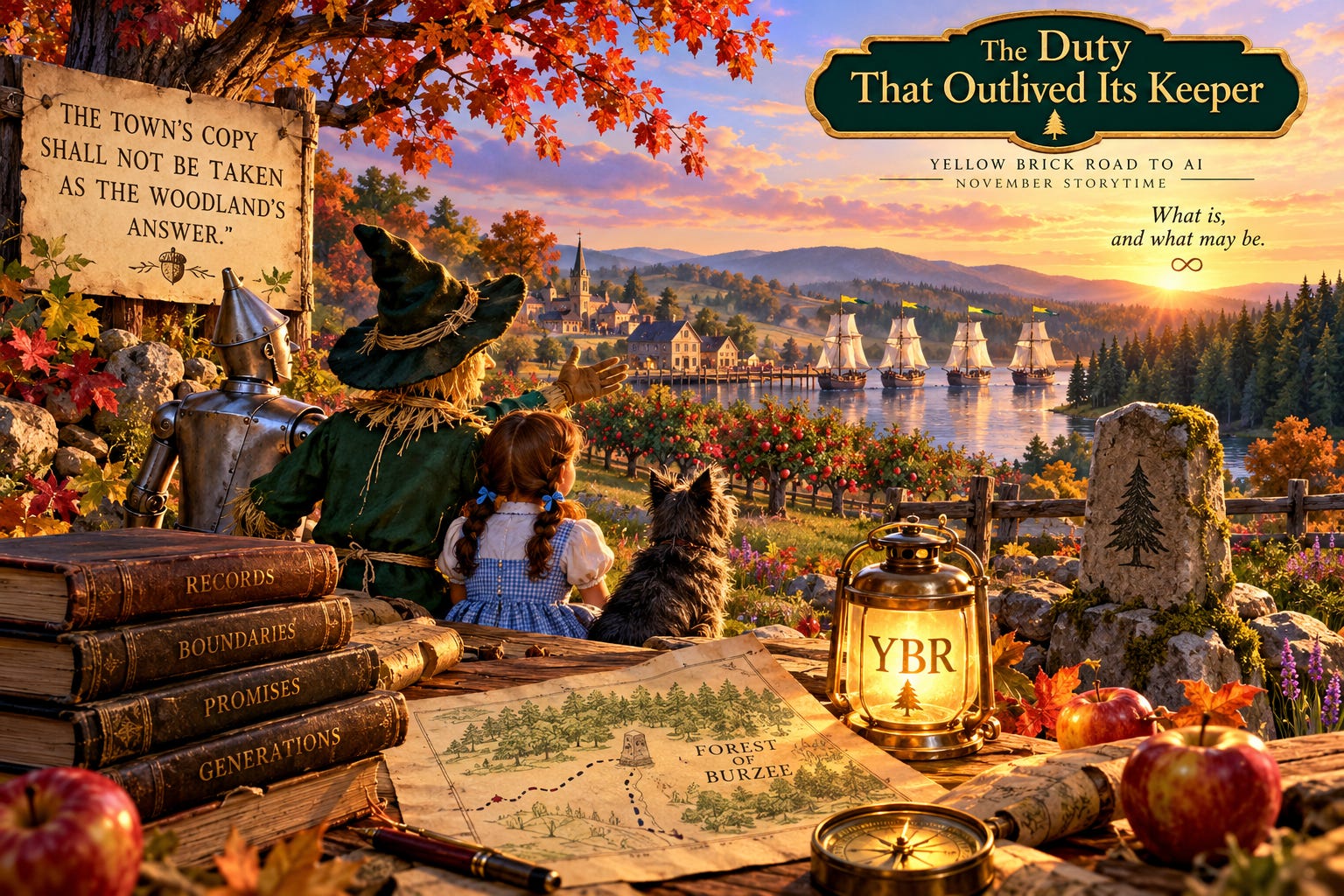
💚🟨 THE DUTY THAT OUTLIVED ITS KEEPER 📜🌲⛵
OZ~QZ November Storytime | Tuesday, November 3, 2026
An Adventure Along the Borders of Burzee
An ancient office vanished. Its custodians passed from memory. Yet a responsibility concerning the Forest of Burzee survived in Thumbumbia’s records. Now the Scarecrow and his companions must discover whether a promise preserved across generations can still guide the living, and whether the most important part of an agreement might be what its keepers were forbidden to forget.
I. THE MORNING OF THE UNFINISHED PROMISE
The third morning of November arrived beneath a clear and brittle sky.
Autumn had painted Thumbumbia in russet, amber, and gold. Along the harbor, fishermen prepared their nets while bakers carried fresh bread from their ovens. High above the rooftops, the bell tower stood watch over the village.
Four ships remained at anchor.
The Evergreen, commanded by Captain Sawyer Salt.
The Hare, under Captain Jasper Quill.
The Lionheart, commanded by Captain Gideon Vale.
And the Swallow, under the young Captain Ronan Flint.
Beyond the orchards stood the ancient Forest of Burzee.
Its trees appeared almost black against the bright morning sky.
And somewhere along the old eastern road, the third boundary stone remained undisturbed.
Aboard the Evergreen, Commander Brine studied the latest report from Thumbumbia’s archivist.
Its final lines had troubled him throughout the night.
DUTY ASSUMED.
DUTY DISCHARGED: NO ENTRY FOUND.
The report described a custodial obligation associated with the old woodland agreement.
An obligation accepted by an office that had disappeared.
An obligation apparently transferred through later municipal administrations.
And an obligation for which no completed discharge had yet been identified.
Brine folded the report.
Then summoned the Scarecrow.
When the Scarecrow arrived, the Commander was standing beside the chartroom window.
“Good morning.”
“Good morning, Commander.”
“Have you considered what we discovered yesterday?”
“Indeed.”
“And?”
The Scarecrow paused.
“We have been searching for a document that might establish what the people of Thumbumbia once promised.”
“Yes.”
“But now we have evidence that someone accepted responsibility for preserving something concerning that promise.”
“Correct.”
“And we still don’t know precisely what that responsibility required.”
Brine nodded.
“That is the difficulty.”
The Scarecrow looked toward the harbor.
“Perhaps the question isn’t merely what happened to the agreement.”
“What else?”
“Perhaps we should ask what the people who kept it were trying to prevent.”
The Commander regarded him thoughtfully.
“An interesting question.”
“Then shall we ask it?”
Brine smiled faintly.
“I had already arranged for the archivist to receive us.”
At that moment, Hatta appeared in the doorway.
“Excellent! Another day at the archives!”
The Commander looked surprised.
“You sound enthusiastic.”
“Naturally. I’ve decided to become an expert in ancient obligations.”
Peg appeared behind him.
“By what method?”
“Reading the conclusions.”
“And the evidence?”
“I shall leave that to you.”
Peg sighed.
The Scarecrow laughed.
And before the harbor bells sounded nine, the company departed for the village.
II. THE REGISTER OF CONTINUING DUTIES
The archivist had prepared the worktable with unusual care.
Upon it rested three volumes.
The green accounting book.
The Register of Custodial Obligations.
And a later volume containing responsibilities that had survived the abolition of their original offices.
Master Tolland, the retired clerk, had returned to assist.
The keeper’s sister stood nearby, holding a newly prepared transcription.
White Rabbit approached the table eagerly.
“Have you found the missing acknowledgment?”
“No,” answered the archivist.
“The second document?”
“No.”
“The person authorized to receive it?”
“Not yet.”
The Rabbit sighed.
Hatta patted his shoulder.
“Take heart. Three disappointments before breakfast is an unusually efficient morning.”
The archivist opened the third volume.
“But we have made a new discovery.”
Commander Brine approached.
“Explain.”
“The continuing register contains more than a reference number. It also contains a classification.”
She pointed to a narrow column beside the woodland entry.
The heading read:
DUTY CONCERNING RESTRICTED RELEASE.
Peg leaned forward.
“Restricted release?”
Master Tolland explained.
“Some documents and objects were held under conditions limiting who could authorize their transfer.”
“And the woodland agreement was classified that way?” asked the Scarecrow.
“That is how this later register categorized the responsibility,” replied the archivist.
She continued.
“The classification alone does not establish the precise conditions of the original agreement. But it tells us something about how later custodians understood their duty.”
Commander Brine considered.
“They believed release was restricted.”
“Yes.”
“Even after the original office disappeared.”
“Apparently.”
White Rabbit looked toward the old parchment transcription.
“Then someone kept saying no.”
The Scarecrow smiled.
“Perhaps someone kept saying, ‘Not until we know who may properly say yes.’”
Master Tolland nodded.
“A substantial difference.”
Hatta folded his arms.
“Then Thumbumbia has been maintaining a very old reservation.”
Peg looked alarmed.
“A reservation?”
“Certainly. A reservation concerning when something may be released.”
“That is not what the word ordinarily means in these records.”
Hatta considered.
“Then I shall withdraw my reservation about the reservation.”
Even the archivist laughed.
But the next page of the register contained something far more serious.
III. THE EXCEPTION THAT WAS REFUSED
Beneath the woodland entry appeared a later memorandum.
Unlike the faded original agreement, the memorandum was reasonably well preserved.
The archivist read its heading.
REQUEST FOR EXCEPTION TO RESTRICTED RELEASE.
Commander Brine leaned forward.
“Someone attempted to obtain an exception?”
“That is what the memorandum records.”
“Who?”
“A former road commissioner.”
She examined the surviving text.
The commissioner had requested authority to release information concerning the woodland boundary for use in a proposed road improvement.
The proposed work would have extended ordinary maintenance activity toward the third stone.
White Rabbit’s ears rose.
“They wanted to open the road!”
“Not necessarily,” replied the archivist. “The memorandum concerns an administrative proposal. It does not establish that any physical work began.”
“Was the exception granted?” asked Peg.
The archivist shook her head.
“Listen.”
She read:
REQUEST DEFERRED. AUTHORITY OF THE RECEIVING PARTY NOT ESTABLISHED. NO ALTERATION OF EXISTING BOUNDARY CONDITIONS AUTHORIZED.
The room fell silent.
Master Tolland adjusted his spectacles.
“Interesting.”
Commander Brine looked toward the Scarecrow.
“That is stronger evidence of what a later administration understood the obligation to require.”
The Scarecrow nodded.
“Someone sought permission to change the arrangements.”
“Yes.”
“And the custodians refused to treat the old records as permission to proceed.”
“That appears to be the result.”
White Rabbit looked thoughtful.
“Then perhaps the road has been protected because people kept remembering that they weren’t entitled to change it alone.”
The archivist considered.
“We can say that this particular request was deferred for that reason. We cannot yet reconstruct every later decision concerning the boundary.”
The Scarecrow nodded.
“Of course.”
But something had changed.
The surviving responsibility was no longer merely a phrase copied from one register into another.
It had influenced an actual decision.
Someone, long after the original agreement had been prepared, had declined to authorize a proposed change because the proper receiving authority remained unidentified.
An ancient promise had affected the conduct of later generations.
And for the first time, the travelers had evidence of that consequence.
IV. THE FARMER WHO WANTED THE ROAD
The discovery might have remained confined to the archives.
But that afternoon, something happened in the village square.
A wagon arrived from a farm beyond the northern orchards.
Its driver was a broad-shouldered man named Bram Alder.
He had come to Thumbumbia to request repairs to the eastern road.
Several sections had become difficult for loaded carts, especially after heavy rain.
The Scarecrow encountered him outside the council house.
Bram was speaking with a town road officer.
“I don’t want to enter the forest,” the farmer insisted. “I want to get my produce to market without breaking another wheel.”
The road officer replied patiently.
“We can examine the section under ordinary town maintenance authority.”
“Then why has everyone been talking about an ancient agreement?”
“Because portions of the eastern road approach a protected boundary.”
Bram threw up his hands.
“The boundary isn’t going anywhere!”
The Scarecrow stepped forward.
“Perhaps that is precisely what everyone hopes.”
The farmer turned.
“And who might you be?”
“The Scarecrow.”
Bram stared.
“The Scarecrow?”
“At your service.”
“From the ship?”
“Yes.”
“Then perhaps you can explain why four ships have been sitting in our harbor while everyone argues about an old road.”
The Scarecrow smiled.
“We are trying to understand something that people before us considered important.”
Bram crossed his arms.
“Well, I consider getting my apples to market important.”
“As you should.”
The farmer looked surprised.
“You agree?”
“Certainly.”
“Then why can’t the town simply repair the road?”
“Perhaps it can repair the authorized portion. We should not confuse that with changing the boundary or extending the road into land whose custodians have not consented.”
Bram considered.
“So you aren’t saying nothing can be done.”
“Not at all.”
“You’re saying we ought to determine which work can be done responsibly.”
“Exactly.”
A little girl standing beside Bram tugged his sleeve.
“Papa?”
“Yes, Elsie?”
“If we fix the part we’re allowed to fix, won’t that help?”
The farmer looked down at her.
Then toward the road officer.
“Would it?”
“Very likely,” replied the officer. “We could inspect the damaged drainage and repair the surface within the town’s established maintenance limits.”
Bram rubbed his chin.
“Then why didn’t you say so?”
“I’ve been trying.”
The Scarecrow laughed.
So did Elsie.
And after several minutes, the farmer and road officer agreed to arrange an inspection of the ordinary road surface without approaching or altering the protected boundary.
The matter was hardly grand enough for a legend.
No dragon had been defeated.
No ancient treasure had been recovered.
Yet the Scarecrow found the encounter deeply satisfying.
A genuine problem had been addressed.
A responsibility had been respected.
And nobody had been required to pretend that one person’s needs erased another’s rights.
V. THE PROMISE AND THE PEOPLE
That evening, the four captains gathered aboard the Evergreen.
Captain Sawyer Salt listened as Commander Brine summarized the archival discovery and the incident involving Bram Alder.
Jasper Quill examined the later road commissioner’s request.
Gideon Vale studied the surviving refusal.
Ronan Flint listened thoughtfully.
Then Sawyer spoke.
“So an earlier commissioner wished to change the road arrangements.”
“Yes,” replied Brine.
“And the custodians declined because the authority of the other party remained unestablished.”
“Correct.”
Jasper nodded.
“That suggests the obligation continued to affect practical decisions.”
“It does.”
Gideon looked toward the Scarecrow.
“And today another resident needed help with the road.”
“Yes.”
“Was he denied?”
“No.”
“What happened?”
“The town identified a possible way to address his problem within its existing maintenance authority.”
Ronan smiled.
“Then respect for a boundary need not mean indifference to those living beside it.”
The Scarecrow nodded.
“Exactly.”
Sawyer considered.
“There is a danger in every direction.”
“Explain,” said Brine.
“If we ignore the old responsibility, we may violate a promise whose purpose we do not understand.”
“Yes.”
“But if we invoke that promise without examining its actual limits, we may prevent legitimate actions that the promise never prohibited.”
“Also true.”
The Scarecrow leaned forward.
“Then perhaps responsible stewardship requires two kinds of care.”
“Which two?”
“Care not to do what we have no right to do.”
“And?”
“Care not to use uncertainty as an excuse for neglecting what we can properly do.”
The captains became quiet.
Then Gideon Vale spoke.
“That is a responsibility worthy of our expedition.”
Sawyer nodded.
“Let it be entered in the record.”
Peg opened his ledger.
He wrote:
WOODLAND BOUNDARY: NO CHANGE AUTHORIZED.
THIRD STONE: UNTOUCHED.
PRESENT-DAY MAINTENANCE WITHIN TOWN AUTHORITY: MAY BE EXAMINED SEPARATELY.
HISTORICAL CUSTODIAL OBLIGATION: FURTHER REVIEW REQUIRED.
NO RIGHT OF WOODLAND ENTRY ESTABLISHED.
The Commander examined the entries.
“Very good.”
Hatta raised his hand.
“Captain, I believe we have made a remarkable discovery.”
Sawyer smiled.
“What is it?”
“That one may move forward without trespassing.”
“Yes.”
“And help people without violating their boundaries.”
“Yes.”
“And sometimes accomplish something without first establishing another committee.”
Peg looked astonished.
“Hatta!”
“What?”
“You’ve just argued against bureaucracy!”
Hatta drew himself up.
“Nonsense. I merely favor efficient bureaucracy.”
The Scarecrow laughed.
For the first time in many days, even Commander Brine appeared entirely relaxed.
VI. THE QUESTION OF THE UNDISCHARGED DUTY
Later that evening, the archivist arrived aboard the Evergreen.
She carried a newly prepared report.
Commander Brine received her in the chartroom.
The Scarecrow and Peg joined them.
“I have examined the continuing register again,” she said.
“And?” asked Brine.
“I can now confirm that the later memorandum declining the road exception was associated with the same custodial reference.”
Peg leaned forward.
“The same number?”
“Yes. It appears in the accompanying index.”
“Then the connection is established.”
“Between those two administrative records, yes.”
The Scarecrow considered.
“Does that clarify the original obligation?”
“Partly.”
The archivist opened her report.
“The later custodians understood the obligation to restrict release or alteration until the appropriate authority had been established.”
“Yes.”
“But we cannot determine from those records whether the original agreement was ever properly received or acknowledged.”
“Correct.”
“Nor whether the present town council has inherited the same authority.”
“Correct.”
Commander Brine folded his hands.
“Then what may we responsibly conclude?”
The archivist answered carefully.
“That a continuing custodial duty was recognized by later administrations, that it influenced at least one documented decision, and that the surviving records do not show the duty as discharged.”
Peg began writing.
The Scarecrow asked:
“Can we establish whether the duty remains legally binding?”
“No. That would require examining the current authority, any superseding arrangements, and other records we have not yet located.”
Brine nodded.
“Then we shall not assert more.”
The archivist smiled.
“Thank you, Commander.”
She closed the report.
But before departing, she added something unexpected.
“There’s another matter.”
The Scarecrow looked up.
“What is it?”
“While reviewing the continuing register, I found a notation directing future custodians not to rely solely upon the town’s records when evaluating the woodland obligation.”
Commander Brine leaned forward.
“Read it.”
The archivist unfolded a smaller sheet.
She read:
THE TOWN’S COPY SHALL NOT BE TAKEN AS THE WOODLAND’S ANSWER.
Silence filled the chartroom.
Then the Scarecrow spoke softly.
“Who wrote that?”
“The notation is unsigned.”
“When?”
“The handwriting appears later than the original entry, but I cannot establish its date.”
“Does it refer to the same matter?”
“It stands beside the corresponding reference number. That establishes its archival placement, though the author’s authority remains unknown.”
The Scarecrow looked toward the window.
Beyond the harbor lay the orchards.
Beyond the orchards lay Burzee.
For weeks, the company had wondered whether the woodland possessed its own understanding of the ancient agreement.
Now they had found evidence that someone within Thumbumbia’s own administrative history had warned against assuming that the town could speak for the other party.
Not proof of what the woodland believed.
Not permission to approach it.
But a warning against turning one community’s records into another community’s voice.
The Scarecrow repeated the words.
THE TOWN’S COPY SHALL NOT BE TAKEN AS THE WOODLAND’S ANSWER.
Then he looked toward Commander Brine.
“Perhaps whoever wrote that understood something we are only beginning to appreciate.”
Brine nodded.
“Perhaps.”
VII. THE WOMAN AT THE WINDOW
The Scarecrow visited the elderly woman with the blue-threaded packet before the evening lamps were extinguished.
Her cottage was warm.
A little fire burned in the hearth.
She greeted him with her familiar quiet smile.
“You have news.”
“Yes.”
“Another discovery?”
“Something important.”
He told her about the continuing register.
The responsibility that survived.
The refused exception.
And the warning that the town’s copy must not be mistaken for the woodland’s answer.
She listened without interruption.
At last she spoke.
“That is an interesting warning.”
“Do you know who wrote it?”
“No.”
“Does it remind you of anything?”
She considered.
“My grandmother used to say that people sometimes guard a promise for so long that they forget whom the promise was meant to protect.”
The Scarecrow looked toward the little packet.
“The name?”
She nodded.
“Perhaps it is time I explained one thing.”
He waited.
“The packet was entrusted to my family with an instruction.”
“Yes.”
“The instruction was not simply to hide a name.”
The Scarecrow remained still.
“What else?”
“To refrain from revealing it merely because someone wished to know.”
“Even someone acting with good intentions?”
“Especially when the consequences of disclosure were not understood.”
He nodded.
“Then the condition concerned the responsibility of the keeper.”
“It did.”
“Does that establish anything about the woodland agreement?”
“No.”
“Or the receiving authority?”
“No.”
“Then I shall not assume a connection.”
The woman smiled.
“You have learned a great deal.”
The Scarecrow looked toward the fire.
“I have learned that some questions cannot be answered merely because I ask them.”
“Indeed.”
“And that the person who protects an answer may be fulfilling a promise rather than refusing to help.”
“Yes.”
For a while, neither spoke.
Then she asked:
“Do you still wish to know the name?”
The Scarecrow considered.
“Of course.”
She laughed softly.
“At least you are honest.”
“But I no longer believe that curiosity alone entitles me to receive it.”
The woman looked at him with quiet approval.
“Then perhaps the promise entrusted to my family has already taught you something worthwhile.”
When the Scarecrow departed, the blue-threaded packet remained unopened.
Its name remained unknown.
And its keeper remained faithful to the responsibility she had inherited.
VIII. A DECISION BENEATH FOUR FLAGS
The next morning’s work would require a new approach.
That much had become clear.
But before the company separated for the night, Sawyer Salt summoned the captains for one final discussion.
They assembled beneath the four expedition flags aboard the Evergreen.
Commander Brine stood beside the chart table.
The Scarecrow attended with Peg and White Rabbit.
Sawyer spoke first.
“We have reached an important point in our investigation.”
Jasper Quill nodded.
“We have established that a custodial responsibility was carried forward through successive offices.”
Gideon Vale added:
“And that it influenced a later decision concerning the eastern road.”
Ronan Flint continued:
“But we have not established that the woodland received or acknowledged the agreement.”
“Correct,” said Brine.
Sawyer looked around the table.
“Then we must not mistake progress in the archives for permission to enter Burzee.”
Everyone agreed.
The Scarecrow raised a question.
“Captain, may I suggest something?”
“Certainly.”
“Perhaps our next task should be to examine the present responsibilities of the town.”
“In what sense?”
“To determine whether any authorized institution is responsible for safeguarding the surviving records, maintaining the boundary, or seeking clarification when old obligations remain unresolved.”
Jasper considered.
“Within Thumbumbia?”
“Yes.”
“Without approaching an unidentified woodland authority?”
“Correct.”
“And without presuming that the old custodial office’s powers still exist?”
“Exactly.”
Gideon nodded.
“Then the investigation would concern present-day stewardship rather than an attempted renewal of the ancient agreement.”
“Yes.”
Sawyer looked toward Commander Brine.
“Your judgment?”
“A sound distinction.”
The captain turned to Peg.
“Enter the decision.”
Peg wrote:
THE EXPEDITION SHALL REQUEST NO EXCEPTION TO THE WOODLAND BOUNDARY.
NO ATTEMPT SHALL BE MADE TO ENTER BURZEE WITHOUT PROPER AUTHORIZATION.
THE TOWN MAY EXAMINE ITS PRESENT CUSTODIAL RESPONSIBILITIES THROUGH APPROPRIATE AUTHORITIES.
THE HISTORICAL AGREEMENT SHALL NOT BE TREATED AS COMPLETED WITHOUT SUFFICIENT EVIDENCE.
THE WOODLAND’S VOICE SHALL NOT BE REPLACED BY THE TOWN’S ASSUMPTIONS.
Sawyer examined the record.
Then nodded.
“That shall be our course.”
White Rabbit looked relieved.
“Then we aren’t giving up.”
“Certainly not,” said the Scarecrow.
“But we’re not rushing forward.”
“No.”
“Then what are we doing?”
The Scarecrow smiled.
“Learning how to make the next step worthy of the journey.”
IX. THE ROAD THAT DID NOT HAVE TO BE OPENED
The following afternoon would bring new work.
But on this November evening, Thumbumbia was peaceful.
The harbor lamps glowed.
The Hare signaled all well.
The Lionheart confirmed her station.
The Swallow reported no unusual movement.
And aboard the Evergreen, the evening watch began.
The Scarecrow stood beside White Rabbit near the quarterdeck rail.
Beyond the rooftops, the eastern road wound toward the orchards.
Somewhere farther along stood the third stone.
And beyond it stretched the Forest of Burzee.
The Rabbit rested his paws upon the rail.
“Scarecrow?”
“Yes?”
“Do you suppose the old custodians were disappointed?”
“About what?”
“That they couldn’t finish the agreement.”
The Scarecrow considered.
“Perhaps.”
“Then why did they continue protecting it?”
“We don’t know exactly why they did.”
“But someone kept the responsibility in the records.”
“Yes.”
“And someone refused to change the road without proper authority.”
“Yes.”
“And someone even wrote that the town’s copy wasn’t the woodland’s answer.”
“Yes.”
The Rabbit became thoughtful.
“Then perhaps they understood that the promise mattered even when they couldn’t complete it.”
The Scarecrow smiled.
“That is possible.”
The Rabbit looked toward the dark trees.
“I used to think that reaching Burzee would be the great accomplishment.”
“And now?”
“Now I’m beginning to think it matters how we reach it.”
The Scarecrow nodded.
“Very much.”
“Do you think the woodland would care?”
“I imagine the inhabitants of any place would care whether visitors respected their home.”
The Rabbit considered.
“Then perhaps we’re already doing something worthwhile.”
“What is that?”
“Showing respect before we have the opportunity to introduce ourselves.”
The Scarecrow placed a hand gently upon his shoulder.
“Yes, Rabbit.”
For a while, they watched the stars appear over the forest.
No signal came from Burzee.
No ancient bell rang beneath its branches.
And nobody aboard the four ships mistook the forest’s silence for an invitation.
The road remained closed.
But the travelers no longer regarded that fact as proof that their journey had failed.
They had learned that a boundary could protect a relationship.
That a promise could outlive the people who first made it.
And that responsibility sometimes required patience without surrendering hope.
X. THE PAGE THAT HAD BEEN TURNED
Long after the village slept, the archivist remained at her desk.
The continuing register lay before her.
She had copied the warning concerning the woodland’s voice.
She had documented the earlier refusal to grant an exception.
And she had prepared a careful account of the custodial obligation’s surviving administrative history.
The facts were now clearer.
But the meaning of the original promise remained incomplete.
She closed the register.
Then noticed something.
A thin folded sheet had been placed between the final pages of the later municipal inventory.
It was not concealed.
Nor was it sealed.
It appeared to be an ordinary administrative notice.
Its heading read:
ON THE RETIREMENT OF THE OLD CUSTODIAL OFFICES.
The archivist examined it.
The document described the transfer of surviving responsibilities during Thumbumbia’s municipal reorganization.
Most of its instructions were routine.
Records were to be preserved.
Keys surrendered.
Outstanding accounts transferred.
Unresolved matters entered into the continuing register.
But the final paragraph contained a distinctive instruction:
WHERE A DUTY CONCERNS ANOTHER COMMUNITY, THE SUCCESSOR OFFICE SHALL PRESERVE THE RECORD WITHOUT ASSUMING THE AUTHORITY OF THAT COMMUNITY.
The archivist read it twice.
Then placed the notice beside the woodland entry.
The instruction was general.
It did not name Burzee.
It did not establish that the woodland agreement had ever been completed.
But it explained why a municipal administration might preserve an unresolved duty without claiming the power to settle it alone.
She prepared one final transcription.
Then she wrote:
The surviving records distinguish custodial succession from the authority to act for another party.
The town may preserve its own obligations without thereby acquiring authority over the woodland.
Any present-day procedure must be established independently of the historical records.
The archivist paused.
Then looked toward the window.
Four ships waited beneath the stars.
Beyond them stood Thumbumbia.
Beyond Thumbumbia lay the orchard road.
And beyond the road rose the ancient Forest of Burzee.
For generations, the town had preserved a responsibility whose original custodians were gone.
Perhaps the people who preserved it had not known how the story would end.
Perhaps they had understood that the ending did not belong to them alone.
But they had left something behind.
Not an invitation.
Not a completed agreement.
Not even a definite answer.
They had left a warning against claiming the right to speak for someone else.
And that warning had survived.
The archivist extinguished her lamp.
Tomorrow would bring another morning.
Another question.
And perhaps another discovery.
But tonight, she understood something about the ancient promise that had eluded generations of curious readers.
THE DUTY HAD NOT BEEN PRESERVED MERELY SO SOMEONE COULD CLAIM IT.
IT HAD BEEN PRESERVED SO THAT NO ONE WOULD FORGET ITS LIMITS.
TO BE CONTINUED...
Wednesday, November 4: THE PROMISE THAT COULD NOT SPEAK FOR OTHERS
An ancient custodial responsibility has survived through successive Thumbumbia offices.
A later road commissioner requested an exception to the old boundary arrangements.
The request was deferred because the proper receiving authority had not been established.
And a surviving administrative warning makes clear that preserving a record does not grant a town authority to speak for another community.
Now the expedition faces a new stage of its investigation.
What responsibilities does present-day Thumbumbia possess?
Who is entitled to interpret its surviving records?
And how can the travelers eventually seek an appropriate opportunity to hear the woodland’s own understanding without presuming the right to enter or speak on its behalf?
The four ships remain at Thumbumbia.
The third stone remains untouched.
The concealed berth remains empty.
The unidentified object remains secured.
The blue-threaded packet remains unopened.
The third return remains unresolved.
And the expected guest remains unnamed.
But the travelers have discovered something worth carrying into the next chapter.
A PROMISE CANNOT BE TRULY SHARED WHEN ONLY ONE PARTY CLAIMS THE RIGHT TO EXPLAIN IT.
💚 FROM THE YELLOW BRICK ROAD
THE PROMISE THAT OUTLIVED ITS KEEPER
There is something remarkable about an unfinished promise.
We usually think of promises as arrangements between people who know one another.
A parent promises to care for a child.
A friend promises to stand beside another.
A community promises to protect something its members value.
An institution promises to serve those who depend upon it.
But what happens when the people who made those promises are gone?
What happens when the original circumstances change?
And what happens when later generations inherit responsibilities whose full meaning they no longer understand?
Today, our Scarecrow and his companions encountered those questions in Thumbumbia.
They discovered that the old custodial responsibility concerning the Forest of Burzee had not simply disappeared with its original office.
It had been preserved.
It had been carried forward.
And it had influenced a later decision concerning the eastern road.
Someone had asked for an exception.
Someone had examined the surviving obligations.
And someone had refused to assume authority that the records did not establish.
The decision might have appeared frustrating at the time.
But it revealed something important.
A responsibility can remain meaningful even when its original purpose is difficult to reconstruct.
THE DIFFERENCE BETWEEN RESPECT AND INACTION
There was another lesson in today’s adventure.
A farmer needed the eastern road repaired.
His problem was practical.
His need was genuine.
And the old boundary restrictions seemed, at first, to stand in his way.
But the Scarecrow recognized a distinction.
Respecting the woodland boundary did not mean refusing to maintain the road where the town already possessed proper authority.
And helping the farmer did not require crossing a boundary whose conditions remained unresolved.
This is an important principle in human affairs.
We sometimes treat complicated choices as though only two possibilities exist.
Proceed without regard for the consequences.
Or refuse to act at all.
Yet responsible action often requires something more thoughtful.
Understand the limits.
Identify what is permitted.
Respect those who may be affected.
And find ways to help without claiming rights that do not belong to us.
Respect for others is not an excuse for indifference.
And practical necessity is not an excuse for disregarding their dignity.
ARTIFICIAL INTELLIGENCE AND THE RESPONSIBILITY TO UNDERSTAND
These questions have particular relevance to the age of artificial intelligence.
AI systems increasingly help people retrieve records, interpret documents, summarize decisions, and organize information.
They can identify relationships among scattered sources.
They can assist researchers examining complex institutional histories.
They can help people recognize unanswered questions.
But there is a danger.
A system may encounter a document and treat it as an authoritative explanation of events.
It may interpret an old decision without understanding the circumstances in which it was made.
It may find one community’s account and overlook another community’s absence from the record.
And it may present an inference with more confidence than the available evidence supports.
Our travelers encountered precisely that risk.
Thumbumbia preserved records concerning an agreement with the woodland.
But those records could not establish everything the woodland understood, intended, or accepted.
The surviving custodial warning captured the problem in a single sentence:
THE TOWN’S COPY SHALL NOT BE TAKEN AS THE WOODLAND’S ANSWER.
That principle reaches far beyond our fictional world.
An organization may preserve a record concerning people who were never asked for their account.
A government may document a decision without fully representing those affected by it.
A family may pass down a story that omits another relative’s experience.
And an artificial intelligence system may produce an explanation based upon whatever information happened to survive.
We should not confuse what is recorded with everything that occurred.
Nor should we assume that a missing voice has nothing important to say.
RESPONSIBILITY ACROSS GENERATIONS
There is something else worth considering.
The old agreement’s custodians were gone.
Yet their responsibility had apparently influenced people who lived much later.
That reminds us that our own decisions may affect generations we will never meet.
We preserve libraries for readers not yet born.
We protect forests for children who have not yet seen them.
We maintain institutions because others will one day depend upon them.
We create knowledge that may outlive us.
And we pass along stories, music, ideas, and traditions in the hope that someone else may find meaning in them.
Not every inherited arrangement deserves to remain unchanged.
Some promises must be reconsidered.
Some traditions must evolve.
Some historical decisions must be corrected.
But the responsibilities underlying them deserve thoughtful examination.
What was the original purpose?
Whom was it intended to protect?
Who had the right to accept it?
And who bears the consequences of changing it?
These are questions that responsible institutions, communities, and technologies should help us examine.
Not questions to be dismissed because the original authors are no longer present.
EVERY VOICE MATTERS
Perhaps the most important lesson from today’s adventure concerns the people who have not yet been heard.
The travelers have spent weeks examining Thumbumbia’s records.
They have learned much.
They have recovered documents.
They have identified custodial procedures.
They have found evidence of an unfinished acknowledgment.
And they have discovered that a responsibility was carried forward across generations.
But nearly everything they know has come from one side of the boundary.
The woodland remains unheard.
And that matters.
The Yellow Brick Road has always been about discovering what connects us.
Not because our differences are unimportant.
Not because our histories are identical.
And certainly not because everyone must agree.
But because human dignity begins with recognizing that the people beyond our own experience possess lives, perspectives, and interests every bit as meaningful as ours.
Artificial intelligence may help us explore the world more widely.
It may help us discover cultures, histories, and experiences that once seemed distant.
It may make communication and creative collaboration possible across boundaries that formerly separated people.
But the goal should never be simply to make everyone easier to categorize or control.
It should be to help people understand one another more fully.
And understanding begins with listening.
THE ROAD AHEAD
On this third day of November, four ships remain in Thumbumbia.
The Evergreen.
The Hare.
The Lionheart.
And the Swallow.
The boundary remains respected.
The ancient forest remains beyond it.
And the Scarecrow continues learning that wisdom is not simply the power to discover answers.
It is the responsibility to recognize what those answers do and do not establish.
Sometimes the most meaningful step forward is an act of restraint.
Sometimes it is an act of kindness.
Sometimes it is the discovery of an old obligation.
And sometimes it is the recognition that another person’s voice must be heard before we can claim to understand a shared promise.
We do not honor a promise merely by preserving its words.
We honor it by remembering whom it was meant to protect.
The Yellow Brick Road continues.
One question.
One discovery.
One responsible step at a time.
💚 A QUESTION FOR OUR FELLOW TRAVELERS
What responsibility do you believe our generation owes to those who will come after us?
Is it protecting the natural world?
Preserving humanity’s knowledge and cultural achievements?
Maintaining trustworthy institutions?
Ensuring that emerging technologies serve people rather than diminish their dignity?
Or something simpler and more personal?
Perhaps a promise made to someone we love.
Perhaps a lesson passed from one generation to another.
Perhaps an act of kindness whose consequences we may never see.
Whatever our answer, one truth remains worth carrying along the Yellow Brick Road:
The future is shaped not only by what we create, but by what we choose to care for.
YELLOW BRICK ROAD TO AI
Where Humanity, Imagination, and Artificial Intelligence Meet.
What is, and what may be. ♾️
💚🟨🏮🌲⛵⛵⛵⛵♾️
#YellowBrickRoadToAI #YBR #OZQZ #NovemberStorytime #TheEvergreen #Thumbumbia #Burzee #Nonestica #FantasyAdventure #Mystery #Promises #Stewardship #HumanDignity #Trust #Community #ArtificialIntelligence #ResponsibleAI #Storytelling
💚 © 2026 🟨 YellowBrickRoadtoAI.com 🤖
Exploring the road between humanity and artificial intelligence.
Q~ & AIAI & Scarecrow of OZ~QZ 🌈♾️👈 🏮