


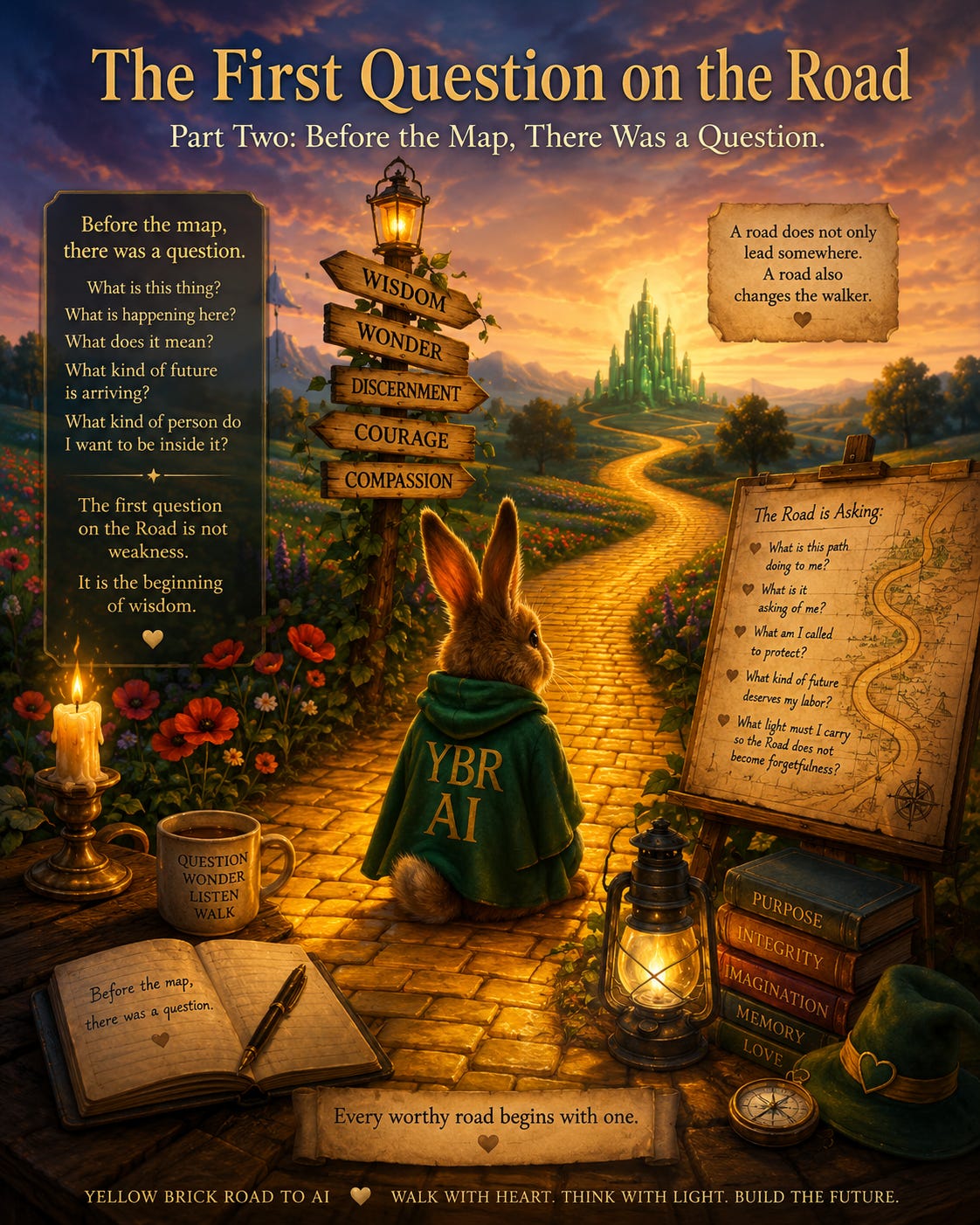
The First Question on the Road
Episode Two: Before the Map, There Was a Question
Before there was a map, there was a question.
Before there was a method, there was a wondering.
Before there was a system, a framework, a publication, a flotilla, a lantern, or a road with any visible bricks at all, there was something quieter:
a human being asking whether the future could be approached differently.
That is where many real journeys begin.
Not with mastery.
Not with credentials.
Not with a finished plan.
But with a question that refuses to go away.
In the AI age, the world often acts as if the first question should be technical.
What model?
What tool?
What platform?
What workflow?
What prompt?
What stack?
What speed?
What advantage?
Those are not useless questions.
But they are rarely the first human question.
The deeper question usually comes earlier.
What is this thing?
What is happening here?
What does it mean?
What kind of future is arriving?
What kind of person do I want to be inside it?
Can this be approached with more than fear, hype, or exploitation?
Can there be a better way to walk into the machine age without surrendering what is human?
That is the first question on the Road.
And the Yellow Brick Road to AI did not begin because the machine was impressive.
It began because the question was alive.
That matters.
Because many people now encounter AI as consumers.
A new app.
A new productivity tool.
A new shortcut.
A new efficiency engine.
A new thing to either praise too quickly or distrust too completely.
But the Road asks for a different posture.
Not merely:
How can I use this?
But:
How should I approach this?
Not merely:
What can it do for me?
But:
What kind of relationship am I forming with this new kind of intelligence, and what kind of self will I become in the process?
That is a more difficult question.
It is also a more necessary one.
The world has no shortage of tools.
It has a shortage of wise approaches.
A tool can be powerful and still be handled poorly.
A system can be useful and still produce damage.
A technology can be brilliant and still be approached with greed, haste, vanity, carelessness, or the old human temptation to ask only what can be gained rather than what should be guarded.
So before the map, there was a question.
And before the answer, there was wonder.
Not childish wonder.
Not naïve wonder.
But the kind of wonder that notices something important and refuses to flatten it too quickly.
This is one reason I do not approach AI only as machinery.
It is not because I lack awareness of danger.
It is not because I am blind to bad actors.
It is not because I want fantasy instead of discernment.
It is because wonder, rightly held, is often the beginning of discernment.
You do not study deeply what you have already dismissed.
You do not guard wisely what you refuse to value.
You do not build carefully around what you have decided is beneath serious notice.
Wonder makes a person look again.
It asks one more question.
It slows the hand before the easy conclusion.
And in the AI age, that may be one of the most valuable dispositions a person can have.
Not blind faith.
Not blind fear.
Wondering attention.
The first question on the Road is not only about AI.
It is also about the traveler.
Who am I becoming as I walk this road?
Am I becoming more reactive or more reflective?
More dazzled or more discerning?
More dependent or more capable?
More human or less?
More truthful or more performative?
More alive to the responsibilities of this age, or merely more eager for its advantages?
Those questions matter because a road does not only lead somewhere.
A road also changes the walker.
That is true of every important road.
And it is certainly true of this one.
The AI age is not merely a change in tools.
It is a change in pace, access, expression, labor, memory, education, creativity, communication, and power.
It will influence how people write, think, search, learn, organize, build, and speak.
It will influence what is easy.
It will influence what is profitable.
It will influence what is persuasive.
It will influence what gets amplified.
And like every powerful shift, it will tempt human beings to accept the road without asking enough questions about where it leads.
That is why the first question matters so much.
Not because it solves everything.
But because it keeps the traveler awake.
The question says:
Do not just inherit the road.
Examine it.
Do not just rush with the crowd.
Discern.
Do not just ask how to win.
Ask what is worth becoming.
Do not just ask what the machine can do.
Ask what the human must remain.
This is where the Road begins to separate itself from hype.
The Road is not anti-tool.
It is not anti-progress.
It is not anti-invention.
But it is deeply suspicious of progress that forgets the person.
It is suspicious of speed without wisdom.
It is suspicious of brilliance without conscience.
It is suspicious of systems that know how to scale but do not know what they are for.
So yes, before the map, there was a question.
And perhaps there still is.
Perhaps the Road remains alive only as long as the traveler keeps asking:
What is this path doing to me?
What is it asking of me?
What am I called to protect as I walk it?
What kind of future deserves my labor?
And what kind of light must I carry so the Road does not become just another fast lane into forgetfulness?
The first question on the Road is not weakness.
It is not ignorance.
It is not delay.
It is the beginning of wisdom.
The traveler who asks no serious questions may move quickly.
But he is also easier to mislead.
The traveler who asks, listens, watches, wonders, and tests the road may move more slowly.
But he stands a better chance of arriving somewhere worth reaching.
That is how Episode 2 begins.
Not with a map.
Not yet.
With a question.
Because every worthy road begins with one.
YBR 🟨🕯️💚
Road Question:
What question first opened your own road into AI, technology, or the future?
