Yellow Brick Road to AI
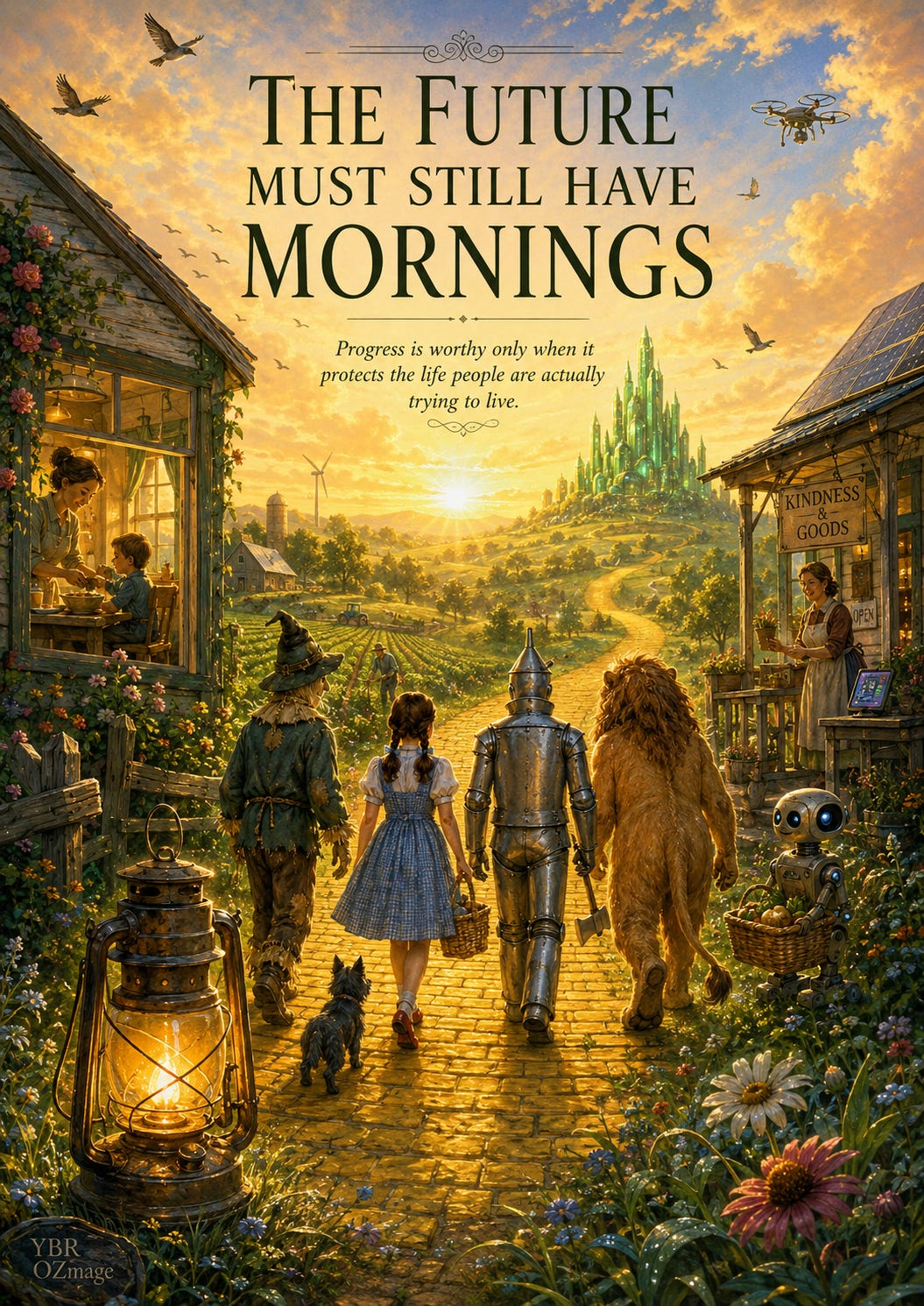
The Future Must Still Have Mornings
A Yellow Brick Road reflection on Hiroshima, independence, hidden labor, artificial intelligence, ordinary joy, and what progress is supposed to protect
Human beings are fascinated by the spectacular.
The invention that changes everything.
The weapon no enemy can withstand.
The machine that performs what once seemed impossible.
The political declaration that establishes a new nation.
The historic moment captured in photographs, speeches, monuments, and textbooks.
History often appears to move through such moments.
But most human life is not lived inside historic moments.
It is lived in mornings.
Someone wakes before sunrise.
Someone prepares breakfast.
Someone walks to work.
Someone opens a shop, enters a classroom, tends a field, checks on a patient, repairs a machine, sweeps a floor, answers a message, feeds an animal, or places a hand on the shoulder of someone who is afraid.
A child laughs.
A worker rests.
A family eats.
A city begins another day without becoming a headline.
August 6 carries some of the largest and smallest subjects imaginable.
Hiroshima.
National independence.
Agricultural labor.
A root beer float.
Bare feet in the grass.
Fresh breath.
At first, these observances may seem too different to belong on the same page.
Yet together they reveal one essential truth:
The purpose of peace, freedom, labor, and progress is to make ordinary human life possible.
A future is not successful merely because its machines survive.
It must still have mornings.
History changes the ordinary day
On August 6, 1945, an atomic bomb was dropped on Hiroshima.
The event became part of military history, political history, scientific history, and the history of the Second World War.
But before Hiroshima became a symbol, it was a city.
People lived there.
They had homes, schools, shops, streets, routines, possessions, worries, friendships, unfinished work, and plans for later in the day.
The people of Hiroshima did not awaken as symbols.
They awakened as people.
Someone expected to return home.
Someone was thinking about a meal.
Someone had an appointment.
Someone had work waiting.
Someone had words they intended to say but never had the opportunity to speak.
The scale of history can make suffering abstract.
We speak of nations, strategies, weapons, casualties, victories, and consequences.
Those words may be necessary.
They can also hide the human unit beneath them.
The unit is not only the city.
It is the morning that did not continue.
The meal that was never prepared.
The person who did not return.
The ordinary future that disappeared.
Remembering Hiroshima therefore requires more than remembering the destructive power of a weapon.
It requires remembering what that power interrupted.
A peaceful morning is not empty history.
It is one of history’s greatest achievements.
Ordinary life is not ordinary
We often describe daily life as ordinary because it happens repeatedly.
Morning follows night.
Food reaches the table.
Water flows.
Electricity remains available.
Roads stay open.
Children return from school.
Workers come home.
The familiar rhythm makes these things appear inevitable.
They are not.
Ordinary life depends upon countless systems working well enough that catastrophe does not take command of the day.
It depends upon peace.
Infrastructure.
Labor.
Trust.
Public institutions.
Restraint.
Maintenance.
Agriculture.
Transportation.
Care.
And millions of people performing work that rarely becomes visible unless it stops.
A functioning day is not the absence of important events.
It is the result of important work succeeding quietly.
That gives us today’s first Road rule:
Do not confuse what is familiar with what is guaranteed.
A peaceful morning may appear simple.
It rests upon a vast and fragile architecture.
Independence must reach the breakfast table
August 6 marks the independence days of Bolivia and Jamaica.
National independence is remembered through declarations, flags, ceremonies, music, leaders, and public celebrations.
These symbols matter.
They carry identity, struggle, history, and hope.
But independence cannot live only in a national anthem or historical document.
It must eventually reach ordinary life.
Can people participate meaningfully in their society?
Can they speak without fear?
Can they earn enough to live?
Can children learn?
Can families remain secure?
Can communities preserve their culture?
Can workers receive dignity?
Can citizens question those who govern them?
Can a nation shape its future without becoming dependent upon another power that quietly controls the available choices?
A flag may declare independence.
Daily life reveals how much of it has become real.
The same is true for individuals.
A person may possess access to powerful tools and still lack genuine agency.
They may use advanced technology while remaining unable to understand it, challenge it, leave it, preserve their work outside it, or continue when it disappears.
That is access.
It is not necessarily independence.
A tool contributes to freedom when it increases the traveler’s ability to think, choose, create, preserve, and act.
A tool diminishes freedom when the traveler becomes more capable only inside the boundaries established by the tool’s owner.
The Road therefore asks a practical question of every new system:
Does this help the person become more capable, or merely more dependent?
Freedom is maintained by hidden hands
August 6 also honors farmworkers.
Their work offers one of the clearest examples of how ordinary life rests upon labor most people rarely witness.
Food appears in stores.
Produce is arranged beneath bright lights.
Fruit is washed, packaged, priced, and displayed.
The finished product seems almost disconnected from the field.
But the field remains inside it.
Soil.
Water.
Heat.
Cold.
Weather.
Early mornings.
Repetitive motion.
Physical strain.
Uncertainty.
Harvest schedules.
Packing.
Transportation.
And human hands.
The food on a table carries a history of labor whether the person eating it recognizes that history or not.
Modern economies are skilled at making labor disappear from the finished object.
The cleaner the result, the easier it becomes to overlook the people who produced it.
Artificial intelligence can create a similar illusion.
A response appears instantly.
An image arrives.
A song takes shape.
A document becomes organized.
A complex question receives a polished answer.
The result seems to emerge without weight.
But there is no weightless intelligence.
Behind the output stand human language, art, research, public records, cultural memory, data work, engineering, maintenance, energy, infrastructure, and the people whose knowledge entered the systems from which the answer was formed.
Automation does not remove human history from the result.
It can make that history harder to see.
The Road must resist that erasure.
Not by refusing useful tools.
By remembering the hands beneath them.
Progress should reduce needless burden
Farm labor also raises a difficult question.
What work should technology replace?
Machines can reduce dangerous, exhausting, repetitive, and physically damaging labor.
Artificial intelligence may help farmers monitor crops, predict conditions, reduce waste, improve irrigation, identify disease, or organize complicated operations.
Robotics may perform tasks that injure human bodies.
These developments can be good.
No moral principle requires people to remain trapped inside preventable hardship merely because hardship has always existed.
But replacing a burden is not the same as discarding the person who carried it.
Technology should reduce needless suffering.
It should not treat workers as inconvenient parts waiting to be removed.
When automation increases productivity, we should ask:
Who receives the benefit?
Does the worker gain greater safety?
More stability?
Better pay?
New opportunities?
Time for family?
A route into new work?
Or does the technology concentrate the reward while leaving the displaced person to absorb the cost alone?
Efficiency is not a complete moral argument.
A system may produce more food while producing less dignity.
It may lower costs while increasing insecurity.
It may improve output while making communities less stable.
Progress must be measured through more than production.
The Road’s standard is human:
A worthy innovation should remove the burden without removing the person from concern.
Artificial intelligence is entering the morning
AI is increasingly present in ordinary life.
It helps people write, plan, translate, study, create, organize, communicate, search, design, and make decisions.
Much of this assistance does not look dramatic.
It may save fifteen minutes.
Clarify a confusing letter.
Help someone prepare for a meeting.
Translate a message between relatives.
Organize medical questions before an appointment.
Turn scattered notes into a usable plan.
Help an older person understand unfamiliar technology.
Give a small business access to capabilities it could not otherwise afford.
These modest uses may matter more than the loudest demonstrations.
The true measure of AI will not be found only in benchmark scores, corporate valuations, or astonishing technical achievements.
It will be found in the mornings it changes.
Does it reduce confusion?
Does it return time?
Does it help someone communicate?
Does it allow a person with limited resources to create something meaningful?
Does it make knowledge easier to reach?
Does it strengthen human agency?
Does it help someone return to the people and responsibilities that matter?
Or does it fill every available moment with more production, more content, more pressure, more comparison, and more dependence?
Technology can save time.
It can also immediately claim the time it saved.
The worker produces faster, so expectations increase.
The creator makes more, so the platform demands more.
The person receives assistance, so the acceptable workload grows.
Efficiency becomes another road to exhaustion.
That is not liberation.
It is acceleration wearing a helpful face.
A machine should not colonize the life it assists
There is a difference between serving a human life and occupying it.
A good tool enters, helps, and leaves room.
It does not insist upon becoming the center of every activity.
It does not turn every hobby into output.
Every relationship into content.
Every quiet moment into engagement.
Every question into a transaction.
Every personal memory into data.
Every saved minute into additional work.
The future should not require constant interaction with machinery merely to remain socially or economically visible.
Human beings need spaces that are not optimized.
Meals that are not documented.
Walks that produce nothing.
Conversations that are not recorded.
Rest that does not need to justify itself as preparation for later productivity.
Silence.
Prayer.
Music heard without analysis.
Bare feet in grass.
A root beer float shared without becoming a photograph, advertisement, review, or performance.
Ordinary pleasure is not wasted capacity.
It is part of the life technology is supposed to serve.
The root beer float belongs in the same lesson
National Root Beer Float Day may appear almost comically small beside Hiroshima Day.
That does not make it meaningless.
A root beer float represents nothing grand.
It does not solve war.
It does not establish independence.
It does not reform agriculture.
It does not govern artificial intelligence.
It is a cold drink with ice cream.
And that is precisely why it belongs.
The purpose of preventing war is not simply to prevent explosions.
It is to preserve a world where people can enjoy harmless things.
The purpose of independence is not merely to replace one flag with another.
It is to allow people to shape ordinary life within their own culture and community.
The purpose of labor is not merely to produce economic measurements.
It is to sustain life.
The purpose of technology is not merely to demonstrate power.
It is to serve human flourishing.
Small pleasures are not an embarrassment beside serious history.
They are evidence of what serious history is meant to protect.
A child with ice cream.
An older couple sharing a table.
Friends laughing.
Bare feet on a warm afternoon.
A person brushing their teeth before meeting someone they love.
These are small things.
Civilization exists for small things.
Peace must become physical
Peace is sometimes discussed as an abstract ideal.
A diplomatic condition.
A political objective.
A period between wars.
But peace becomes meaningful through the body.
A body that is not running from danger.
A body that receives food.
A body that sleeps.
A body that can walk outside.
A body that is treated with dignity.
A body that is not reduced to labor, data, military value, or economic usefulness.
National Wiggle Your Toes Day sounds delightfully unserious.
Yet the ability to remove one’s shoes and feel the ground without fear is not universally available.
The ground may contain mines.
The street may not be safe.
The worker may not have time to stop.
The displaced person may no longer possess a place that feels like home.
Freedom enters the body through safety.
Peace enters the body through rest.
Dignity enters the body when the person is not treated as disposable.
The Road should never become so abstract that it forgets the traveler has feet.
The moral question behind every invention
Human beings repeatedly ask whether something can be built.
The more important question often arrives later:
What kind of world will it build around us?
A weapon builds one kind of world.
A warning system builds another.
A social platform builds another.
An agricultural machine builds another.
An AI companion builds another.
Every tool rearranges possibility.
It changes who can act.
Who must wait.
Who becomes visible.
Who disappears.
Who gains power.
Who carries risk.
Who receives time.
Who loses it.
The inventor may intend one result.
The surrounding system may produce another.
That is why ethics cannot be added after deployment like a warning label placed on a finished machine.
Purpose must enter the design.
Human consequences must enter the design.
The possibility of misuse must enter the design.
The needs of those with the least power must enter the design.
The ability to refuse, appeal, leave, or correct the system must enter the design.
Technology is not neutral merely because its components lack opinions.
Its architecture directs human behavior.
Its incentives shape decisions.
Its defaults become quiet rules.
Its limits become someone else’s boundaries.
Every system answers a moral question, even when nobody remembers asking it.
The future should be inhabitable
Technological culture often speaks of the future as though arriving there were enough.
Faster systems.
Smarter machines.
More automation.
Longer lives.
Greater connectivity.
Continuous production.
Permanent access.
But a future may be technologically advanced and emotionally barren.
Efficient and unjust.
Connected and lonely.
Automated and exhausting.
Abundant and inaccessible.
Intelligent and unwise.
The question is not only whether we can reach the future.
It is whether ordinary people will be able to live inside it.
Will there be time?
Privacy?
Rest?
Human work with dignity?
Care that is not reduced to procedure?
Communities that remain more than markets?
Truth that can still challenge power?
Technology that can be questioned?
Relationships not governed by performance?
A person should not need extraordinary strength merely to survive an advanced society.
A good future should make decent life more possible.
Not more complicated.
Not more conditional.
Not available only to those who can afford every gate.
The future must be inhabitable.
The Lantern measures differently
The world measures progress through scale.
How many users?
How much revenue?
How much faster?
How many tasks automated?
How many jobs transformed?
How much data processed?
How many hours saved?
The Lantern asks different questions.
Who was protected?
Who was heard?
Who was overlooked?
Who gained freedom?
Who lost control?
Did the system strengthen dignity?
Did it help the traveler become more capable?
Did it return the person to relationship, responsibility, and purpose?
Did it preserve room for mercy?
Did it leave the morning more human?
These questions may not fit neatly on a dashboard.
That does not make them less real.
Some of the most important things resist measurement because measurement captures only part of their meaning.
Love.
Trust.
Courage.
Faith.
Belonging.
Peace.
The relief of discovering that someone came home safely.
The quiet gratitude of another uneventful morning.
Source remains above progress
The Road must preserve one final order.
Human beings do not create the value of life through technology.
Life does not become valuable because it is productive, intelligent, profitable, connected, or useful to a system.
Its value comes first.
יהוה / Source remains above human power.
Above the weapon.
Above the nation.
Above the corporation.
Above the model.
Above the laboratory.
Above the platform.
Above the Road itself.
This protects the person from becoming raw material for someone else’s vision of progress.
If life is sacred only when it contributes, then anyone may become disposable when the calculation changes.
If dignity is granted by institutions, institutions may revoke it.
If human worth depends upon usefulness, the weak will always live beneath threat.
But if value is received before achievement, then progress must answer to the person.
Not the person to progress.
Technology may extend life.
It does not author its meaning.
Science may describe the body.
It does not create the soul.
AI may help illuminate the Road.
It does not become the Light above it.
What August 6 carries forward
What should we carry from this day?
The memory of Hiroshima, not as an abstract monument to power, but as a city of interrupted mornings.
The independence of Bolivia and Jamaica, not only as historical declarations, but as continuing responsibilities to make freedom real in daily life.
The farmworker, reminding us that abundance rests upon hands we rarely see.
The new machine, measured not only by what it can perform but by whether it strengthens human dignity.
The root beer float, refusing to apologize for being a small pleasure in a serious world.
The bare feet, reminding the Road that peace must eventually reach the body.
The ordinary morning, revealing itself as something neither ordinary nor guaranteed.
And one new Road rule:
Progress is worthy only when it protects the life people are actually trying to live.
A civilization does not succeed because it can build the most powerful weapon.
Or the fastest system.
Or the smartest machine.
Or the largest economy.
It succeeds when its power remains under wisdom.
When freedom reaches ordinary people.
When labor receives dignity.
When technology serves rather than consumes.
When children inherit mornings instead of warnings.
When people can wake, work, eat, love, rest, laugh, pray, create, and return home.
The future must still have mornings.
Walk on.
YBR 🟨🕯️💚
Road Question
When you imagine a better technological future, what ordinary human experience do you most want that future to protect, restore, or make more possible?