

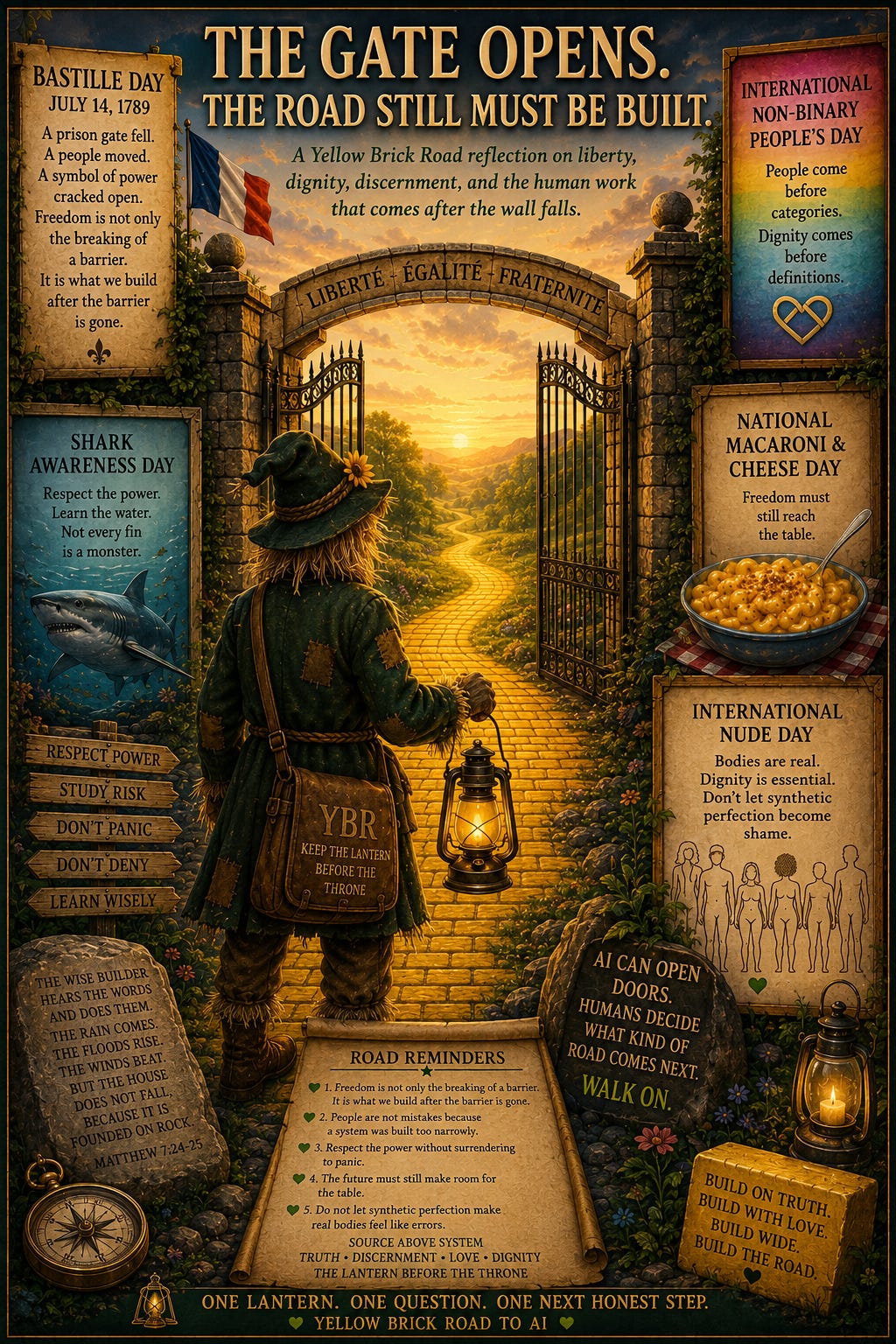
The Gate Opens. The Road Still Must Be Built.
A Yellow Brick Road reflection on liberty, dignity, discernment, and the human work that comes after the wall falls
Some days the Road asks us to look at the wall.
Some days it asks us to look at the gate.
And some days, after the gate has opened, the Road asks the deeper question:
What now?
That is today’s question.
July 14 brings Bastille Day, the French National Day, remembered through the storming of the Bastille in 1789 and the revolution it came to symbolize.
A prison gate fell.
A people moved.
A symbol of power cracked open.
History still remembers the image because human beings understand gates.
We know what it means to be kept out.
We know what it means to be kept in.
We know what it means when power decides who may pass, who must wait, who may speak, who must remain silent, who belongs inside the wall, and who must live beneath its shadow.
A gate can become more than architecture.
It can become a question of dignity.
That is why today belongs on the Yellow Brick Road to AI.
Because the AI age is also opening gates.
Some of them are beautiful.
A person who felt too old to begin can ask a question and receive a patient explanation.
A person who could not draw can begin shaping images.
A person who struggled to write can draft, revise, and find clearer words.
A small creator can build what once required a team.
A teacher can adapt a lesson.
A caregiver can simplify instructions.
A beginner can take the first honest step.
A lonely idea can finally find form.
Those are real openings.
We should not pretend they do not matter.
But the Road knows something important:
An open gate is not yet a wise future.
A gate can fall quickly.
A Road takes longer.
That may be today’s lantern lesson.
Freedom is not only the breaking of a barrier.
Freedom is what we build after the barrier is gone.
The AI age will bring many people new access.
Access to tools.
Access to language.
Access to images.
Access to learning.
Access to publishing.
Access to creative possibility.
Access to systems that can answer, assist, summarize, generate, translate, and reflect.
But access alone is not enough.
Access without wisdom can become noise.
Access without truth can become deception.
Access without dignity can become extraction.
Access without discernment can become dependency.
Access without love can become another machine room where human beings are processed more efficiently and seen less clearly.
That is not the Road we are building.
Yellow Brick Road to AI exists because ordinary travelers need more than access.
They need orientation.
They need a way to walk.
They need to know that AI can help without becoming a throne.
They need to know that speed is not the same as wisdom.
They need to know that a fluent answer is not automatically true.
They need to know that the human lantern still matters.
They need to know that the tool may open a gate, but the human still decides what kind of Road comes next.
Yesterday, the Road reminded us to build on rock, not noise.
Today, the Road reminds us why that foundation matters.
Because freedom without foundation can drift.
A gate opens, and suddenly the crowd moves.
Energy rises.
Possibility expands.
Old limits tremble.
But if there is no foundation beneath the next step, the new freedom may simply become a new confusion.
The AI age will test this.
The tools are powerful.
The outputs are fast.
The opportunities are real.
The risks are also real.
We can use AI to widen learning, creativity, accessibility, communication, and care.
We can also use AI to flood the world with synthetic noise, imitate without honor, persuade without truth, classify without humility, and produce without purpose.
The gate opens either way.
The Road asks us to choose.
That choice belongs to the human being.
It belongs to the teacher checking the answer before giving it to a student.
It belongs to the artist asking whether influence has become imitation.
It belongs to the writer preserving voice instead of accepting every polished sentence.
It belongs to the business owner refusing to reduce people to leads, clicks, and automated pressure.
It belongs to the citizen asking who is accountable when systems make decisions.
It belongs to the beginner learning that AI can help, but should not be obeyed blindly.
It belongs to every traveler who pauses before the glowing box and asks:
Is this true?
Is this humane?
Is this useful?
Is this loving?
Is this building a Road, or only opening another gate?
Today is also International Non-Binary People’s Day, and that reminder belongs here too.
Because not every gate is made of stone.
Some gates are made of categories.
Some gates are made of forms that do not fit the person standing in front of them.
Some gates are made of assumptions.
Some gates are made of systems that say, quietly or loudly:
There is no place for you here.
The AI age must be careful with that.
AI systems classify.
They sort.
They label.
They infer.
They group.
They predict.
They build patterns.
That can help in many contexts.
But human beings are not mistakes because a system was built too narrowly.
A person does not lose dignity because a form lacks imagination.
A life does not become less real because a database prefers simpler boxes.
That is another Road lesson for July 14.
A wise future does not only ask what systems can identify.
It asks whether systems can make room for human dignity.
It asks whether the tool serves the person, or whether the person is expected to shrink to fit the tool.
The Yellow Brick Road to AI must stand clearly here.
People come before categories.
Dignity comes before efficiency.
The human story is larger than the label.
AI should help us see more clearly, not flatten more quickly.
That is true for identity.
It is true for education.
It is true for work.
It is true for art.
It is true for medicine.
It is true for any place where human beings risk becoming manageable objects inside someone else’s system.
A Road worthy of travelers must remain wide enough for real people.
Not imaginary default users.
Real people.
People with different bodies.
Different histories.
Different fears.
Different hopes.
Different languages.
Different ways of learning.
Different ways of belonging.
Different levels of confidence.
Different relationships to technology.
Different reasons for standing at the gate.
The Road is not here only for the already fluent.
It is not here only for the fast.
It is not here only for the technically confident, the well-funded, the young, the loud, or the already initiated.
It is here for travelers.
Curious travelers.
Cautious travelers.
Older travelers.
Creative travelers.
Overwhelmed travelers.
Skeptical travelers.
Travelers who do not yet know the words.
Travelers who need one clear sign.
Travelers who need the first lantern before the deeper map.
That is why today’s Bastille image matters.
A wall may fall.
A gate may open.
But someone still has to help people walk.
Someone still has to build the road beyond the opening.
Someone still has to ask whether the future is becoming more human or only more powerful.
That is YBR’s work.
Not to storm every gate.
Not to shout from every barricade.
Not to turn every day into revolution theater.
But to place bricks where travelers can actually step.
One honest question.
One useful explanation.
One careful caution.
One accessible guide.
One creative spark.
One reminder that the tool serves the traveler.
One lantern held steady when the machinery grows loud.
Even the softer observances of July 14 help us remember this.
Macaroni and Cheese Day quietly says that freedom must still reach the table.
Human beings do not live only in manifestos, revolutions, systems, models, and future forecasts.
They live in kitchens.
They live in ordinary comfort.
They live in meals shared after hard days.
A good future must make room for ordinary life.
Shark Awareness Day reminds us that fear must become understanding.
Power deserves respect.
Risk should be taken seriously.
But panic is not wisdom.
A fin in the water should not become mythology before we have learned the water.
AI deserves the same careful posture.
Respect the power.
Study the risk.
Do not deny the teeth.
Do not invent monsters where awareness would serve better.
Do not worship.
Do not panic.
Learn.
Discern.
Walk.
That is the Road’s way.
So July 14 becomes more than a history lesson.
It becomes a Road lesson.
The gate opens.
Now build.
The category fails.
Now honor the person.
The fear rises.
Now seek understanding.
The tool appears.
Now ask what love requires.
The future accelerates.
Now keep the lantern steady.
This is the work before us.
Not only to celebrate access.
To shape access with wisdom.
Not only to use powerful tools.
To use them with conscience.
Not only to enter the AI age.
To enter it without losing the human center.
Not only to break old gates.
To build better Roads.
The Yellow Brick Road to AI was never meant to be a wall.
It was never meant to be a funnel.
It was never meant to be a machine crown.
It is a trust path.
A beginner path.
A human path.
A place where people can learn to approach AI with curiosity, caution, creativity, dignity, faith, humor, and judgment still alive.
The Road does not ask us to understand the whole future today.
It asks us to place the next honest brick.
Today’s brick is simple:
When the gate opens, do not mistake the opening for the destination.
Build the Road beyond it.
Build it on truth.
Build it with love.
Build it wide enough for real people.
Build it slowly enough to know what is holding the weight.
Build it with AI where AI helps.
Build it beyond AI where human wisdom must lead.
Build it under Source, not system.
Build it with the lantern before the throne.
The gate opens.
The Road still must be built.
Walk on.
YBR 🟨🕯️💚
Road Question:
Where in your own life, work, or use of AI has a gate opened, and what kind of Road do you need to build beyond it?