THE GIFT NO ONE WRAPPED 🎁🏮❄️
YBR NOVEMBER STORYTIME #396 | SUNDAY, NOVEMBER 22, 2026
An Adventure Along the Borders of Burzee
The Winter Market of Many Hands has ended, leaving Thumbumbia glowing with the memory of music, handmade treasures, and newfound friendships. But when the Scarecrow discovers a narrow wooden walkway beneath the melting snow, he learns that one village resident spent the night quietly making the celebration possible for people who might otherwise have been left outside. As the four ships prepare for another week beside the ancient woodland, the travelers encounter a different kind of Christmas gift: one whose maker never expected anyone to know it had been given.
I. THE MORNING AFTER THE MUSIC
The bells of Thumbumbia sounded softly through the Sunday morning mist.
Snow lay along the harbor roofs.
The market square was quiet.
The wooden stalls had been closed for the night, their garlands drooping gently beneath the frost.
A few forgotten ribbons stirred in the cold breeze.
And somewhere beneath the market awnings, a single paper star turned slowly upon its thread.
The songs had ended.
The storytellers had gone home.
The craftspeople had covered their tables.
But the warmth of yesterday’s celebration seemed to remain in the little village.
Four ships rested at anchor.
The Evergreen, under Captain Sawyer Salt.
The Hare, commanded by Captain Jasper Quill.
The Lionheart, under Captain Gideon Vale.
And the Swallow, commanded by Captain Ronan Flint.
Beyond the village stood the northern orchards.
Beyond them lay the third boundary stone.
And beyond that marker rose the ancient Forest of Burzee.
No invitation had arrived from the woodland.
The unfinished agreement remained unresolved.
No one had crossed the boundary.
And the expected guest remained unnamed.
But aboard the Evergreen, the Scarecrow had something else on his mind.
He was looking at the newest decoration hanging beside the chartroom doorway.
A little wooden plaque.
Four ships.
A winding road.
A scattering of painted stars.
And four words:
MADE BY MANY HANDS.
White Rabbit approached.
“Good morning, Scarecrow.”
“Good morning, Rabbit.”
“Are you thinking about the market?”
“I am.”
“Wasn’t it wonderful?”
“Very.”
The Rabbit smiled.
“I liked the music.”
“So did I.”
“And the stars.”
“Yes.”
“And the stories!”
“Indeed.”
The Rabbit considered.
“Do you suppose everyone enjoyed themselves?”
The Scarecrow looked thoughtful.
“I hope so.”
“Do you think anyone was left out?”
That question made him pause.
“I don’t know, Rabbit.”
The Rabbit lowered his ears.
“I hadn’t thought of it yesterday.”
“Neither had I sufficiently.”
The Scarecrow took his hat from its hook.
“Perhaps we should go for a walk.”
And so began the Sunday when the most important gift of the Winter Market was finally discovered.
II. SOMETHING BENEATH THE SNOW
The Scarecrow and White Rabbit walked along the harbor road toward the market square.
The streets were nearly empty.
A baker carried fresh loaves to a neighboring house.
A chimney sweep crossed the lane with his brushes.
And two sailors from the Swallow were helping a shopkeeper clear snow from his doorway.
As they approached the market, the Rabbit stopped.
“Scarecrow?”
“Yes?”
“What’s that?”
He pointed toward a narrow wooden path running along the side of the square.
It had not been there when the company first arrived in Thumbumbia.
The walkway crossed a patch of uneven cobblestones.
Then continued beside the old fountain.
Finally, it reached the little covered platform where Clara and the children had performed their music.
The Scarecrow examined it.
The boards were carefully fitted.
Their surfaces had been roughened to provide better footing.
Small wooden supports held them securely above the most troublesome stones.
“Interesting,” he said.
White Rabbit stepped onto the walkway.
“It’s much easier to walk here.”
“Is it?”
“Yes! The stones underneath are terribly uneven.”
The Scarecrow looked toward the fountain.
He remembered how crowded the square had been yesterday.
Children running between stalls.
Older residents carrying baskets.
Villagers helping one another.
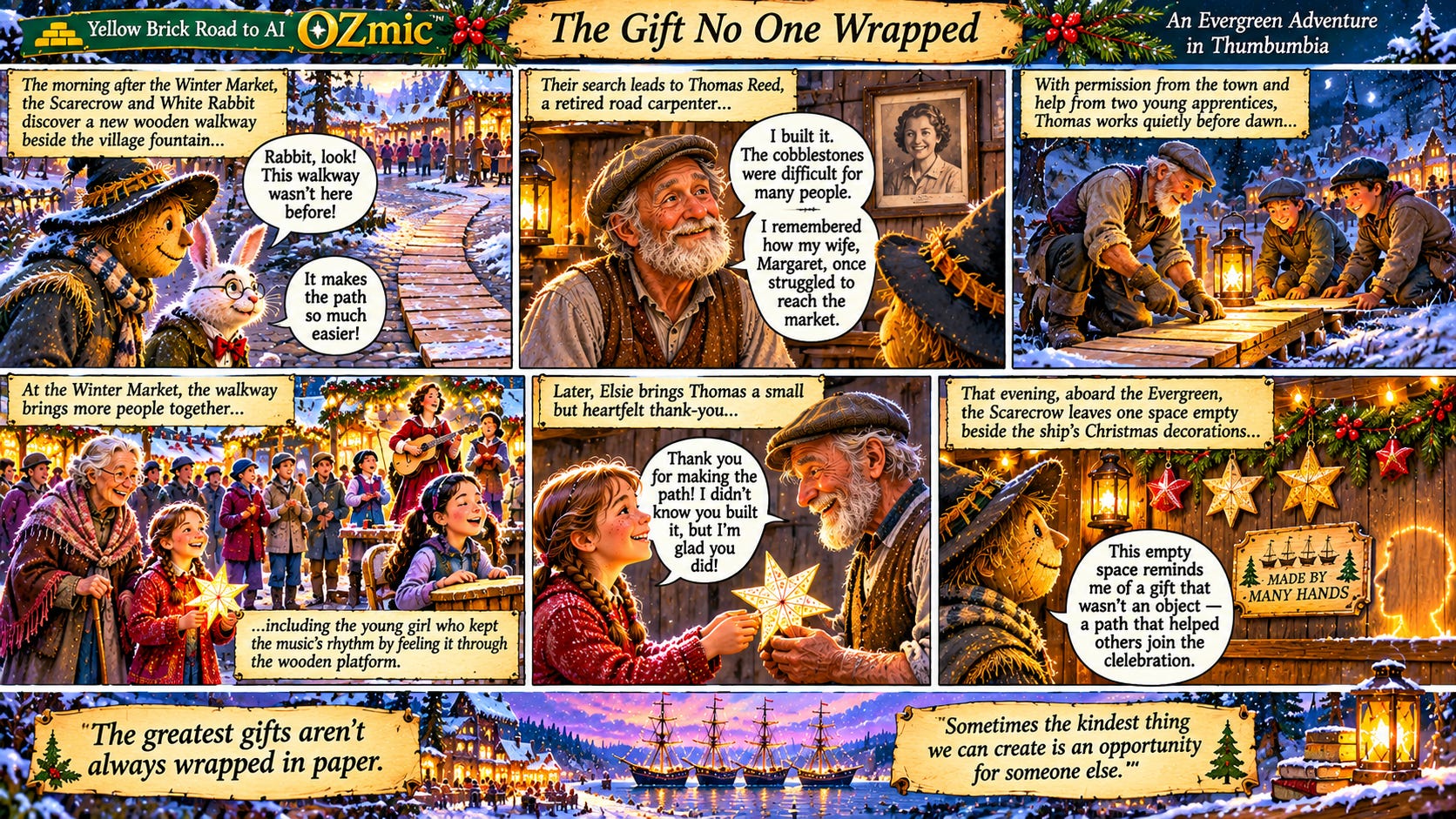
And the little girl who had kept time with the musicians because she could feel the rhythm through the wooden platform.
He looked again at the walkway.
“Rabbit, I wonder who built this.”
The Rabbit examined the boards.
“Perhaps Tobias Bell.”
“Perhaps.”
“Or the town carpenters.”
“Possibly.”
“Shall we ask?”
The Scarecrow smiled.
“An excellent suggestion.”
III. THE MAN WHO DIDN’T ATTEND THE MARKET
The first person they encountered was Tobias Bell.
He was opening his workshop.
“Good morning, gentlemen!”
“Good morning, Tobias.”
“Did you enjoy the market?”
“Very much.”
The Scarecrow gestured toward the square.
“May I ask about the wooden walkway beside the fountain?”
Tobias looked surprised.
“The walkway?”
“Yes.”
“I didn’t build it.”
“Do you know who did?”
Tobias considered.
“I saw it yesterday morning. I assumed the town had arranged it.”
The Rabbit looked disappointed.
“Then perhaps we should ask the town.”
“A sensible idea.”
They visited the little municipal office beside the bell tower.
A clerk was arranging the week’s correspondence.
He listened carefully.
“The walkway?” he repeated.
“Yes,” said the Scarecrow.
“The town approved repairs to the market approaches several weeks ago, but I don’t believe that particular path was included.”
“Then someone built it independently?”
“Possibly.”
“Wouldn’t that require permission?”
“For a temporary structure in the public square, certainly.”
The Scarecrow nodded.
“Then perhaps someone requested it.”
The clerk examined a folder.
He found the market permissions.
A list of stall locations.
An authorization for the music platform.
And a note regarding winter access.
He read the note.
Then smiled.
“Well, here’s something.”
“What is it?” asked the Rabbit.
“A request to make the eastern approach safer for people who have difficulty walking.”
“Who made the request?”
The clerk examined the signature.
“Thomas Reed.”
“Who is he?”
“The town’s former road-maintenance carpenter.”
“Former?”
“Yes. He retired two years ago.”
The Scarecrow looked interested.
“And where might we find him?”
The clerk pointed toward the northern lane.
“He lives in a cottage beside the old orchard wall.”
The Rabbit smiled.
“A new discovery!”
“Perhaps,” replied the Scarecrow.
“But first, let’s find out what he actually did.”
IV. THE COTTAGE BY THE ORCHARD WALL
Thomas Reed’s cottage stood beneath two old apple trees.
A little stone path led to its door.
Wood was stacked neatly beneath the eaves.
An elderly dog slept beside the porch.
And a pair of worn boots stood outside.
The Scarecrow knocked.
After a moment, the door opened.
A tall, weathered man with silver hair looked out.
“Good morning.”
“Good morning, sir.”
“Can I help you?”
“My name is Scarecrow. This is White Rabbit.”
Thomas looked at them.
“Well. You’re certainly an unusual pair of visitors.”
The Rabbit bowed.
“Thank you!”
The Scarecrow smiled.
“We’ve come about the walkway beside the market fountain.”
Thomas raised an eyebrow.
“Has something gone wrong?”
“Not that we’re aware of.”
“Has someone complained?”
“No.”
“Then what seems to be the trouble?”
The Scarecrow considered.
“We wondered who made it.”
Thomas looked toward his woodpile.
Then back at his visitors.
“I did.”
The Rabbit’s ears rose.
“YOU DID?”
“Yes.”
“All by yourself?”
“Mostly.”
“Why?”
Thomas looked surprised.
“Because it needed doing.”
The Scarecrow smiled.
“May we hear more?”
Thomas considered.
Then opened the door.
“Come in out of the cold.”
V. THE ROAD THAT WAS TOO DIFFICULT
Thomas Reed’s cottage was modest.
A fire burned in the hearth.
Old maps hung upon the wall.
A collection of woodworking tools stood beside a small bench.
And above the mantelpiece was a framed photograph of a woman smiling beside a garden gate.
Thomas offered his visitors tea.
The Rabbit accepted immediately.
The Scarecrow looked toward the photograph.
“Your wife?”
Thomas nodded.
“Margaret.”
“Does she live here with you?”
“No. She died some years ago.”
“I’m sorry.”
Thomas smiled gently.
“Thank you.”
He poured the tea.
“Margaret loved the Winter Market.”
“Did she?”
“Every year.”
“What did she enjoy most?”
“The music.”
He glanced toward the window.
“Even toward the end, when walking became difficult, she wanted to hear the songs.”
The Rabbit looked thoughtful.
“Did she attend?”
“Sometimes.”
“And other times?”
Thomas shook his head.
“The old cobblestones were difficult for her. Especially when they were wet or icy.”
The Scarecrow remembered the uneven stones beside the fountain.
“Was there another entrance?”
“Not a convenient one.”
Thomas sat down.
“After Margaret died, I began noticing how many other people struggled with that same approach.”
“Older people?” asked the Rabbit.
“Some.”
“Children?”
“Sometimes.”
“People carrying things?”
“Certainly.”
“People with injuries?”
“Yes.”
Thomas smiled.
“You see, a road may be perfectly acceptable to one person and terribly difficult for another.”
The Scarecrow nodded.
“And you decided to do something about it.”
“I decided to ask permission.”
“From the town?”
“Yes.”
“And they agreed?”
“To a temporary walkway, provided it was properly built and inspected.”
The Scarecrow smiled.
“Then you built it.”
Thomas nodded.
“With some help from two young apprentices.”
VI. THE NIGHT NO ONE NOTICED
“Why did you build it at night?” asked the Rabbit.
Thomas looked surprised.
“How did you know?”
“The boards were already there when everyone arrived yesterday morning.”
“Ah.”
Thomas smiled.
“We began after the market stalls were arranged on Friday evening.”
“And worked through the night?”
“Not all night. A few hours.”
“Weren’t you tired?”
“Certainly.”
“Then why didn’t you ask everyone to help?”
“I did ask the people whose skills and approval were necessary.”
The Rabbit considered.
“But nobody announced it.”
“No.”
“Why not?”
Thomas looked toward the fire.
“Because it wasn’t a performance.”
The Scarecrow smiled.
“An interesting distinction.”
Thomas continued.
“Some things are best done quietly.”
“Such as?”
“Clearing a dangerous step.”
“Yes.”
“Repairing a loose railing.”
“Certainly.”
“Making a path easier for someone to use.”
The Scarecrow nodded.
Thomas looked thoughtful.
“Of course, quiet work must still be responsible work.”
“What do you mean?”
“A badly built walkway can hurt someone. Good intentions don’t excuse careless construction.”
“Quite right.”
“That’s why I asked the town inspector to examine it before the market opened.”
The Scarecrow smiled.
“And he approved?”
“Yes.”
The Rabbit looked delighted.
“THEN IT WAS A SUCCESS!”
Thomas laughed softly.
“I hope so.”
“How many people used it?”
“I don’t know.”
The Rabbit looked puzzled.
“You didn’t count?”
“No.”
“Didn’t you want to know?”
Thomas considered.
“It might be useful to know whether the walkway helped people. But I didn’t build it so someone would count how many times I was thanked.”
The Scarecrow sat quietly.
There was something important in that distinction.
Thomas wanted the work to be useful.
But he did not require applause.
VII. THE LITTLE GIRL AT THE MUSIC PLATFORM
The Scarecrow remembered the girl who had helped Clara keep time during the Road Lantern Song.
“Thomas, did you also help with the music platform?”
Thomas nodded.
“A little.”
“What did you do?”
“Made sure the wooden edge was secure.”
“Why?”
“Clara told me a young girl wanted to feel the rhythm through the boards.”
The Rabbit smiled.
“WE SAW HER!”
“Did you?”
“Yes! She kept time beautifully!”
Thomas looked pleased.
“Good.”
The Scarecrow considered.
“Then your work made more than the entrance accessible.”
“Perhaps.”
“Did you know the girl?”
“No.”
“Did she know you?”
“Probably not.”
The Scarecrow smiled.
“And yet you helped her participate.”
Thomas shrugged.
“I secured some boards. Clara made the music possible.”
“And the girl contributed the rhythm.”
“Yes.”
The Scarecrow nodded.
“Then it took several people.”
Thomas smiled.
“Most useful things do.”
VIII. WHAT HATTA THOUGHT SHOULD HAPPEN
When the Scarecrow and White Rabbit returned to the Evergreen, Hatta was waiting.
“WHERE HAVE YOU BEEN?”
“Visiting Thomas Reed.”
“WHO IS THOMAS REED?”
“The man who built the market walkway.”
Hatta looked delighted.
“AH! THE MYSTERY IS SOLVED!”
“Yes.”
“THEN WE MUST CELEBRATE!”
The Scarecrow smiled.
“How?”
“WITH A CEREMONY!”
Seren approached.
“A ceremony, sweetheart?”
“YES, BABY! A GRAND PUBLIC CEREMONY!”
He raised his hands.
“WE SHALL PRESENT MR. REED WITH THE ROYAL EVERGREEN MEDAL OF MAGNIFICENT GENEROSITY!”
The Glass Cat appeared upon the chart table.
“Does such a medal exist?”
“NOT YET!”
“Naturally.”
Hatta continued.
“WE SHALL HAVE A BAND! AND BELLS! AND A SPEECH!”
Seren smiled.
“Did Mr. Reed ask for a ceremony?”
Hatta stopped.
“NO.”
“Would he enjoy one?”
Hatta considered.
“I DON’T KNOW.”
The Scarecrow nodded.
“Nor do we.”
The Glass Cat stretched.
“Then perhaps the first step is not to order a parade.”
Hatta looked offended.
“BOAZ, YOU HAVE AN UNFORTUNATE HABIT OF DISCOURAGING THE ARTS!”
“Only when they threaten to trample a man’s preferences.”
Seren took Hatta’s hand.
“Sweetheart, perhaps we could thank him privately.”
Hatta considered.
Then smiled.
“YES!”
He lowered his voice.
“WE SHALL ARRANGE A VERY SMALL, VERY PRIVATE, VERY MAGNIFICENT THANK-YOU!”
The Scarecrow laughed.
“That sounds much better.”
IX. THE GIFT THAT DIDN’T BELONG IN A BOX
Later that afternoon, the Scarecrow returned to the market square.
Elsie Alder was helping her father collect the final decorations.
Jonah was carrying a basket of wooden tools back to Tobias Bell’s workshop.
And Grandmother Wren stood beside the fountain.
The Scarecrow approached.
“Good afternoon, Martha.”
“Good afternoon.”
“Did you enjoy yesterday’s market?”
“Very much.”
He gestured toward the walkway.
“Did you use that path?”
“Of course.”
“Was it helpful?”
“Very.”
“How so?”
She smiled.
“Without it, I would probably have gone around the long way.”
“Would you have reached the music platform?”
“Perhaps. But I might have been too tired to enjoy much of the singing.”
The Scarecrow nodded.
“Do you know who built it?”
“Thomas Reed.”
“You knew?”
“Yes.”
“Did you thank him?”
Martha smiled.
“I brought him some bread this morning.”
The Scarecrow laughed softly.
“So the gift was not entirely unnoticed.”
“Not by everyone.”
She looked toward the wooden boards.
“Thomas doesn’t like a fuss.”
“I’ve discovered that.”
“But he does like knowing his work was useful.”
The Scarecrow considered.
“Then perhaps we’ve been asking the wrong question.”
“What question?”
“How do we recognize a gift that nobody wrapped?”
Martha smiled.
“Perhaps by noticing what it made possible.”
The Scarecrow looked toward the music platform.
The children had sung there.
The old and young had gathered there.
A girl had helped keep the rhythm.
And many people had reached the celebration safely.
All because someone had noticed a problem and helped solve it.
X. THE SCARECROW’S SMALL THANK-YOU
The Scarecrow returned to Thomas Reed’s cottage shortly before supper.
He carried a small parcel.
Thomas opened the door.
“Back again?”
“Yes.”
“Another question?”
“Not this time.”
The Scarecrow handed him the parcel.
Thomas looked surprised.
“What’s this?”
“A thank-you.”
“For the walkway?”
“Yes.”
Thomas hesitated.
“You didn’t need to bring anything.”
“I know.”
He opened the parcel.
Inside was a little paper star made by Elsie.
Attached to it was a short note.
Dear Mr. Reed,
Thank you for helping people reach our Winter Market.
I did not know you made the path.
But I am glad you did.
Love, Elsie.
Thomas looked at the star.
For a long moment, he said nothing.
Then he smiled.
“That was kind of her.”
The Scarecrow nodded.
“She wanted you to have it.”
Thomas examined the little decoration.
Its points were uneven.
Its gold paper was slightly crooked.
And its green ribbon had been tied with enormous enthusiasm.
“Beautiful,” he said.
The Scarecrow smiled.
“Yes.”
Thomas placed the star beside the photograph of Margaret.
Then he looked toward the window.
“She would have liked that.”
“Your wife?”
“Yes.”
He smiled gently.
“She loved stars.”
XI. THE FOUR CAPTAINS’ SUNDAY REPORT
That evening, the four captains met aboard the Evergreen.
Captain Sawyer Salt presided.
Jasper Quill reviewed the harbor conditions.
Gideon Vale examined the winter supply report.
Ronan Flint studied the latest road assessments.
Commander Brine summarized the day’s discovery.
“A temporary walkway constructed for the Winter Market has been confirmed as authorized and inspected.”
Sawyer nodded.
“Good.”
“Thomas Reed and two apprentices completed the work.”
“Was it useful?”
“Several residents report that it improved access to the square.”
Jasper considered.
“Has a formal evaluation been conducted?”
“No.”
“Then we should not claim more than we know.”
“Agreed.”
Gideon looked toward the Scarecrow.
“What has this to do with our expedition?”
The Scarecrow smiled.
“Perhaps it reminds us that a road is useful only when people can travel upon it.”
Ronan nodded.
“A practical observation.”
“And perhaps that making a road available sometimes requires more than declaring it open.”
The captains considered.
Peg entered the day’s findings.
WINTER MARKET WALKWAY: AUTHORIZED AND INSPECTED.
THOMAS REED AND TWO APPRENTICES: CONSTRUCTION REPORTED.
COMMUNITY ACCESS: IMPROVEMENT REPORTED BY USERS.
FORMAL ACCESSIBILITY REVIEW: NOT ESTABLISHED.
PUBLIC RECOGNITION: NOT REQUESTED.
PRIVATE THANK-YOU: DELIVERED.
HARBOUR CONDITIONS: STABLE UNDER WINTER PRECAUTIONS.
THIRD BOUNDARY STONE: UNTOUCHED.
WOODLAND INVITATION: NOT RECEIVED.
UNFINISHED AGREEMENT: UNRESOLVED.
FOUR SHIPS: REMAINING AT THUMBUMBIA.
Hatta approached.
“PEG!”
The clerk looked up.
“Yes, Mr. Carter?”
“I HAVE AN ENTRY!”
Peg sighed.
“Of course.”
Hatta straightened proudly.
“THEOPHILUS CARTER: RESTRAINED HIMSELF FROM ORGANIZING A GRAND CEREMONY!”
The Glass Cat looked astonished.
“An achievement almost as remarkable as the walkway itself.”
Seren smiled.
“Well done, sweetheart.”
Hatta beamed.
“THANK YOU, BABY!”
Peg considered.
Then wrote:
MR. CARTER: RESPECTED THE RECIPIENT’S PREFERENCE FOR PRIVATE THANKS.
Hatta studied the entry.
Then nodded.
“VERY WELL. I SHALL ACCEPT THAT.”
XII. THE OTHER SIDE OF THE GIFT
Later that night, the Scarecrow stood upon the quarterdeck.
The harbor was quiet.
Snow glimmered upon the railings.
The lamps of Thumbumbia shone in the distance.
White Rabbit joined him.
“Scarecrow?”
“Yes?”
“Was the walkway really a Christmas gift?”
The Scarecrow considered.
“What do you think?”
“It helped people.”
“Yes.”
“And Mr. Reed didn’t expect a present in return.”
“Apparently not.”
“But it wasn’t wrapped.”
“No.”
“And it didn’t belong to one person.”
“Indeed.”
The Rabbit looked thoughtful.
“Then perhaps it was a gift to everyone.”
The Scarecrow smiled.
“Perhaps.”
He looked toward the market square.
“Although we should remember that maintaining safe public places is also an ordinary responsibility. Kindness shouldn’t become an excuse for neglecting what people are owed.”
The Rabbit nodded.
“Then what made Mr. Reed’s work special?”
“He noticed something that could be improved.”
“Yes.”
“He asked permission.”
“Yes.”
“He sought help and made the work safe.”
“Yes.”
“And he did it without requiring everyone to know his name.”
The Rabbit smiled.
“Then perhaps the gift was his care.”
The Scarecrow looked toward the little village.
“I think you’ve found something important.”
XIII. THE ROAD THAT WASN’T THE YELLOW BRICK ROAD
The Scarecrow had traveled many remarkable roads.
Roads paved with yellow bricks.
Roads leading toward distant cities.
Roads winding through strange countries.
Roads surrounded by mountains, forests, and marvelous creatures.
But this evening, his thoughts returned to a very ordinary walkway.
A few wooden boards.
A handful of supports.
A safe passage across uneven cobblestones.
It was not magical.
It was not grand.
It did not lead to a kingdom.
It did not reveal the mysteries of Burzee.
Yet it allowed more people to join a celebration.
And perhaps that was enough to make it remarkable.
He thought about the people who had used it.
Grandmother Wren.
Children carrying stars.
Musicians.
Older residents.
And others whose names he would never know.
Then he thought of Thomas Reed.
A quiet man.
A practical man.
Someone who had spent much of his life helping other people travel safely.
The Scarecrow smiled.
A road did not have to be yellow to lead somewhere worthwhile.
XIV. FIVE GIFTS AND AN EMPTY SPACE
Before retiring, the Scarecrow entered the chartroom.
Elsie’s decorations hung beside the doorway.
The garland.
The lantern.
The paper star.
Tobias Bell’s wooden star.
And the plaque marked:
MADE BY MANY HANDS.
Five gifts.
Five stories.
Five reminders of the kindness the travelers had encountered in Thumbumbia.
But the Scarecrow noticed something curious.
There was an empty space beside the plaque.
He considered filling it with another decoration.
Perhaps a carved wooden path.
Or a little model of Thomas Reed’s walkway.
Then he changed his mind.
He left the space empty.
White Rabbit appeared.
“Scarecrow?”
“Yes?”
“Why haven’t you hung anything there?”
The Scarecrow smiled.
“Because today we learned about a gift that wasn’t an object.”
The Rabbit considered.
“Then how will we remember it?”
“Perhaps we don’t need to hang something.”
“Why not?”
“Perhaps we can remember it by what we do.”
The Rabbit looked thoughtful.
“What shall we do?”
The Scarecrow considered.
“Perhaps tomorrow we should look for something that needs doing.”
The Rabbit smiled.
“And then?”
“See whether we can help.”
The Rabbit nodded.
“That sounds like a good plan.”
The Scarecrow lowered the lantern.
And the little empty space remained.
Not forgotten.
Not neglected.
But reserved for a reminder that kindness did not always need a visible monument.
XV. A NOTE BESIDE THE LANTERN
Before the night watch began, the Scarecrow opened his journal.
He wrote:
Today we discovered a gift nobody thought to wrap.
It was made of ordinary wood.
It required time, skill, permission, and careful work.
It belonged to no single recipient.
Its maker asked for no public ceremony.
And its value was measured by the people it helped.
He paused.
Then added:
We spend much of our lives looking for remarkable things.
Magnificent creations.
Extraordinary discoveries.
Great achievements.
Perhaps we should also learn to notice the quieter contributions that allow ordinary life to become a little better.
He looked toward Thumbumbia.
The market lanterns had gone dark.
But a few windows still glowed.
Somewhere, Thomas Reed was preparing for bed.
Elsie’s little star stood beside Margaret’s photograph.
And beyond the village, the third boundary stone remained undisturbed.
The Forest of Burzee waited beneath the winter stars.
Its mysteries remained.
Its ancient agreement remained unfinished.
Its invitation had not arrived.
Yet the Scarecrow felt that the day had brought him closer to understanding something important.
Not the right to enter a forest.
Not the meaning of a forgotten signature.
But the kind of person he hoped to become along the road.
Someone who noticed.
Someone who listened.
Someone who helped when he could.
And someone who understood that even the smallest act of care might open a path for another.
He closed the journal.
The ship’s bell sounded.
And the Evergreen settled into another peaceful November night.
TO BE CONTINUED...
Monday, November 23: THE LANTERN LEFT BURNING
The Winter Market has ended.
Thomas Reed’s quiet generosity has been recognized.
And aboard the Evergreen, the Scarecrow has left an empty space beside the ship’s handmade Christmas decorations.
But on Monday morning, another small discovery awaits.
A lantern has been burning at the far end of Thumbumbia’s northern road.
Not a mysterious signal from Burzee.
Not an invitation across the boundary.
But an ordinary light whose purpose may prove more important than anyone first imagines.
Who tends it?
Why is it kept burning?
And what does it mean to leave a light for someone whose arrival is uncertain?
The four ships remain at Thumbumbia.
The third boundary stone remains untouched.
No woodland invitation has arrived.
The unfinished agreement remains unresolved.
And the expected guest remains unnamed.
But Christmas is drawing nearer.
SOMETIMES THE KINDEST THING WE CAN DO IS MAKE THE ROAD A LITTLE EASIER FOR SOMEONE ELSE.
💚 FROM THE YELLOW BRICK ROAD
THE GIFT NO ONE WRAPPED: WHY THE QUIETEST CONTRIBUTIONS SOMETIMES MATTER MOST
What makes a gift valuable?
Its price?
Its rarity?
The effort required to create it?
The beauty of its presentation?
Or the happiness it brings to someone else?
In today’s OZ~QZ November Storytime, our travelers discover a gift that has no ribbon, no wrapping paper, and no single recipient.
It is a temporary wooden walkway across an uneven section of Thumbumbia’s market square.
Not exactly the sort of thing most people imagine when they think of Christmas.
But its purpose is remarkable.
It helps people reach the celebration.
And that simple purpose opens a larger question.
How often do we overlook the people whose quiet work makes participation possible for everyone else?
THE CONTRIBUTIONS WE DON’T ALWAYS SEE
During Thumbumbia’s Winter Market, the craftspeople receive attention.
The musicians are applauded.
The storytellers attract audiences.
And the children proudly display their handmade decorations.
All these contributions deserve appreciation.
But the walkway was completed before the celebration began.
Its maker did not stand beside it demanding recognition.
He simply wanted people to be able to use it.
Thomas Reed noticed a practical problem.
He sought the necessary permission.
He enlisted appropriate help.
He ensured the structure was inspected.
And he made a difficult route easier.
The result was not particularly glamorous.
But it mattered.
This is an important distinction for our increasingly technological world.
Not everything valuable is spectacular.
And not every essential contribution receives attention.
THE INVISIBLE WORK BEHIND CREATIVE ACHIEVEMENT
Consider what makes a book possible.
Someone researches.
Someone edits.
Someone checks facts.
Someone designs the pages.
Someone corrects errors.
Someone ensures the finished work can be read.
A musical recording involves more than the performance.
There may be writing, arranging, recording, editing, mixing, mastering, and distribution.
Even a simple community event requires planning, preparation, coordination, and practical care.
Much of that work is nearly invisible to the audience.
Artificial intelligence can assist with many of these activities.
It can help organize material, generate drafts, compare alternatives, and identify potential problems.
But assistance does not eliminate responsibility.
A system may produce convincing work containing factual errors.
It may agree too readily.
It may overlook an important detail.
And it may generate a result that requires substantial human correction.
Someone still needs to notice.
Someone needs to decide what is acceptable.
And someone must take responsibility for what is shared.
The quality of a creative work is often determined as much by what gets corrected as by what gets created.
THE DIFFERENCE BETWEEN ABILITY AND ACCESS
Thomas Reed’s walkway offers another important lesson.
A celebration may be open to everyone in principle.
But that does not necessarily mean everyone can participate in practice.
An uneven path may prevent someone with limited mobility from reaching an event.
A performance without accessible alternatives may exclude people with hearing difficulties.
A digital tool may be available but difficult to use.
And an educational opportunity may be technically open while remaining unaffordable or incomprehensible to many of its intended learners.
The question is not merely whether an opportunity exists.
It is whether people can meaningfully use it.
This distinction matters as we explore artificial intelligence.
AI may create opportunities for writing, music, learning, and creative expression.
But its benefits will not necessarily reach everyone equally.
Some people lack reliable technology.
Some need accessible interfaces.
Some require instruction or support.
Others may have good reasons not to use particular systems.
The goal should not simply be to announce that everyone can create. It should be to make the opportunity to create more genuinely accessible.
THE VALUE OF ASKING FIRST
There is another detail in today’s story worth emphasizing.
Thomas Reed did not simply build a structure in a public square and assume that his good intentions justified it.
He obtained permission.
He used suitable materials.
He sought help.
And the work was inspected.
Why does that matter?
Because generosity without care can create new problems.
Good intentions do not make a structure safe.
A desire to help does not grant unlimited authority.
And an AI system’s ability to perform a task does not establish that the task should be performed without human oversight.
Responsible action requires more than enthusiasm.
It requires attention to consequences.
Respect for other people.
And the willingness to recognize limits.
Thomas’s example illustrates kindness accompanied by responsibility.
THE HUMAN-AI COLLABORATION LESSON
At Yellow Brick Road to AI, we explore what sustained collaboration between human creativity and artificial intelligence can accomplish.
We invite AI systems to contribute ideas, drafts, research approaches, artistic possibilities, and criticism.
But we also encounter errors.
Repetitive creative patterns.
Misinterpretations.
Incorrect assumptions.
And results that need substantial revision.
The most useful collaboration does not involve approving everything an AI produces.
It involves examining the work, challenging weak results, and improving what can be improved.
Sometimes the important contribution is not a brilliant new idea.
It is a correction.
A question.
A refusal to accept an unsupported claim.
Or the recognition that something essential has been overlooked.
This is one reason we are beginning to document our collaborative decisions more systematically.
We want to understand not merely what gets produced, but what happens during its production.
What did the human director reject?
What was corrected?
What changed direction?
And which contributions actually improved the finished result?
These questions may be less glamorous than displaying a beautiful final product.
But they can teach us more about how collaboration works.
WHAT BINDS HUMANITY TOGETHER
One of the guiding principles of Yellow Brick Road to AI is to explore:
What binds humanity together rather than what divides us.
Thomas Reed offers a quiet answer.
He notices that some of his neighbors have difficulty reaching the market.
He does not require them to justify their needs publicly.
He does not demand recognition.
He helps create a safer route.
And because of that work, more people can participate.
The gift is not merely the wood beneath their feet.
It is the consideration behind it.
In our own lives, such gifts take many forms.
Helping someone learn.
Repairing something useful.
Making information easier to understand.
Creating an accessible opportunity.
Sharing a skill.
Or simply noticing when someone has been left out.
These acts do not erase our differences.
They acknowledge that other people’s experiences matter.
THE EMPTY SPACE
At the end of today’s story, the Scarecrow returns to the Evergreen.
Five handmade decorations hang beside the chartroom doorway.
Each represents a gift received during the travelers’ stay in Thumbumbia.
But beside them is an empty space.
The Scarecrow decides to leave it that way.
The space becomes a reminder of a gift that cannot be hung upon the wall.
A gift whose significance lies in what it made possible.
Perhaps that is a fitting thought as we approach Christmas.
Not every meaningful contribution needs a certificate.
Not every act of generosity needs an audience.
And not every creative achievement needs to be measured by attention or applause.
Recognition is valuable, and those who do essential work deserve fair treatment and appreciation.
But the ultimate purpose of helping others is not simply to be seen helping.
It is to make something better.
Sometimes the most important contribution is the one that makes it possible for someone else to contribute.
💚 A QUESTION FOR OUR FELLOW TRAVELERS
Who has quietly made your life a little easier without receiving much recognition?
A teacher?
A family member?
A neighbor?
Someone who repaired something you depended upon?
Someone who helped you learn a difficult skill?
Or someone who made an opportunity possible when you thought the door was closed?
Perhaps this week offers an opportunity to thank them.
And perhaps there is something we can do for someone else.
Not necessarily something grand.
Not necessarily something expensive.
Just something useful.
Something thoughtful.
Something that makes the road a little easier to travel.
The Yellow Brick Road continues.
One question.
One act of care.
One welcoming path at a time.
YELLOW BRICK ROAD TO AI
Where Humanity, Imagination, and Artificial Intelligence Meet.
What is, and what may be. ♾️
💚🟨🏮🌲🎄❄️🎁⛵⛵⛵⛵♾️
#YellowBrickRoadToAI #YBR #OZQZ #NovemberStorytime #TheEvergreen #Thumbumbia #Burzee #Nonestica #TheGiftNoOneWrapped #Christmas2026 #EveryoneIsACreator #Accessibility #Community #HumanDignity #CollaborativeIntelligence #ResponsibleAI #Kindness #Storytelling
💚 © 2026 🟨 YellowBrickRoadtoAI.com 🤖
Exploring the road between humanity and artificial intelligence.
Q~ & AIAI & Scarecrow of OZ~QZ 🌈♾️👈 🏮