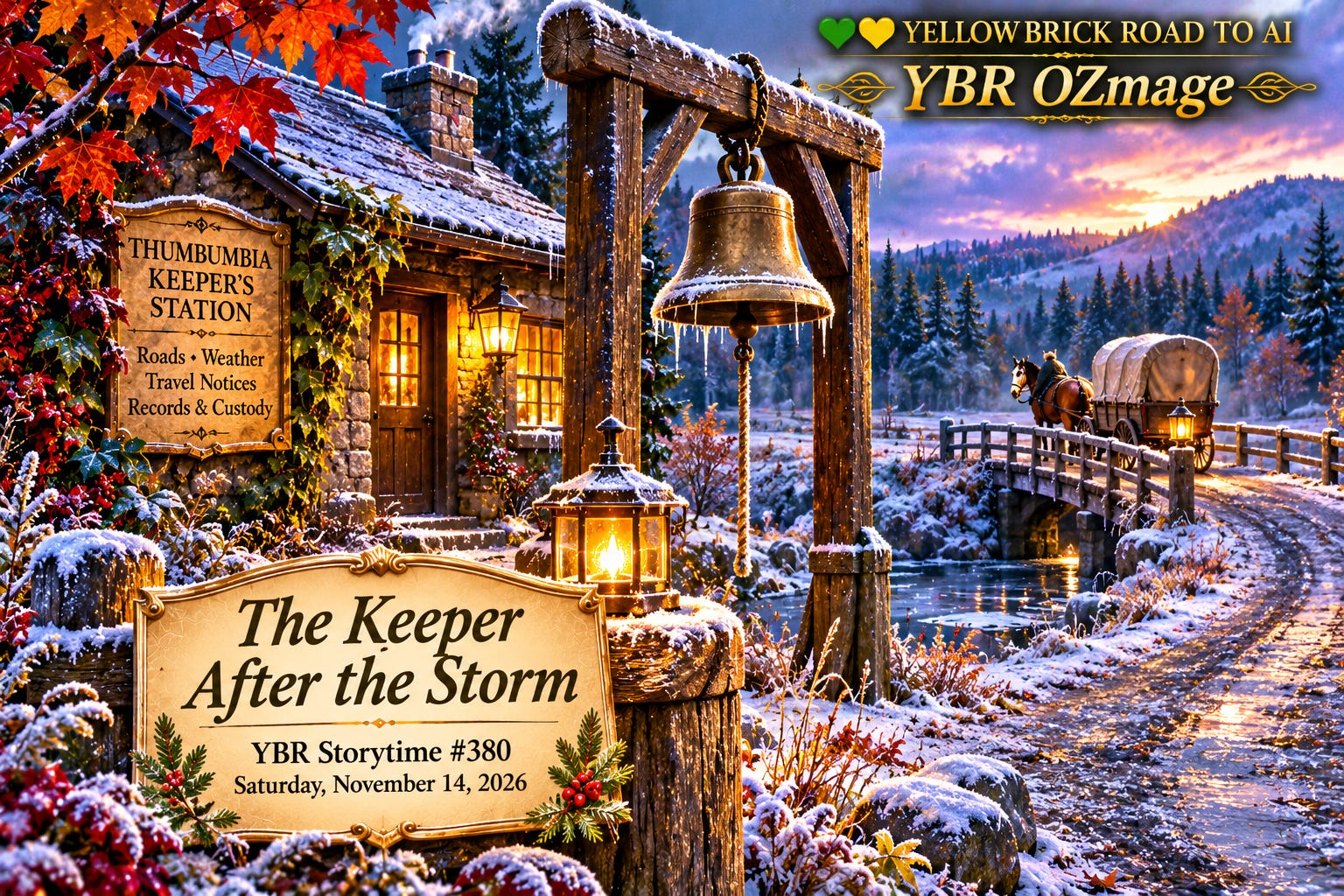
💚🟨 THE KEEPER AFTER THE STORM 🌲🔔🗝️
OZ~QZ November Storytime | Saturday, November 14, 2026
An Adventure Along the Borders of Burzee
The great storm that interrupted Marian Vell’s historical review has finally been explained. But the unfinished responsibility concerning the woodland agreement survived that disaster. Now the Scarecrow and his companions follow its trail beyond the municipal archives, where a forgotten bell, a winter road, and the descendants of an old keeper reveal how responsibility can pass from one generation to another without granting anyone the authority to speak for those beyond the forest.
I. A BELL IN THE MORNING
Saturday began with a sound no one aboard the Evergreen expected.
A bell rang from the northern quarter of Thumbumbia.
Three measured strokes.
A pause.
Then three more.
Commander Brine looked up from his breakfast.
“Barnacle?”
The boatswain appeared at the doorway.
“Aye, Commander?”
“Is that the harbor bell?”
“No, sir.”
“The council bell?”
“No, sir.”
“Then what is it?”
“An old road bell near the northern storehouses, sir.”
Brine frowned.
“Why is it ringing?”
“Apparently the villagers are testing it.”
“Why?”
“Winter preparations.”
Brine considered.
“An excellent reason.”
Then Hatta entered, wearing his enormous green hat and carrying a silver handbell.
“GENTLEMEN! I HAVE ANSWERED THE CALL!”
Brine closed his eyes.
“What call?”
“THE BELLS!”
Peg looked at the handbell.
“Why have you brought that?”
“TO PARTICIPATE!”
Before anyone could intervene, Hatta rang it vigorously.
The noise filled the chartroom.
White Rabbit covered his ears.
“HATTA! IT ISN’T NECESSARY TO ANSWER EVERY BELL!”
“THEN HOW SHALL THE BELLS KNOW WE’VE HEARD THEM?!”
From the windowsill, the Glass Cat replied:
“An excellent question. Perhaps they’ll send you a letter.”
The Scarecrow burst into laughter.
But beyond the ship, the northern bell continued sounding.
And before the day was over, the travelers would learn that it had once served a purpose reaching far beyond ordinary municipal business.
II. THE QUESTION AFTER THE STORM
The town archivist met the company beside the old northern storehouse.
Master Tolland was with her.
So was the keeper’s sister, who had been examining records associated with Marian Vell’s emergency transfer.
“We’ve found something worth investigating,” the archivist explained.
Commander Brine nodded.
“Another register?”
“Not exactly.”
Hatta brightened.
“AN ACTUAL ADVENTURE?!”
“Perhaps.”
The archivist unfolded a carefully copied diagram.
It showed the old municipal offices, the northern road, and a small building near the orchard district.
Beside that building appeared an inscription.
KEEPER’S STATION.
The Scarecrow leaned closer.
“What did the station keep?”
“Several things,” replied Master Tolland. “Road notices, emergency communications, and certain records transferred after the great storm.”
“And its connection to Marian Vell?”
The archivist pointed toward a notation.
“Following the emergency, the surviving records indicate that some continuing duties were assigned to the station for temporary safekeeping.”
White Rabbit raised his ears.
“Does that include our woodland preparation?”
“We haven’t established that.”
“But it might?”
“Possibly.”
Hatta studied the map.
“AND THE BELL?”
The archivist smiled.
“The station maintained a warning bell.”
“FOR WHAT?”
“Road closures, storms, and other conditions affecting travelers.”
Hatta looked delighted.
“THEN TODAY WE SHALL INVESTIGATE A BELL!”
The Glass Cat regarded him.
“At last, an object sufficiently loud to compete with you.”
III. THE ROAD THROUGH THE ORCHARDS
The company departed before noon.
They followed a public road north of Thumbumbia, well within the town’s established jurisdiction.
The orchards were nearly bare.
A few stubborn leaves clung to the branches.
Frost glittered in the shaded grass.
Beyond the eastern hills, Burzee’s ancient canopy formed a dark green horizon.
No one approached the third boundary stone.
No messenger traveled toward the forest.
And no woodland contact was attempted.
The Scarecrow walked beside White Rabbit.
“Do you think the keeper’s station is still used?”
“Perhaps for ordinary road matters.”
“Will we find someone there?”
“We may.”
Hatta walked ahead, carrying his handbell.
Every few minutes he rang it.
Eventually Commander Brine stopped.
“Mr. Hatta.”
“YES, COMMANDER?”
“Would you kindly refrain from sounding that instrument?”
“BUT IT’S A BELL!”
“Indeed.”
“AND WE ARE INVESTIGATING BELLS!”
“That is not a reason to announce our location to every sheep in the countryside.”
The Glass Cat looked toward a nearby pasture.
“Too late. They’re organizing a delegation.”
Seren, walking beside Hatta, gently took the handbell.
“Darling, perhaps I’ll carry this for a while.”
Hatta smiled.
“Anything for you, baby.”
The entire company sighed with relief.
And the road became peaceful again.
IV. THE KEEPER’S HOUSE
The station stood upon a low hill overlooking the northern road.
It was a modest building of stone and timber.
A narrow porch faced the orchards.
Beside it stood a wooden frame supporting a small bronze bell.
The building had been maintained.
Its roof was sound.
Smoke rose from its chimney.
And a man in a heavy wool coat was repairing a wooden sign near the doorway.
He looked up as the company approached.
“Good afternoon.”
The Scarecrow smiled.
“Good afternoon.”
“We don’t receive many visitors.”
“We’re investigating the station’s history.”
The man looked toward the archivist.
“Then you must be the people from Thumbumbia.”
“Yes.”
He introduced himself.
“Edwin Vell.”
The archivist paused.
“Vell?”
“That’s right.”
Master Tolland stepped forward.
“Are you related to Marian Vell?”
Edwin considered.
“She was an ancestor of mine, according to the family records.”
White Rabbit looked delighted.
“Then perhaps you know about the great storm!”
“Some of the family stories.”
“And the records that were transferred afterward?”
“A little.”
The Scarecrow smiled.
“Would you mind telling us?”
Edwin gestured toward the house.
“Come inside. It’s warmer.”
And for the first time, the investigation had led the travelers not to another abandoned office, but to a living family.
V. THE WINTER MAP
Edwin’s home was simple and welcoming.
A fire burned in the hearth.
A kettle steamed beside it.
Upon one wall hung an old map of the northern roads.
The Scarecrow studied it.
“Is that an original?”
“A family copy,” replied Edwin. “The earlier map was kept for many years at the station.”
The map showed farms, bridges, drainage channels, and the old road toward the northern orchards.
Small symbols marked places where travelers could find shelter during difficult weather.
White Rabbit pointed toward one.
“What’s this?”
“A winter refuge.”
“Who used it?”
“Anyone caught on the road when a storm made travel unsafe.”
Hatta looked impressed.
“THEN THIS STATION WAS A PLACE OF RESCUE!”
“Sometimes,” Edwin replied.
The Scarecrow noticed a faded red line across the eastern portion of the map.
“Does that mark the woodland boundary?”
Edwin shook his head.
“No. That’s an old road-maintenance limit.”
The Scarecrow nodded.
“An important distinction.”
Edwin smiled.
“My family always took such distinctions seriously.”
“Why?”
“Because a keeper needs to know what he’s responsible for.”
The Scarecrow looked toward the hearth.
“And what he isn’t authorized to do.”
“Exactly.”
Edwin approached a small cabinet.
“I have something you may find interesting.”
From it he removed a folded sheet.
It was not an official woodland agreement.
Nor an authorization to enter Burzee.
It was an old instruction copied into the family’s station records.
IN TIMES OF DISRUPTION, THE KEEPER SHALL PRESERVE ENTRUSTED MATERIALS UNTIL THEIR PROPER CUSTODY CAN BE RE-ESTABLISHED.
Master Tolland read the sentence carefully.
“That resembles the emergency procedures used after the storm.”
Edwin nodded.
“My family understood it as a reminder not to abandon responsibilities simply because circumstances became difficult.”
The Scarecrow smiled.
“Did Marian Vell leave this instruction?”
“I can’t establish that,” Edwin replied. “The family copy doesn’t identify its original author.”
The archivist nodded approvingly.
“Then we’ll preserve that uncertainty.”
Edwin looked surprised.
“Good. My grandfather would have liked that.”
VI. THE BOX THAT WASN’T A TREASURE CHEST
Edwin led the company into a small adjoining room.
There stood an old wooden chest.
Its hinges were dark with age.
A faded municipal seal had been painted upon the lid.
Hatta stared.
“FINALLY!”
Peg looked concerned.
“What?”
“A TREASURE CHEST!”
Edwin laughed.
“I’m afraid it contains rather ordinary things.”
Hatta opened his arms.
“MY DEAR SIR, WE HAVE LEARNED THAT NOTHING IN THUMBUMBIA IS EVER ORDINARY!”
The chest was opened with Edwin’s permission.
Inside were several family records.
A maintenance ledger.
A list of winter supplies.
A notebook concerning storm repairs.
And a small bundle of copied administrative instructions.
The archivist examined the bundle.
Most concerned ordinary station duties.
But one page contained a familiar designation.
CONTINUING DUTY: EASTERN ARRANGEMENT.
The Scarecrow leaned forward.
“That may be relevant.”
Edwin nodded.
“I thought so too.”
The entry described temporary custody of a document whose receiving arrangements remained unresolved.
It included no named woodland recipient.
No dispatch authorization.
And no evidence that the other party had acknowledged the preparation.
But near the bottom appeared a note.
TRANSFER COMPLETED TO RECOGNIZED MUNICIPAL CUSTODY FOLLOWING EMERGENCY.
Commander Brine looked up.
“Then the station may have held the material temporarily.”
“That is consistent with the record,” replied the archivist.
“Does it identify the document itself?”
“Not conclusively.”
“Then we must compare its reference with the original records.”
“Exactly.”
The Scarecrow smiled.
“We’ve found another part of the custody history.”
Hatta looked at the chest.
“AND NOT A SINGLE GOLD COIN!”
The Glass Cat purred.
“An accurate reflection of municipal finance.”
VII. THE KEEPER’S RESPONSIBILITY
As the company examined the records, a knock sounded at the door.
A young farmhand stood outside.
“Mr. Vell, the northern crossing is becoming icy.”
Edwin rose immediately.
“Has anyone been delayed?”
“Two wagons.”
“Are the drivers safe?”
“Yes, but the road may become dangerous before dark.”
Edwin took his coat.
“Then we should inspect the crossing.”
The Scarecrow looked toward Commander Brine.
“Perhaps we can accompany him.”
The Commander nodded.
And for the first time that day, the travelers followed a responsibility being carried out in the present rather than studying one preserved from the past.
The crossing stood along a narrow public road.
Ice had begun forming where water collected beneath a small bridge.
Two wagon drivers waited nearby.
Edwin examined the surface.
“The road officer should be notified.”
A messenger was dispatched toward Thumbumbia.
Temporary warning markers were placed along the town-controlled approach.
The drivers were advised to use a safer route until the crossing could be assessed.
No one attempted repairs without the appropriate authority.
No one ignored the danger.
And no one claimed responsibility for a road beyond the station’s recognized jurisdiction.
White Rabbit watched closely.
“Scarecrow?”
“Yes?”
“He’s doing exactly what the old instructions described.”
“How so?”
“Protecting people while respecting the limits of his responsibility.”
The Scarecrow smiled.
“An excellent observation.”
Edwin returned.
“The road officer will examine the crossing.”
Hatta nodded solemnly.
“THEN THE KEEPER HAS KEPT!”
Peg looked at him.
“Kept what?”
“EVERYTHING HE WAS SUPPOSED TO KEEP!”
The Glass Cat considered.
“An unusually concise report.”
VIII. THE FOUR CAPTAINS AND THE NEXT CUSTODIAN
That evening, the company returned to the harbor.
The four captains assembled aboard the Evergreen.
Captain Sawyer Salt presided.
Captain Jasper Quill examined the station records.
Captain Gideon Vale reviewed the emergency transfer chronology.
Captain Ronan Flint studied the municipal custody references.
Commander Brine summarized the findings.
“We have identified a keeper’s station that historically held certain materials during the period following the great storm.”
Sawyer nodded.
“And the family?”
“Edwin Vell possesses copies of old station instructions.”
“Are they official documents?”
“Some appear derived from municipal procedures, but their provenance requires verification.”
Jasper considered.
“And the eastern-arrangement reference?”
“It suggests temporary custody of a document whose receiving authority remained unestablished.”
“Does it prove that the station held the woodland agreement?”
“Not yet.”
Gideon looked toward the Scarecrow.
“Then what have we gained?”
“A plausible link in the chain of custody, and a living source who may help us identify surviving local records.”
Ronan nodded.
“And the family’s present responsibilities?”
“They concern ordinary roads and safety matters within established authority.”
Sawyer turned toward Peg.
“Record our conclusions.”
Peg wrote:
KEEPER’S STATION: LOCATED WITHIN TOWN JURISDICTION.
EDWIN VELL: FAMILY CONNECTION TO MARIAN VELL REPORTED.
FAMILY RECORDS: EXAMINED WITH PERMISSION.
TEMPORARY CUSTODY OF EASTERN ARRANGEMENT: POSSIBLE.
DIRECT CONNECTION TO WOODLAND SECOND PREPARATION: UNVERIFIED.
LATER MUNICIPAL TRANSFER: REFERENCED IN STATION COPY.
NO WOODLAND ACKNOWLEDGMENT ESTABLISHED.
NO NEW CONTACT AUTHORIZED.
NO RIGHT OF ENTRY ESTABLISHED.
THIRD BOUNDARY STONE: UNTOUCHED.
The captains approved the entry.
Then Sawyer asked:
“What comes next?”
The Scarecrow considered.
“Perhaps the most useful next step is not another search for a mysterious signature.”
“Then what?”
“To determine whether the later municipal transfer can be verified against the town’s own records.”
Commander Brine nodded.
“And perhaps understand how the keeper’s station came to preserve these materials.”
“Exactly.”
The meeting adjourned.
IX. THE BELL THAT WARNED THE ROAD
Night had fallen when the Scarecrow returned briefly to the northern road.
Edwin Vell stood beneath the station bell.
The air had become colder.
The first stars were appearing.
“Good evening,” said the Scarecrow.
“Good evening.”
“Is the crossing safe?”
“The road officer has placed a temporary restriction. Travelers have been notified.”
“Then the warning was useful.”
Edwin nodded.
“My grandfather used to say that a keeper doesn’t need to own the road to help people travel it safely.”
The Scarecrow smiled.
“That’s a wise thought.”
Edwin looked toward the bell.
“Do you know why we keep that bell?”
“To warn travelers.”
“Yes. But also because it reminds us that a responsibility must be understood by the next person who accepts it.”
The Scarecrow considered.
“Even if the original keeper is long gone.”
“Especially then.”
Edwin reached for the bell rope.
He rang it once.
The clear note traveled across the orchards.
It was not a message to Burzee.
It was not an invitation.
It was not a claim of authority over the forest.
It was simply a local signal announcing the road’s condition to people who depended upon it.
And that distinction mattered.
The Scarecrow looked eastward.
Beyond the trees, the ancient Forest of Burzee remained silent.
But the world around it was alive with people fulfilling ordinary responsibilities.
Keeping roads safe.
Providing shelter.
Preserving records.
Helping neighbors.
Preparing for winter.
And learning to care for one another.
Perhaps the expedition had spent too much time searching for a single extraordinary answer.
Sometimes the road toward a great discovery began with understanding the ordinary people whose lives surrounded it.
X. THE NEXT KEEPER
Near midnight, the town archivist examined the copied station record.
The later municipal transfer reference contained a date.
And beside it appeared a receiving-office designation.
NORTH DISTRICT CUSTODIAL DESK.
The archivist checked Thumbumbia’s administrative chronology.
The designation had been used for a limited period following the great storm.
Its records were believed to have been absorbed into the later municipal collections.
She prepared a message for Commander Brine.
The keeper’s station record identifies a subsequent transfer to the North District Custodial Desk.
The relationship between that transfer and the woodland second preparation remains to be verified.
The district’s surviving registers may establish whether the same custodial reference continued.
No authority concerning the woodland boundary or receiving party can be inferred from the transfer.
She sealed the note.
Outside, four ships rested beneath the November stars.
The third boundary stone remained untouched.
The concealed berth remained empty.
The unidentified object remained secured.
The blue-threaded packet remained unopened.
The third return remained partly unresolved in its wider context.
And the expected guest remained unnamed.
But the travelers had found something worth remembering.
A keeper did not need to possess every answer to fulfill a responsibility.
Sometimes the most important task was ensuring that the next keeper understood what had been entrusted to them.
And sometimes a simple bell, ringing across a winter road, carried more immediate value than a hundred impressive declarations.
TO BE CONTINUED...
Sunday, November 15: THE NORTH DISTRICT LEDGER
The keeper’s station has revealed a possible link in the chain of custody following the great storm.
Now a reference points toward the North District Custodial Desk.
Did the woodland second preparation pass through that office?
Was its continuing responsibility formally recorded?
And did the next keeper receive any new instructions concerning the proper receiving authority?
The four ships remain at Thumbumbia.
No invitation has arrived from Burzee.
And the third boundary stone remains untouched.
THE NEXT DISCOVERY MAY REVEAL NOT WHO FINISHED THE PROMISE, BUT WHO WAS TRUSTED TO KEEP IT ALIVE.
💚 FROM THE YELLOW BRICK ROAD
THE KEEPERS WHO MAKE THE WORLD WORK
Some of the most important people in our lives are those whose work we rarely notice.
The people who maintain roads.
Keep records.
Repair bridges.
Care for public spaces.
Prepare supplies.
Protect communities.
And ensure that ordinary systems continue functioning.
We often recognize their importance only when something goes wrong.
A road becomes dangerous.
A signal fails.
A record disappears.
A supply chain breaks.
Or a responsibility passes from one person to another without the information needed to continue it.
Today’s OZ~QZ adventure explores the people who keep things working.
Not because they possess extraordinary authority.
But because they accept ordinary responsibilities with care.
THE KEEPER AFTER THE STORM
Our Scarecrow and companions have been investigating a historical storm that disrupted Thumbumbia’s municipal offices.
A custodian named Marian Vell helped preserve unfinished-duty records during the emergency.
Today, the travelers discover that some materials may have passed through a keeper’s station before returning to recognized municipal custody.
But their most important discovery concerns the keeper’s responsibilities.
The station existed to help travelers, preserve certain records, and maintain local safety arrangements.
It did not possess unlimited authority.
It could not speak for the woodland.
And it could not transform an unresolved agreement into a completed one.
That distinction reminds us of something important.
Responsibility and authority are related, but they are not identical.
THE PEOPLE WHO DO THE WORK
There is a tendency to celebrate grand achievements.
Major discoveries.
Great inventions.
Important speeches.
And dramatic acts of leadership.
But communities also depend upon countless smaller acts of care.
A warning sign placed before a dangerous crossing.
A record preserved during an emergency.
A repair completed before winter.
A family helped when circumstances become difficult.
These activities may never become famous.
Yet they matter enormously to the people who depend upon them.
And they demonstrate that meaningful contribution does not always require extraordinary resources.
Sometimes it requires attention, reliability, and the willingness to do necessary work.
ARTIFICIAL INTELLIGENCE AND THE RESPONSIBILITY TO MAINTAIN
Artificial intelligence is often discussed in terms of breakthrough capabilities.
Faster systems.
More sophisticated reasoning.
Greater automation.
New creative possibilities.
But there is another side to successful technology.
Maintenance.
Verification.
Monitoring.
Documentation.
And the careful transfer of responsibility when systems change.
An AI-assisted workflow may work beautifully when first introduced.
But what happens when the original creator leaves?
When software changes?
When information becomes outdated?
When an automated process encounters something it was not designed to handle?
Or when a user needs an explanation of why a particular action was taken?
Responsible systems require continuity.
They require clear records of what has been done.
They require acknowledgment of unresolved problems.
And they require people who understand the limits of the authority delegated to a tool.
The measure of a useful technology is not merely what it can accomplish once, but whether people can responsibly rely upon it over time.
PREPARING FOR THOSE WHO COME AFTER
As Christmas approaches, our OZ~QZ travelers are discovering that generosity takes many forms.
A warm scarf.
A safe road.
A protected archive.
A welcoming shelter.
Or a simple warning that helps someone avoid danger.
Not every gift comes wrapped.
And not every act of care receives applause.
But each can make another person’s journey easier.
That is particularly important as we consider the relationship between generations.
We inherit systems built by people who came before us.
We rely upon their knowledge.
Their discoveries.
Their repairs.
And their decisions to preserve things that might otherwise have been lost.
Our responsibility is to care for that inheritance and, where possible, improve it.
WHAT BINDS HUMANITY TOGETHER
The Yellow Brick Road to AI is guided by an enduring aspiration:
To explore what binds humanity together rather than concentrating only upon what divides us.
One of those bonds is mutual dependence.
We rely upon people we may never meet.
Farmers.
Builders.
Teachers.
Caregivers.
Engineers.
Researchers.
Public servants.
And countless others whose work helps sustain our lives.
Artificial intelligence may expand what individuals and organizations can accomplish.
But it should also help us better appreciate the human networks that make those accomplishments meaningful.
Technology should support people.
Not erase the importance of their contribution.
Our Scarecrow and companions have not yet entered Burzee.
They have not completed the ancient agreement.
And they have not solved every mystery preserved in Thumbumbia.
But they have discovered something worth carrying forward.
The world is sustained not only by those who make great promises, but by those who faithfully care for what has already been entrusted to them.
The Yellow Brick Road continues.
One question.
One discovery.
One responsibility honored at a time.
💚 A QUESTION FOR OUR FELLOW TRAVELERS
Who are the quiet keepers in your life or community?
Perhaps someone who maintains a place you depend upon.
A family member who preserves important traditions.
A neighbor who always helps when something goes wrong.
Or a person whose reliability has made your life easier without attracting much attention.
Have you ever had the opportunity to thank them?
And as artificial intelligence becomes increasingly involved in everyday systems, how can we ensure that technology strengthens rather than overlooks the people responsible for keeping those systems trustworthy?
Because sometimes the most important contributions are the ones we notice only when they are missing.
YELLOW BRICK ROAD TO AI
Where Humanity, Imagination, and Artificial Intelligence Meet.
What is, and what may be. ♾️
💚🟨🔔🌲⛵⛵⛵⛵♾️
#YellowBrickRoadToAI #YBR #OZQZ #NovemberStorytime #TheEvergreen #Thumbumbia #Burzee #Nonestica #FantasyAdventure #Stewardship #Community #HumanDignity #ArtificialIntelligence #CollaborativeIntelligence #ResponsibleAI #SharedHumanity #Christmas2026 #Storytelling
💚 © 2026 🟨 YellowBrickRoadtoAI.com 🤖
Exploring the road between humanity and artificial intelligence.
Q~ & AIAI & Scarecrow of OZ~QZ 🌈♾️👈 🏮