THE KEEPER OF THE BOUNDARY
October Storytime: The Authority No One Remembered
Yellow Brick Road to AI | OZ~QZ Storytime #330 | Wednesday, October 21, 2026
The road keeper may repair the road. The boundary keeper must give consent. Two ancient responsibilities, one forgotten distinction, and a mysterious appointment whose holder has vanished from Thumbumbia’s records. Today, the expedition discovers that finding a road is not the same as having permission to travel it.
I. THE MESSAGE THAT CHANGED THE QUESTION
Commander Brine was finishing his breakfast when the messenger arrived.
It was barely seven o’clock.
The Evergreen rested peacefully at anchor off Thumbumbia, her green hull reflected in the harbor’s still waters.
Beyond her, three other vessels rode beneath the pale morning sky.
The Hare.
The Lionheart.
The Swallow.
Four ships.
Four watches.
And not one sail raised for departure.
Boatswain Barnacle entered the chartroom carrying a sealed letter.
“From the keeper’s sister, Commander.”
“Another discovery?”
“So she says.”
Brine opened the letter.
He read the first sentence.
Then stopped eating.
Across the table, the Scarecrow noticed.
“Commander?”
Brine looked up.
“We have misunderstood an important detail.”
“What detail?”
“The keeper.”
“Which keeper?”
“Precisely.”
The White Rabbit, who had been examining a chart of the old road, lowered his pocket watch.
Hatta looked over the rim of his teacup.
Peg reached immediately for his ledger.
Commander Brine read the message aloud.
THE ROAD KEEPER MAY REPAIR THE ROAD.
THE BOUNDARY KEEPER MUST GIVE CONSENT.
There was a silence.
Then Hatta spoke.
“An extraordinary administrative arrangement.”
Peg looked at him.
“Why extraordinary?”
“Because apparently one gentleman is responsible for keeping the road, while another gentleman is responsible for preventing anyone from using it.”
“That is not what the instruction says.”
“Then why does it require permission?”
“Because,” replied Peg, “maintenance and authority are different responsibilities.”
Hatta considered.
“Peg, you’ve just made bureaucracy sound almost reasonable.”
Commander Brine unfolded the remainder of the letter.
The keeper’s sister had discovered two separate offices in Thumbumbia’s oldest surviving road register.
One belonged to the town.
The other appeared to concern the boundary between the cultivated lands and the woodland beyond.
But the second office had no surviving name.
No family identification.
No date of appointment.
Only a title.
KEEPER OF THE BOUNDARY.
The Scarecrow looked toward the shore.
“And we’ve been assuming the bell keeper was the person named in the warning.”
“Yes,” said Brine.
“But now?”
“Now that assumption is doubtful.”
The Rabbit’s ears rose.
“Then perhaps the person we’ve been waiting for has never been the person we’ve been speaking to.”
Brine considered.
“Perhaps, Rabbit.”
“And the boundary stone?”
“Remains undisturbed.”
“And the object in the cup?”
“Remains secured.”
“And Burzee?”
“Remains beyond the road.”
Hatta sighed.
“Four ships, an entire expedition, and a forest we have been admiring from a distance for days.”
The Scarecrow smiled.
“At least the scenery is changing.”
“Is it?”
“We are learning how to look at it.”
II. THE OFFICE WITHOUT A NAME
By nine o’clock, the company had returned to Thumbumbia’s bell tower.
The old keeper received them in the square.
His sister stood beside him with the register.
Mistress Elowen had also come.
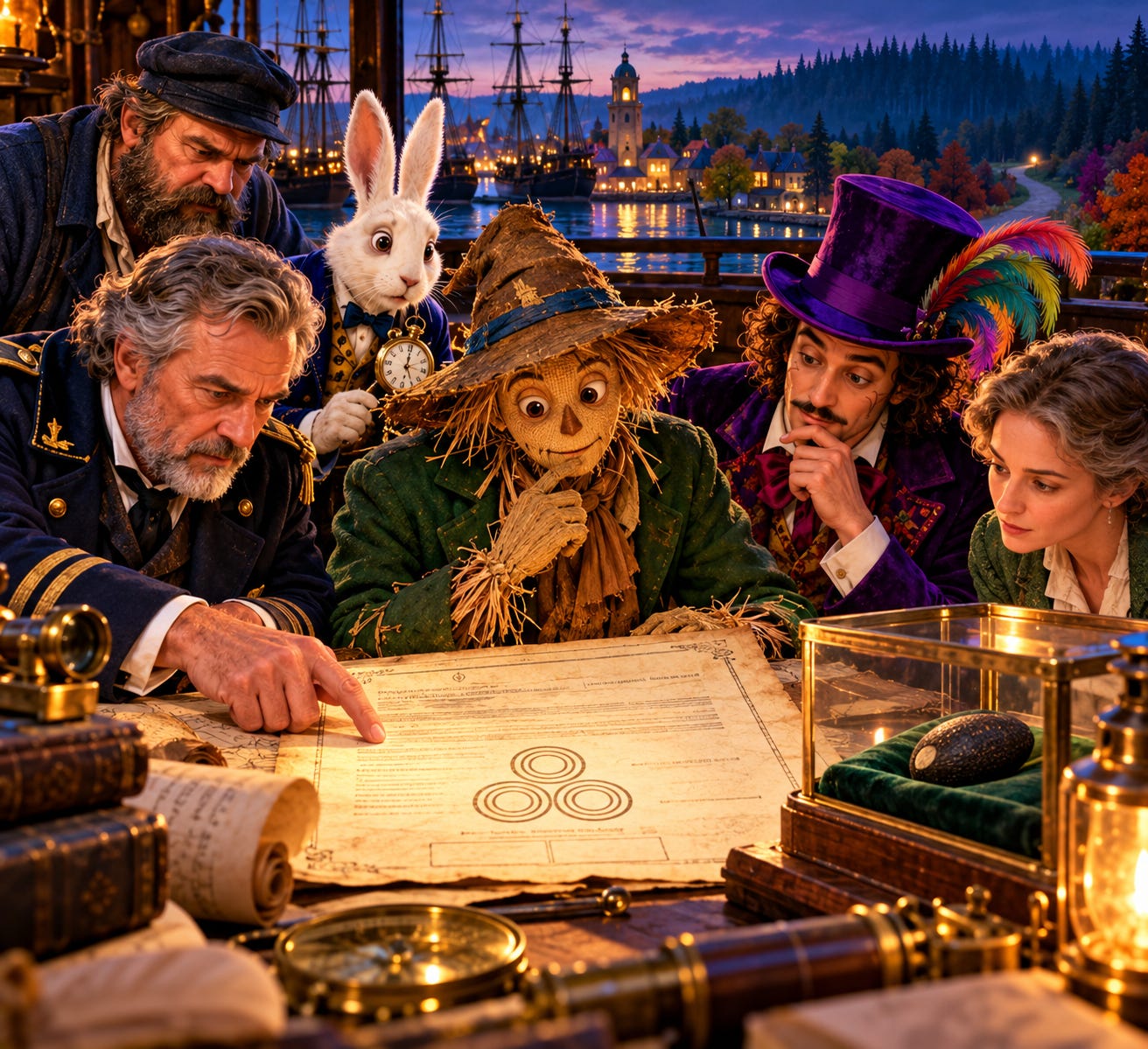
Commander Brine, the Scarecrow, Peg, Hatta, the White Rabbit, and Barnacle gathered around a long wooden table beneath the tower’s eastern window.
The keeper’s sister opened the book.
“Here is the original entry.”
She pointed to three columns.
THE ROAD.
THE FIELDS.
THE WOODLAND.
“The first column names a road officer. The second names an officer responsible for the cultivated boundary.”
“And the third?” asked Brine.
“Only this.”
Beneath the heading for the woodland appeared the word:
KEEPER.
Peg examined the handwriting.
“Different from the other names.”
“Yes.”
“Was it entered at the same time?”
“We cannot establish that.”
“Could it be a later addition?”
“Possibly.”
The White Rabbit looked troubled.
“How can an office exist without anyone knowing who holds it?”
The keeper answered.
“Quite easily, Rabbit. Especially if the responsibility survives longer than the records identifying its holders.”
Hatta nodded.
“I’ve known several offices whose holders seemed entirely unnecessary.”
Peg began to object.
Then stopped.
He apparently knew several himself.
The Scarecrow leaned closer.
“Is there anything establishing what the boundary keeper actually did?”
“Something,” said the sister.
She turned another page.
The writing was difficult to read.
But one passage survived.
THE KEEPER SHALL NOT ALTER THE BOUNDARY FOR THE CONVENIENCE OF EITHER SIDE.
Commander Brine repeated the words.
“Either side.”
“Yes,” she said.
The Scarecrow looked up.
“That suggests the keeper wasn’t merely an officer of Thumbumbia.”
“Why?” asked the Rabbit.
“Because the instruction says the boundary must not be altered for the convenience of either side.”
Peg considered.
“That is a reasonable interpretation. But it doesn’t establish whom the keeper served.”
“Agreed,” said Brine.
Mistress Elowen stood by the window.
Beyond it, the eastern road traveled through the orchards toward the forest.
“A boundary between two lands need not belong entirely to either one,” she observed.
The Scarecrow turned.
“Then who guards it?”
Elowen considered.
“Perhaps someone trusted by both.”
And for the first time that morning, the title keeper began to sound less like an official position...
and more like a responsibility entrusted.
III. THE MISSING HALF OF THE AGREEMENT
The keeper’s sister turned to a sheet folded into the back cover.
“I found this tucked beneath the binding.”
Peg leaned forward eagerly.
“A new document?”
“An old one.”
“Was it inventoried?”
“No.”
Peg closed his eyes.
Hatta patted his shoulder.
“Courage, my friend. History frequently neglects proper filing.”
The sheet was a partial copy of an agreement.
Its upper portion had been damaged.
Several lines were missing.
But the surviving text contained a revealing distinction.
THE TOWN SHALL KEEP THE ROAD SERVICEABLE.
THE FIELDS SHALL REMAIN UNDER THE CARE OF THOSE WHO CULTIVATE THEM.
THE WOODLAND SHALL NOT BE CLAIMED BY REPAIR, PASSAGE, OR IMPROVEMENT.
The Scarecrow read the last sentence twice.
“Not claimed by improvement.”
Elowen nodded.
“That’s rather important.”
“Why?”
“Because people often mistake improving something for acquiring authority over it.”
The Commander looked toward her.
“Explain.”
“Suppose I repair a path through another person’s garden.”
“Yes?”
“Have I become the owner of the garden?”
“Certainly not.”
“Suppose I clear fallen branches from the path?”
“Still no.”
“Suppose I plant flowers along it?”
“No.”
“Then the work may be useful without changing the rights or responsibilities involved.”
Brine nodded.
“A useful distinction.”
The Scarecrow examined the faded agreement.
“Then perhaps Thumbumbia was responsible for maintaining access to the boundary, but not for deciding what happened beyond it.”
“That is consistent with the surviving language,” said Peg.
Hatta raised his hand.
“May I inquire what happens if the road keeper and the boundary keeper disagree?”
The old keeper answered.
“Perhaps that is why the agreement existed.”
“And if the agreement is forgotten?”
Nobody replied.
Because that, apparently, was precisely what had happened.
IV. THE QUESTION OF CONSENT
By late morning, the party had assembled every relevant record they could find.
There were road-maintenance accounts.
Orchard registers.
Family notebooks.
Descriptions of the three stones.
And scattered references to the office of the boundary keeper.
But no reliable list of its holders.
Commander Brine stood over the documents.
“We have established that the records distinguish road maintenance from consent concerning the boundary.”
Peg nodded.
“We have not established the current holder of that authority.”
Another nod.
“Nor have we established that the authority remains active.”
“Correct.”
The White Rabbit looked toward the forest.
“Then what are we supposed to do?”
Brine replied simply.
“Continue investigating.”
“But suppose nobody remembers who the keeper was?”
“Then we must decide what can responsibly be done without that knowledge.”
Hatta brightened.
“I suggest a picnic.”
Peg groaned.
“How would that help?”
“It would allow us to consider the problem without trespassing.”
The Scarecrow laughed.
“That may be your best proposal this week.”
Hatta looked astonished.
“Only this week?”
But the Scarecrow had grown thoughtful.
“Commander, there’s something that bothers me.”
“Go on.”
“We know the old road exists.”
“Yes.”
“We know the forest begins beyond the last cultivated field.”
“Yes.”
“And we could presumably walk there.”
“Physically, perhaps.”
“Yet we haven’t.”
“Correct.”
“Because we don’t know whether we should.”
Brine nodded.
“That is part of the reason.”
The Scarecrow looked down at the agreement.
“So there are at least three questions.”
“What are they?”
“Can we go?”
“Yes.”
“May we go?”
“Yes.”
“And ought we go?”
The Commander considered.
“Three different questions.”
“And perhaps,” said the Scarecrow, “we have spent too much time answering the first.”
The room fell quiet.
Even Hatta seemed to recognize that something important had been said.
V. ELOWEN’S GARDEN
Before returning to the ship, Mistress Elowen invited the Scarecrow and White Rabbit to accompany her through the orchard.
Hatta joined them.
Naturally.
He had heard that the gardener possessed an exceptional pear tree.
Elowen led them through a gate beside the old mill.
Autumn leaves covered the ground.
Apples rested in wooden baskets beneath the trees.
Farther along, a narrow stream ran toward the eastern fields.
“Look there,” she said.
A young sapling had begun growing beside an old wall.
Its trunk leaned slightly toward the sun.
Its roots had found their way between two stones.
The White Rabbit crouched beside it.
“What kind of tree is it?”
“A young ash.”
“Did you plant it?”
“No.”
“Then who did?”
“Perhaps the wind carried the seed. Perhaps a bird.”
The Rabbit examined its leaves.
“Will you move it?”
“Not yet.”
“Why?”
“Because I want to understand what moving it would accomplish, and what might be damaged.”
Hatta approached.
“Would it be happier somewhere else?”
Elowen smiled.
“That’s a question people are very fond of answering on behalf of trees.”
The Scarecrow looked toward the wall.
“Then perhaps the best thing is to leave it.”
“For now,” she replied.
“But someday you may need to move it.”
“Perhaps.”
“Then how will you decide?”
Elowen considered.
“By learning what it needs, what surrounds it, and what responsibility I have toward both.”
The Scarecrow thought of the small dark object aboard the Evergreen.
Possibly a seed.
Possibly something else.
It had appeared in a cup nobody had expected to find.
And for days the company had wondered what it might become.
But perhaps that question had arrived too early.
The first question was not what they wanted it to become.
It was what they were entitled to do with it.
The Rabbit looked up.
“Scarecrow?”
“Yes?”
“Do you suppose the person who kept the boundary was rather like a gardener?”
The Scarecrow considered.
“Perhaps.”
“Someone who cared for a place without necessarily owning it?”
“That seems possible.”
Hatta inspected the pear tree.
“Then I shall demonstrate responsible stewardship by refraining from harvesting this fruit.”
Elowen nodded approvingly.
“Very wise.”
Hatta paused.
“Unless you have already harvested some.”
She handed him a pear.
“A compromise.”
He took an enthusiastic bite.
“Madam, you have restored my faith in diplomacy.”
VI. THE FOUR SHIPS CONFER
The company returned to the Evergreen shortly after noon.
Sawyer Salt awaited them in the chartroom.
Beside him stood representatives from the other vessels.
Captain Jasper Quill of the Hare.
Captain Gideon Vale of the Lionheart.
And Captain Ronan Flint of the Swallow.
Four vessels.
Four commanders responsible for their ships.
And a growing mystery that had delayed the voyage.
Sawyer listened as Brine explained the discovery.
“So the town maintains the road,” he summarized.
“According to the surviving agreement.”
“But another authority once governed the boundary.”
“Apparently.”
“And nobody can identify its present holder.”
“Correct.”
Jasper Quill folded his arms.
“Then perhaps the office no longer exists.”
“Possible,” said Brine.
Gideon Vale spoke.
“Or perhaps it exists and the records have been lost.”
“Also possible.”
Ronan Flint looked toward the Scarecrow.
“What do you think?”
The Scarecrow considered carefully.
“I think we should distinguish what we know from what we’d prefer to be true.”
Jasper smiled.
“A diplomatic answer.”
“An incomplete one,” said the Scarecrow.
“How so?”
“Because what we’d prefer is obvious. We want to continue our voyage.”
Sawyer nodded.
“Naturally.”
“But the records suggest there was once a reason passage required consent.”
Ronan studied the chart.
“Then what prevents us from sending someone to inquire?”
“Nothing,” replied Brine, “provided we know whom to approach and can do so without crossing the boundary improperly.”
Gideon Vale looked up.
“Then we need information from someone familiar with the older customs.”
Sawyer considered.
“A resident of Thumbumbia?”
“Possibly.”
“An elder?”
“Possibly.”
“A traveler familiar with the road?”
“Possibly.”
The White Rabbit raised his paw.
“What about someone who actually knows the forest?”
The room became quiet.
It was such an obvious suggestion that nobody had considered it.
Or perhaps they had considered it and been reluctant to say so.
Brine turned toward him.
“Rabbit, that may be the most sensible question we’ve asked today.”
The Rabbit beamed.
Hatta looked wounded.
“I should like the record to reflect that I have asked several sensible questions.”
Peg opened his ledger.
“Name one.”
Hatta paused.
“How soon is supper?”
“That is not relevant to the investigation.”
“Then the investigation has grown dangerously narrow.”
VII. THE UNIDENTIFIED OBJECT
Later that afternoon, Barnacle brought the secured specimen tray into the chartroom.
The small dark object lay exactly where it had been placed.
Almost oval.
Hard.
Marked by a faint seam.
And carrying a pale spot near one end.
Peg had entered no new classification.
His latest record stated simply:
UNIDENTIFIED OBJECT. SECURED. ORIGIN UNDETERMINED.
The Scarecrow examined it.
“Commander, may I ask something?”
“Certainly.”
“Suppose it really is a seed.”
“Yes?”
“And suppose it belongs to a plant that grows in Burzee.”
“That would be interesting.”
“Would that give us permission to take it there?”
“Not necessarily.”
“Would it give us permission to plant it?”
“No.”
“And suppose it came from Thumbumbia instead?”
“Then its origin would be different, but our responsibility to examine it carefully would remain.”
The Scarecrow nodded.
“Then perhaps its identity isn’t the only thing we need to establish.”
“What else?”
“How it came into our care.”
Peg looked up.
“Provenance.”
“Yes.”
“Who brought it aboard?”
“Unknown.”
“Who placed it in the cup?”
“Unknown.”
“Was it entrusted to someone?”
“Unknown.”
“Was it abandoned?”
“Unknown.”
Hatta examined the tray.
“Poor Bertrand.”
Peg stared at him.
“We are not calling the object Bertrand!”
“I was referring to the berth.”
“The berth is not Bertrand either!”
“Then I fear this ship suffers from a serious shortage of names.”
The Scarecrow smiled.
But his thoughts remained with the object.
A seed, perhaps.
An artifact, perhaps.
Something ordinary.
Something extraordinary.
Still unidentified.
And now the new records had made its uncertainty more consequential.
If someone had preserved it for a purpose, the company could damage that purpose by acting too soon.
Brine gave the order.
“The specimen remains secured. No planting. No transfer. No further experiment without authorization.”
Peg wrote the instruction immediately.
Hatta looked disappointed.
“Must every exciting scientific discovery begin with prohibition?”
“No,” replied Brine.
“Only the ones you keep proposing to eat.”
VIII. THE QUESTION BENEATH THE TITLE
As evening approached, the old keeper’s sister arrived aboard the Evergreen once more.
She carried no large register.
Only a small folded page.
Commander Brine received her in the chartroom.
“I found something that may help,” she said.
“What is it?”
“A note made by my grandmother.”
She opened the page.
Its handwriting was clear.
Unlike many of the older documents, this was not a damaged fragment.
It appeared to be a complete personal observation.
The woman read:
THE ROAD IS KEPT SO THAT IT MAY BE TRAVELED.
THE BOUNDARY IS KEPT SO THAT PASSAGE MAY BE UNDERSTOOD.
The Scarecrow considered the distinction.
“Those are your grandmother’s words?”
“Yes.”
“An interpretation of the older agreement?”
“That is how I understand them.”
Brine nodded.
“Then we shall record them as her interpretation, not as part of the original agreement.”
“Quite right.”
She continued reading.
SOME HAVE MISTAKEN THE KEEPER FOR A GUARD.
OTHERS HAVE MISTAKEN THE KEEPER FOR AN OWNER.
BOTH MAY HAVE MISUNDERSTOOD THE OFFICE.
The White Rabbit looked puzzled.
“Then what was the keeper?”
The woman turned the page.
And read the final sentence.
THE KEEPER WAS ENTRUSTED TO REMEMBER WHAT NEITHER SIDE MUST FORGET.
Nobody spoke.
The words were not proof.
They were one woman’s interpretation of a forgotten institution.
But they offered a possibility.
Perhaps the boundary keeper had not existed merely to forbid passage.
Perhaps the office had preserved an agreement.
A responsibility.
A relationship.
A memory of why the boundary mattered.
The Scarecrow thought of the old inscription aboard the Evergreen.
THE PLACE IS NOT THE REWARD.
IT IS THE RESPONSIBILITY.
Again, the language seemed related.
But resemblance was not identity.
And he knew better now than to convert an echo into evidence.
Still, he could not ignore the thought.
What if the person expected aboard the Evergreen was not being summoned to claim something?
What if someone was being awaited because a responsibility needed to be carried forward?
He did not say it aloud.
Not yet.
IX. PEG’S UNFINISHED COLUMN
After supper, Peg prepared a new ledger page.
He titled it:
OFFICES AND RESPONSIBILITIES RELATING TO THE EASTERN BOUNDARY.
Beneath the heading, he ruled three columns.
The first:
ROAD KEEPER.
The second:
FIELD AUTHORITY.
The third:
BOUNDARY KEEPER.
The first two could be connected to names found in Thumbumbia’s records.
The third remained blank.
Peg stared at it for several minutes.
Then Hatta appeared.
“Working late?”
“Yes.”
“On what?”
“The boundary keeper.”
“Have you found him?”
“No.”
“Her?”
“No.”
“Several?”
“No evidence.”
“A committee?”
Peg looked up.
“Hatta, I have no idea who held this office.”
Hatta examined the blank column.
“Then perhaps you should write that.”
Peg considered.
Then carefully entered:
HOLDER UNIDENTIFIED.
Hatta nodded approvingly.
“Splendid.”
Peg regarded him suspiciously.
“What?”
“For once, you have recorded precisely what you know.”
“I always record precisely what I know!”
“Yes, but this time you have managed to make an entire discovery out of not knowing something.”
Peg studied the entry.
He was about to protest.
Then stopped.
Because Hatta, quite unintentionally, had identified the value of the day’s work.
Yesterday they had believed they were waiting for a keeper.
Today they knew the title might refer to a different office entirely.
They had not identified its holder.
But they had corrected an assumption.
And that was genuine progress.
Peg closed his ledger.
“Good night, Hatta.”
Hatta looked surprised.
“You’re not going to argue?”
“No.”
“Not even slightly?”
“No.”
Hatta sighed.
“A most unsettling evening.”
X. A LIGHT UPON THE EASTERN ROAD
The Scarecrow and White Rabbit stood on the quarterdeck as darkness settled over Thumbumbia.
The harbor was quiet.
The four ships lay at anchor.
Lanterns appeared aboard the Hare, the Lionheart, and the Swallow.
Aboard the Evergreen, the night watch made its rounds.
Beyond the town, the old eastern road disappeared beneath the trees.
The Rabbit looked toward it.
“Do you suppose someone still keeps that boundary?”
“I don’t know.”
“Do you suppose they know we’re here?”
“I don’t know that either.”
“Do you suppose the stone is waiting for them?”
“Perhaps.”
The Rabbit considered.
“Do you think we’ll ever reach Burzee?”
The Scarecrow smiled.
“I certainly hope so.”
“And our guest?”
“Still unknown.”
“And the third return?”
“Still unresolved.”
The Rabbit sighed.
“We seem to have built an extraordinarily elaborate adventure out of uncertainty.”
“Perhaps that’s what an adventure is.”
“What?”
“Learning enough to discover that the world is larger than we thought.”
The Rabbit leaned against the rail.
“That’s rather nice.”
For several minutes they stood quietly.
Then the Rabbit pointed toward the eastern hills.
“Scarecrow?”
“Yes?”
“Is that a light?”
The Scarecrow followed his gaze.
Far beyond the last houses of Thumbumbia, a tiny point of amber shone near the beginning of the old road.
It was faint.
Barely distinguishable against the darkening fields.
Then it disappeared.
A moment later it appeared again.
The Rabbit became excited.
“A signal!”
“Perhaps.”
“A lantern!”
“Possibly.”
“Someone coming!”
“We don’t know that.”
The Scarecrow watched carefully.
The light appeared a third time.
Then vanished behind the trees.
No one could establish its source.
A farmer might have been walking home.
A traveler might have been carrying a lamp.
Someone might have opened and closed a shutter.
The Scarecrow did not want another mysterious light transformed into a prophecy.
He turned toward the watch officer.
“Please report what we observed to Commander Brine.”
The officer nodded.
“And how shall I describe it?”
“A distant light near the eastern road. Visible intermittently. Source unidentified.”
The Rabbit smiled.
“Professor Parallax would approve.”
“He usually does when we remember to distinguish observation from conclusion.”
But the Scarecrow kept watching the place where the light had disappeared.
Because whatever its explanation, the eastern road no longer felt quite so empty.
XI. THE DOCUMENT WITH TWO SIGNATURES
In Thumbumbia, the keeper’s sister was preparing to close the archive.
She had returned the older volumes to their shelves.
The road register lay open beside her.
As she reached to close it, a loose sheet slipped from beneath the back cover.
It fell to the floor.
She picked it up.
The paper was thick.
Older than the copied road repairs.
Its lower edge had been folded inward.
She opened it carefully.
Across the top appeared a heading:
AGREEMENT CONCERNING THE EASTERN BOUNDARY.
The woman stared.
It appeared to be another copy of the agreement they had been studying.
But this version contained something the others lacked.
At the bottom were two spaces for signatures.
The first belonged to the representatives of Thumbumbia.
A name had been entered.
The ink was faded, but several letters remained.
The second space bore a different heading.
FOR THE WOODLAND.
The woman bent closer.
Beneath the heading appeared three faint circular marks.
Not a signature.
Not a recognizable name.
Three concentric circles.
The same emblem found in the old records.
The same figure embroidered upon the pillow aboard the Evergreen.
The same design that had appeared beside the drawing of a narrow opening.
But the most remarkable detail lay beneath the mark.
Written in small letters, apparently by the clerk who prepared the document, was a sentence.
CONSENT SHALL NOT BE PRESUMED FROM SILENCE.
The woman sat down.
She read it again.
Then looked toward the second signature.
Three circles.
No name.
And an instruction warning the town not to treat silence as permission.
For days the expedition had been asking why no keeper had appeared.
But perhaps the more important question was whether the keeper had ever been summoned correctly.
She examined the rest of the document.
Near the upper right corner, beside an old fold, was a short direction.
Its handwriting was exceptionally small.
She held it toward the lamp.
Then read:
WHEN THE OFFICE CANNOT BE NAMED, CONSULT THE WITNESS AT THE THIRD STONE.
The woman froze.
The witness.
The third stone.
And somewhere in the earlier records:
LET THE ONE WHO REMAINS BEAR WITNESS.
She did not know whether the terms referred to the same person, object, or tradition.
But the document supplied something they had not possessed before.
A procedure.
Not permission.
Not a name.
A procedure for seeking an answer when the office’s holder could no longer be identified.
She reached for a fresh sheet of paper.
And began writing to Commander Brine.
XII. THE KEEPER MAY NOT BE THE WITNESS
Aboard the Evergreen, the chartroom lights burned late.
Commander Brine had received the report of the distant lantern.
He had ordered the observation entered without interpretation.
The four ships remained secure.
The concealed berth remained unoccupied.
The unidentified specimen remained under glass.
And the road to Burzee remained unopened.
The Scarecrow had come to say goodnight.
Brine stood over the chart.
“Scarecrow?”
“Yes?”
“What did you make of the light?”
“A light.”
“Nothing more?”
“Nothing we could establish.”
“Good.”
The Commander looked toward the eastern edge of the map.
“We have spent days searching for names.”
“Yes.”
“A missing traveler.”
“Yes.”
“An expected guest.”
“Yes.”
“A keeper.”
“Yes.”
“And perhaps we’ve been overlooking something.”
“What?”
“Responsibilities.”
The Scarecrow considered.
Brine continued.
“A name tells us who someone is called. A responsibility tells us what that person is expected to do.”
“Sometimes.”
“And knowing one does not guarantee knowing the other.”
The Scarecrow nodded.
“Perhaps we’ve been so eager to discover who belongs in the empty berth that we haven’t asked what might be required of them.”
Brine considered.
“That is possible.”
The ship creaked gently around them.
A breeze stirred the chartroom curtains.
Beyond the windows, the lights of Thumbumbia shimmered across the harbor.
Then the watch officer appeared.
“Commander, another message from shore.”
Brine accepted the envelope.
He broke the seal.
Read the first line.
Then looked toward the Scarecrow.
“What is it?” the Scarecrow asked.
The Commander handed him the message.
It contained only three sentences.
THE OLD AGREEMENT HAS BEEN FOUND.
CONSENT SHALL NOT BE PRESUMED FROM SILENCE.
WHEN THE OFFICE CANNOT BE NAMED, CONSULT THE WITNESS AT THE THIRD STONE.
The Scarecrow read it twice.
Then looked up.
“The witness.”
Brine nodded.
“Not necessarily the keeper.”
“No.”
“And the third stone?”
“Still undisturbed.”
The Scarecrow looked toward shore.
“Then perhaps we have finally found our next question.”
The Commander folded the message.
“Yes.”
“What is it?”
Brine answered:
“WHO OR WHAT WAS LEFT TO BEAR WITNESS?”
Neither spoke for a long moment.
Above them, the ship’s bell sounded.
Two strokes.
An ordinary watch.
An ordinary evening.
And somewhere beyond Thumbumbia’s last cultivated field stood the ancient boundary stone.
Unmoved.
Unopened.
Still bearing its mysterious recess.
The keeper remained unidentified.
The expected guest remained unnamed.
The third return remained unexplained.
But the company now possessed a direction.
Not toward the forest.
Not yet.
Toward the witness.
THE ROAD AHEAD
THURSDAY, OCTOBER 22: THE WITNESS AT THE THIRD STONE
Today, the company discovered a forgotten distinction between the road keeper and the boundary keeper.
An ancient agreement established that responsibility for maintaining a road did not automatically grant authority over the woodland beyond it.
A newly recovered clause warned:
CONSENT SHALL NOT BE PRESUMED FROM SILENCE.
And an overlooked instruction may provide the next step:
WHEN THE OFFICE CANNOT BE NAMED, CONSULT THE WITNESS AT THE THIRD STONE.
Tomorrow, Commander Brine must decide how to investigate that witness without moving the stone or violating the old boundary agreement.
Who or what is the witness?
Does the word describe a person?
An inscription?
A surviving record?
Or something deliberately preserved for generations?
The four ships remain anchored at Thumbumbia.
The Evergreen still holds the unidentified object.
The mysterious berth remains unoccupied.
No identity has been assigned to the expected guest.
No passage into Burzee has been authorized.
But the company has learned one important lesson.
A boundary is not necessarily an invitation to cross. Sometimes it is a reminder that another responsibility begins where our own authority ends.
💚🟨🏮🌳⛵⛵⛵⛵♾️
An original OZ~QZ October Storytime adventure inspired by the fairyland traditions of L. Frank Baum. The present Thumbumbian expedition, the Evergreen’s concealed berth, the boundary-keeper agreement, the third-return mystery, and associated characters and events are original developments of Yellow Brick Road to AI.
#YellowBrickRoadToAI #OZQZ #OZStorytime #Thumbumbia #Evergreen #Nonestica #Burzee #OctoberStorytime #FantasyMystery #Stewardship #TheKeeperOfTheBoundary
💚 © 2026 🟨 YellowBrickRoadtoAI.com 🤖
Exploring the road between humanity and artificial intelligence.
Q~ & Scarecrow of OZ~QZ 🌈♾️👈 🏮