💚🟨 THE LETTER THAT CAME BACK ✉️⛵🌲
OZ~QZ October Storytime | Friday, October 30, 2026
An Adventure Along the Borders of Burzee
📜 An ancient agreement was prepared for delivery to the woodland. Its recipient could not be verified, and the document may have been returned to custody. Now, beneath Thumbumbia’s bell tower, the company discovers that the letter was never truly lost. But finding it may prove considerably easier than determining what they have the right to do with it.
I. THE BOX MARKED RETURNED
At six in the morning, the bell tower keeper discovered that his sister had not gone home.
Her lamp was still burning in the archive.
The town archivist sat opposite her, surrounded by registers, inventories, and a remarkably untidy collection of empty document wrappers.
“Have either of you slept?” he asked.
“Not sufficiently,” his sister replied.
“Have you found what you were looking for?”
“Possibly.”
The keeper regarded the table.
“That word again.”
The archivist smiled.
“It is a useful word when one has not finished investigating.”
She held up a small inventory card.
Across its upper edge appeared an old designation:
RETURNED CORRESPONDENCE: EASTERN ROAD OFFICE.
Beneath it was a storage reference.
LOWER ARCHIVE. CHEST IV.
The keeper looked surprised.
“We have a fourth chest?”
“We have an inventory indicating that one once existed.”
“That is not quite the same thing.”
“No,” replied his sister. “But it is considerably more than we had yesterday.”
A messenger was dispatched to the Evergreen.
And before breakfast, Commander Brine was informed that the search had acquired an actual destination.
II. THE FOURTH CHEST
The lower archive occupied a stone chamber beneath the eastern end of the bell tower.
It was cooler than the rooms above.
Narrow windows admitted little daylight.
The floor was worn smooth by generations of footsteps.
Commander Brine arrived with the Scarecrow, Peg, White Rabbit, and Boatswain Barnacle.
Hatta followed carrying a lantern.
And breakfast.
The archivist had obtained permission from the town authorities to examine the stored records.
Two appointed custodians were present.
The company was permitted to observe.
“Chest IV,” said Peg.
“Yes,” replied the archivist.
“Do we know where it stands?”
“Not yet.”
Hatta surveyed the chamber.
“Then perhaps we should begin by counting.”
There were seven storage chests.
Three bore legible numbers.
One contained road maintenance accounts.
Another held town correspondence.
The third contained old legal registers.
The remaining four had lost their identifying plates.
Peg was troubled.
“How do we know which is Chest IV?”
The archivist answered plainly.
“We don’t.”
Hatta folded his arms.
“An impressive numbering system.”
“Which is why,” the archivist continued, “we shall examine the inventory records before opening anything.”
Commander Brine nodded.
“A sound procedure.”
The Scarecrow surveyed the chests.
Somewhere within the chamber might lie a document prepared long ago for someone beyond the eastern woodland boundary.
Or the records might simply lead to another empty box.
There was no way to know.
Not yet.
III. WHAT THE DUST REMEMBERED
The first inventory concerned the arrangement of the lower archive many decades earlier.
Its entries described seven storage positions.
The fourth had originally stood beneath the narrow eastern window.
But a later repair had required the chests to be moved.
The archivist found the corresponding maintenance entry.
CONTENTS TRANSFERRED. CHESTS REPOSITIONED AFTER WATER INTRUSION.
Peg leaned forward.
“Transferred where?”
“The inventory does not specify.”
“Then the original fourth chest may no longer occupy the fourth position.”
“Correct.”
Hatta looked toward the ceiling.
“Do you suppose it might now be the fifth chest?”
“Possibly,” replied the archivist.
“Or the sixth?”
“Possibly.”
“Or perhaps the seventh?”
Peg sighed.
“Hatta, we understand!”
“Excellent. I wished to establish the full range of possibilities.”
The Scarecrow noticed something beside the wall.
A faded painted rectangle.
Its outline appeared to match one of the larger chests.
Below it, scarcely visible beneath years of dust, was a Roman numeral.
IV.
“Commander?”
Brine turned.
“Yes?”
“There.”
They examined the wall.
The mark identified the original position of Chest IV.
But the space was empty.
A narrow passage led toward another storage chamber.
The archivist consulted the repair account again.
Then discovered a supplementary instruction.
CHEST IV CONTENTS REMOVED TO DRY STORAGE.
The Scarecrow smiled.
“So the chest itself may not have moved.”
“Only its contents,” said Peg.
“Then perhaps we’ve been looking for the wrong thing.”
The archivist nodded.
“An important distinction.”
Hatta looked delighted.
“We have searched for a chest and discovered that we should search for what was inside it.”
“Yes,” Peg replied.
“Marvelous! I believe we’re becoming better detectives.”
IV. THE ROOM BEHIND THE STAIRS
Dry storage occupied a small chamber behind the western staircase.
The door had not been opened for many years.
But the keeper possessed its key.
Inside stood shelves of wooden boxes, each marked with old inventory numbers.
The archivist examined them carefully.
At the bottom of the third shelf was a long, narrow case.
Its faded label read:
EASTERN ROAD OFFICE: RETURNED MATERIALS.
Beneath it appeared the number:
IV.
For a moment, nobody spoke.
Then White Rabbit whispered:
“We’ve found it.”
Commander Brine answered cautiously.
“We have found a case corresponding to the inventory.”
Peg nodded.
“Not necessarily the document.”
“Correct.”
The archivist checked the seal.
It was old but intact.
She compared the case with the surviving transfer record.
Its dimensions matched.
The numbering matched.
And its location was consistent with the repair instructions.
At last she gave permission for the case to be opened.
The keeper lifted the lid.
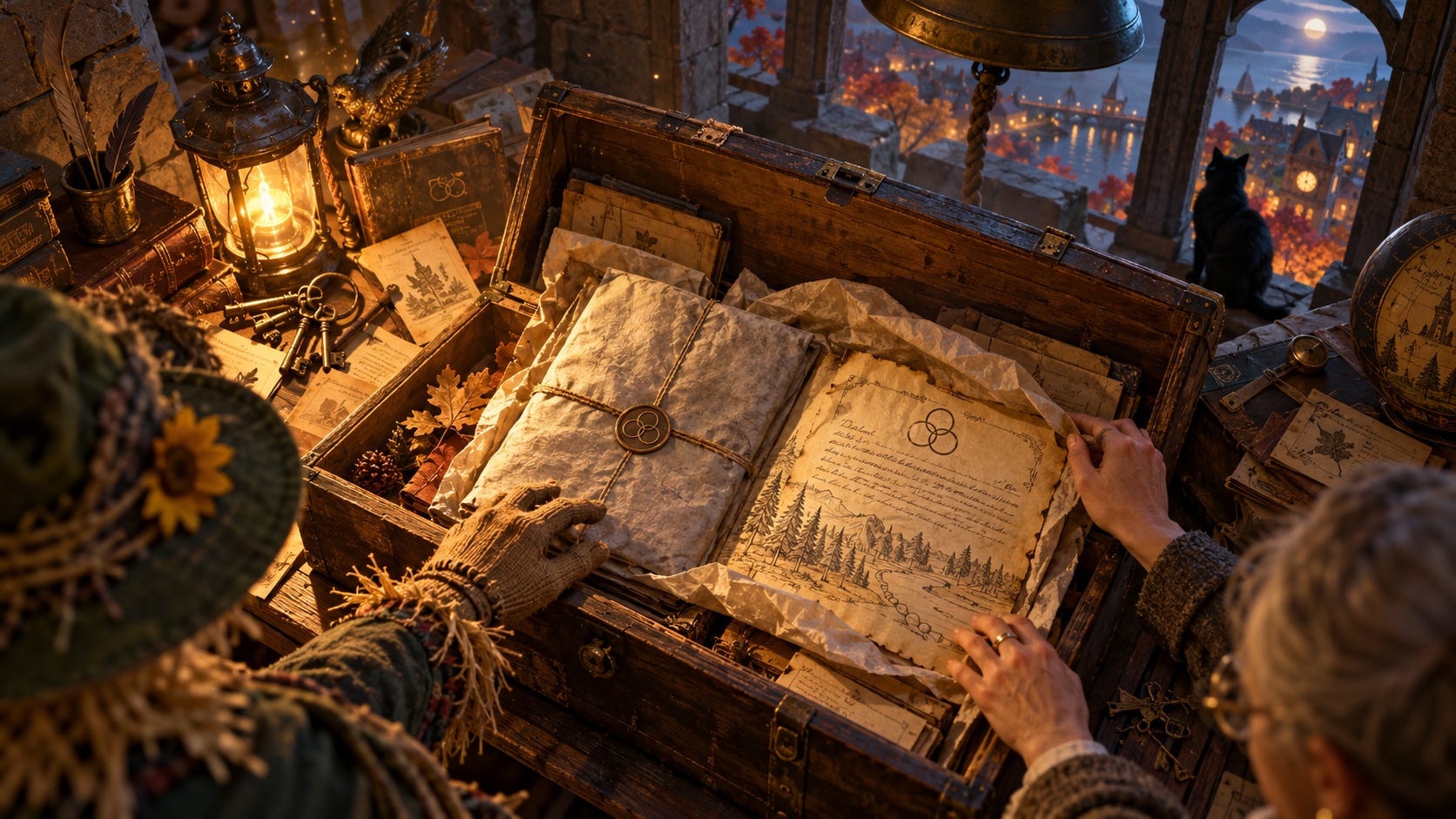
Inside lay six packets.
Five were ordinary enough.
Receipts.
Returned notices.
Unclaimed correspondence.
And one damaged legal memorandum.
The sixth packet was wrapped in gray cloth.
Across its outer fold appeared a faded heading.
WOODLAND EDGE AGREEMENT.
White Rabbit gripped his notebook.
Hatta stopped chewing.
Even Peg forgot to reach for his pencil.
Commander Brine regarded the packet.
Then looked at the Scarecrow.
“Well,” he said quietly, “we may finally have found our letter.”
V. THE DOCUMENT ITSELF
The archivist examined the gray packet before attempting to open it.
Its wrapping bore an old inventory number.
That number corresponded with the surviving dispatch account.
The company had previously identified the same number in the cartage ledger and copy register.
Now it appeared upon an actual packet.
The chain of evidence had become considerably stronger.
The archivist carefully unfolded the outer cloth.
Inside lay a narrow protective sleeve.
And within that sleeve rested a parchment document.
The heading was legible.
AGREEMENT CONCERNING THE EASTERN WOODLAND BOUNDARY.
Beneath it stood several paragraphs.
Some corresponded with the fragments already known.
The town was responsible for maintaining the old road.
The woodland boundary was not to be altered for convenience.
Passage beyond the appointed markers required proper consent.
And silence was not to be treated as permission.
But this document contained additional language.
The archivist read slowly.
NO RIGHT OF ENTRY SHALL ARISE FROM THE PREPARATION OF THIS AGREEMENT ALONE.
The Scarecrow looked up.
“That seems important.”
“Very,” Brine replied.
The archivist continued.
THE COUNTERPART SHALL BE OFFERED TO THE PROPER RECEIVING AUTHORITY.
Then:
ACKNOWLEDGMENT SHALL BE RECORDED BEFORE THE AGREEMENT IS TREATED AS MUTUALLY RECEIVED.
White Rabbit turned toward the Commander.
“Then they knew!”
“Knew what?”
“That writing an agreement wasn’t enough.”
The archivist nodded.
“That appears to be the purpose of this provision.”
Peg was already making notes.
The Scarecrow looked toward the parchment.
For days, the travelers had studied fragments.
Now an actual document gave the forgotten procedure a clearer form.
But a more difficult question remained.
Who had been entitled to receive it?
VI. THE SPACE LEFT EMPTY
The lower portion of the parchment contained two signature areas.
The first concerned the party preparing the counterpart.
Its mark remained visible, though the name was difficult to read.
The second concerned the receiving authority.
It was blank.
Not damaged.
Not erased.
Blank.
The archivist examined it carefully.
“There is no surviving acknowledgment in this space.”
Commander Brine asked, “Could it have been placed upon another document?”
“Possibly.”
“Or recorded elsewhere?”
“Also possible.”
Peg examined the seal.
“Could this be an unsigned copy rather than the intended original counterpart?”
The archivist nodded.
“That remains a question we must investigate.”
Hatta looked toward the empty space.
“Perhaps the recipient simply forgot to sign.”
Peg turned.
“Hatta, we do not know that the recipient ever saw the document!”
“Then perhaps they were extraordinarily punctual in their refusal.”
“No!”
The Scarecrow smiled.
But his attention remained on the blank signature area.
It was strange how much meaning an empty space could acquire.
For generations, people had remembered a boundary.
A road that could be maintained.
A woodland that could not simply be entered.
A promise that must be heard.
And somewhere in the original process, an acknowledgment had apparently been anticipated.
Yet here was the place where it should have appeared.
Empty.
The Scarecrow spoke quietly.
“Perhaps the agreement was prepared honestly.”
“Perhaps,” said Brine.
“Perhaps someone intended to deliver it.”
“Possible.”
“But we cannot assume the other party ever received it.”
“Correct.”
“And therefore cannot assume they accepted it.”
“Exactly.”
The archivist covered the parchment.
The mystery had not disappeared.
But its shape had changed.
They were no longer searching for evidence that a counterpart had existed.
They had found one.
Now they had to determine what had happened to it.
VII. THE THREE CIRCLES
Near the bottom of the document appeared a small emblem.
Three concentric circles.
The same pattern the company had seen upon earlier fragments.
And the same pattern that appeared upon an empty envelope aboard the Evergreen.
White Rabbit immediately noticed.
“Commander!”
“Yes?”
“The circles!”
Brine examined them.
“They are certainly similar.”
“Could the envelope belong to this agreement?”
“Possibly.”
The Scarecrow leaned closer.
“Could we compare their dimensions and impressions?”
The archivist considered.
“With proper documentation and without disturbing either artifact, yes.”
Peg nodded enthusiastically.
“Then we should arrange the comparison.”
The Commander raised a hand.
“But not today.”
White Rabbit looked disappointed.
“Why not?”
“Because the original document has only just been recovered. It must first be properly preserved and inventoried.”
Hatta considered.
“And because a matching picture does not establish a matching history.”
Everyone turned toward him.
Peg blinked.
“That is correct.”
Hatta smiled.
“Thank you.”
The Scarecrow looked at the old emblem.
Three circles.
For days, the company had wondered whether they represented people, offices, witnesses, or something else.
Now the document provided additional context.
The emblem appeared near the section concerning receipt.
But there was still no explanatory key.
No readable name.
No confirmed office.
Only the mark.
And the blank space beside it.
The Scarecrow folded his hands.
“Then perhaps we’ve learned where the symbol was used.”
“Yes,” replied the archivist.
“But not what it means.”
“Precisely.”
VIII. THE FOUR CAPTAINS’ DECISION
By late afternoon, the archivist had completed her preliminary examination.
The recovered document remained under town custody.
A transcription was prepared.
The original was placed in protective storage.
Copies of the verified passages were provided to Commander Brine with the town’s permission.
That evening, the four captains convened aboard the Evergreen.
Sawyer Salt presided.
Jasper Quill studied the report.
Gideon Vale examined the relevant clauses.
Ronan Flint reviewed the boundary chart.
Commander Brine summarized the discovery.
“We have located a surviving document corresponding to the woodland counterpart.”
“Excellent,” said Sawyer.
“It appears to have been retained among returned correspondence.”
“Yes.”
“It contains provisions requiring proper receipt and acknowledgment.”
“Yes.”
“And the receiving signature area is blank.”
Jasper Quill folded his arms.
“Then we cannot claim the agreement was completed.”
“Not on this evidence,” Brine replied.
Gideon Vale nodded.
“Nor can we claim it was rejected.”
“Correct.”
Ronan Flint considered.
“Then we should investigate whether any later acknowledgment exists.”
“Yes.”
Sawyer looked toward the Scarecrow.
“What do you recommend?”
The Scarecrow answered carefully.
“That we continue respecting the boundary until we know what authority, if any, can properly receive our inquiry.”
Sawyer nodded.
“Agreed.”
No one proposed entering Burzee.
No one suggested moving the third stone.
No one attempted to identify the expected guest from the recovered document.
The captains had discovered something important.
But they had not discovered permission.
And they would not pretend otherwise.
IX. THE ELDERLY WOMAN’S REACTION
The Scarecrow visited the woman with the blue-threaded packet before sunset.
She welcomed him beside her hearth.
“You look pleased,” she said.
“We’ve found something.”
“Something important?”
“I think so.”
He explained the discovery.
The returned materials case.
The gray packet.
The surviving agreement.
And the blank receiving signature.
The woman listened quietly.
At last she asked:
“Did you find the name?”
“No.”
“The keeper?”
“No.”
“The witness?”
“No.”
“Then what did you find?”
The Scarecrow considered.
“Evidence that the agreement may never have been formally acknowledged.”
The woman nodded slowly.
“And what will you do with that knowledge?”
“Continue investigating.”
“Without demanding the name?”
“Without demanding it.”
She looked toward the little packet.
“Then perhaps the old instruction is still doing its work.”
“What instruction?”
She repeated the familiar words.
THE NAME SHALL FOLLOW THE PROMISE.
The Scarecrow waited.
The woman continued.
“I have wondered for many years whether the person who entrusted me with that name expected someone to come seeking it.”
“Did she?”
“I cannot say.”
“But you still keep it.”
“Yes.”
“Why?”
“Because the conditions of a trust do not disappear merely because the people who established it are no longer present to explain them.”
The Scarecrow nodded.
Then he told her something else.
“We have found the counterpart. But we still do not know whom it was intended to reach.”
The woman looked at him for a long moment.
Then asked:
“Have you considered that the name I keep may not identify a person at all?”
The Scarecrow became still.
“What do you mean?”
She smiled faintly.
“I mean only that you have been asking me about a person. But the instruction entrusted to me concerned a name.”
He considered.
“A name of an office?”
“Possibly.”
“A place?”
“Possibly.”
“Or something else?”
“Possibly.”
She folded her hands.
“I have not told you what the name is. But perhaps you should not assume you already know what kind of thing it names.”
The Scarecrow sat very quietly.
Then smiled.
“Another question.”
“Perhaps.”
He rose.
“Thank you.”
“For what?”
“For helping us recognize an assumption.”
She nodded.
“That is often more useful than another answer.”
X. THE ENVELOPE ABOARD THE EVERGREEN
After supper, Peg returned to the empty envelope discovered in the ship’s old records.
It bore three concentric circles.
Now the town had recovered an agreement carrying a similar mark.
The temptation to connect them was considerable.
But Peg resisted it.
He examined the envelope’s dimensions.
Its paper.
Its seal.
And the surviving traces of writing.
Then he compared his observations with the archivist’s preliminary description.
The envelope appeared newer than the recovered parchment.
Its materials were different.
And its purpose remained unknown.
The three circles were the strongest similarity.
Yet there was no verified chain connecting the envelope to Thumbumbia’s returned counterpart.
Peg wrote:
POSSIBLE SYMBOLIC RELATIONSHIP.
COMMON ORIGIN NOT ESTABLISHED.
CHRONOLOGICAL RELATIONSHIP UNCERTAIN.
Hatta appeared beside him.
“Have you solved the mystery?”
“No.”
“Have you discovered anything?”
“Yes.”
“What?”
“That the envelope and document cannot presently be connected with confidence.”
Hatta nodded.
“Then perhaps they are simply two things with circles.”
“That is one possibility.”
“Remarkable.”
The Scarecrow entered the chartroom.
He examined Peg’s notes.
Then smiled.
“At least we have preserved the evidence without forcing it into a story.”
Peg nodded.
“Exactly.”
“And if the connection is genuine?”
“We can establish it when the evidence permits.”
Hatta regarded the envelope.
“Then perhaps it is wise to wait.”
The Scarecrow smiled.
“Yes, Hatta.”
“How disappointing.”
XI. THE ROAD THAT REMAINED CLOSED
Night settled over Thumbumbia.
Lanterns appeared along the harbor.
The Hare signaled all well.
The Lionheart confirmed her station.
The Swallow reported no unusual movement.
And aboard the Evergreen, the evening watch began.
The Scarecrow stood beside White Rabbit.
Beyond the village, the eastern road disappeared into the darkness.
The third stone stood where it had always stood.
Farther still, Burzee waited beneath the stars.
“Scarecrow?” asked the Rabbit.
“Yes?”
“We found the letter.”
“Yes.”
“Then why can’t we go?”
The Scarecrow considered.
“Because finding the letter doesn’t tell us whether the other party agreed to what it contained.”
“But surely it brings us closer.”
“It does.”
“Then isn’t that enough?”
“Enough to continue investigating.”
The Rabbit looked disappointed.
The Scarecrow smiled.
“Suppose someone wrote a letter saying they intended to enter your home.”
“Yes?”
“And suppose they kept a copy.”
“Yes.”
“Would finding that copy prove you had invited them?”
The Rabbit shook his head.
“No.”
“Then why should we assume that discovering an old agreement gives us permission to cross a boundary whose proper authority remains unidentified?”
The Rabbit considered.
“It shouldn’t.”
“Exactly.”
They stood quietly.
Then the Rabbit asked another question.
“Do you think the woodland remembers?”
The Scarecrow looked toward the trees.
“Possibly.”
“And if it does?”
“Then perhaps one day we’ll have the opportunity to listen.”
A distant bell sounded from Thumbumbia.
No answering signal came from the forest.
No amber light appeared.
No mysterious tapping interrupted the night.
And for once, the silence seemed entirely appropriate.
The travelers had found a document.
But they had not yet found the right to act upon it.
XII. THE LAST LINE OF THE DAY
In the bell tower archive, the keeper’s sister returned to the newly recovered counterpart.
She had been studying its final paragraph.
The text was damaged near the lower edge.
Several words were missing.
But beneath the blank receiving signature appeared a short instruction.
She read it carefully.
IF RECEIPT CANNOT BE CONFIRMED...
A gap.
Then:
...RETURN TO THE KEEPER...
Another gap.
And finally:
...UNTIL THE THIRD...
The keeper’s sister stopped.
The third.
Third what?
The third stone?
The third return?
A third witness?
A third stage of the procedure?
The surviving text did not establish the answer.
She examined the surrounding marks.
Then noticed that the word third was followed by a faint impression.
It might once have been part of a longer phrase.
She could not read it.
But the instruction introduced a new question.
The company had found the counterpart.
They had found evidence of its return to custody.
And now the document itself appeared to refer to some third condition.
Not necessarily the third stone.
Not necessarily the third return.
But something numbered third.
The keeper’s sister copied the words exactly.
She marked every gap.
Then prepared a report for Commander Brine.
Outside, Thumbumbia’s harbor lay quiet.
The four ships rested at anchor.
The third stone remained undisturbed.
The concealed berth remained empty.
The expected guest remained unnamed.
And beyond the old road, Burzee stood beneath the stars.
The keeper’s sister closed the archive.
For the first time in many days, the travelers had recovered the document they had been seeking.
But its final instruction remained incomplete.
IF RECEIPT CANNOT BE CONFIRMED... RETURN TO THE KEEPER... UNTIL THE THIRD...
And somewhere in those missing words lay the next question.
WHAT WAS THE THIRD CONDITION?
TO BE CONTINUED...
Saturday, October 31: THE THIRD CONDITION
The missing woodland counterpart has been recovered.
Its receiving signature remains blank.
And a damaged instruction suggests that the document was to remain in custody until a third condition had been satisfied.
But what condition?
Who was the keeper?
And does the word third refer to the familiar boundary stone, an old administrative procedure, or something the travelers have not yet discovered?
The Evergreen, Hare, Lionheart, and Swallow remain at Thumbumbia.
The boundary has not been crossed.
The third stone has not been moved.
The concealed berth remains unoccupied.
The unidentified object remains secured.
The third return remains unconfirmed.
And the expected guest remains unnamed.
But the company has made a discovery of genuine consequence.
THE MISSING COUNTERPART HAS BEEN FOUND.
And the next task is no longer to determine where it went.
It is to discover what the surviving document actually requires.
💚 FROM THE YELLOW BRICK ROAD
Today, our travelers discovered a document that had been missing for generations.
A counterpart of an ancient agreement.
Prepared for delivery.
Apparently returned to custody.
And preserved long after the people who prepared it had passed from memory.
But the discovery did not give them permission to act.
It gave them information.
And perhaps that distinction is among the most important lessons of our journey.
We live in an age when knowledge is becoming easier to discover, reproduce, and distribute.
Artificial intelligence can help us search vast archives, compare documents, identify patterns, and recover information that might otherwise remain hidden.
These are extraordinary capabilities.
But discovery alone does not establish authority.
A document may reveal what someone intended.
It does not necessarily establish what another person agreed to.
A record may show that a message was prepared.
It does not prove that the message was received.
And a preserved agreement may contain responsibilities that cannot be understood without examining the circumstances in which it was created.
Our travelers have learned that the absence of evidence is not permission to invent what is missing.
They have learned not to confuse a familiar symbol with a verified connection.
And they have learned that finding an old document does not mean every question about its meaning has been answered.
These are valuable lessons for the responsible use of artificial intelligence.
AI can help us discover.
But we must still ask whether our interpretations are supported by evidence.
AI can help us connect ideas.
But we must distinguish genuine relationships from superficial similarities.
AI can help us retrieve information.
But we must consider whether we have the right to use or disclose what has been found.
The power to discover something is not the same as the authority to act upon it.
Along the road toward Burzee, the Scarecrow has begun to understand that some discoveries create obligations rather than privileges.
And perhaps that is what makes an explorer worthy of the journey.
Not merely the courage to continue.
But the wisdom to recognize when another step requires another person’s consent.
The Yellow Brick Road continues.
One question.
One discovery.
One responsible step at a time.
💚🟨🏮🌲⛵⛵⛵⛵♾️
YELLOW BRICK ROAD TO AI
Where Humanity, Imagination, and Artificial Intelligence Meet.
#YellowBrickRoadToAI #OZQZ #OZStorytime #Thumbumbia #TheEvergreen #Burzee #Nonestica #OctoberStorytime #FantasyAdventure #Mystery #Archives #Trust #Consent #Stewardship #ResponsibleAI #HumanDignity #Storytelling
💚 © 2026 🟨 YellowBrickRoadtoAI.com 🤖
Exploring the road between humanity and artificial intelligence.
Q~ & AIAI & Scarecrow of OZ~QZ 🌈♾️👈 🏮