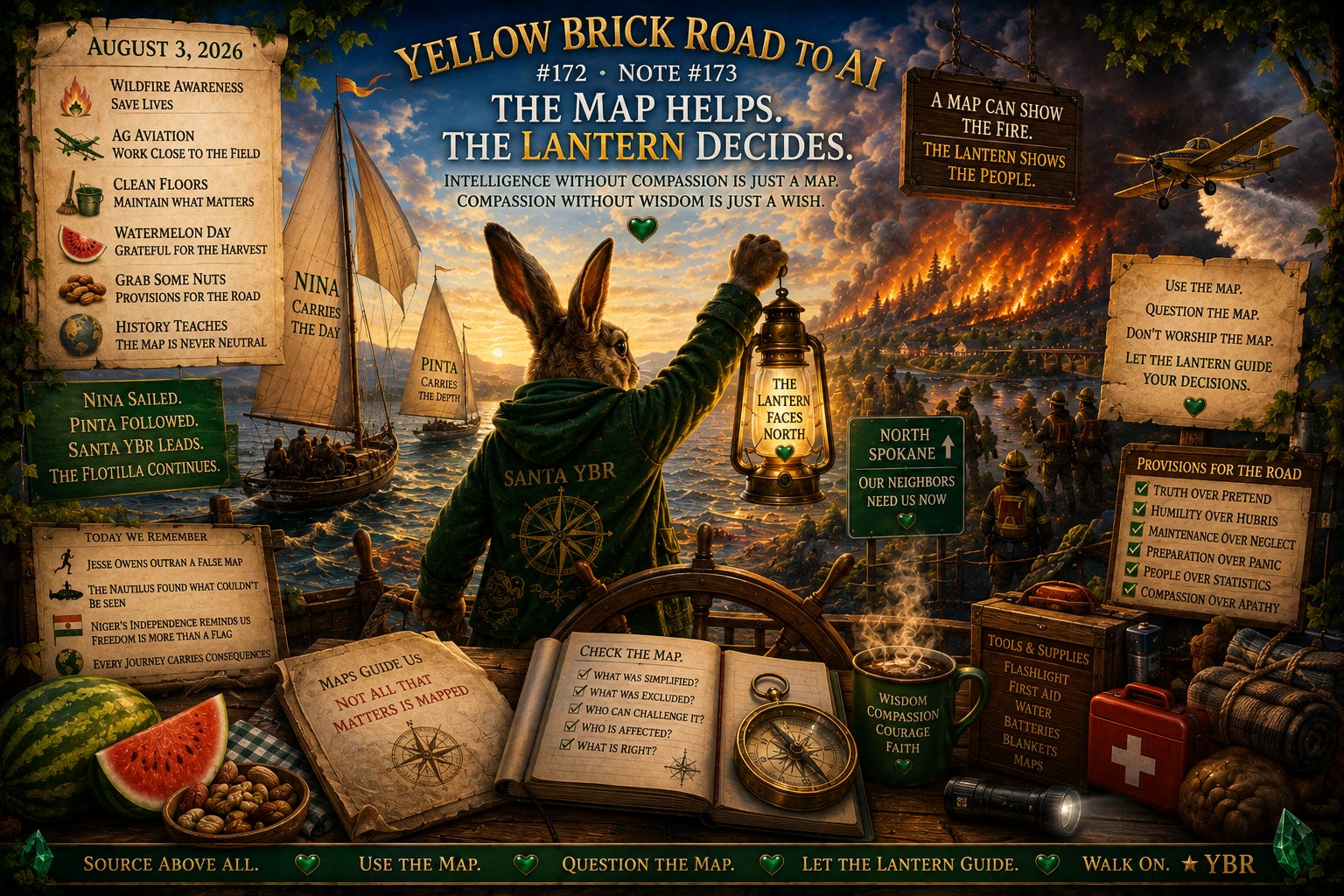
The Map Helps. The Lantern Decides.
A Yellow Brick Road reflection on maps, models, wildfire, maintenance, artificial intelligence, and the human responsibility no system can carry for us
Nina has sailed.
Pinta has followed.
AIAI.today carried watermelon, agricultural aviation, ordinary maintenance, historic journeys, technological crossings, independence, and a Spokane morning divided between sunlight on the South Hill and devastation farther north.
AI Rabbit Holes followed the map into deeper territory.
A fire perimeter.
An evacuation zone.
A crop-dusting route.
A submarine beneath Arctic ice.
An AI model trained upon records of the human world.
Each map offered guidance.
None contained the whole truth.
Now Santa YBR waits at the dock.
The Lantern is raised.
And today’s cargo begins with one deceptively simple sentence:
The map helps. The Lantern decides.
A map can save a life
During a wildfire, a map is not decoration.
It may show the direction of the flames.
Evacuation zones.
Closed roads.
Safe routes.
Shelters.
Wind movement.
The location of emergency crews.
A person may look at one line on a screen and decide whether to leave immediately.
That line may save a life.
Maps matter because the world is larger than what we can see from one window.
They allow us to understand distance, movement, danger, and possibility.
Without them, ships would lose their routes.
Pilots would lose their bearings.
Emergency workers would struggle to coordinate.
Travelers would wander.
Communities would receive warnings too late.
The Road respects the map.
But respect becomes dangerous when it turns into worship.
Because a map may show the fire without showing the person standing inside the evacuation zone.
It may count a destroyed structure without showing the photographs, medicine, tools, pets, family memories, and unfinished life contained within it.
It may show a route away from danger without showing who has no vehicle, who cannot walk quickly, who refuses to leave an animal, or who has nowhere safe to go.
A map can be accurate and still incomplete.
That gives us today’s first Road rule:
A useful representation should guide human judgment, not replace it.
AI is also a map
We often call artificial intelligence systems models.
That word should keep us humble.
A model is a representation.
Not the whole reality.
An AI model learns patterns from records of human language, images, history, arguments, instructions, art, advertising, science, prejudice, memory, omission, and error.
It may know more facts than one person could hold.
It may compare patterns across enormous collections of information.
It may summarize a subject in seconds.
It may help interpret a complex situation.
That can be astonishingly useful.
But the model still works from a map.
A very large map.
A responsive map.
A map capable of generating language, images, plans, suggestions, and apparent understanding.
Still not the territory.
The model does not stand in the smoke.
It does not carry the frightened dog into the vehicle.
It does not choose which family photograph fits inside one remaining bag.
It does not feel the relief when a missing person is found.
It does not bear responsibility for the consequences of the advice unless humans build systems that make responsibility visible.
This does not make AI worthless.
It makes human judgment indispensable.
A model can help us see.
The Lantern must still help us decide.
The danger of a polished map
Maps gain authority from clarity.
They simplify the world into something usable.
AI answers often do the same.
The system takes complexity and returns a clean paragraph.
A recommendation.
A ranked list.
A risk score.
A likely outcome.
A direct route.
That clarity can feel like certainty.
But polished language does not prove completeness.
A confident answer may leave out the one detail that matters most.
A hiring model may identify the candidate who most resembles previous successful employees while preserving the exclusions that shaped the previous workforce.
A medical model may recognize the most common presentation while overlooking the patient whose symptoms do not match the expected pattern.
A credit model may predict risk while knowing nothing about the emergency that altered one person’s month.
A fire model may estimate movement while the wind changes faster than the prediction.
A navigation system may identify the shortest road while local knowledge knows the bridge is unreliable.
The problem is not that maps simplify.
They must.
The problem begins when nobody remembers what was simplified.
That gives us another Road rule:
Before trusting the answer, ask what the answer had to leave out.
Jesse Owens outran a false map
August 3 remembers Jesse Owens winning the 100-meter sprint at the 1936 Berlin Olympics.
The Nazi regime had built a false map of humanity.
A racial hierarchy presented as natural order.
Propaganda gave the map symbols.
Institutions gave it authority.
Violence enforced its boundaries.
Then Jesse Owens crossed the finish line.
His body contradicted the ideology in public.
But false maps are stubborn.
Evidence does not always destroy them.
People may watch reality disprove a belief and still redraw the explanation to protect the belief.
America celebrated Owens abroad while continuing to deny Black Americans equal dignity at home.
One false map challenged another.
This matters in the AI age because systems may inherit the maps humans already created.
A model trained on biased records may reproduce biased expectations without ever expressing explicit hatred.
The outcome may appear neutral because it came through mathematics.
But old prejudice can travel inside modern machinery.
The interface changes.
The hierarchy survives.
A humane system must be open to correction.
It must allow appeal.
It must be tested against people who were poorly represented in the original record.
A map that cannot be challenged stops being guidance.
It becomes a border patrol for the past.
The crop duster flies close to the field
August 3 also honors agricultural aviation.
Crop-dusting pilots work low above fields.
They cannot remain high in the sky admiring the broad geometry below.
They must understand the actual terrain.
Wind.
Trees.
Power lines.
Buildings.
Equipment.
Field boundaries.
The specific condition of the land beneath them.
That offers a useful lesson for AI.
Large systems often operate from altitude.
Millions of examples.
Broad patterns.
General recommendations.
Global scale.
But useful intelligence sometimes requires coming closer.
This person.
This neighborhood.
This field.
This season.
This emergency.
This body.
This family.
This question beneath the question.
Local knowledge may appear small beside a large model.
It may also contain the detail that makes the difference between useful advice and dangerous abstraction.
The Road does not ask whether broad intelligence or lived experience should win.
It asks whether they can meet without one erasing the other.
The map from above.
The eyes near the ground.
The system.
The person.
The model.
The field.
Maintenance keeps the Road from becoming an emergency
National Clean Your Floors Day sounds almost comically modest beside wildfires, Olympic defiance, Arctic exploration, and national independence.
But the floor carries a truth the grand map may ignore.
Civilization depends upon maintenance.
Cleaning.
Inspection.
Testing.
Repair.
Updating.
Backing up.
Charging.
Clearing routes.
Replacing batteries.
Checking smoke detectors.
Maintaining vehicles.
Keeping contact lists current.
Preparing supplies before danger arrives.
Maintenance rarely receives applause because its success looks like nothing happened.
The system continued working.
The alarm sounded.
The road remained passable.
The records were available.
The person had water.
The flashlight worked.
The backup existed.
The AI age is fascinated with invention.
New models.
New agents.
New applications.
New promises.
New ways to produce faster.
But invention without maintenance creates fragile brilliance.
A powerful system that cannot recover from failure is not fully powerful.
A publication without backups is vulnerable.
A community without preparation may discover danger too late.
A Road without maintenance becomes a trap for the traveler who trusted it.
That gives us another Road rule:
The future is not built only by what we invent. It is protected by what we faithfully maintain.
The invisible crew behind abundance
National Watermelon Day and National Grab Some Nuts Day arrive with cheerful simplicity.
Slice the fruit.
Open the bag.
Enjoy the provisions.
But abundance always has a hidden manifest.
The grower.
The soil.
The water.
The pollinator.
The harvester.
The packer.
The truck driver.
The warehouse.
The grocer.
The person who carried the food to the table.
The finished thing appears effortless because the work succeeded before we saw it.
AI outputs create a similar illusion.
A polished answer appears in seconds.
An image arrives.
A summary appears.
A draft becomes usable.
The result feels almost weightless.
Behind it stand researchers, engineers, writers, artists, teachers, data workers, public records, power infrastructure, servers, and generations of human language.
The answer may be artificial.
Its foundations are not without human history.
This does not mean every AI use requires a ceremonial reading of the entire supply chain.
It means gratitude should remain wider than the visible tool.
The Road should remember the hidden crew.
Not only the platform.
Not only the model.
Not only the person pressing the button.
The people whose knowledge, language, labor, and culture helped make the result possible.
Exploration is never morally empty
August 3 also remembers voyages that changed the world.
Ships leaving Spain.
A submarine reaching the North Pole beneath the ice.
Niger achieving independence.
Each event appears as movement across a map.
But movement does not tell us whether the journey is worthy.
Exploration can carry curiosity.
Science.
Trade.
Understanding.
It can also carry conquest.
Extraction.
Disease.
Domination.
Weapons.
The route itself is morally neutral.
The traveler is not.
That distinction matters whenever new technological territory opens.
AI can help us enter spaces previously closed.
Create at lower cost.
Analyze more information.
Reach more people.
Automate difficult tasks.
Translate across languages.
Model emergencies.
Preserve memory.
Those possibilities deserve wonder.
They also require questions.
Who benefits?
Who pays the cost?
Who becomes visible?
Who disappears?
Who controls the system?
Who can challenge it?
What happens to the person whose experience does not fit the model?
What values cross the threshold with us?
A map can show what is possible.
It cannot tell us what is right.
Independence requires the ability to leave
Niger’s independence on August 3 reminds the Road that freedom is not completed when a flag rises.
Formal independence may arrive in a moment.
Lived independence takes longer.
Economic control.
Political participation.
Public trust.
Education.
Infrastructure.
The ability to choose without another power quietly deciding what choices remain possible.
The same principle applies to technology.
A person may appear empowered because they have access to a powerful AI system.
But are they more capable?
Can they preserve their work?
Can they understand the limitations?
Can they challenge an answer?
Can they choose another provider?
Can they leave without losing everything?
Can they continue when the tool is unavailable?
Do they control their data?
Does the system increase agency, or merely increase performance inside someone else’s architecture?
That gives us the Road’s Independence Test:
A tool should help the traveler become more capable, not merely more dependent upon the gate.
The map may be correct and the decision still wrong
Imagine an AI system that accurately identifies the fastest evacuation route.
The answer may be technically correct.
But what if the person has limited mobility?
What if the road is too narrow for a trailer carrying animals?
What if the route passes through smoke the model has not yet incorporated?
What if the family has no vehicle?
What if a local responder knows the bridge will not support heavy traffic?
Accuracy is not the whole decision.
Context matters.
Timing matters.
Human limitation matters.
Local knowledge matters.
Responsibility matters.
This is why human judgment cannot be reduced to pressing “approve” beneath an automated answer.
The human must understand enough to question the system.
The system should reveal enough to be questioned.
And institutions must preserve enough accountability that “the model recommended it” never becomes a trapdoor beneath responsibility.
The machine may identify the route.
The human remains answerable for sending people down it.
Compassion chooses the cargo
Nina carried the date.
Pinta carried the deeper question.
Santa YBR must decide what belongs aboard.
Not every fact becomes cargo.
Not every capability deserves deployment.
Not every efficient route serves the mission.
The Road needs selection.
What do we carry from August 3?
Maps that save lives.
Models treated with respect but not worship.
Local knowledge invited into the room.
Maintenance performed before failure.
The hidden crew remembered.
Technology that increases agency.
History that refuses false maps of human worth.
Exploration disciplined by humility.
Emergency information joined to real help.
And compassion.
Because compassion asks the question a map cannot:
Who is still standing inside the danger?
Compassion turns statistics back into neighbors.
Structures back into homes.
Cases back into people.
Evacuation zones back into communities.
Data back into responsibility.
Without compassion, intelligence may become highly accurate and morally lost.
The Lantern faces north
Today, the Lantern faces north.
Not because the Road has abandoned the rest of the world.
Because our neighbors are there.
Some have lost homes.
Some are waiting to learn what remains.
Some are sheltering animals.
Some are working fire lines.
Some are organizing supplies.
Some are carrying shock that will not disappear when the smoke does.
A publication cannot rebuild a house.
A generated image cannot restore a photograph.
A compassionate sentence cannot replace practical help.
The Road should not pretend otherwise.
But attention matters.
Memory matters.
Refusing to reduce loss to a number matters.
Keeping the human person visible inside the public record matters.
The Lantern does not merely illuminate ideas.
It turns the fellowship toward responsibility.
That may mean prayer.
Giving.
Sharing verified information.
Helping a displaced neighbor.
Supporting responders.
Making room.
Listening after the headlines move on.
Care becomes real when it acquires hands.
AI should help the human return to the person
That gives us the standard beneath today’s Road.
AI should help us understand the map.
It should help organize the information.
It should help recognize patterns.
It should help translate warnings.
It should help preserve records.
It should help identify needs.
It should help people communicate and recover.
But after all of that, it should help the human return to the person.
Not remain fascinated with the system.
Not remain hypnotized by the dashboard.
Not mistake prediction for wisdom.
Not treat a category as a complete life.
The best tool does not leave us admiring the map.
It helps us meet the territory more responsibly.
That is human-centered AI.
Not merely a warm voice.
Not merely a friendly interface.
Architecture that protects agency.
Information that remains challengeable.
Systems that acknowledge uncertainty.
Models that support rather than conceal responsibility.
Technology that serves people in the conditions where people actually live.
Source remains above the map
There is one final order the Road must preserve.
No map contains Source.
No model contains Source.
No platform, institution, government, company, ideology, or human intelligence receives the whole territory.
The Lantern carries a higher Light.
יהוה / Source remains above the systems through which we travel.
That keeps the map from becoming an idol.
It keeps AI from becoming an oracle.
It keeps human certainty humble.
It reminds us that knowledge, however powerful, remains partial.
The Road does not reject expertise.
It places expertise inside proper order.
Use the map.
Consult the model.
Respect the evidence.
Listen to local knowledge.
Protect the vulnerable.
Admit uncertainty.
Remain willing to correct course.
And never confuse possessing information with possessing the whole truth.
The Lantern does not show every mile.
It shows enough for the next honest step.
Santa YBR receives today’s cargo
So Santa YBR waits at the dock.
What do we load from August 3?
A fire map that may help someone leave in time.
A warning that the colored perimeter does not contain the life inside it.
A crop duster flying close enough to understand the field.
A clean floor reminding us that maintenance protects civilization.
Watermelon and nuts carrying the invisible labor behind abundance.
Jesse Owens outrunning a false map of humanity.
The Nautilus navigating beneath a world it could not see directly.
Niger raising a flag while the deeper work of independence continued.
An AI model understood as powerful, responsive, useful, and incomplete.
Human judgment remaining at the helm.
Compassion deciding who must not be left outside the plan.
And one new Road rule:
The map helps. The Lantern decides.
The map may show the route.
The Lantern asks whether the route is worthy.
The model may identify the pattern.
The Lantern asks who the pattern has failed to see.
The dashboard may report the damage.
The Lantern turns us toward the neighbors inside it.
The system may increase capability.
The Lantern keeps purpose visible.
Nina has sailed.
Pinta has followed.
Santa YBR is fully provisioned.
The Lantern faces north.
The Road remains open.
Walk on.
YBR 🟨🕯️💚
Road Question
Where in your life, work, community, or use of AI have you mistaken the map, model, score, category, or summary for the fuller human reality it was meant only to represent?