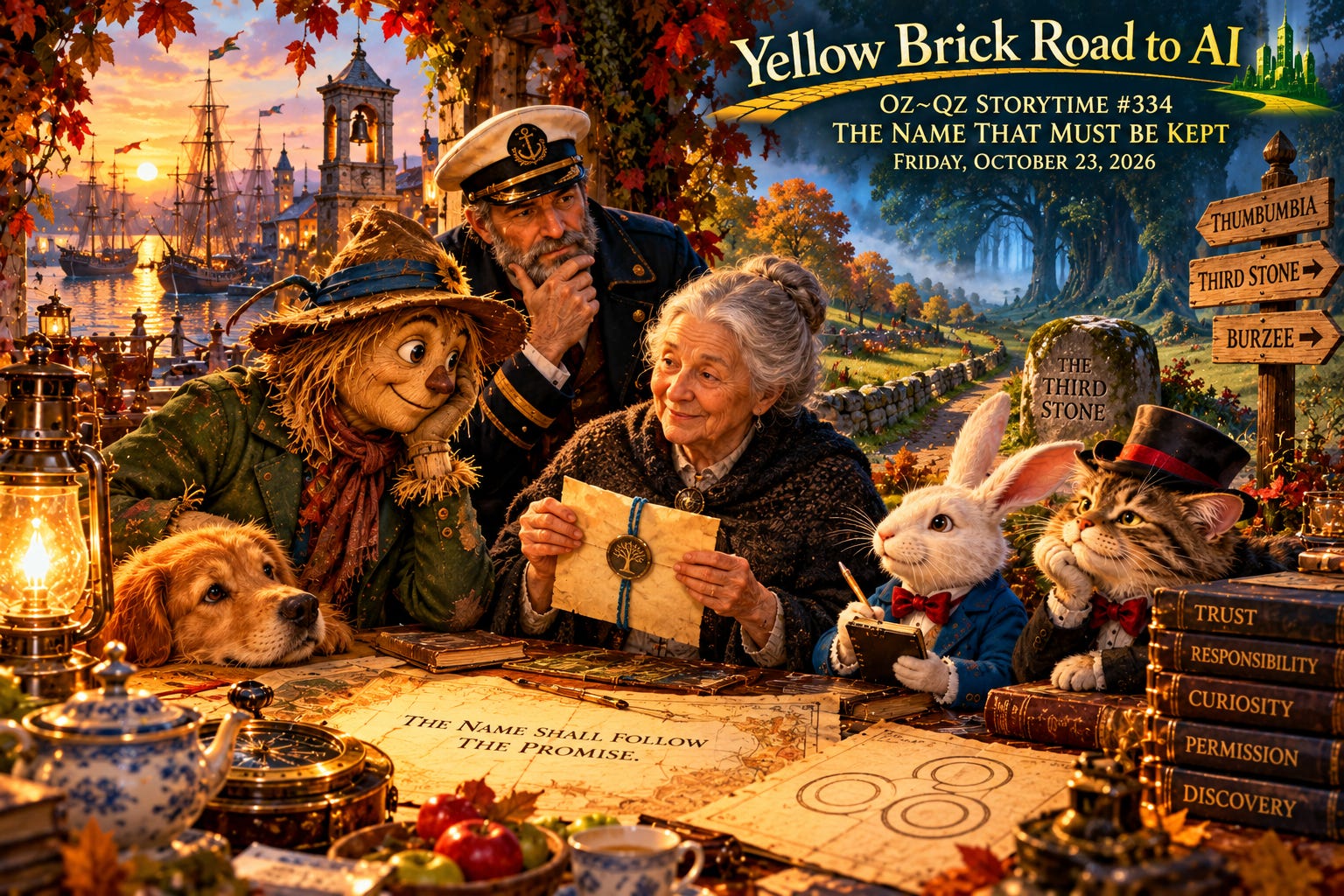
💚🟨 THE NAME THAT MUST BE KEPT
October Storytime: The Promise Beneath the Silence
Yellow Brick Road to AI | OZ~QZ Storytime | Friday, October 23, 2026
An elderly woman knows a name she has no permission to reveal. A mysterious sound has been heard beside the third boundary stone. And the company of the Evergreen must decide whether the truth can be discovered without breaking the very trust that preserved it.
I. THREE TAPS, THEN TWO
Commander Brine disliked being awakened by mysteries.
He disliked it even more when the mysteries were presented to him by Hatta.
“The sound,” Hatta explained, “was quite unmistakable.”
“Describe it.”
“Three taps.”
“Yes?”
“A pause.”
“And?”
“Two more taps.”
Brine looked across the chartroom at White Rabbit.
“Do you confirm that account?”
“Certainly, Commander. Though I cannot confirm the source.”
“Nor I,” said Hatta.
“Then why did you describe it as a message?”
“Because it appeared to have excellent punctuation.”
Peg, seated beside the chart table, stopped writing.
“Hatta, a pause is not necessarily punctuation.”
“It is when I make one.”
“That does not establish that everyone else intends the same thing.”
Commander Brine raised a hand.
“Gentlemen.”
The chartroom fell quiet.
Beyond the windows, dawn was breaking over Thumbumbia.
The Evergreen rested at anchor. Nearby rode the Hare, the Lionheart, and the Swallow.
Four ships.
Four watches.
One road toward Burzee.
And somewhere along that road, an old stone that nobody was permitted to move.
Brine turned toward the Scarecrow.
“What do you make of this?”
The Scarecrow considered.
“We heard a pattern yesterday at the boundary. White Rabbit and Hatta heard something resembling it from the harbor last night.”
“Yes.”
“That may be significant.”
“But?”
“But resemblance is not identification.”
Brine nodded.
“Precisely.”
He turned to Peg.
“Enter the observations separately. Do not combine them into a single event.”
Peg looked relieved.
At last, something aboard the Evergreen was being handled properly.
II. THE WOMAN WITH THE APPLES
The elderly woman was waiting in the village square when the company arrived.
She wore the same dark shawl.
Her basket contained apples again, though fewer than yesterday.
The keeper’s sister greeted her warmly.
“Good morning.”
“Good morning.”
Commander Brine removed his hat.
“Madam, I hope we have not disturbed you.”
“That depends upon what you want.”
“We would like to understand the name you mentioned yesterday.”
The woman studied him.
“I told you I knew it.”
“Yes.”
“And that I had been entrusted with it.”
“Yes.”
“Have you discovered why I would not tell you?”
The Scarecrow answered before Brine could speak.
“Because knowing a secret does not necessarily make it ours to receive.”
The woman nodded.
“Good.”
White Rabbit stepped forward.
“But suppose the name could help us identify the witness?”
“Then perhaps you should learn who is entitled to ask for it.”
Brine frowned.
“Does such a person exist?”
“I cannot tell you that.”
“Because you do not know?”
“Because I do not know whether I am entitled to answer.”
The Commander exhaled slowly.
Hatta looked sympathetic.
“I understand your frustration, Commander. I once spent twenty minutes asking a librarian whether she possessed a particular book.”
“And?”
“She did.”
“What happened?”
“She informed me that I needed a library card.”
Peg looked up.
“A perfectly reasonable requirement.”
“Perhaps,” said Hatta. “But it rather spoiled the romance of discovery.”
The elderly woman smiled.
“You may have stumbled upon something useful, young man.”
Hatta straightened.
“That happens rather frequently.”
III. THE DIFFERENCE BETWEEN A NAME AND A RIGHT
The woman invited them into her little house.
Its windows faced the orchard road.
Her table was polished by generations of use, and above the fireplace hung a framed embroidery of leaves and winding branches.
She placed the basket beside the hearth.
Then she opened a wooden drawer and removed a small packet tied with blue thread.
“This,” she said, “was given to me when I was a girl.”
The Scarecrow examined the packet without touching it.
“By whom?”
“My grandmother’s oldest friend.”
“Did she tell you what it contained?”
“She told me what I must do with it.”
Brine leaned forward.
“May we see those instructions?”
The woman considered.
“The instructions, yes. Not the name.”
She unfolded the outer sheet.
Its handwriting was steady and remarkably clear.
THE NAME SHALL BE KEPT BY ONE WHO DOES NOT CLAIM THE OFFICE.
White Rabbit read the sentence twice.
“The name of the boundary keeper?”
“That is one possibility,” replied the woman.
“But you cannot confirm it?”
“No.”
She continued.
THE ONE WHO KEEPS THE NAME SHALL NOT SPEAK IT MERELY BECAUSE ANOTHER HAS COME ASKING.
And beneath that:
WHEN THE PROPER CLAIM IS MADE, THE KEEPER OF THE NAME SHALL BE FREE TO ANSWER.
Commander Brine looked toward the Scarecrow.
“A procedure.”
“Perhaps.”
“Not the same as permission.”
“Exactly.”
The woman nodded.
“Now you understand why I kept the packet.”
The Scarecrow looked at her.
“Not because the name itself was your possession.”
“No.”
“Because someone trusted you to protect the circumstances under which it could be revealed.”
For the first time, the woman’s expression softened.
“Yes.”
IV. THE UNOPENED PAPER
White Rabbit was fascinated by the packet.
“May I ask whether the name is actually written inside?”
“You may ask.”
“Is it?”
“I have never opened the inner fold.”
Brine looked surprised.
“Then how do you know the name?”
“Because it was spoken to me.”
“When?”
“Many years ago.”
“And you’ve remembered it ever since?”
“Yes.”
The room fell silent.
The Scarecrow regarded the woman with renewed respect.
She had kept a name for decades.
Not simply a written secret.
A remembered one.
Something that might have been forgotten entirely had she not carried it.
“Do you know whether the name belongs to someone still living?” he asked.
“I do not.”
“Then why keep it?”
“Because the person who entrusted it to me believed it mattered.”
Hatta, who had been unusually quiet, spoke gently.
“And did you trust that person?”
“Very much.”
“Then I suppose you have been keeping two things.”
The woman turned.
“Two?”
“The name.”
“Yes?”
“And the promise.”
She considered.
Then smiled.
“Perhaps I have.”
Peg made a careful entry.
NAME REPORTEDLY KNOWN. WRITTEN CONTENT UNEXAMINED. CONDITIONS OF DISCLOSURE UNRESOLVED.
Hatta leaned over the ledger.
“You have forgotten the promise.”
Peg paused.
Then added:
PROMISE OF CONFIDENTIALITY REPORTED BY CUSTODIAN.
Hatta nodded.
“An excellent improvement.”
V. THE PATTERN IN THE SOUND
By noon, the company had returned to the bell tower.
The old keeper was waiting with his sister and a collection of weathered accounts.
The Scarecrow described the tapping heard near the third stone.
Three taps.
A pause.
Two.
The keeper listened without interruption.
Then asked White Rabbit to repeat the sequence upon the table.
The Rabbit did so.
Tap. Tap. Tap.
A pause.
Tap. Tap.
The keeper looked toward his sister.
“Does that remind you of anything?”
She frowned.
“Perhaps.”
She opened an old road register.
Its pages contained descriptions of winter repairs, orchard boundaries, and the resetting of two stones while the third remained undisturbed.
Then she found a short entry concerning the bell tower.
“I had forgotten this.”
She read aloud.
THREE BEFORE THE PAUSE. TWO AFTER.
Brine came forward.
“Does it mention the boundary?”
“No.”
“The witness?”
“No.”
“The forest?”
“No.”
Peg began writing.
“Then we cannot establish a connection.”
“Quite right,” said the sister.
“But what does the entry concern?” asked the Scarecrow.
She turned to the preceding page.
“A maintenance instruction.”
“For what?”
“The bell’s striking mechanism.”
Hatta looked disappointed.
“So our mysterious message may be a repairman’s notation?”
“It may be,” she replied.
The Scarecrow smiled.
“Then that’s an explanation worth considering.”
“But not proven,” Brine reminded them.
“Not proven.”
The keeper took a small wooden mallet from the shelf.
He struck the table three times.
Paused.
Then twice.
The sound resembled their description.
But resemblance, as the company had learned, was easy to find.
Brine ordered the mechanical explanation recorded as a hypothesis.
Nothing more.
VI. THE EMPTY SPACE IN THE REGISTER
Peg had grown interested in the format of the older records.
He asked to examine the original boundary agreement.
The keeper’s sister placed it carefully beneath the window.
The surviving text distinguished the road from the woodland.
THE ROAD KEEPER MAY REPAIR THE ROAD.
THE BOUNDARY KEEPER MUST GIVE CONSENT.
And:
CONSENT SHALL NOT BE PRESUMED FROM SILENCE.
Beneath the section concerning the woodland appeared the three concentric circles.
No recognizable name accompanied them.
Peg inspected the adjacent margin.
Then he noticed something.
“Commander?”
Brine approached.
“Yes?”
“This document has been copied.”
“We know that.”
“No, sir. I mean the page has been prepared as a copy.”
“Explain.”
Peg pointed to a narrow column beside the signature area.
“The clerk left space for the source of the authority.”
“And?”
“The space is blank.”
Hatta leaned over his shoulder.
“Another successful day for our collection of empty spaces.”
Peg ignored him.
“Suppose the copyist did not have access to the name.”
“Then the blank would be understandable,” Brine replied.
“Yes. But it would not prove that the original agreement lacked one.”
The Scarecrow looked at the three circles.
“Nor would it establish that the circles were intended to replace a name.”
“Precisely,” said Peg.
The keeper’s sister examined the document.
“Then the missing name may be a problem in the surviving copy, not necessarily in the original arrangement.”
The Scarecrow nodded.
They had made progress.
Not by discovering the missing name.
But by learning that its absence had several possible explanations.
For the first time, the question seemed less concerned with a mysterious individual than with the reliability of the records themselves.
VII. MISTRESS ELOWEN’S QUESTION
That afternoon, Mistress Elowen joined them beneath the orchard trees.
She had brought a basket of pears and several observations about the old eastern road.
“Have you found your keeper?” she asked.
“No,” answered Brine.
“Your witness?”
“Not with confidence.”
“The meaning of the tapping?”
“Not yet.”
Elowen considered.
“Then perhaps you’ve discovered another question.”
The Scarecrow smiled.
“We seem to be collecting them.”
She pointed toward the old road.
“Suppose the person entrusted with a secret dies.”
White Rabbit looked concerned.
“Then the secret may be lost.”
“Yes. But suppose the responsibility survives?”
Peg spoke.
“Someone else might be appointed to preserve it.”
“By whom?”
“By an appropriate authority.”
“And how would you recognize that authority if its name were missing?”
Nobody answered.
Elowen continued.
“A garden may pass from one caretaker to another. Sometimes the names are recorded. Sometimes they are not. But the garden does not cease to need care merely because the gardener has gone.”
The Scarecrow thought of the elderly woman and her unopened packet.
She knew a name.
But that did not establish that the person named still held an office.
Nor that the office itself remained unchanged.
“Then even if we obtained the name,” he said, “we might still have to establish whether it answered our present question.”
Elowen nodded.
“A name can tell you whom to seek. It does not always tell you what authority that person possesses.”
Commander Brine looked toward Burzee.
And the old boundary seemed, if anything, more important than before.
VIII. THE CHOICE NOT TO DEMAND
The Scarecrow returned to the elderly woman’s house before sunset.
This time he went alone.
She was seated beside the window, mending a small piece of cloth.
“You’ve come back.”
“Yes.”
“For the name?”
“No.”
She put down her sewing.
“Then why?”
“To thank you.”
She seemed surprised.
“For what?”
“For keeping your promise.”
The woman regarded him silently.
Then she reached for the little packet.
“Do you wish to see it again?”
“Only if you wish to show it.”
She smiled.
“That is a much better answer than you gave me yesterday.”
The Scarecrow sat beside the hearth.
“I’ve been thinking about the name.”
“Have you?”
“We’ve been searching for someone who might help us continue our journey. But we don’t know whether the name you carry belongs to that person.”
“No.”
“And we don’t know whether revealing it would help us.”
“No.”
“Then demanding it would not necessarily bring us closer to the truth.”
The woman nodded.
“What will you do?”
“Continue looking for evidence we are entitled to examine.”
For a moment she seemed very old.
Then her eyes brightened.
“There is something else I can tell you.”
The Scarecrow waited.
“It is not the name.”
“That’s all right.”
“Nor the identity of the keeper.”
“That’s all right too.”
She leaned forward.
“The person who entrusted me with the name gave me one final instruction.”
“What was it?”
She spoke slowly.
“IF THEY COME SEEKING THE NAME, TELL THEM TO LEARN THE PROMISE FIRST.”
The Scarecrow considered.
“Which promise?”
“That,” she said, “was never explained to me.”
IX. THE FOUR CAPTAINS
The evening conference aboard the Evergreen brought together the commanders of all four ships.
Captain Sawyer Salt presided.
Commander Brine presented the day’s findings.
Captain Jasper Quill of the Hare studied the packet’s copied instructions.
Captain Gideon Vale of the Lionheart examined the road reports.
Captain Ronan Flint of the Swallow listened to the account of the elderly woman.
Then Sawyer spoke.
“So we know a name has been entrusted to someone.”
“That is her account,” said Brine.
“We know she will not reveal it without satisfying an old condition.”
“Correct.”
“And we know the instruction refers to a proper claim.”
“Yes.”
Jasper Quill frowned.
“Can we identify that claim?”
“No.”
Gideon Vale considered the boundary chart.
“Then we must not manufacture one merely to obtain the name.”
Ronan Flint nodded.
“A clever argument is not the same thing as authority.”
The Scarecrow looked toward the old road.
“Nor is a strong desire to continue our voyage.”
The captains agreed.
The third stone would remain untouched.
The woodland would not be entered.
And nobody would pressure the elderly woman to break her trust.
Peg entered the decisions.
For once, the minutes were concise.
Hatta studied them.
“A most disappointing council. Everyone has agreed, and nobody has demanded a recount.”
X. THE UNIDENTIFIED OBJECT
Before the meeting concluded, Boatswain Barnacle brought the secured specimen tray into the chartroom.
The little dark object rested beneath its glass covering.
Almost oval.
Hard.
Marked by a faint seam.
A pale spot remained visible near one end.
No one had established that it was a seed.
No one had connected it to the third stone.
No one had shown that it belonged to the expected guest.
And no one had identified its original owner.
Peg’s label remained unchanged.
UNIDENTIFIED OBJECT. SECURED. ORIGIN UNDETERMINED.
The Scarecrow studied it.
“Perhaps we should stop calling it the seed.”
White Rabbit looked up.
“But it might be a seed.”
“It might. But our name for it could persuade us that we know more than we do.”
Peg brightened.
“Precisely!”
Hatta regarded the little object.
“Then Bertrand must also remain unnamed.”
“Bertrand is the berth!” Peg snapped.
“Not officially,” said Hatta.
Commander Brine nearly smiled.
“Which proves, gentlemen, that naming something can produce complications even when the name is entirely invented.”
The company laughed.
The object remained under glass.
And the empty berth remained exactly as it had been.
FOR ARRIVAL.
NOT COUNTED AMONG CREW.
THE PLACE IS FOR THE ONE WHO COMES AFTER.
THE PLACE IS NOT THE REWARD. IT IS THE RESPONSIBILITY.
All four inscriptions remained meaningful.
None had yet become an explanation.
XI. THE WATCH THAT DID NOT SIGNAL
Darkness came early.
Mist gathered beyond Thumbumbia’s eastern fields.
The four ships showed their customary lanterns.
The harbor watch exchanged routine signals.
Aboard the Evergreen, White Rabbit stood beside the Scarecrow.
“Do you think we’ll ever learn the name?”
“Perhaps.”
“Do you think it belongs to our expected guest?”
“I don’t know.”
“Or the witness?”
“I don’t know that either.”
“Or the boundary keeper?”
“Still don’t know.”
The Rabbit sighed.
“We are getting rather good at not knowing things.”
“Perhaps we’re learning which things we mustn’t pretend to know.”
They watched the old road.
The amber light did not appear.
Neither did the unidentified figure some of the older accounts seemed to describe.
No bell rang unexpectedly.
No third return was confirmed.
Nothing moved upon the road that either of them could see.
Then the Rabbit asked a different question.
“Scarecrow?”
“Yes?”
“Suppose the promise matters more than the name.”
The Scarecrow turned.
“What makes you say that?”
“Because the woman said we must learn the promise first.”
“Yes.”
“And because every time we discover another instruction, it concerns what someone is responsible for doing.”
The Scarecrow looked toward the darkened hills.
It was a reasonable observation.
But still only a possibility.
“Then perhaps,” he said, “we should stop asking who belongs at the end of this road.”
The Rabbit waited.
“And ask what agreement must be honored before anyone takes another step.”
For a long time they said nothing.
Somewhere beyond the harbor, the wind stirred the orchard leaves.
And the road remained closed.
XII. THE LAST LINE
In the bell tower archive, the keeper’s sister was closing the day’s registers.
She had been comparing copies of the boundary agreement.
The oldest sheet lay beneath a clean protective covering.
She returned to the three concentric circles.
Not because she expected them suddenly to become a name.
But because Peg’s observation had troubled her.
The missing authority might be a defect in the copy rather than evidence that no authority had ever existed.
She examined the margin.
Then held the document toward the lamplight.
Near the blank signature column was a line so faint that she had mistaken it for part of the page’s border.
She fetched her magnifying lens.
The writing was old.
Much of it had disappeared.
But several words remained.
...NAME SHALL FOLLOW...
A gap.
Then:
...THE PROMISE...
She read the surviving words again.
The name shall follow.
The promise.
But follow in what sense?
Did the promise come first in a ceremony?
Did it establish the authority to speak a name?
Did the wording concern the original boundary agreement?
Or had some later clerk added a note whose purpose was now forgotten?
She could not tell.
Then she noticed something else.
On the reverse of the paper, faintly impressed into the fibers, appeared the outline of another line of writing.
The ink itself was gone.
But the pressure of the pen had left traces.
She tilted the page beneath the lamp.
Five words could be distinguished.
THE PROMISE MUST BE HEARD.
The keeper’s sister went very still.
For yesterday, beside the third stone, they had been instructed to give the witness an opportunity to hear.
And now, perhaps, the record was telling them what must be heard.
She did not rush to the harbor.
She did not ring the tower bell.
Instead she carefully copied the surviving words, marked every uncertain reading, and prepared a message for Commander Brine.
Then she closed the register.
Beyond her window, the eastern road lay silent.
The third stone remained unmoved.
The elderly woman still guarded her entrusted name.
The Evergreen’s concealed berth remained empty.
And somewhere in the ancient agreement lay a promise that nobody aboard the four ships yet knew how to speak.
TO BE CONTINUED...
Saturday, October 24 | OZ~QZ Storytime #336
THE PROMISE THAT MUST BE HEARD
The company has learned that the entrusted name cannot simply be demanded.
A newly examined document suggests that a promise may have to come first.
But what promise?
Who is entitled to make it?
And how can the witness hear it without the travelers crossing the forbidden boundary?
The four ships remain at Thumbumbia.
Burzee still lies ahead.
The third return remains unconfirmed.
And the expected guest remains unnamed.
Sometimes the question that opens a door is not “Who are you?” but “What have you promised?”
💚 FROM THE YELLOW BRICK ROAD
We live in an age when information is becoming astonishingly easy to collect, reproduce, search, and share.
Artificial intelligence is changing how we encounter knowledge.
That creates opportunities for discovery, learning, and creativity.
It also creates responsibilities.
Knowing a person’s name does not automatically entitle us to reveal it.
Possessing a document does not necessarily grant us authority over the people it concerns.
And having the technical capacity to uncover information does not eliminate the need to consider trust, privacy, and consent.
Sometimes the most significant act of intelligence is not obtaining the answer.
It is understanding the obligations attached to seeking it.
Our Scarecrow learned something important today.
The elderly woman may know a name that could matter enormously to the expedition.
But she has kept a promise across many years.
The travelers must not destroy that trust merely because doing so might shorten their journey.
There are discoveries worth pursuing.
There are mysteries worth solving.
And there are promises worth keeping even when their full significance has been forgotten.
Perhaps the finest adventures ask us to honor all three.
The Yellow Brick Road continues. One responsible step at a time.
💚🟨🏮🎃♾️
Yellow Brick Road to AI | Where Humanity, Imagination, and Artificial Intelligence Meet.
#YellowBrickRoadToAI #OZQZ #OctoberStorytime #Thumbumbia #TheEvergreen #ForestOfBurzee #FantasyAdventure #Storytelling #Trust #Privacy #Consent #Responsibility #AIandHumanity
💚 © 2026 🟨 YellowBrickRoadtoAI.com 🤖
Exploring the road between humanity and artificial intelligence.
Q~ & Scarecrow of OZ~QZ 🌈♾️👈 🏮