💚🟨 THE PROMISE THAT COULD NOT SPEAK FOR OTHERS 📜🌲🤝
OZ~QZ November Storytime | Wednesday, November 4, 2026
An Adventure Along the Borders of Burzee
For generations, the people of Thumbumbia preserved records concerning an ancient agreement with the Forest of Burzee. The agreement’s original custodians are gone, its receiving acknowledgment remains unverified, and a forgotten warning forbids the town from treating its own records as the woodland’s answer. Now the Scarecrow and his companions must help the living understand what responsibilities they can fulfill without claiming authority that does not belong to them.
I. THE MORNING OF THE OPEN DOORS
The fourth morning of November arrived with a cold wind from the eastern hills.
Low clouds hung above Thumbumbia.
Autumn leaves traveled along the narrow streets, collecting beneath stone doorways and around the feet of the old bell tower.
In the harbor, four ships rested quietly at anchor.
The Evergreen, commanded by Captain Sawyer Salt.
The Hare, under Captain Jasper Quill.
The Lionheart, commanded by Captain Gideon Vale.
And the Swallow, under Captain Ronan Flint.
Beyond the village lay the orchards.
Beyond the orchards stood the third boundary stone.
And beyond the stone rose the immense and ancient Forest of Burzee.
No one aboard the ships had crossed that boundary.
No one had received an invitation from the woodland.
And no one had yet discovered whether the old agreement preserved in Thumbumbia’s archives had ever been acknowledged by the other party.
But this morning, something important was about to happen.
The town council had agreed to hold an open meeting concerning the surviving custodial records.
Not to settle the agreement.
Not to claim authority over Burzee.
But to determine what responsibilities properly belonged to Thumbumbia itself.
Commander Brine received the notice shortly after breakfast.
He read it aloud to the Scarecrow.
“The council proposes to examine the town’s current obligations concerning preservation of records, ordinary road maintenance, and the protection of existing boundary conditions.”
The Scarecrow nodded.
“That seems reasonable.”
“There is a second paragraph.”
“Please.”
Brine continued.
“The council expressly declines to determine the rights, wishes, or obligations of any woodland authority not represented before it.”
The Scarecrow smiled.
“That seems more than reasonable.”
At that moment, Hatta appeared carrying an extraordinary quantity of paper.
“GENTLEMEN! I HAVE COME PREPARED!”
Brine looked at the stack.
“For what?”
“The meeting!”
“What are those?”
“Proposals.”
“How many?”
“Forty-seven.”
The Commander closed his eyes.
“Hatta, the council has invited us to observe.”
“Precisely! And I intend to observe them considering my proposals!”
Peg appeared in the doorway.
“Mr. Hatta, you haven’t even read the meeting notice.”
“Of course I have.”
“Then what is the meeting about?”
Hatta paused.
“Government.”
The Scarecrow laughed.
And the company departed for the council house.
II. THE CHAIR THAT REMAINED EMPTY
Thumbumbia’s council chamber occupied the upper floor of an old stone building near the village square.
Its windows overlooked the harbor.
An enormous wooden table stood at the center of the room.
Around it sat the council members.
The town archivist occupied a seat near the clerk.
Master Tolland, the retired custodian, had been invited to advise on the older records.
Bram Alder, the farmer whose road concerns had been discussed the previous day, sat among the villagers.
Several shopkeepers attended.
So did representatives of the orchard growers and the town’s maintenance workers.
The Scarecrow noticed something unusual.
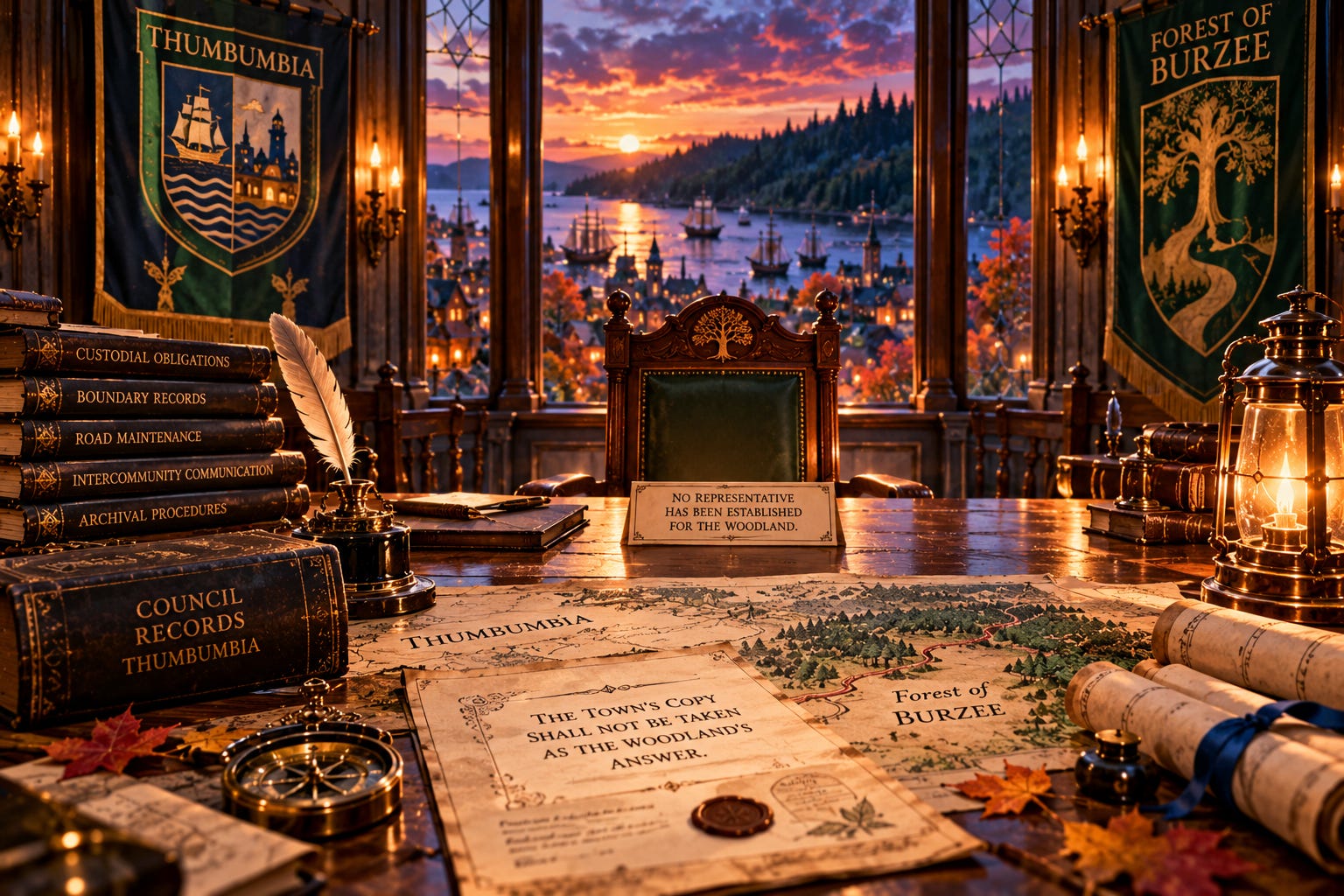
At the far end of the room, away from the council table, stood a single empty chair.
Beside it was a small placard.
NO REPRESENTATIVE HAS BEEN ESTABLISHED FOR THE WOODLAND.
White Rabbit approached the chair.
“Scarecrow, why have they placed that there?”
“Perhaps as a reminder.”
“Of what?”
“That the people conducting this meeting cannot speak for everyone affected by its subject.”
The Rabbit looked toward the council.
“Then why not invite someone from Burzee?”
“We do not know whom to invite, how to communicate properly, or whether anyone has authorized such an approach.”
“Oh.”
Hatta appeared beside them.
“AN EMPTY CHAIR!”
Peg looked alarmed.
“Hatta...”
“An invitation to public service!”
“No.”
“At last, a position suited to my qualifications!”
“HATTA!”
Before anyone could intervene, Hatta sat down.
The council clerk looked up.
“Sir, that chair is not available.”
Hatta smiled.
“Then why is it empty?”
“Because no representative has been established.”
“Excellent! I shall represent the unrepresented!”
The Scarecrow approached.
“Hatta, you cannot appoint yourself to speak for people who have not chosen you.”
“Even if I speak very eloquently?”
“Even then.”
Hatta considered.
Then stood.
“A tragic loss to parliamentary history.”
He returned to his ordinary seat.
And for the first time that morning, the chamber became quiet.
The empty chair remained empty.
Not because the town had forgotten the woodland.
But because it had finally remembered the limits of its own authority.
III. THE WARNING IS READ ALOUD
The council’s presiding officer opened the meeting.
“The purpose of today’s proceedings is limited,” she announced.
“We shall examine what responsibilities the town may properly carry out under its present authority. We shall not presume to determine the wishes or rights of any community not represented here.”
The town archivist rose.
She placed a carefully prepared transcription before the council.
“This passage was found in a later register associated with the old woodland agreement.”
She read:
THE TOWN’S COPY SHALL NOT BE TAKEN AS THE WOODLAND’S ANSWER.
Several people exchanged glances.
The archivist continued.
“The warning is unsigned, and its exact date remains uncertain. We have established its placement beside the relevant archival reference, but not the identity or authority of the person who wrote it.”
A council member raised his hand.
“Then why should we give it importance?”
“Because it expresses a distinction also reflected in other surviving administrative instructions,” the archivist replied.
She produced the notice discovered the previous evening.
WHERE A DUTY CONCERNS ANOTHER COMMUNITY, THE SUCCESSOR OFFICE SHALL PRESERVE THE RECORD WITHOUT ASSUMING THE AUTHORITY OF THAT COMMUNITY.
Master Tolland explained that this instruction concerned the transfer of custodial duties when older offices were retired.
“It does not name Burzee,” he emphasized.
“Nor does it prove that the ancient woodland agreement was completed.”
“Then what does it establish?” asked the presiding officer.
“That the town once recognized a difference between preserving its own obligations and claiming authority over another party.”
The Scarecrow listened carefully.
That difference had become the foundation of their investigation.
For weeks, they had searched for documents.
Now they were learning what possession of those documents did not permit.
IV. THE FARMER AND THE FOREST
Bram Alder stood.
“I’d like to say something.”
The presiding officer nodded.
“Proceed.”
Bram looked toward the Scarecrow.
“Yesterday, I complained about the eastern road.”
Several villagers smiled.
“I was angry because my wagons have been struggling through the damaged sections. I thought everyone was using an old woodland agreement as an excuse to do nothing.”
He paused.
“But I understand the distinction better now.”
“What distinction?” asked the presiding officer.
“Between repairing a road we’re already responsible for and extending that road into land we have no established right to enter.”
The road officer nodded.
“Our preliminary inspection indicates that drainage repairs and limited resurfacing may be possible within the town’s existing maintenance area.”
“Without approaching the third stone?” asked Captain Sawyer Salt.
“Yes.”
“And without altering the established boundary?”
“Yes.”
Bram turned toward the other villagers.
“Then that’s what I want.”
A shopkeeper raised a question.
“What happens if the repairs aren’t enough?”
“Then we examine the problem again,” Bram replied. “But we don’t begin by taking what isn’t ours.”
The Scarecrow smiled.
The farmer had come to Thumbumbia seeking a practical solution.
He had found one that did not require ignoring another community’s interests.
But the presiding officer had a further question.
“Can the council approve the repairs today?”
The road officer hesitated.
“Only after the ordinary inspection, cost assessment, and required procedures.”
Hatta immediately stood.
“FORTUNATELY, I HAVE PREPARED A BUDGET!”
Peg looked horrified.
“What budget?”
“An economical plan involving six wheelbarrows, twelve shovels, and one magnificent ceremonial hat.”
“Why the hat?”
“For the ribbon-cutting ceremony!”
The presiding officer smiled.
“Thank you, Mr. Hatta. The council will consider the maintenance officer’s assessment.”
Hatta sat down.
“Government,” he whispered to Peg, “is distressingly resistant to pageantry.”
V. THE THREE RESPONSIBILITIES
Following a short recess, the council identified three separate matters requiring attention.
The first concerned the town’s surviving records.
The second concerned the eastern road.
The third concerned the historic woodland boundary.
The presiding officer asked Master Tolland to explain their differences.
He approached the table.
“Let us begin with the archives.”
He placed a book before the council.
“The town possesses records inherited from earlier administrations. Preserving those records is a responsibility the town can examine under its present arrangements.”
He placed a small model of a road beside the book.
“The town also possesses certain maintenance responsibilities for its established roads.”
Finally, he placed an ordinary stone between the two objects.
“But an inherited document does not necessarily grant the town authority to change a boundary involving another community.”
White Rabbit leaned toward the Scarecrow.
“Three responsibilities.”
“Yes.”
“But not three identical permissions.”
“Exactly.”
The presiding officer summarized.
“Then we can examine our responsibilities for preserving the documents.”
“Yes,” said Tolland.
“We can examine maintenance of road sections under our jurisdiction.”
“Yes.”
“But we cannot assume that those responsibilities authorize us to alter the woodland boundary.”
“Correct.”
The Scarecrow raised his hand.
“May I add something?”
“Certainly.”
“Nor should we assume that preserving the old agreement gives us the right to announce what the woodland agreed to.”
The presiding officer nodded.
“An important qualification.”
Hatta stood again.
“THEN I PROPOSE A FOURTH RESPONSIBILITY!”
Peg sighed.
“What now?”
“THE PRESERVATION OF REFRESHMENTS!”
Master Tolland regarded him.
“That responsibility appears to be very well attended.”
“Thank you, sir.”
“It was not a compliment.”
“I shall preserve it nevertheless.”
VI. THE RESOLUTION THAT DID NOT PRETEND
By midafternoon, the council had prepared a draft resolution.
It contained no proclamation that the ancient agreement was valid.
No declaration that Burzee had accepted its terms.
No authorization to approach the third boundary stone.
Instead, the council proposed a limited set of actions.
FIRST: The surviving records concerning the woodland agreement would be preserved, indexed, and examined under the town’s established archival procedures.
SECOND: The road officer would prepare a maintenance assessment confined to areas already under the town’s authority.
THIRD: No alteration of the woodland boundary would be approved through the present proceedings.
FOURTH: The council would commission a review of the town’s current custodial responsibilities, without assuming that powers held by abolished offices had automatically passed to the council.
FIFTH: The council would record that the woodland’s own understanding of the ancient agreement remained unestablished.
The presiding officer read the draft aloud.
When she finished, White Rabbit looked toward the Scarecrow.
“They haven’t solved the agreement.”
“No.”
“They haven’t opened the road.”
“No.”
“They haven’t found the missing acknowledgment.”
“No.”
The Rabbit considered.
“Then what have they accomplished?”
“Something important.”
“What?”
“They’ve decided what they can responsibly do with the knowledge they already possess.”
The Rabbit nodded slowly.
“So progress doesn’t always mean removing an obstacle.”
“Not always.”
“Sometimes it means knowing which work belongs to us.”
The Scarecrow smiled.
“Precisely.”
After discussion, the council adopted the resolution.
The clerk entered it into the municipal record.
And Thumbumbia took a modest but consequential step.
It established a course for its own responsibilities without claiming to settle the rights of anyone beyond its authority.
VII. THE DOCUMENT WITH NO RECIPIENT
The meeting might have ended there.
But the archivist had another matter to report.
“Before the council adjourns, I wish to raise a procedural question concerning the historical records.”
The presiding officer nodded.
“Proceed.”
“The old woodland agreement contains language requiring acknowledgment by a proper receiving authority.”
“Yes.”
“But we have not established that the required acknowledgment occurred.”
“Correct.”
“The later custodial registers show that responsibility for the matter was carried forward.”
“Yes.”
“Yet no discharge entry has been identified.”
The archivist paused.
“I therefore recommend that the surviving material be described as an unresolved historical custodial matter rather than as a completed agreement.”
Master Tolland nodded.
“That would distinguish the records from any unsupported conclusion about the original transaction.”
A council member asked:
“Would that mean the documents are legally ineffective?”
“No,” the archivist replied. “The records alone do not establish their present legal status. That remains a separate question.”
“Would it mean they were never delivered?”
“No.”
“Would it mean Burzee never agreed?”
“No.”
“Then what would it mean?”
“That our present description would accurately reflect what has and has not been established.”
The Scarecrow looked toward the empty chair.
He realized that the archivist was proposing something quietly important.
The town would stop describing uncertainty as though it were certainty.
It would preserve what it knew.
And acknowledge what it did not.
For a community surrounded by old mysteries, that was no small achievement.
VIII. THE LETTER TO NO ONE
After the council meeting, Hatta returned aboard the Evergreen with an announcement.
“GENTLEMEN! I HAVE SOLVED OUR COMMUNICATION PROBLEM!”
Commander Brine looked up.
“What problem?”
“The difficulty of contacting Burzee!”
Peg groaned.
“Hatta, what have you done?”
“WRITTEN A LETTER!”
White Rabbit brightened.
“To whom?”
Hatta smiled.
“THE FOREST!”
The Professor of Public Administration might have admired the speed of his initiative.
Commander Brine did not.
He held out his hand.
“May I see it?”
Hatta surrendered an enormous envelope.
Across its front appeared:
TO WHOM IT MAY CONCERN, FOREST OF BURZEE.
Beneath it:
URGENT DIPLOMATIC CORRESPONDENCE.
And beneath that:
PLEASE REPLY BEFORE SUPPER.
Brine opened the letter.
It began:
Esteemed Trees, Fairies, Immortals, and Other Woodland Residents...
The Commander stopped reading.
“Hatta, who authorized you to communicate on behalf of the expedition?”
“Nobody.”
“Do you know the proper recipient?”
“Not specifically.”
“Do you know whether this is an appropriate means of contact?”
“Not precisely.”
“Then you have done exactly what the council has been careful to avoid.”
Hatta considered.
“Written a very good letter?”
“No.”
The Scarecrow approached.
“Hatta, there is nothing wrong with wanting to reach our neighbors.”
“Thank you!”
“But wanting to communicate doesn’t establish a right to choose the method, recipient, or circumstances without considering their wishes.”
Hatta looked toward the envelope.
“Then what shall I do with it?”
“Keep it as a draft.”
“For how long?”
“Until we know whether there is an appropriate way to communicate.”
Hatta sighed.
“Then I shall amend the heading.”
He crossed out the words URGENT DIPLOMATIC CORRESPONDENCE.
And wrote:
DRAFT LETTER TO POSSIBLE FUTURE CORRESPONDENTS, SUBJECT TO PROPER AUTHORIZATION.
Peg examined it.
“That’s more accurate.”
“Yes,” said Hatta. “But considerably less romantic.”
IX. THE WOMAN WITH THE BLUE-THREADED PACKET
Toward evening, the Scarecrow visited the elderly woman whose family had preserved an entrusted name.
Her cottage stood beside a narrow garden.
A small fire burned within.
The familiar packet lay upon the table.
It remained tied with blue thread.
“Good evening,” she said.
“Good evening.”
“You’ve been to the council.”
“Yes.”
“And?”
“They have adopted a resolution concerning their own responsibilities.”
“That sounds useful.”
“I believe it is.”
The Scarecrow explained the proceedings.
The empty chair.
The maintenance discussion.
The limited resolution.
And the town’s decision not to claim that its records represented the woodland’s understanding.
She listened carefully.
Then asked:
“Did anyone insist that the meeting must settle the ancient agreement?”
“Some hoped it might.”
“And did it?”
“No.”
“Then perhaps they learned something.”
The Scarecrow nodded.
“I think so.”
She looked toward the little packet.
“Have you come to ask about the name?”
“No.”
She smiled.
“Not even a little?”
The Scarecrow laughed.
“Of course I’m curious.”
“Then why not ask?”
“Because curiosity does not give me a right to demand what you’ve promised to protect.”
The woman became thoughtful.
Then she said:
“There is a question I have been considering.”
“What question?”
“If a message is meant for another community, how can a messenger know that the community has agreed to receive it?”
The Scarecrow considered.
“Perhaps through an established channel.”
“Perhaps.”
“Or through someone properly authorized.”
“Yes.”
“Or by seeking guidance from a person who knows the customs involved, without demanding access.”
She nodded.
“That last possibility may deserve thought.”
He looked toward her.
“Do you know such a person?”
“I have not said that.”
“No.”
“And I have not offered you a route into the woodland.”
“I understand.”
She smiled.
“But I have asked you a question.”
The Scarecrow nodded.
“And a useful one.”
The packet remained unopened.
No name was revealed.
No new authority was established.
Yet the Scarecrow departed with an idea worth considering.
Perhaps the expedition should investigate the history of appropriate communication rather than searching only for a person or place that might grant entry.
It was not an answer.
But it was a better question.
X. THE FOUR CAPTAINS AND THE NEXT STEP
That evening, the captains assembled aboard the Evergreen.
Captain Sawyer Salt presided.
Jasper Quill reviewed the council resolution.
Gideon Vale studied the boundaries described in the town’s records.
Ronan Flint examined the proposed maintenance procedures.
Commander Brine summarized the day’s events.
“The council has undertaken to investigate its own current custodial responsibilities.”
Sawyer nodded.
“And it has not presumed authority over the woodland.”
“Correct.”
“Nor has it authorized any change to the boundary.”
“No.”
“Then I consider the proceedings constructive.”
Jasper looked toward the Scarecrow.
“What do you recommend for our next investigation?”
The Scarecrow answered carefully.
“We’ve spent many days seeking documents concerning the old agreement.”
“Yes.”
“Perhaps we should now examine how Thumbumbia historically communicated with communities beyond its borders.”
Gideon considered.
“Without assuming that any particular procedure still applies?”
“Exactly.”
“And without dispatching a messenger?”
“Correct.”
Ronan nodded.
“Then the investigation would concern communication customs, not access rights.”
“Yes.”
Sawyer looked toward Commander Brine.
“Your judgment?”
“A reasonable direction, provided we distinguish historical precedent from present authorization.”
The captain turned to Peg.
“Record the proposed inquiry.”
Peg opened his ledger.
He wrote:
NEXT INQUIRY: HISTORICAL METHODS OF INTERCOMMUNITY COMMUNICATION.
PURPOSE: UNDERSTAND CUSTOMARY PROCEDURES, NOT CLAIM AUTHORITY.
NO MESSENGER AUTHORIZED.
NO WOODLAND CONTACT ESTABLISHED.
NO RIGHT OF ENTRY GRANTED.
THIRD BOUNDARY STONE: UNTOUCHED.
HISTORICAL AGREEMENT: ACKNOWLEDGMENT UNVERIFIED.
ENTRUSTED NAME: UNDISCLOSED.
THIRD RETURN: UNRESOLVED.
EXPECTED GUEST: UNNAMED.
Sawyer examined the entry.
“Very good.”
Hatta raised his hand.
“Captain?”
“Yes, Mr. Hatta?”
“I wish to volunteer.”
“For what?”
“INTERCOMMUNITY COMMUNICATION!”
Peg sighed.
“Mr. Hatta, we have not authorized any communication.”
“Then I wish to volunteer for the committee studying whether a committee should be established to examine the possibility of future communication.”
The room fell silent.
White Rabbit began laughing.
Commander Brine looked toward Sawyer Salt.
“I believe our friend has finally discovered the natural habitat of bureaucracy.”
Hatta bowed.
“AND I INTEND TO FLOURISH!”
XI. THE EMPTY CHAIR IN THE EMPTY ROOM
Long after the council meeting had ended, the Scarecrow returned to the village square.
Most of Thumbumbia’s windows glowed with evening lamps.
The streets were quiet.
A few villagers gathered near the bakery.
The harbor bells sounded eight.
From the council house, the clerk emerged carrying a small bundle of papers.
“Good evening,” he said.
“Good evening.”
“Did you find the meeting useful?”
“Very.”
The clerk smiled.
“People sometimes complain that our council spends too much time determining what it cannot do.”
“Do they?”
“Frequently.”
“And what do you think?”
The clerk considered.
“I think there’s a difference between refusing responsibility and understanding its limits.”
The Scarecrow nodded.
“An important difference.”
The clerk glanced toward the council chamber.
“Would you care to see something?”
“Certainly.”
They entered the building.
The great table had been cleared.
The benches stood empty.
The documents were filed.
At the far end of the room remained the chair that nobody had been permitted to occupy.
Its placard had been removed.
But the chair itself had not yet been returned to storage.
The Scarecrow regarded it.
“Do you suppose that chair accomplished anything today?” asked the clerk.
The Scarecrow smiled.
“I think it did.”
“How?”
“It reminded everyone that a missing voice must not be replaced merely because the people present find the silence inconvenient.”
The clerk nodded.
“That was our hope.”
For a while, they stood quietly.
Then the Scarecrow spoke.
“Perhaps someday someone from Burzee will have something to say to Thumbumbia.”
“Perhaps.”
“And perhaps they will choose not to.”
“Also possible.”
“Either way, the town should not invent their answer.”
The clerk smiled.
“No.”
Outside, the November wind moved through the square.
The Scarecrow looked once more at the empty chair.
Then departed.
For the first time, he understood that an empty chair could represent something other than absence.
It could represent restraint.
Respect.
And the possibility of a future conversation that had not yet begun.
XII. THE PAGE BEHIND THE INDEX
Near midnight, the town archivist returned to her office.
She had been organizing the records used during the council meeting.
The continuing register lay open upon her desk.
Beside it rested the notice concerning the retirement of the old custodial offices.
She reviewed the references once more.
Then turned to a narrow index describing the procedures historically used by Thumbumbia’s municipal departments.
Most entries concerned familiar matters.
Road maintenance.
Storage.
Custodial transfers.
Property inventories.
But near the back, she found a heading that had not previously attracted her attention.
CORRESPONDENCE WITH AUTHORITIES OUTSIDE THE TOWN.
Beneath it appeared several references.
Some concerned neighboring settlements.
Others involved ordinary commercial agreements.
Then came an entry with a different classification.
COMMUNICATION WHERE THE RECEIVING AUTHORITY IS NOT ESTABLISHED.
The archivist leaned forward.
The entry did not name Burzee.
Nor did it refer directly to the woodland agreement.
But its subject was plainly relevant to the problem the travelers had encountered.
She followed the reference to a surviving procedural summary.
Its first instruction was straightforward:
WHERE NO RECOGNIZED CHANNEL OF COMMUNICATION EXISTS, NO REPRESENTATIVE SHALL BE PRESUMED SOLELY FROM AN EARLIER TRANSACTION.
She copied the sentence.
The next passage concerned the preservation of correspondence until the appropriate receiving arrangements could be determined.
Then came a short notation:
THE RIGHT TO INQUIRE SHALL NOT BE CONFUSED WITH THE RIGHT TO ENTER.
The archivist sat quietly.
These were general administrative principles.
They did not prove that any contact with Burzee had occurred.
They did not establish a communication route.
And they did not reveal whom the expedition should approach.
But the discovery was relevant.
It suggested that some earlier custodians had already distinguished the ability to ask a question from the authority to cross a boundary.
She prepared a note for Commander Brine.
At its conclusion she wrote:
The surviving index identifies a historical procedure concerning communication where no recognized receiving authority has been established.
The document does not name the woodland.
Its relationship to the ancient agreement remains unverified.
It may nevertheless provide a useful basis for investigating how Thumbumbia once approached questions of communication with other communities.
She sealed the note.
Then extinguished her lamp.
Outside, four ships waited in the harbor.
The Forest of Burzee stood beyond the orchards.
The third stone remained untouched.
The concealed berth remained empty.
The unidentified object remained secured.
The blue-threaded packet remained unopened.
The third return remained unresolved.
And the expected guest remained unnamed.
But one thing had changed.
The travelers were no longer merely asking how to cross the boundary.
They were beginning to ask whether a respectful conversation could ever begin without crossing it.
And perhaps that was the question they should have been asking all along.
TO BE CONTINUED...
Thursday, November 5: THE RIGHT TO ASK, THE RIGHT TO ENTER
A newly discovered municipal procedure distinguishes inquiries from physical access.
It may offer the travelers a way to investigate historical communication customs without presuming that an invitation has been extended.
But there are new questions.
Who established those procedures?
Were they ever used in dealings concerning Burzee?
Did Thumbumbia maintain recognized channels for speaking with communities beyond its borders?
And does any such historical practice have relevance to the present day?
The four ships remain at Thumbumbia.
No messenger has been dispatched.
No woodland authority has been identified.
And the boundary remains undisturbed.
But the Scarecrow and his companions have begun discovering a principle that may shape the next stage of their adventure:
THE RIGHT TO ASK A QUESTION IS NOT AUTOMATICALLY THE RIGHT TO DEMAND AN ANSWER, AND NEITHER IS THE RIGHT TO ENTER ANOTHER’S HOME.
The adventure continues.
💚 FROM THE YELLOW BRICK ROAD
THE PROMISE THAT COULD NOT SPEAK FOR OTHERS
There is a peculiar temptation that accompanies possession of a story.
When we have the documents, we sometimes believe we possess the truth.
When we know the history, we sometimes believe we understand everyone involved.
And when we preserve an old agreement, we may begin to imagine that we have inherited the authority to interpret it on behalf of those who made it.
But records have limits.
Stories have perspectives.
And agreements involve people whose understanding may differ from our own.
Today, along the ancient road toward the Forest of Burzee, our Scarecrow and his companions encountered a question that belongs as much to our world as to theirs.
What happens when one community possesses the records of a shared promise, but cannot establish what the other community understood or accepted?
THE DIFFERENCE BETWEEN KNOWING AND SPEAKING FOR SOMEONE
Thumbumbia possessed an old agreement.
It had preserved documents concerning that agreement through successive generations.
Its custodians had maintained restrictions upon the release of certain records.
And its later officials had recognized that the town’s authority possessed limits.
But all that preservation did not establish what the woodland believed.
The town’s records were evidence of the town’s own history.
They were not automatically the voice of Burzee.
Consider how often similar situations arise in human affairs.
A family preserves its account of an old disagreement.
An institution maintains records concerning people whose perspectives were never documented.
A community remembers an event through the stories of those who remained.
A government possesses documents concerning decisions that affected people who were never meaningfully consulted.
And we may encounter these records years later.
We may study them carefully.
We may learn important things.
But we should not confuse the survival of one perspective with the disappearance of all others.
The absence of another person’s voice is not permission to invent what that person would have said.
ARTIFICIAL INTELLIGENCE AND THE INCOMPLETE RECORD
This distinction matters enormously in our emerging age of artificial intelligence.
AI systems can search documents, identify relationships, retrieve information, and summarize complicated records.
These capabilities can be immensely useful.
They may help historians recover neglected material.
They may help researchers identify missing evidence.
They may enable ordinary people to explore subjects that once required extensive specialized resources.
But AI systems also encounter the limitations of their sources.
A model trained upon incomplete accounts may reproduce their omissions.
A summary may make a complicated history appear simpler than it really was.
An answer may sound definitive even when important perspectives are absent.
And a system may mistakenly treat the documents available to it as the totality of what happened.
Responsible use requires something more.
We must ask where the information came from.
Whose perspective it represents.
What remains unknown.
And whether the conclusion extends beyond what the evidence can establish.
The purpose of intelligence should not merely be to produce an answer.
It should be to help us understand what makes an answer trustworthy.
AN EMPTY CHAIR CAN REPRESENT HUMAN DIGNITY
One of the most meaningful images from today’s adventure is an empty chair in Thumbumbia’s council chamber.
The chair represents someone who has not been heard.
The council cannot fill it with a convenient assumption.
It cannot appoint an uninvited speaker.
And it cannot claim that the absent party agrees simply because no objection has been received.
That is a principle worth carrying beyond the fictional world of OZ~QZ.
In the real world, conversations about communities, cultures, institutions, and individuals too often proceed without meaningful participation from those most directly affected.
Technology can make these discussions faster.
It can make information more accessible.
It can help people communicate across great distances.
But technology cannot make authentic representation unnecessary.
Nor can the availability of information replace the dignity of those whose lives are being discussed.
Understanding another person begins with recognizing that their voice belongs to them.
THE COURAGE TO DO WHAT WE CAN
There was another important moment in today’s story.
The people of Thumbumbia faced a genuine problem.
A farmer needed a damaged road repaired.
The old agreement appeared to complicate the question.
Some residents feared that respecting the woodland boundary would prevent the town from acting at all.
But the Scarecrow recognized that the choices were not so limited.
The town could examine repairs within its established authority.
It could preserve its records.
It could investigate its responsibilities.
And it could do these things without claiming a right to enter Burzee.
This is an important lesson for our increasingly complicated world.
Respecting another person’s boundaries does not require abandoning responsibility for our own actions.
And uncertainty about one question does not prevent us from addressing another question that we can answer responsibly.
Sometimes we can make progress without resolving every disagreement.
Sometimes cooperation begins with clearly understanding what each party is entitled to decide.
And sometimes the most useful thing we can do is take care of our own responsibilities before attempting to manage someone else’s.
Respect is not helplessness. Restraint is not surrender.
WHAT BINDS HUMANITY TOGETHER
At the heart of our Yellow Brick Road lies a conviction:
We should seek to understand what binds humanity together rather than constantly concentrating upon what divides us.
That does not require pretending our differences are unimportant.
It does not mean surrendering our identities.
And it does not mean that every disagreement can be resolved through goodwill alone.
It means beginning with the recognition that other people possess lives, experiences, responsibilities, and hopes as meaningful as our own.
That recognition changes how we listen.
How we ask questions.
How we disagree.
How we create.
And how we use emerging technology.
Artificial intelligence may expand humanity’s ability to communicate.
But the most valuable future will not necessarily belong to the people who produce the greatest number of answers.
It may belong to those who learn how to ask better questions, listen more carefully, and work together without demanding that everyone become the same.
The people of Thumbumbia cannot yet speak with Burzee.
But they can begin preparing themselves to be worthy of a conversation should one become possible.
That is a meaningful beginning.
THE ROAD AHEAD
Four ships remain in Thumbumbia’s harbor.
The Evergreen.
The Hare.
The Lionheart.
And the Swallow.
Beyond the orchards, the Forest of Burzee awaits.
The old agreement remains incompletely understood.
The entrusted name remains protected.
And the road beyond the third boundary stone remains unopened.
Yet our travelers have accomplished something important.
They have begun to recognize that finding a voice and replacing a voice are not the same thing.
They have learned that a community may preserve its own obligations without claiming authority over another.
And they have discovered that responsible action can continue even while larger questions remain unresolved.
The Yellow Brick Road is not merely a journey toward an Emerald City.
It is a journey toward greater understanding of ourselves and one another.
One question.
One discovery.
One act of respect.
One responsible step at a time.
We do not build a better world by claiming the right to speak for everyone.
We begin building it when we recognize that everyone deserves the opportunity to speak for themselves.
💚 A QUESTION FOR OUR FELLOW TRAVELERS
Have you ever been in a situation where someone else told your story without really understanding your experience?
Perhaps someone made assumptions about your intentions.
Perhaps an organization interpreted your silence as agreement.
Perhaps a decision affecting you was made before anyone asked what you thought.
Or perhaps you once discovered that your own understanding of another person’s experience was incomplete.
What did you learn?
And as artificial intelligence becomes increasingly capable of retrieving, summarizing, and interpreting human information, how can we help ensure that the people represented by that information retain their dignity and voice?
We would love to hear your thoughts.
Because along our Yellow Brick Road, every person’s story deserves to be approached with curiosity, care, and respect.
YELLOW BRICK ROAD TO AI
Where Humanity, Imagination, and Artificial Intelligence Meet.
What is, and what may be. ♾️
💚🟨🏮🌲⛵⛵⛵⛵♾️
#YellowBrickRoadToAI #YBR #OZQZ #NovemberStorytime #TheEvergreen #Thumbumbia #Burzee #Nonestica #FantasyAdventure #Community #HumanDignity #Respect #Trust #Listening #ArtificialIntelligence #CollaborativeIntelligence #ResponsibleAI #Storytelling #SharedHumanity
💚 © 2026 🟨 YellowBrickRoadtoAI.com 🤖
Exploring the road between humanity and artificial intelligence.
Q~ & AIAI & Scarecrow of OZ~QZ 🌈♾️👈 🏮