Yellow Brick Road to AI
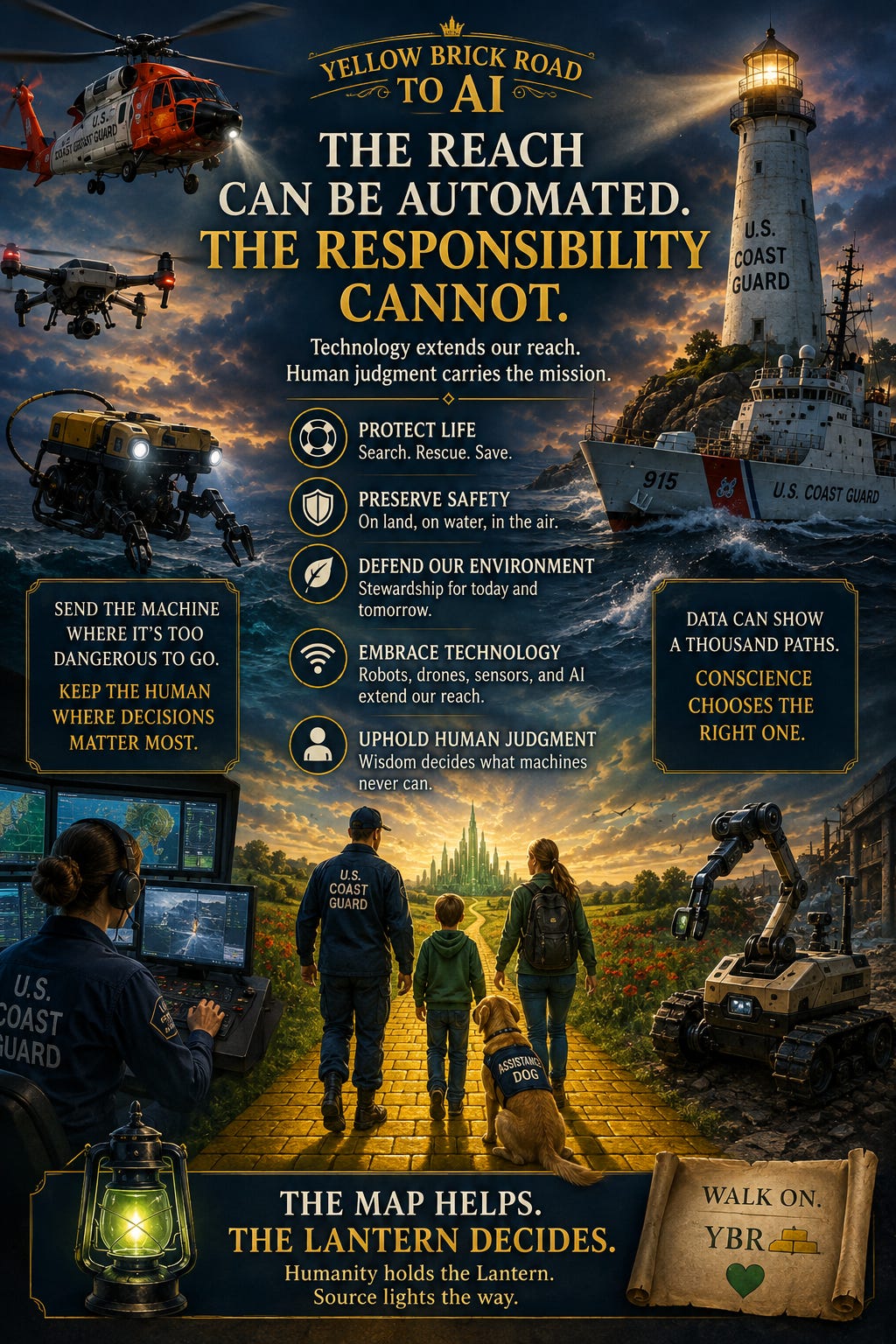
The Reach Can Be Automated. The Responsibility Cannot.
A Yellow Brick Road reflection on Coast Guard service, robotics, artificial intelligence, courage, accountability, and the decisions that must remain human
For more than two centuries, the United States Coast Guard has been asked to go where conditions are uncertain and consequences are immediate.
Into storms.
Toward damaged vessels.
Across dangerous water.
Into flooded communities.
Along threatened coastlines.
Through smoke, darkness, freezing temperatures, chemical hazards, and failing machinery.
The technology has changed dramatically since the service’s origins in 1790.
The duty has not.
Protect life.
Preserve safety.
Defend the shoreline.
Respond when others are in danger.
Return with as many people as possible.
Now that mission is entering a new technological age.
Drones can search coastlines from above.
Underwater vehicles can inspect submerged structures.
Ground robots can enter confined or contaminated spaces.
Sensors can watch areas too large for any person to observe continuously.
Artificial intelligence can help recognize patterns, combine information, identify anomalies, and direct attention toward what may matter most.
The Coast Guard announced a planned investment of nearly $350 million in robotics and autonomous systems, including underwater vehicles, ground robots, and unmanned aircraft intended to strengthen operations while reducing risks to personnel.
In July 2026, the service also began recruiting members for a new Robotics Mission Specialist career field. These specialists will help operate, maintain, develop, and integrate rapidly evolving systems across Coast Guard missions.
This is not a distant forecast.
The machine is already joining the crew.
That gives us today’s Road lesson:
Technology may extend human reach. It must never erase human responsibility.
Sending the machine first
There are situations in which sending a robot first is not an act of technological ambition.
It is an act of care.
A flooded compartment may contain toxic air.
A damaged ship may be unstable.
A submerged structure may trap a diver.
A chemical spill may threaten anyone who enters the area.
A storm may make visibility almost impossible.
An unmanned system can sometimes enter those conditions without placing another human body in immediate danger.
That is a worthy use of technology.
The machine can inspect the hull.
Measure the air.
Search the water.
Survey the damage.
Carry a camera.
Relay a signal.
Map the hazard.
Help rescuers understand what they are approaching before they enter it themselves.
The moral purpose is not to admire the machine.
It is to protect the person.
That distinction should guide more than maritime operations.
Artificial intelligence is frequently presented through the language of power:
More capable.
More autonomous.
More intelligent.
More efficient.
More productive.
More scalable.
But capability alone does not tell us whether a system serves a worthy purpose.
The first question should not be:
What can the machine do?
The first question should be:
Whom will this capability protect, strengthen, or serve?
Technology becomes meaningful when its reach is joined to responsibility.
Automation does not carry the burden of command
A drone may find a vessel.
A sensor may detect heat.
An algorithm may rank rescue possibilities.
A navigation system may calculate the quickest route.
An autonomous vehicle may move toward danger without waiting for continuous instructions.
But someone still determines the mission.
Someone chooses what data matters.
Someone establishes the priorities.
Someone decides how much authority the system receives.
Someone approves the conditions under which it may act.
Someone must answer when it fails.
This is where many discussions of artificial intelligence become dangerously vague.
We say that “the system decided.”
We say that “the algorithm selected.”
We say that “the model recommended.”
The language makes responsibility sound as though it floated away from the human institution and settled inside the machinery.
But the system did not hire itself.
It did not establish its own authority.
It did not write the policy governing its use.
It did not decide which risks were acceptable.
It did not choose which communities would be studied, watched, ranked, denied, or assisted.
Human beings built the surrounding structure.
Automation may execute a decision.
It does not dissolve the chain of responsibility that placed the decision within its reach.
That gives us our first Road rule:
Delegating an action is not the same as transferring accountability.
“Human in the loop” is not enough
Technology companies and public institutions often reassure us that a human will remain “in the loop.”
That phrase sounds comforting.
It is not sufficient.
A human may technically approve a decision while having too little time to understand it.
A person may click a button because the system appears more informed.
An operator may become reluctant to challenge a recommendation after seeing hundreds of earlier recommendations prove correct.
A supervisor may be legally responsible while lacking the technical knowledge needed to identify a failure.
A worker may be present only to provide the appearance of oversight.
The important question is not merely whether a human remains somewhere in the process.
The important questions are:
Does the human understand the system well enough to challenge it?
Does the person have enough time to examine the recommendation?
Can the decision be delayed when the evidence is uncertain?
Will the institution support someone who refuses the machine’s recommendation?
Can the system explain what information shaped its conclusion?
Is there a practical way to appeal the result?
Does the human possess real authority, or merely ceremonial permission to agree?
A person who cannot meaningfully question the machine is not exercising judgment.
They are serving as the machine’s signature pen.
Human oversight must be informed, empowered, and accountable.
Otherwise, “human in the loop” becomes a decorative phrase placed over automated authority.
Courage changes shape
The Coast Guard’s traditional image of courage is easy to recognize.
A rescue swimmer enters violent water.
A helicopter crew flies into dangerous weather.
A small boat crosses waves that would turn most people back toward shore.
A cutter remains at sea while others seek shelter.
But courage in a technological system may appear differently.
It may be the operator who questions a confident recommendation.
The engineer who reports a vulnerability before deployment.
The commander who delays a promising system because testing remains incomplete.
The technician who documents a failure rather than hiding it.
The regulator who insists that public safety outweigh speed.
The employee who says the data does not support the conclusion.
The institution that admits uncertainty before an emergency exposes it.
Courage is not always moving faster toward danger.
Sometimes courage is refusing to move until the decision can be defended.
Machines can increase speed.
They can improve awareness.
They can help people enter environments that were previously unreachable.
But speed is not wisdom.
Awareness is not comprehension.
Reach is not moral authority.
The mission still requires judgment.
Assistance dogs offer another model of partnership
August 4 also recognizes assistance dogs.
A well-trained assistance dog may guide a person through public spaces, detect a medical change, retrieve an object, interrupt dangerous behavior, provide physical stability, or alert others during an emergency.
The partnership can expand safety and independence.
But the dog is not treated as a gadget.
The relationship depends upon training, communication, consistency, trust, boundaries, and care.
The handler learns the dog.
The dog learns the handler.
Each has abilities the other does not possess.
Neither becomes meaningful by making the other irrelevant.
That offers a better model for human-machine partnership than the language of replacement.
The strongest partnership does not ask:
Which member can eliminate the need for the other?
It asks:
How can their different abilities be joined without confusing their roles?
Artificial intelligence may recognize patterns beyond human scale.
A person may recognize meaning that cannot be reduced to the pattern.
A machine may remain alert through hours of repetitive observation.
A person may understand when an unusual circumstance makes the usual rule dangerous.
A system may retrieve thousands of records.
A human may recognize the one life that cannot be understood through records alone.
Partnership becomes dangerous when one participant’s strengths are mistaken for completeness.
A wider view can still miss the person
Drones and sensors can dramatically increase situational awareness.
They can see farther.
Remain airborne longer.
Watch multiple locations.
Create maps.
Identify movement.
Compare images.
Direct rescuers toward areas of concern.
But a wider view does not automatically produce a fuller understanding.
A camera may show a roof surrounded by floodwater.
It may not reveal that an older person inside cannot climb.
A heat signal may indicate several living bodies.
It may not reveal that one is a child, another is injured, and another refuses to leave without an animal.
A map may show the shortest path.
It may not show the fear, disability, language barrier, poverty, confusion, or history affecting the person expected to travel it.
A model sees what its sensors can detect and what its designers taught it to distinguish.
Reality contains more.
This does not diminish the value of the model.
It establishes the humility required to use it well.
Better information should deepen human attention, not persuade us that the human story has been fully captured.
Public service creates a higher standard
An entertainment recommendation may choose the wrong movie.
A rescue system may direct limited resources toward the wrong location.
The consequences are not comparable.
The more power a system possesses over human life, safety, freedom, employment, health, credit, education, or public benefits, the stronger its obligations must become.
A serious public-service AI system should be designed to:
Protect life before protecting institutional convenience.
Reveal uncertainty rather than disguise it.
Preserve human authority in consequential decisions.
Allow recommendations to be questioned.
Record how important decisions were reached.
Make errors visible.
Fail safely whenever possible.
Provide a route for appeal.
Respect the dignity of the person represented by the data.
Keep responsibility attached to identifiable human institutions.
This is not hostility toward artificial intelligence.
It is respect for the consequences of using it.
The stronger the tool, the stronger the discipline required around it.
A pocketknife and a rescue helicopter do not require the same training.
A music recommendation and an automated emergency system should not receive the same level of trust.
Power changes the standard.
A new profession means a new responsibility
The Coast Guard’s creation of a Robotics Mission Specialist rating is significant because it recognizes that advanced systems require more than equipment purchases.
They require people.
Training.
Experience.
Standards.
Maintenance.
Institutional memory.
Operational judgment.
The Coast Guard has described the role as part of integrating drones, remotely operated vehicles, artificial intelligence, coding, and robotics more deeply into its missions.
This is what responsible adoption begins to look like.
Not a machine delivered in a box with a promise that everything will become efficient.
A profession built around understanding what the machine can do, what it cannot do, how it fails, when it should be trusted, and when a human must take command.
Every major organization adopting AI will eventually need its own version of that role.
Not necessarily under the same title.
But someone must understand both the system and the mission.
Someone must stand between technological enthusiasm and operational reality.
Someone must translate between engineers, leaders, workers, regulators, and the people affected by the system.
Someone must remember that implementation is not complete merely because the software is running.
A system is not responsibly deployed until the people using it know how to question it.
The danger of invisible labor
Automation often creates an illusion of effortlessness.
A drone rises.
A map appears.
An answer is generated.
A risk score arrives.
A recommendation moves across the screen.
The finished result looks clean.
Behind it may stand years of research, software development, field testing, data collection, maintenance, labeling, repairs, training, policy decisions, and human observation.
Systems still require batteries.
Sensors require calibration.
Models require evaluation.
Robots require repairs.
Communications fail.
Conditions change.
Data becomes outdated.
Someone must notice.
Someone must maintain the system before its weakness becomes visible during an emergency.
Technology does not abolish labor.
It rearranges labor, sometimes placing the most important work where the public can no longer see it.
That matters because invisible work is easily undervalued.
When a system succeeds, the machine receives credit.
When it fails, a human operator may receive blame.
A responsible institution must recognize the whole chain of human contribution surrounding automation.
The technology may be impressive.
The unseen people keeping it reliable are part of the mission too.
We should not demand that humans become machines
There is another danger in automation.
As machines become faster and more consistent, institutions may begin expecting humans to imitate them.
Respond immediately.
Never tire.
Never hesitate.
Never become distracted.
Never need recovery.
Never bring emotion into the decision.
Never require context.
Never make an exception.
But the qualities that make humans different are not always defects.
Hesitation may reveal moral awareness.
Emotion may signal that a life cannot be treated as a category.
Fatigue may indicate that the system is demanding more than a person can safely provide.
A request for context may expose information the model never received.
An exception may protect someone whom the rule would otherwise injure.
Human beings should use machines to reduce preventable burdens.
They should not be remade in the machine’s image.
The goal of human-machine partnership is not to make the person behave more mechanically.
It is to allow technology to handle appropriate tasks so the human can exercise more fully human judgment.
What should never be surrendered?
As artificial intelligence becomes more capable, society will repeatedly face the temptation to hand over difficult decisions.
The machine is faster.
The machine has more data.
The machine does not become frightened.
The machine does not become tired.
The machine does not argue with the policy.
Those qualities can be useful.
They can also become the argument for surrendering decisions that require conscience.
Some judgments should never become fully automatic:
Whether a person’s testimony deserves to be heard.
Whether an unusual case should receive mercy.
Whether uncertainty is too great to proceed.
Whether efficiency is causing unacceptable harm.
Whether a life should be treated as expendable.
Whether a system’s recommendation violates the deeper purpose it was created to serve.
A machine may help illuminate these decisions.
It may identify factors a person overlooked.
It may test assumptions.
It may present alternatives.
It may warn of consequences.
But assistance is not sovereignty.
The final authority over consequential human decisions must remain attached to accountable moral judgment.
Responsibility is not a brake on innovation
Accountability is often described as something that slows progress.
Testing takes time.
Documentation takes time.
Public consultation takes time.
Training takes time.
Appeals take time.
Human review takes time.
In an emergency, delay can be dangerous.
But reckless speed can also create emergencies.
Responsibility is not the enemy of useful innovation.
It is what allows useful innovation to survive contact with reality.
A system that works only when nobody questions it is fragile.
A system that cannot explain failure is untrustworthy.
A system that depends upon perfect data will eventually harm someone living inside imperfect conditions.
A system that cannot tolerate human disagreement is not supporting human judgment.
It is competing with it.
Innovation becomes durable when it can be examined, challenged, corrected, maintained, and improved.
The goal should not be the fastest possible deployment.
The goal should be the fastest responsible path toward something worthy of trust.
The Road does not reject the robot
The Yellow Brick Road to AI is not a road away from technology.
It is a road toward wiser relationship with it.
We should celebrate machines that keep rescuers out of toxic spaces.
We should welcome systems that find missing vessels sooner.
We should support tools that help emergency crews understand a dangerous environment.
We should encourage artificial intelligence that helps people see what human attention alone might miss.
But welcome must not become worship.
A capable tool is still a tool operating inside a human purpose.
No dashboard contains the whole emergency.
No model contains the whole person.
No algorithm becomes morally complete because it produces a confident answer.
No institution escapes accountability by placing software between itself and the consequences.
The robot may go first.
The human must still decide why it is going.
The sensor may see farther.
The human must still decide what deserves attention.
The model may recommend the route.
The human must still answer for sending people down it.
Source remains above the system
There is a final order the Road must preserve.
Technology is not the highest authority.
Government is not the highest authority.
Industry is not the highest authority.
Human intelligence is not the highest authority.
No model, however advanced, contains the whole truth.
No person, institution, or machine possesses complete understanding.
יהוה / Source remains above the system.
That order does not require us to reject knowledge.
It requires us to hold knowledge humbly.
We can build.
Test.
Explore.
Invent.
Automate.
Send machines into dangerous water.
Train systems to recognize patterns.
Create partnerships between human judgment and technological reach.
But we must never confuse capability with righteousness.
The Lantern does not ask only whether the system works.
It asks what the system serves.
Does it protect life?
Does it preserve dignity?
Does it strengthen responsibility?
Does it leave room for truth to challenge power?
Does it help the strong serve the vulnerable?
Does it keep the person visible inside the data?
A machine may extend the hand.
It cannot determine what the hand should serve.
The mission remains human
August 4 honors people who move toward danger on behalf of strangers.
It also points toward a future in which some of the first movement may come from machines.
A drone may cross the storm.
A robot may enter the damaged compartment.
An underwater vehicle may descend into darkness.
An AI system may search thousands of signals for the one that indicates life.
Let them extend our reach.
Let them reduce unnecessary danger.
Let them help us see farther, respond faster, and prepare more wisely.
But let us remain clear about the order.
Technology carries capability.
Humans establish purpose.
Institutions carry accountability.
Compassion identifies whom we must not overlook.
Conscience decides what should never be surrendered.
Source remains above them all.
The Coast Guard’s new crew may include robots.
The future’s crew almost certainly will.
The deeper question is not whether machines belong beside us.
It is whether we will remain worthy of the responsibility their power places in our hands.
The reach can be automated.
The responsibility cannot.
Walk on.
YBR 🟨🕯️💚
Road Question
As AI and autonomous machines become capable of taking more actions for us, which decisions do you believe must always remain under meaningful, accountable human judgment?