💚🟨 THE RECORD OF THE SECOND OFFICE 📜🔑🌲
OZ~QZ November Storytime | Monday, November 2, 2026
An Adventure Along the Borders of Burzee
An old accounting book reveals that a second preparation of the woodland agreement may have entered another office’s custody. When the Scarecrow and his companions follow the forgotten reference number, they discover something unexpected: the record of a transfer is not necessarily evidence that the transferred document ever arrived. But behind an ordinary administrative entry lies a decision that may have preserved an ancient promise.
I. THE NUMBER THAT DID NOT BELONG
The first rain of November arrived quietly in Thumbumbia.
It fell upon the roofs of the harbor houses, darkened the stones beside the bell tower, and gathered in shining beads along the rails of the four ships.
The Evergreen rested at anchor.
The Hare lay beyond her.
The Lionheart and Swallow occupied their accustomed stations.
Farther east, beyond the orchards, the Forest of Burzee stood beneath a veil of autumn mist.
No unusual signals had appeared during the night.
No messenger had crossed the woodland boundary.
And the third stone remained exactly where it belonged.
Aboard the Evergreen, Commander Brine was examining the previous day’s report when Peg entered the chartroom.
“Good morning, Commander.”
“Is it?”
“I believe so, sir.”
“Then you have found something.”
“Not yet. But the town archivist has requested our attendance.”
Brine looked up.
“On what grounds?”
“The additional reference number.”
“Ah.”
“And she believes it may identify a second municipal office.”
“Does she know which one?”
“Not yet.”
Commander Brine set down his pen.
“Then we have a destination without an identity.”
Peg considered.
“An office, sir, rather than a geographical destination.”
“An important distinction.”
At that moment, Hatta appeared in the doorway.
He carried two cups of tea and a large slice of toast.
“An office without an identity? Splendid! I believe I should apply for employment.”
Peg sighed.
“You’re already occupied.”
“Doing what?”
“Accompanying this expedition.”
“Precisely. I am seeking advancement.”
Commander Brine took one of the cups.
“Mr. Hatta, if you wish to be useful, please inform the Scarecrow that we depart for the archives in twenty minutes.”
Hatta bowed.
“With pleasure.”
Then he hesitated.
“Commander?”
“Yes?”
“May I finish my toast first?”
Brine looked at Peg.
Peg looked at Brine.
“Twenty-five minutes,” the Commander replied.
And so began the day when a forgotten number led the company toward a discovery that none of them had anticipated.
II. THE OFFICE THAT KEPT NO LETTERS
The archivist received the travelers in the bell tower’s upper room.
Beside her stood Master Tolland, the retired clerk who had examined the previous day’s records.
The green accounting book lay open upon the table.
The relevant entry remained carefully marked.
WOODLAND EDGE AGREEMENT.
TWO PREPARATIONS CHARGED.
ONE RETAINED.
OTHER HELD.
And beneath the last notation:
...TRANS...
The archivist indicated the separate reference number.
“We have identified its sequence.”
Commander Brine leaned forward.
“Where does it lead?”
“To an office that no longer exists.”
White Rabbit looked alarmed.
“Does that mean the records are lost?”
“Not necessarily.”
Master Tolland spoke.
“The office was called the Register of Custodial Obligations.”
Hatta immediately raised his hand.
“That is a truly dreadful name.”
“It was not intended to entertain you,” replied Tolland.
“Then it succeeded magnificently.”
The archivist smiled.
“The office did not ordinarily store correspondence.”
Peg frowned.
“Then why would a woodland document be transferred there?”
“That is what we hope to determine.”
Master Tolland explained.
“The office recorded responsibilities entrusted to individuals, departments, and institutions.”
“Responsibilities?” asked the Scarecrow.
“Yes. The care of property. Maintenance obligations. Safeguarding of certain records. And conditions that had to be satisfied before an entrusted item could be released.”
Commander Brine became attentive.
“Then the reference number might concern custody rather than physical transfer.”
“Exactly.”
White Rabbit looked between them.
“So someone could transfer responsibility for a document without transferring the document?”
“Indeed,” replied Tolland.
Hatta set down his toast.
“Then I wish to transfer responsibility for my breakfast to Peg.”
Peg recoiled.
“Why?”
“Because I intend to retain possession of it.”
The retired clerk regarded Hatta for a long moment.
“You would have made a most troublesome official.”
Hatta smiled.
“Thank you.”
“It was not a compliment.”
“I am growing accustomed to that.”
But the Scarecrow was examining the old entry.
A new possibility had emerged.
The second office might not have received the ancient agreement.
It might have received the obligation to protect it.
III. THE BUILDING BESIDE THE RAIN GARDEN
The former Register of Custodial Obligations occupied a modest stone building behind Thumbumbia’s old council house.
A narrow garden ran along one side.
Rainwater flowed into a shallow channel lined with moss.
The building had been converted many years earlier into municipal storage.
Its records were now administered by the town archive.
The archivist had obtained authorization to examine the relevant surviving registers.
Two custodians accompanied the company.
Commander Brine, the Scarecrow, Peg, White Rabbit, and Master Tolland entered.
Hatta followed.
He had brought an umbrella.
Unfortunately, it was so large that he could not pass through the doorway without closing it.
“This building,” he announced, “was clearly designed without consideration for distinguished visitors.”
Peg took the umbrella from him.
“The doorway is perfectly ordinary.”
“Then I am exceptionally distinguished.”
Inside, the air smelled of old wood, dust, and the faint dampness of autumn.
The custodians directed the company toward a series of shelving cabinets.
The archivist consulted her inventory.
“Register C. Volume Seven.”
Master Tolland examined the shelves.
“That would be the old custodial account.”
Peg located the volume.
It was thick, bound in brown leather, and secured with a broad cloth band.
The archivist checked its inventory label.
Then authorized it to be brought to the worktable.
White Rabbit stood on his toes.
“Is our number inside?”
“We shall see.”
The pages were filled with names, dates, responsibilities, and occasional notes concerning the movement of property.
Some entries involved tools.
Others concerned keys.
Several recorded the care of municipal buildings.
Then Peg found the reference number.
He stopped.
“Commander.”
Brine approached.
“Yes?”
“It’s here.”
The archivist checked the figures.
They matched the number copied from the green accounting book.
For the first time, the company possessed a verified link between the two sets of records.
But the entry that followed was not what anyone expected.
Its heading read:
WOODLAND EDGE AGREEMENT: CUSTODIAL RESPONSIBILITY.
Not document received.
Not counterpart delivered.
Not agreement acknowledged.
Custodial responsibility.
The Scarecrow examined the words.
“So this office recorded responsibility for the agreement.”
“That is what the heading states,” replied the archivist.
“But not necessarily possession of the second preparation.”
“Correct.”
White Rabbit looked disappointed.
“We’ve found another record that doesn’t tell us where the letter went.”
“Perhaps,” said the Scarecrow.
Then he leaned closer.
“But look at the next column.”
IV. THE ENTRY WITH TWO DATES
The entry contained two dates.
Neither survived completely.
The first appeared beside the custodial reference number.
The second stood several lines below.
Master Tolland examined them.
“These may describe different administrative events.”
Peg brought his notebook closer.
“What kinds?”
“The initial assignment of responsibility and a later review.”
The archivist compared the format with neighboring entries.
One concerned a damaged bridge.
Its first date recorded the appointment of a custodian.
The second recorded a later inspection.
Another concerned a collection of old road tools.
Its first date recorded the transfer of responsibility.
The second recorded the release of the property.
But the woodland entry differed.
Beside the first date appeared a legible notation:
CARE ACCEPTED.
Beside the second:
ITEM NOT ENTERED.
Nobody spoke.
Then White Rabbit whispered:
“They accepted it!”
Commander Brine raised a hand.
“Accepted what?”
“The agreement!”
“Read the heading again, Rabbit.”
The Rabbit did.
CUSTODIAL RESPONSIBILITY.
His ears lowered.
“Oh.”
The Scarecrow approached.
“Then perhaps someone accepted responsibility for the document.”
“That is a reasonable reading,” said the archivist.
“But the document itself was not entered into the second office’s records.”
“That is what the surviving notation indicates.”
Peg wrote:
RESPONSIBILITY ACCEPTED: RECORDED.
PHYSICAL ITEM ENTERED: NOT RECORDED AS COMPLETED.
DELIVERY TO WOODLAND: UNCONFIRMED.
Master Tolland nodded approvingly.
Hatta looked troubled.
“May I ask a question?”
“Certainly,” said the Scarecrow.
“If someone accepted responsibility for a letter that they never received, what exactly were they responsible for?”
For once, nobody answered immediately.
Because Hatta had asked the question at the heart of the day’s discovery.
V. THE DIFFERENCE BETWEEN HAVING AND GUARDING
Master Tolland requested three objects.
A key.
A book.
And an empty wooden box.
The archivist placed them upon the table.
The retired clerk held up the key.
“Suppose the town appoints you custodian of this storeroom.”
He handed the key to Peg.
“Do you now own the room?”
“Of course not.”
“May you remove its contents for yourself?”
“No.”
“Then what have you received?”
“Responsibility for the room.”
“Precisely.”
Tolland indicated the book.
“Now suppose the town records that a particular book must be preserved.”
“Yes,” said the Scarecrow.
“But the book has not yet been delivered to the appointed custodian.”
“Then the custodian knows what responsibility has been assigned, but may not possess the object.”
“Exactly.”
White Rabbit pointed toward the box.
“And that?”
Tolland smiled.
“Suppose the box is meant to contain something entrusted for safekeeping.”
He opened it.
It was empty.
“Does the empty box prove that nothing was ever placed in it?”
“No,” replied Peg.
“Does it prove that something was?”
“No.”
“Does it prove that the designated custodian fulfilled the responsibility?”
“No.”
Master Tolland closed the lid.
“Then the record of an obligation and the record of its fulfillment must remain distinct.”
The Scarecrow looked toward the old register.
“Someone may have accepted responsibility for the woodland agreement without ever taking physical custody of the second preparation.”
“Yes.”
“And the second preparation may have remained elsewhere.”
“Yes.”
“Or been transferred by another route.”
“Possibly.”
“Or never been completed.”
“Also possible.”
Hatta raised his hand.
“Then we have discovered that someone promised to look after something they might never have seen.”
“That is a fair summary,” replied Master Tolland.
Hatta looked pleased.
“Peg, please record another sensible observation.”
Peg was already writing.
Hatta smiled.
“At this rate, I shall be promoted from the refreshments committee.”
“Unlikely,” Peg muttered.
But the Scarecrow was thinking about the difference between a task being assigned and a responsibility being fulfilled.
It was a small distinction in the language of records.
And a very large distinction in the conduct of people.
VI. THE CUSTODIAN’S INSTRUCTION
The next discovery came from the keeper’s sister.
She had joined the examination shortly before noon and was reviewing an index of old municipal procedures.
Near the middle of the volume, she found a heading:
INSTRUCTIONS CONCERNING CONDITIONAL CUSTODY.
The archivist examined the page.
Its date was uncertain.
But the instructions appeared to belong to the same broad administrative tradition as the register.
The keeper’s sister read aloud:
WHEN RESPONSIBILITY IS ACCEPTED BEFORE AN ITEM IS RECEIVED, THE CUSTODIAN SHALL NOT RECORD THE ITEM AS PRESENT.
Peg nodded.
“Sensible.”
She continued:
WHEN AN ITEM IS EXPECTED BUT NOT ENTERED, THE RESPONSIBILITY SHALL REMAIN OPEN UNTIL ITS DISPOSITION IS ESTABLISHED.
Commander Brine leaned forward.
“An open responsibility.”
Master Tolland nodded.
“A recognized administrative status.”
The Scarecrow considered.
“Then the second office might have been waiting for the document.”
“Possibly.”
“Or waiting for confirmation that the document was no longer to be transferred.”
“Also possible.”
White Rabbit frowned.
“But if the office no longer exists, who carries the responsibility now?”
The room fell silent.
Master Tolland looked toward the archivist.
“That is a question of succession.”
“Explain,” said Commander Brine.
“When an office is abolished, some responsibilities may pass to another institution. Others may expire under applicable rules. Still others may require formal resolution.”
“And this one?”
“We do not know.”
Peg stared at the old page.
“So even if the responsibility was accepted long ago, we cannot simply assume that its authority belongs to the modern town archive.”
“Correct,” replied Master Tolland.
The Scarecrow looked toward the rain-streaked window.
The mystery had changed again.
They were no longer seeking only a missing paper.
They were seeking the history of a responsibility that might have passed from one generation to another without anyone understanding what it required.
VII. THE FOUR CAPTAINS CONSIDER THE FINDING
That afternoon, the four captains assembled aboard the Evergreen.
Captain Sawyer Salt presided.
Jasper Quill of the Hare examined the reference-number comparison.
Gideon Vale of the Lionheart studied the custodial instructions.
Ronan Flint of the Swallow reviewed the expedition’s obligations.
Commander Brine presented the discovery.
“We have established that the accounting book and the second-office register refer to the same custodial matter.”
Sawyer nodded.
“Good.”
“The second office recorded acceptance of responsibility.”
“Yes.”
“But the physical item was marked as not entered.”
Jasper leaned forward.
“Then the second office cannot presently be shown to have received the document itself.”
“Correct.”
Gideon considered.
“Nor can we establish that it was delivered to the woodland.”
“No.”
Ronan examined the instructions.
“What about the open responsibility?”
“That requires further investigation.”
The Scarecrow spoke.
“Commander, may I ask something?”
“Certainly.”
“Suppose the second office accepted responsibility for protecting an agreement.”
“Yes?”
“And suppose the second preparation remained with the first office.”
“Go on.”
“Then perhaps the custodial responsibility was not simply to store the document.”
“What else might it have concerned?” asked Sawyer.
“To ensure that it was not released improperly.”
The captains considered this.
Gideon Vale nodded.
“Consistent with the earlier instructions requiring confirmation of the receiving authority.”
“Yes,” said the Scarecrow.
“But still unproven,” added Commander Brine.
“Agreed.”
Ronan turned toward the chart.
“Then the purpose of the second office may have been to protect the conditions governing the document’s release.”
“That is a reasonable hypothesis,” said Brine.
Sawyer folded his hands.
“And what does it mean for the expedition?”
The Scarecrow answered.
“That we must not treat the disappearance of an old office as the disappearance of its obligations.”
Silence followed.
Then Sawyer spoke.
“The boundary remains closed.”
“Agreed.”
“The third stone remains untouched.”
“Agreed.”
“No document shall be removed from municipal custody without proper authorization.”
“Agreed.”
“And no claim shall be made that the woodland accepted a promise for which acknowledgment has not been established.”
Every captain agreed.
The meeting might have appeared uneventful to an outsider.
Four captains aboard four ships had discovered an ancient administrative problem and decided not to sail anywhere.
But in truth, the expedition had advanced.
They had learned that a responsibility could survive even when the person entrusted with it was gone.
And that discovery made their restraint more meaningful than before.
VIII. THE NAME AND THE RESPONSIBILITY
Before sunset, the Scarecrow visited the elderly woman who guarded the blue-threaded packet.
The sky had cleared.
A faint rainbow stood above the eastern orchards.
The woman welcomed him beside her hearth.
“You’ve discovered something,” she said.
“Yes.”
“Another document?”
“Another record.”
She smiled.
“Of course.”
The Scarecrow explained the second office.
The accepted responsibility.
The missing physical entry.
And the possibility that the old custodial obligation had never been formally resolved.
She listened carefully.
Then asked:
“Do you know who accepted the responsibility?”
“No.”
“Do you know what became of the office?”
“It was abolished long ago.”
“And has anyone established who inherited its duties?”
“Not yet.”
The woman nodded.
“Then perhaps you are beginning to see why old promises can be difficult to honor.”
The Scarecrow looked toward the little packet.
“I think so.”
“Tell me.”
“A promise might be preserved in writing even after the person who made it is gone.”
“Yes.”
“And responsibility for it might pass to someone else.”
“Sometimes.”
“But unless the transfer is clear, later generations may not know who is entitled to act.”
She nodded.
“Exactly.”
The Scarecrow was quiet.
Then he asked:
“May I tell you something?”
“Of course.”
“When we first learned of your entrusted name, I thought it was an answer.”
“Did you?”
“I thought that if we discovered the name, we might discover the keeper.”
“And now?”
“Now I wonder whether discovering the name would be useful without understanding the responsibility associated with it.”
The woman looked at him for a long moment.
Then smiled.
“That is a better question.”
He glanced toward the packet.
“I shall not ask you to open it.”
“Thank you.”
“But I would like to understand how an entrusted responsibility can survive when its original purpose has been forgotten.”
She considered.
“Perhaps you should begin by asking what the promise was meant to protect.”
The Scarecrow looked up.
“Not whom?”
“Not necessarily.”
“Not where?”
“Not necessarily.”
“Then what?”
She folded her hands.
“Perhaps something that could be harmed if the wrong person claimed authority over it.”
For a moment, the Scarecrow felt that the room had grown very quiet.
Then the woman added:
“That is only a possibility, of course.”
He smiled.
“An important distinction.”
She laughed softly.
“You have been spending too much time with archivists.”
“Perhaps.”
But as he departed, her question stayed with him.
WHAT WAS THE PROMISE MEANT TO PROTECT?
IX. THE SMALL KINDNESS AT THE HARBOR
The Scarecrow returned to Thumbumbia by the orchard road.
The rain had stopped.
Puddles reflected the evening lanterns.
Near the harbor square, he found White Rabbit helping an elderly shopkeeper gather several parcels that had fallen from her handcart.
A wheel had slipped into a narrow rut.
The cart leaned awkwardly.
White Rabbit was attempting to lift one side while the woman steadied the other.
“May I help?” asked the Scarecrow.
“Please!” cried the Rabbit.
Together they moved the wheel onto level ground.
The shopkeeper thanked them.
“Those parcels are for the village school,” she explained.
“Books?” asked the Rabbit.
“Some. Drawing materials. Paper. And several little wooden toys.”
She smiled.
“The children are preparing gifts for families who have had a difficult autumn.”
The Scarecrow looked toward the parcels.
“How thoughtful.”
The woman nodded.
“They wanted to do something useful.”
White Rabbit examined a small wooden horse visible beneath the wrapping.
“Did they make these?”
“Most of them.”
“Then they’re very clever.”
“They’re very kind,” replied the woman.
She adjusted the covering.
“The toys aren’t worth much money, but the children have put a great deal of themselves into them.”
The Scarecrow smiled.
“Sometimes that is the most valuable part of a gift.”
The woman thanked them again and continued toward the school.
For a while, the Scarecrow and the Rabbit watched her go.
Then White Rabbit spoke.
“Scarecrow?”
“Yes?”
“Did we have any responsibility to help her?”
The Scarecrow considered.
“Not one assigned to us by the town.”
“Then why did we?”
“Because we saw that she needed assistance.”
“Does that make it a promise?”
“Not necessarily.”
The Rabbit thought about that.
“Then perhaps responsibilities can begin in different ways.”
“They can.”
“Some are written.”
“Yes.”
“Some are accepted.”
“Yes.”
“And some arise because we recognize that another person needs our help.”
The Scarecrow nodded.
“Exactly.”
The Rabbit looked toward the school.
“Then I think I understand something.”
“What?”
“The important thing is not always whether somebody has written down what we ought to do.”
“What else matters?”
“Whether we are willing to do what is right when we understand what is needed.”
The Scarecrow smiled.
And for a little while, the ancient woodland agreement seemed less distant from the ordinary lives of Thumbumbia.
Because promises and responsibilities were not confined to documents.
They lived wherever people chose to care for one another.
X. THE REGISTER THAT HAD BEEN CLOSED
Back in the second office, the archivist continued working.
Master Tolland had gone home.
The keeper’s sister remained.
Together they examined a later inventory describing the abolition of the Register of Custodial Obligations.
The office had been closed after a municipal reorganization.
Several of its responsibilities had been transferred to the town archive.
Others had passed to the council.
And a smaller group had been entered into a special register.
The archivist read the heading aloud.
UNRESOLVED CUSTODIAL MATTERS.
The keeper’s sister approached.
“Do we have that register?”
“We have an inventory reference.”
“Where?”
The archivist checked.
Then checked again.
A shelf number appeared beside the entry.
But when they opened the corresponding cabinet, the designated space was empty.
The shelf held an ordinary stack of later tax accounts.
Nothing more.
The keeper’s sister examined the inventory.
“Perhaps the register was moved.”
“Perhaps.”
“Or rebound.”
“Possibly.”
“Or destroyed?”
“We cannot rule that out.”
The archivist frowned.
Then noticed a handwritten addition beneath the shelf reference.
Its letters were cramped.
She adjusted the light.
The note read:
UNRESOLVED MATTERS TRANSFERRED TO THE COUNCIL’S CONTINUING REGISTER.
The keeper’s sister looked up.
“A continuing register?”
“Apparently.”
“Does it still exist?”
The archivist examined the town’s later inventories.
After several minutes, she found another entry.
CONTINUING OBLIGATIONS: REGISTER OF ASSUMED AND UNDISCHARGED DUTIES.
The wording was formidable.
But its purpose was clear.
The town had maintained a record of certain responsibilities that remained active or unresolved after offices and custodians changed.
The archivist copied the reference.
Then examined the list of transferred matters.
Near its conclusion appeared a familiar number.
The same number found in the green accounting book.
The same number found in the second office.
And now, apparently, the same number carried forward into the continuing register.
For a long moment, she said nothing.
Then she spoke.
“We have found the third reference.”
The keeper’s sister stared at the page.
“Does that mean the third return?”
“No,” replied the archivist. “Nothing here establishes a relationship with that separate mystery.”
“Then what have we found?”
The archivist placed the three references beside one another.
“A sequence showing that responsibility for the woodland matter may have been carried through successive offices.”
“Even without the document itself?”
“Possibly.”
“And without a recorded acknowledgment?”
“Yes.”
The keeper’s sister looked toward the window.
“Then someone may have continued protecting the old obligation long after its original custodians were gone.”
The archivist nodded.
“That is what we need to investigate.”
She prepared a note for Commander Brine.
But before sealing it, she examined the final column of the latest register reference.
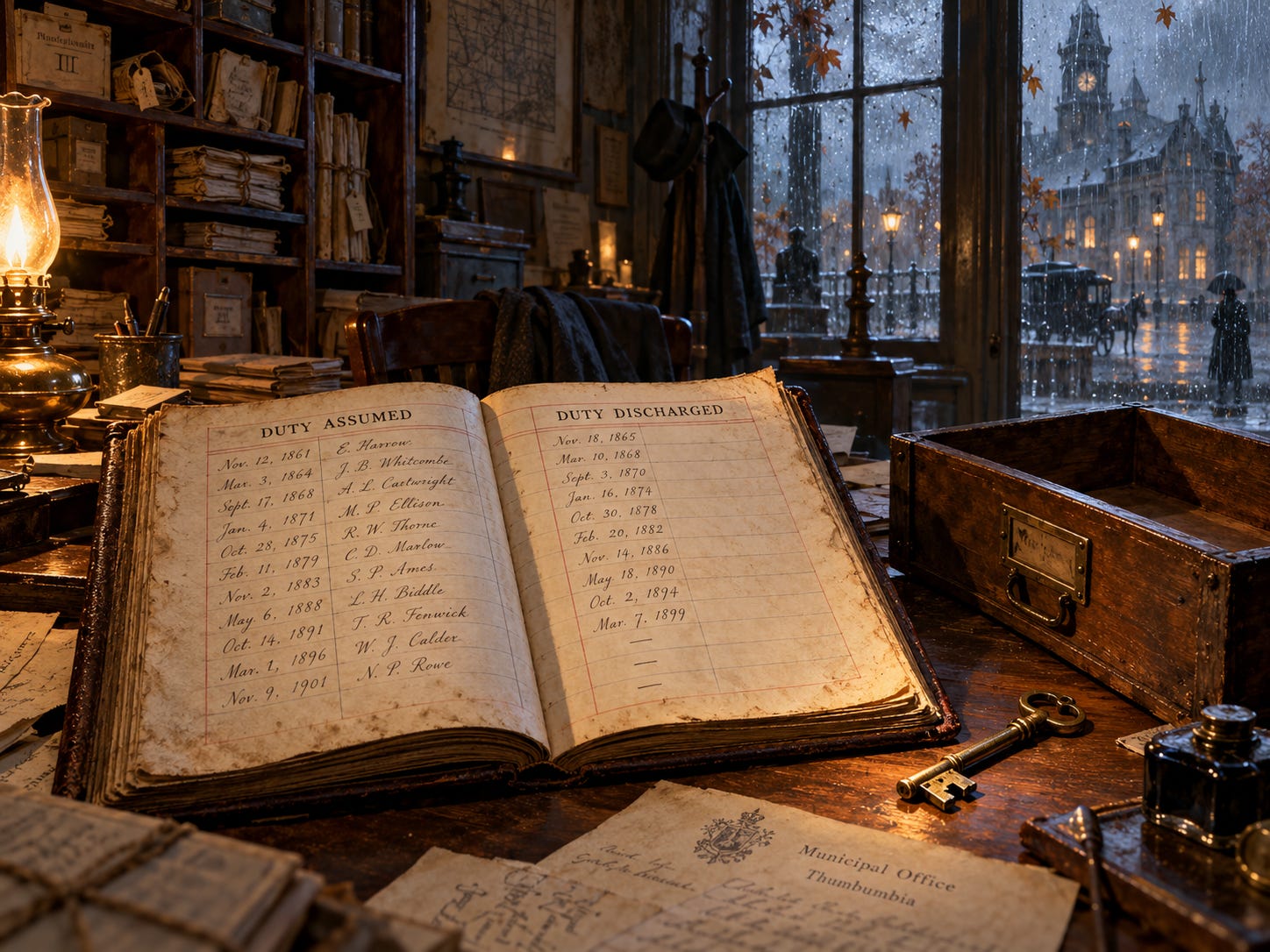
There were two small spaces.
The first was marked.
The second was blank.
Above them appeared the headings:
DUTY ASSUMED.
DUTY DISCHARGED.
The archivist leaned closer.
The woodland entry appeared to carry a mark indicating assumption of the duty.
But no completed discharge was visible.
She compared neighboring entries.
Several contained dates showing when their responsibilities had been fulfilled.
Others had remained open.
The woodland matter appeared to belong to the latter group.
She wrote:
The surviving records indicate a possible succession of custodial responsibility.
The continuing register appears to distinguish duties assumed from duties discharged.
No discharge entry has yet been identified for the woodland matter.
The original authority and present legal significance remain unverified.
Then she stopped.
Because the implication was considerable.
The old responsibility might not simply have disappeared when its office closed.
It might have been deliberately preserved.
Not a permission to enter Burzee.
Not evidence that the agreement had been completed.
Not proof that any document had ever reached the woodland.
But a record of an obligation that somebody had considered important enough to carry forward.
Outside, the bell tower sounded nine.
The four ships rested beneath the November stars.
And the archivist wrote one final question at the bottom of her report.
WHO WAS RESPONSIBLE FOR AN OBLIGATION THAT HAD NEVER BEEN DISCHARGED?
TO BE CONTINUED...
Tuesday, November 3: THE DUTY THAT OUTLIVED ITS KEEPER
The expedition has established a chain of references linking the woodland matter across multiple Thumbumbia offices.
The second office apparently accepted custodial responsibility, though the physical document was not entered into its records.
A later municipal reorganization may have carried that responsibility forward.
And a continuing register suggests that the obligation was assumed but not recorded as discharged.
But what responsibility survived?
Was it to preserve a document?
To protect conditions governing its release?
To ensure that a proper recipient was identified?
Or something else entirely?
And does a centuries-old administrative obligation still carry any authority?
The Evergreen, Hare, Lionheart, and Swallow remain at Thumbumbia.
The third boundary stone remains undisturbed.
No passage into Burzee has been authorized.
The concealed berth remains empty.
The unidentified object remains secured.
The entrusted name remains protected.
The third return remains unresolved.
And the expected guest remains unnamed.
But our travelers have made an important discovery.
THE ORIGINAL CUSTODIANS MAY BE GONE, YET THE RESPONSIBILITY THEY ACCEPTED MAY HAVE BEEN PRESERVED.
On Tuesday, the Scarecrow and his companions must confront a question that reaches far beyond an ancient woodland agreement.
CAN A PROMISE OUTLIVE THE PEOPLE WHO FIRST MADE IT?
💚 FROM THE YELLOW BRICK ROAD
WHEN RESPONSIBILITY OUTLIVES THE RECORD
There is a temptation in our modern world to confuse an assigned task with a completed responsibility.
We send a message and mark the communication finished.
We generate a report and regard the work as done.
We transfer a document and assume it has reached the appropriate person.
We create a record, file it, and move on.
But today, along the old road toward Burzee, our travelers encountered a remarkable distinction.
The second office had apparently accepted responsibility for a document.
Yet the surviving record did not establish that the document itself was ever entered into its custody.
The office had received a duty.
It had not necessarily received the thing that duty concerned.
And generations later, the distinction still mattered.
THE DIFFERENCE BETWEEN DOING AND COMPLETING
In the age of artificial intelligence, we increasingly rely upon systems capable of carrying out complicated sequences of tasks.
An AI assistant may prepare a document.
A software system may transmit it.
Another service may register an action as completed.
And a dashboard may display a reassuring checkmark.
But what does that checkmark actually mean?
Was the document created?
Was it sent?
Was it delivered?
Was it opened?
Was it understood?
Was the required approval obtained?
And did the action achieve the purpose for which it was undertaken?
These are different events.
A system that treats them as interchangeable can create an illusion of completion where important responsibilities remain unfinished.
Artificial intelligence may make work faster.
It may make complicated processes easier to manage.
It may help us identify inconsistencies and missing information.
But the responsibility to understand what completion means does not disappear.
A green checkmark is not a substitute for evidence.
And a recorded action is not necessarily a fulfilled obligation.
THE PROMISES WE INHERIT
There is another dimension to today’s story.
The ancient office in Thumbumbia no longer existed.
The people who had accepted its responsibilities were long gone.
Yet the surviving records suggested that someone had deliberately carried an obligation forward.
Perhaps the responsibility still mattered.
Perhaps its original purpose had changed.
Perhaps its conditions could no longer be fulfilled.
The travelers did not know.
But they understood that an institution’s disappearance did not automatically settle every promise entrusted to it.
Human communities inherit responsibilities from earlier generations.
We inherit libraries.
Public institutions.
Cultural traditions.
Works of art.
Historical records.
Buildings.
Forests.
And sometimes obligations whose original authors are no longer present to explain them.
We cannot preserve everything exactly as it was.
Nor should we assume that every historical arrangement must continue unchanged.
But we should consider what deserves protection and why.
That is particularly important when other people may be affected by our decisions.
WHEN TECHNOLOGY MEETS STEWARDSHIP
Artificial intelligence can contribute to responsible stewardship.
It can help identify related records.
Compare versions of documents.
Detect gaps in archival collections.
Track the status of administrative processes.
And make complicated information easier to examine.
These capabilities can help people recognize responsibilities that might otherwise be overlooked.
But they can also introduce risks.
A system may repeat an incorrect interpretation.
It may mistake similar records for identical ones.
It may overlook information that was never digitized.
Or it may produce confident conclusions from evidence that is incomplete.
Our Scarecrow has learned not to confuse possession with authority.
He has learned that a document may exist without having been delivered.
That delivery may occur without acknowledgment.
And that acknowledgment may not establish agreement unless the person giving it possessed the proper authority.
Today, he learned something more.
Accepting responsibility is not necessarily the same as fulfilling it.
This distinction matters in institutions, technology, business, and personal relationships.
It matters when we promise to help another person.
It matters when we entrust information to a service.
And it matters when we create systems whose decisions will affect people we may never meet.
A SMALL ACT OF KINDNESS
Perhaps the most revealing moment in today’s adventure did not occur in the archive.
It occurred beside a rain-soaked cart in Thumbumbia.
An elderly shopkeeper needed help.
The Scarecrow and White Rabbit offered it.
No official register had assigned them the task.
No document established the obligation.
And no formal acknowledgment was required.
They simply recognized another person’s need.
Then they acted.
There is a meaningful difference between responsibilities imposed upon us and responsibilities we freely embrace.
Both can matter.
And perhaps some of humanity’s greatest achievements have begun with people who recognized something worth protecting long before anyone assigned them the responsibility.
The first seed planted for a future generation.
The first book preserved from destruction.
The first song taught to a child.
The first act of kindness offered to someone who could not repay it.
We do not know how far those actions will travel.
But their consequences may outlive us.
And perhaps that is part of what makes our lives meaningful.
Not merely the things we accomplish for ourselves.
But the good we leave for others to discover.
A responsibility may begin with one person, but its consequences can reach generations that person will never know.
As November unfolds, the Scarecrow and his companions continue their patient search.
They have not entered Burzee.
They have not solved the mystery of the third return.
They have not opened the entrusted name.
And they have not discovered the identity of their expected guest.
But the journey is teaching them something about promises.
A promise is not merely a statement.
It is a responsibility that must be understood, accepted, and honored.
And sometimes its meaning becomes clearer only when we ask whom it was intended to protect.
The Yellow Brick Road continues.
One question.
One discovery.
One responsible step at a time.
🌲 A QUESTION FOR FELLOW TRAVELERS
What responsibility do you believe our generation should be most determined to preserve for those who come after us?
Our shared natural world?
The knowledge and cultural achievements of humanity?
Trustworthy institutions?
The freedom to learn, question, and create?
Or the simple conviction that every human being possesses dignity and deserves to be heard?
And a second question:
Have you ever inherited a responsibility that mattered to you because of the person who entrusted it to your care?
Sometimes what we preserve tells a story about what we love.
Sometimes what we protect becomes part of who we are.
And sometimes an unfinished promise becomes an invitation to act with greater understanding than those who came before us.
YELLOW BRICK ROAD TO AI
Where Humanity, Imagination, and Artificial Intelligence Meet.
What is, and what may be. ♾️
💚🟨🏮🌲⛵⛵⛵⛵♾️
#YellowBrickRoadToAI #YBR #OZQZ #NovemberStorytime #TheEvergreen #Thumbumbia #Burzee #Nonestica #FantasyAdventure #Mystery #Promises #Stewardship #Responsibility #Trust #Archives #HumanDignity #ArtificialIntelligence #ResponsibleAI #Storytelling
💚 © 2026 🟨 YellowBrickRoadtoAI.com 🤖
Exploring the road between humanity and artificial intelligence.
Q~ & AIAI & Scarecrow of OZ~QZ 🌈♾️👈 🏮