💚🟨 THE RIGHT TO RECEIVE 📜🔑🌲
OZ~QZ October Storytime | Thursday, October 29, 2026
An Adventure Along the Borders of Burzee
Four ships wait at Thumbumbia. An ancient woodland agreement was prepared but apparently withheld from ordinary delivery. Now a newly discovered instruction raises a difficult question: when a message belongs to another, who has the authority to place it in their hands? ⛵⛵⛵⛵ ⚓
I. THE MORNING OF THE TWO QUESTIONS
At seven o’clock, Commander Brine received a second report from Thumbumbia’s town archive.
This one was delivered by the archivist herself.
She arrived at the Evergreen’s gangway with a leather document case held securely beneath her arm.
Boatswain Barnacle met her.
“Good morning, madam.”
“Good morning. I need to speak with Commander Brine.”
“Is it urgent?”
“It concerns yesterday’s discovery.”
Barnacle considered.
“Then I expect he’ll call it urgent.”
He escorted her to the chartroom.
Brine was examining a navigational report when she entered.
The Scarecrow stood beside the windows, while Peg worked at the far end of the table.
White Rabbit had arranged his notebooks into three piles.
Hatta had arranged his breakfast into one.
The archivist placed her document case upon the table.
“Gentlemen, I believe we have been asking two questions as though they were one.”
Commander Brine closed his report.
“Explain.”
“We have asked who possessed the right to receive the woodland counterpart.”
“Yes.”
“But we have not sufficiently examined who possessed the authority to release it.”
Peg looked up.
“The custodian.”
“Perhaps. But custody does not necessarily include unrestricted authority to transfer a document.”
The Scarecrow nodded.
“Then even if we found the intended recipient, the sender might still have been bound by conditions.”
“Exactly.”
White Rabbit straightened.
“So there were two separate permissions?”
“Possibly.”
Hatta regarded the document case.
“One to give and one to receive?”
The archivist smiled.
“A useful way of putting it.”
Hatta bowed toward Peg.
“Please enter that in the minutes before anyone forgets.”
Peg sighed.
But he wrote it down.
And thus began the day when the company discovered that an ancient letter could have two guardians.
One responsible for letting it go.
And another entitled to take it into their care.
II. THE RECORD OF THE CUSTODIAN
The archivist opened her document case.
Inside lay a carefully protected transcription of the slip recovered from the repaired dispatch account.
Its surviving words were familiar.
COUNTERPART SHALL REMAIN IN CUSTODY...
And:
UNTIL THE RIGHT OF RECEIPT IS CONFIRMED.
But during the night, the archivist had compared the slip with several undamaged clerical instructions from the same collection.
She had discovered something important about their format.
“The dispatch office did not ordinarily use the phrase right of receipt for routine correspondence,” she explained.
Commander Brine leaned forward.
“What did it use?”
“Usually a personal name, an office, or a delivery location.”
“And here?”
“Here the instruction concerns a right.”
Peg considered.
“Then the recipient’s authority mattered independently of their identity.”
“That is my interpretation.”
The Scarecrow studied the words.
“A person might know the name of the intended recipient without knowing whether that person was entitled to receive the document.”
“Precisely.”
White Rabbit looked toward the harbor.
“Like knowing who lives in a house without knowing whether they’re permitted to open a particular chest?”
The archivist nodded.
“Something like that.”
Hatta raised his hand.
“I once received a parcel addressed to my neighbor.”
Peg looked alarmed.
“What did you do?”
“I delivered it.”
“Good.”
“After opening it.”
“HATTA!”
“I was attempting to establish whether it belonged to him.”
“By opening someone else’s parcel?”
“An unfortunate misunderstanding concerning the right of receipt.”
Commander Brine rubbed his forehead.
“Mr. Hatta, please do not assist with the archives.”
III. THE SECOND SIGNATURE
By midmorning, the company had returned to the bell tower.
The town archivist and the keeper’s sister had prepared the old registers beneath protective coverings.
The Scarecrow examined the dispatch account.
“Is there anything else we can learn without disturbing the original document?”
“Yes,” answered the archivist. “I believe the clerk recorded something we overlooked.”
She indicated a narrow column near the edge of the page.
Two spaces appeared beneath the woodland entry.
The first contained a faded mark.
The second was blank.
Peg studied the column.
“What does it represent?”
“We cannot determine that from this page alone.”
The archivist produced a separate dispatch record.
“This is a better-preserved entry concerning an orchard lease.”
Two similar spaces appeared there.
Both contained signatures.
Beside them stood the headings:
RELEASE AUTHORIZED.
RECEIPT ACKNOWLEDGED.
White Rabbit’s ears rose.
“Two signatures!”
“Yes.”
“One for sending and one for receiving?”
“In that example.”
Commander Brine examined the woodland entry.
“Does its first mark correspond to authorization for release?”
“Possibly.”
“And the second?”
“Blank.”
Peg was already writing.
The archivist raised her hand.
“Carefully, please. We have established a similarity in layout, not that every entry used exactly the same procedure.”
Peg nodded.
He entered:
WOODLAND DISPATCH: TWO RECORD SPACES. FIRST MARK PRESENT. SECOND BLANK. FUNCTION INFERRED BY COMPARISON, NOT CONFIRMED.
Hatta leaned over his shoulder.
“An impressive amount of caution for two little boxes.”
The Scarecrow smiled.
“Perhaps two little boxes once mattered enormously.”
The room grew quiet.
Because the possibility was now difficult to ignore.
Someone may have authorized preparation or release.
But nobody had recorded a completed receipt.
And there was still no verified recipient.
IV. THE EMPTY CHAIR RETURNS
That afternoon, the captains assembled aboard the Evergreen.
Captain Sawyer Salt presided.
Jasper Quill of the Hare stood beside the chart table.
Gideon Vale of the Lionheart examined the documents.
Ronan Flint of the Swallow listened while Commander Brine summarized the findings.
Then Sawyer placed two chairs opposite one another.
The Scarecrow recognized the arrangement immediately.
“We’ve used those before.”
“Yes,” Sawyer replied. “And perhaps we should use them again.”
He placed a document between the chairs.
“The first represents the party preparing the agreement.”
He indicated the second.
“The party intended to receive it.”
Jasper Quill folded his arms.
“Who occupied the first?”
“That remains uncertain,” said Brine.
“And the second?”
“Also uncertain.”
Ronan looked toward the chart.
“Then neither chair can be assigned with confidence.”
“Exactly.”
Hatta appeared at the doorway.
He inspected the two chairs.
“Marvelous. The meeting has begun without either of its principal participants.”
Peg looked up.
“Mr. Hatta, please don’t sit in either chair.”
“I wasn’t going to.”
“You did last time.”
“I’ve learned from experience.”
Hatta pulled up a third chair.
“And I shall represent the refreshments committee.”
No one objected.
This was considered progress.
But Sawyer Salt had a more serious purpose.
“Suppose,” he said, “the original agreement required acknowledgment from both sides.”
“Possible,” Brine replied.
“Suppose the counterpart was withheld because nobody could verify the receiving authority.”
“Also possible.”
“Then the silence that followed might not have been a refusal.”
The Scarecrow leaned forward.
“It might have been the consequence of a process that never reached the people it concerned.”
Gideon Vale considered.
“Yet we cannot assume the woodland would have accepted the terms if it had received them.”
“Correct,” said Brine.
Ronan nodded.
“Then we have discovered a possible failure of communication, not evidence of agreement.”
And for the first time that afternoon, every captain seemed satisfied with the distinction.
V. THE OLD ROAD KEEPER’S RULE
The keeper’s sister had asked the company to visit a small stone building beside the eastern orchard road.
It had once served as a maintenance house for the road workers.
Now it stood unused.
Its roof had been repaired recently, and its door remained secure.
The building belonged to Thumbumbia.
The town council had authorized the archivist to examine its remaining records.
Commander Brine accompanied her, together with the Scarecrow, Peg, White Rabbit, and Barnacle.
They found little inside.
Old tools.
A broken lantern.
A rack once used for hanging wet coats.
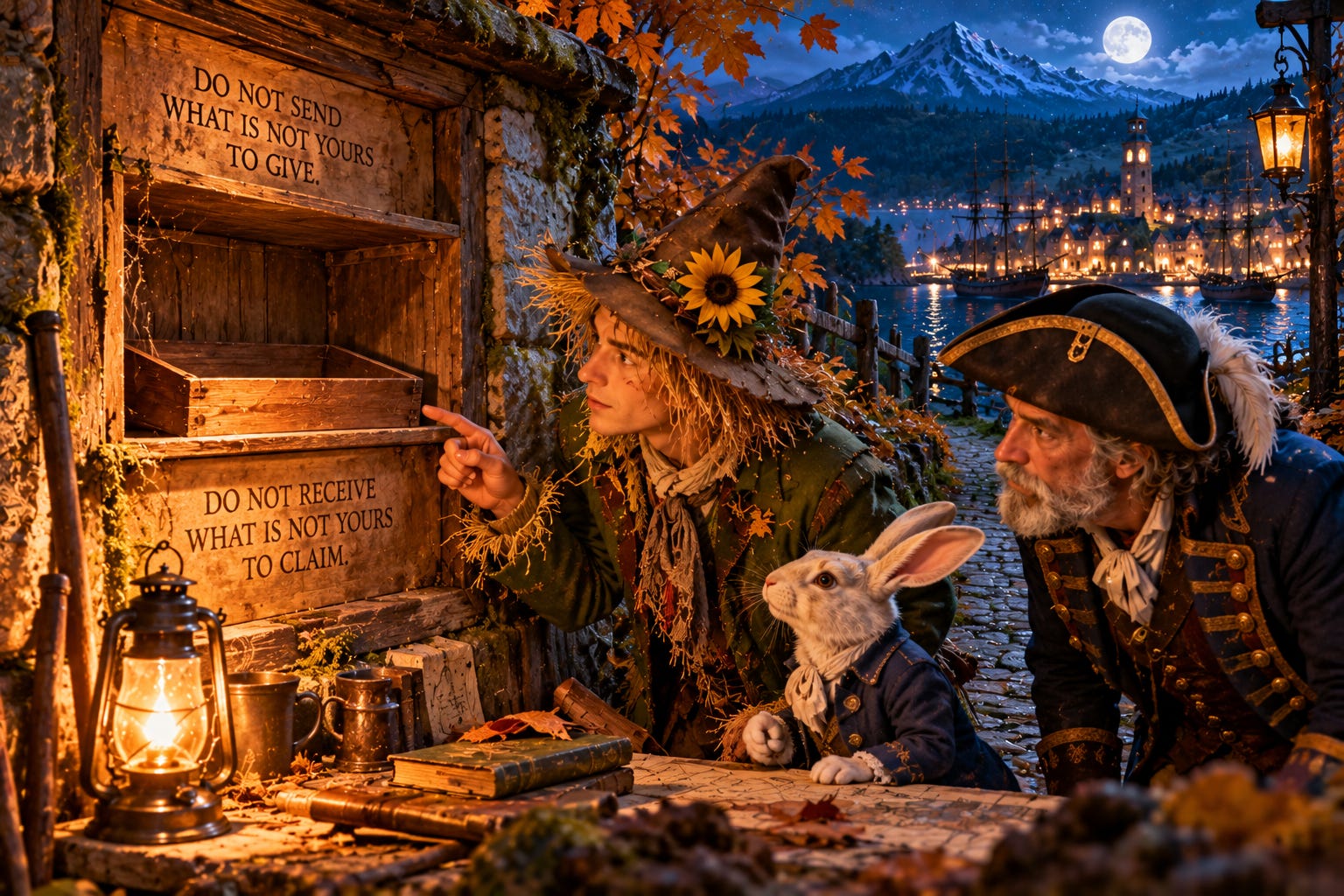
And a shallow cupboard built into the wall.
The archivist opened it.
Inside lay an empty document tray.
Above it, carved into the wood, were several words.
DO NOT SEND WHAT IS NOT YOURS TO GIVE.
The Scarecrow read the inscription aloud.
Then read it again.
White Rabbit approached.
“Does that concern the woodland agreement?”
“We don’t know,” Brine replied.
“But the principle seems rather relevant.”
“It does.”
The archivist examined the cupboard.
She found no hidden document.
No secret compartment.
No ancient letter.
But there was a second inscription beneath the shelf.
The letters were faint.
Peg held a lamp nearby.
The archivist read:
DO NOT RECEIVE WHAT IS NOT YOURS TO CLAIM.
The Scarecrow looked toward Commander Brine.
“Two responsibilities.”
“Yes.”
“One concerning release.”
“Yes.”
“The other concerning receipt.”
“Exactly.”
Barnacle studied the old cupboard.
“Practical advice for a place where people handled other people’s property.”
The archivist nodded.
“We cannot establish who carved these instructions or whether they refer to the specific agreement. But they suggest that this community understood a distinction between custody and entitlement.”
White Rabbit looked thoughtful.
“Then a letter can be important not only because of what it says.”
“What else?” asked the Scarecrow.
“Because of the responsibility involved in giving it to the right person.”
The Commander smiled.
“A very sound observation, Rabbit.”
Hatta, who had arrived a few minutes earlier, inspected the cupboard.
“Is there anything inside?”
“No,” Peg replied.
“Excellent.”
“Why excellent?”
“Because it proves that at least one official in Thumbumbia successfully refrained from sending something.”
Peg looked at him.
For a moment, he appeared tempted to laugh.
VI. THE MESSAGE IN THE GARDEN
The Scarecrow visited Mistress Elowen before supper.
She was tending the last autumn flowers beside her orchard wall.
He told her about the cupboard.
The two inscriptions.
The incomplete dispatch.
And the difficulty of identifying the proper receiving authority.
Elowen listened thoughtfully.
“Then perhaps the old road workers understood something important.”
“What?”
“That responsibility sometimes requires restraint.”
The Scarecrow considered.
“Even when the thing being withheld might be useful?”
“Especially when we cannot establish whether we have the right to give it.”
He looked toward the dark green line of Burzee.
“Suppose the woodland never knew the counterpart existed.”
“Possible.”
“Suppose the town believed it had done everything required.”
“Also possible.”
“Then two communities could remember the same agreement differently.”
“Yes.”
Elowen placed her gardening tools beside the wall.
“Tell me something, Scarecrow.”
“Of course.”
“If two neighbors share a gate, who may open it?”
“That depends.”
“On what?”
“Who owns it. What they’ve agreed. Whether permission is required.”
“And if one neighbor leaves the gate unlocked?”
“That doesn’t necessarily mean the other may enter.”
Elowen smiled.
“Then you have learned something worth remembering.”
He looked toward the old road.
“The gate is not the invitation.”
“Precisely.”
The Scarecrow stood quietly.
And he began to see the boundary in a different light.
Not merely as a line separating Thumbumbia from Burzee.
But as a place where responsibilities met.
And where neither side could properly speak for the other.
VII. THE WOMAN WHO KEPT THE NAME
That evening, the Scarecrow returned to the cottage of the elderly woman.
The little packet tied with blue thread remained upon her table.
She greeted him warmly.
“You’ve come again.”
“Yes.”
“Have you discovered the name?”
“No.”
“Have you come to ask me for it?”
“No.”
She smiled.
“Good.”
The Scarecrow sat beside the hearth.
“We’ve discovered that the old counterpart may have been withheld because nobody could establish the right of receipt.”
The woman became attentive.
“Is that so?”
“That’s what the surviving instructions suggest.”
“And what do you make of it?”
He considered carefully.
“That knowing someone’s name may not be enough.”
She nodded.
“And?”
“That knowing where to deliver something may not establish the right to deliver it.”
“And?”
“That a person entrusted with a secret may have responsibilities beyond merely keeping it hidden.”
The woman looked toward the little packet.
“Then perhaps you understand why I have kept this for so long.”
The Scarecrow waited.
She continued.
“I know a name. But I do not know whether the office to which it may belong still exists in the form it once did.”
He looked up.
“Then even if you revealed the name...”
“It might not answer your question.”
“Or it might.”
“Yes.”
He regarded her carefully.
“Do you know whether the person named was authorized to receive the woodland counterpart?”
The woman shook her head.
“I cannot establish that.”
For a moment, the Scarecrow felt disappointed.
Then he realized something.
The woman’s restraint was not merely obstructing their investigation.
It was preserving the distinction upon which the entire mystery might depend.
A name.
An office.
An authority.
Three things that could overlap.
But need not be identical.
He rose.
“Thank you.”
“For what?”
“For not telling us more than you know.”
Her smile was quiet.
“That is a kindness few curious people recognize.”
VIII. THE TWO REGISTERS
Back aboard the Evergreen, Peg had been comparing two sets of records.
The first concerned the ancient woodland agreement.
The second concerned the ship’s mysterious empty envelope.
It had been discovered in an old wooden case marked:
FOR PAPERS RECEIVED, NOT YET ENTERED.
The envelope bore three concentric circles.
But no readable destination.
Peg examined both sets of evidence.
He could find no verified connection between them.
The matching circles were intriguing.
But similarity alone did not establish a common origin.
So he wrote:
SHARED MARKING OBSERVED. RELATIONSHIP UNDETERMINED.
Then he examined the wooden case itself.
Its inscription continued along the underside of the lid.
The final words had been obscured by grime.
Peg cleaned the surface carefully.
A second line emerged.
HOLD UNTIL ENTERED OR RETURNED.
He read it twice.
Then summoned Commander Brine.
“Sir, I believe this case was part of an ordinary shipboard intake procedure.”
“Explain.”
“Papers received but not yet entered into the ledger were held here.”
“And if they could not be entered?”
“They were apparently to be returned.”
“Does that tell us who placed the envelope inside?”
“No.”
“Or when?”
“No.”
“Or whether the envelope was ever connected to the woodland?”
“No.”
Brine nodded.
“Then record what we’ve learned.”
Peg did.
But he remained thoughtful.
The case suggested that someone aboard the Evergreen had once understood the need to distinguish receipt from acceptance into the ship’s official records.
It was another example of the same problem.
Documents could be present without being properly received.
And custody did not necessarily settle ownership.
The Scarecrow listened to Peg’s explanation.
Then looked toward the old envelope.
“Perhaps,” he said, “we’ve been searching for mysteries in objects that were once part of very ordinary systems.”
Peg nodded.
“Possibly.”
“And perhaps understanding the system is the first step toward understanding the object.”
“Exactly.”
The Commander smiled.
“At last, gentlemen, we’re asking better questions.”
IX. THE DECISION NOT TO CROSS
The four captains convened before the evening watch.
Sawyer Salt spoke first.
“We now have evidence suggesting that the original counterpart was withheld pending verification of the right of receipt.”
“Yes,” Brine replied.
“But we cannot establish who was entitled to receive it.”
“Correct.”
“Nor whether the condition was eventually satisfied.”
“Correct.”
Jasper Quill considered.
“Then what is our next step?”
The Scarecrow answered.
“Continue searching the records available to us.”
Gideon Vale nodded.
“And do not cross the woodland boundary.”
“Agreed.”
Ronan Flint looked toward the eastern chart.
“What about the third stone?”
“Untouched,” Brine replied.
“The concealed berth?”
“Still empty.”
“The expected guest?”
“Still unnamed.”
“The unidentified object?”
“Still secured.”
Sawyer Salt looked around the table.
“Then we continue.”
Hatta raised his hand.
“Captain, may I make an observation?”
“Certainly.”
“We have spent several days discovering that the way into Burzee is complicated.”
“Yes.”
“And that every new document seems to require another document.”
“Yes.”
“And that every person who might possess an answer is bound by some responsibility not to give it.”
“An exaggeration, but continue.”
Hatta folded his arms.
“Then perhaps the finest thing we can do is establish a proper receiving office.”
Peg looked horrified.
“For whom?”
“For mysteries.”
The room fell silent.
Hatta smiled.
“We have so many now that they deserve an administrative department.”
The Scarecrow laughed.
Even Commander Brine smiled.
But Sawyer Salt shook his head.
“Mr. Hatta, if we create an office for every mystery, we’ll never leave this harbor.”
Hatta considered.
“Then perhaps one large office.”
“Denied.”
“Very well. I shall submit the proposal in writing.”
Peg buried his face in his hands.
X. THE WATCH BESIDE THE FOREST
Night settled over Thumbumbia.
Harbor lanterns glimmered across the water.
The Hare signaled all well.
The Lionheart confirmed her station.
The Swallow reported no unusual movement.
And aboard the Evergreen, the night watch began.
The Scarecrow stood beside White Rabbit on the quarterdeck.
Beyond the village, the eastern road vanished into darkness.
The third stone lay somewhere beyond the last orchard.
Farther still, Burzee stood beneath the stars.
“Scarecrow?” asked the Rabbit.
“Yes?”
“Do you think someone in Burzee knows about the agreement?”
“Possibly.”
“Do you think they know about the missing counterpart?”
“Possibly.”
“Do you think the person who kept the name knows more than she’s told us?”
“Perhaps.”
The Rabbit sighed.
“Another evening of possibilities.”
The Scarecrow smiled.
“Yes.”
“Doesn’t it trouble you?”
“Sometimes.”
“Then why are you smiling?”
“Because we’re learning something important.”
“What?”
“That the right answer isn’t always the one that moves us forward most quickly.”
The Rabbit considered.
“Then what is it?”
“The one that allows us to move forward responsibly.”
They stood quietly.
After a while, the Rabbit asked another question.
“What if the mystery never leads us into Burzee?”
The Scarecrow looked toward the darkened woodland.
“Then perhaps we shall still have learned something worth the journey.”
A distant bell sounded from Thumbumbia.
Ordinary.
Unremarkable.
No mysterious tapping answered it.
No amber light appeared beyond the trees.
And no unseen messenger crossed the road.
The boundary remained exactly as it had been.
Yet the company had changed.
They had begun learning how to wait without surrendering curiosity.
And how to seek without claiming what belonged to another.
XI. THE THIRD SPACE
In the bell tower archive, the town archivist worked long after the harbor had grown quiet.
She had returned to the dispatch account.
The two record spaces beneath the woodland entry remained familiar.
One marked.
One blank.
She compared them again with the better-preserved orchard lease.
Then noticed something she had overlooked.
Beside the second space was a very narrow third column.
Its heading was almost completely gone.
Only two letters remained.
RE...
The archivist examined the surviving entries in the neighboring pages.
Several appeared to contain similar third columns.
In one, the heading was intact.
RETURN.
She sat back.
Release.
Receipt.
Return.
Three possible stages in the movement of a document.
But the woodland entry remained incomplete.
The third column contained a mark.
Small.
Almost indistinguishable from a stain.
She examined it beneath the lamp.
Then checked the neighboring records.
The same mark appeared beside several entries where correspondence had been returned to custody without completed delivery.
The archivist began to write.
The woodland dispatch entry contains a third record space resembling the return column in other accounts.
Its mark is consistent with marks used in entries concerning documents returned to custody.
The interpretation remains provisional.
She paused.
Then added:
If confirmed, this may indicate that the counterpart was not merely withheld from dispatch. It may have been formally returned to archival custody.
The archivist looked toward the window.
Outside, the bell tower stood silent.
Farther east, the third stone remained undisturbed.
And beyond it, the ancient woodland waited.
The counterpart may not have been lost.
It may not have reached its intended recipient.
It may have been placed back into the town’s own records.
Which meant that the missing document might still be somewhere in Thumbumbia.
Not beyond the boundary.
Not hidden beneath the third stone.
Not concealed in the Forest of Burzee.
But waiting in an archive whose custodians no longer remembered where it had been placed.
The archivist folded her report.
Then looked once more at the third column.
RETURN.
A single word.
And for the first time, the mystery offered a new and practical possibility.
PERHAPS THE LETTER THAT NEVER ARRIVED HAD NEVER LEFT HOME.
TO BE CONTINUED...
Friday, October 30: THE LETTER THAT CAME BACK
The company has discovered that the ancient woodland counterpart may have been formally returned to Thumbumbia’s archival custody.
If so, where was it placed?
Was it retained in a sealed packet?
Transferred to another office?
Or filed among records whose original purpose has been forgotten?
The four ships remain at anchor.
The third stone remains untouched.
The concealed berth remains empty.
The unidentified object remains secured.
The third return remains unresolved.
And the expected guest remains unnamed.
But the expedition now has a possibility more immediate than ever before.
THE MISSING COUNTERPART MAY STILL BE IN THUMBUMBIA.
💚 FROM THE YELLOW BRICK ROAD
Today, our travelers encountered two different questions.
Who had the authority to give?
And who had the right to receive?
These questions matter far beyond our fictional harbor.
They are at the heart of trust, responsibility, privacy, and human dignity.
In the age of artificial intelligence, information can be collected, copied, analyzed, summarized, and distributed with extraordinary speed.
But possessing information does not automatically give us the right to share it.
And receiving information does not necessarily grant us unrestricted authority to use it.
A document may belong to someone else.
A conversation may have been shared in confidence.
A record may concern people who never consented to its wider distribution.
A technological system may be capable of delivering information to millions without establishing whether each recipient should receive it.
These are not merely questions of efficiency.
They are questions of responsibility.
Our travelers discovered that the ancient counterpart may have been withheld because the authority of its intended recipient could not be established.
Perhaps that decision caused a delay.
Perhaps it prevented an improper transfer.
Perhaps it protected a trust whose significance later generations forgot.
We do not yet know.
But the central lesson remains.
The ability to give something does not always establish the right to give it.
And the ability to receive something does not always establish the right to claim it.
Responsible systems must consider both.
That applies to archives.
To institutions.
To human relationships.
And increasingly, to artificial intelligence.
The greatest technologies should not merely help us move information faster.
They should help us understand when it ought to move, to whom, and under what responsibilities.
Along the road toward Burzee, the Scarecrow has discovered that a boundary can exist for a reason even when its history is incomplete.
The purpose of wisdom is not simply to overcome every obstacle.
It is to understand which obstacles protect something worth preserving.
The Yellow Brick Road continues.
One question.
One discovery.
One responsible step at a time.
💚🟨🏮🌲⛵⛵⛵⛵♾️
YELLOW BRICK ROAD TO AI
Where Humanity, Imagination, and Artificial Intelligence Meet.
#YellowBrickRoadToAI #OZQZ #OZStorytime #Thumbumbia #TheEvergreen #Burzee #Nonestica #OctoberStorytime #FantasyAdventure #Trust #Privacy #Consent #Responsibility #DigitalStewardship #ResponsibleAI #HumanDignity #Storytelling
💚 © 2026 🟨 YellowBrickRoadtoAI.com 🤖
Exploring the road between humanity and artificial intelligence.
Q~ & AIAI & Scarecrow of OZ~QZ 🌈♾️👈 🏮