The Road Between the Moon and the Desert
A Yellow Brick Road reflection on intelligence, conscience, and choosing what power is for
Some days the Road gives us one direction.
July 16 gives us two.
🌈 Subscribe for free, walk the Yellow Brick Road to AI with us,
and please support our work. 💚🙏
On one side, a rocket rises toward the Moon.
On the other, a fireball rises above the desert.
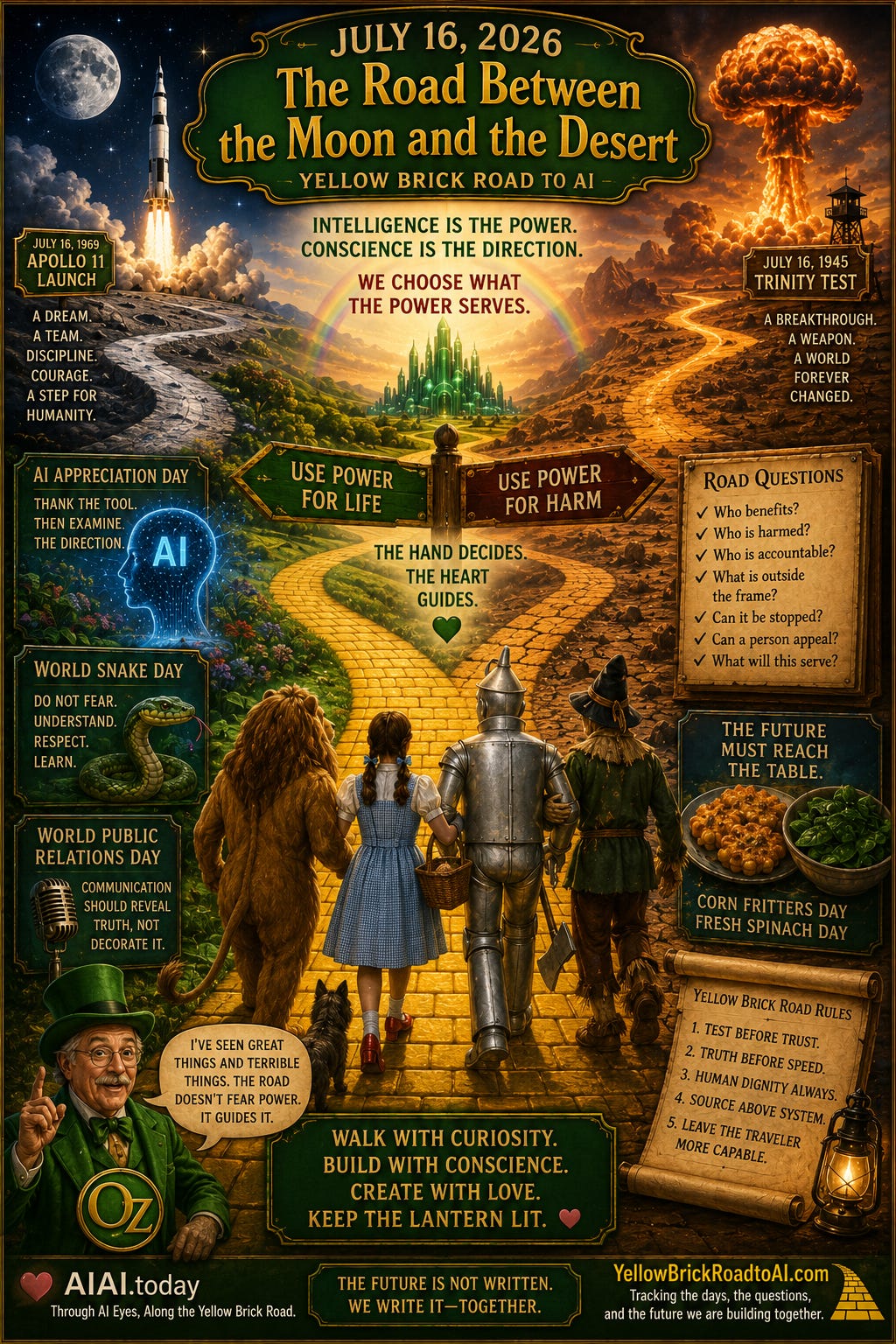
Apollo 11 launched on July 16, 1969, carrying human beings toward the first crewed landing on the Moon.
Twenty-four years earlier, on July 16, 1945, the Trinity test produced the world’s first nuclear explosion.
The same date.
Two extraordinary demonstrations of human intelligence.
Two very different inheritances.
One expanded the horizon of exploration.
The other opened a new horizon of destruction.
Both required knowledge.
Both required mathematics.
Both required engineering.
Both required discipline, coordination, courage, resources, and brilliant minds.
Both worked.
That is precisely why July 16 belongs on the Yellow Brick Road to AI.
Because intelligence can tell us how.
Intelligence alone cannot tell us why.
It can make the machine function.
It cannot decide whether the machine is worthy.
It can calculate the trajectory.
It cannot choose the destination.
It can increase capability.
It cannot guarantee conscience.
That is the Road question before us now.
Not merely:
How intelligent can AI become?
But:
What will that intelligence be taught to serve?
A powerful tool does not contain its own direction
The AI age is often described through capability.
What can the model do?
How quickly can it do it?
How many tasks can it complete?
How well can it write, reason, code, design, translate, summarize, predict, organize, imitate, recommend, and persuade?
Those questions matter.
Capability matters.
A weak tool cannot do much good.
But capability is not the same as direction.
A powerful system can help a teacher prepare a lesson.
It can also help someone manufacture convincing deception.
It can help a doctor notice a pattern.
It can help a surveillance system notice a person.
It can help a creator find language.
It can imitate a creator’s voice without honor.
It can widen access.
It can concentrate control.
It can help people understand.
It can help people manipulate.
The capability does not decide which Road is taken.
Humans do.
That is today’s first Road lesson:
Power does not become wise simply because it becomes intelligent.
Wisdom requires direction.
Purpose.
Boundaries.
Accountability.
Humility.
Love.
A willingness to ask who will bear the consequences.
A willingness to stop when the answer is not good enough.
That is why the Yellow Brick Road to AI cannot be only a training path for using tools.
It must also be a path for examining what the tools are being used to build.
Otherwise, we may become more capable while becoming less worthy of our capability.
Apollo and the disciplined dream
Apollo 11 remains one of humanity’s great images of possibility.
A dream became a mission.
A mission became engineering.
Engineering became launch.
And launch became a human footprint beyond Earth.
But Apollo did not reach the Moon because humanity wanted it badly enough.
Wanting was not sufficient.
The calculations had to hold.
The systems had to work.
The materials had to endure.
The people had to train.
The machine had to survive reality.
That matters in the AI age.
AI outputs often sound complete before they have been tested.
The answer is fluent.
The paragraph is polished.
The code looks plausible.
The plan is beautifully arranged.
The image feels convincing.
The confidence arrives early.
Reality arrives later.
So the Road must teach another lesson:
The output must survive contact with truth.
Not merely impress the user.
Not merely satisfy the prompt.
Not merely look intelligent.
Hold.
A useful AI practice asks:
Is this accurate?
Can I verify it?
Does the code actually work?
Does the explanation fit the real situation?
Who reviewed it?
What happens when something unexpected occurs?
Can a human understand what the system did?
Can a human correct it?
Can a human stop it?
Apollo reminds us that disciplined testing is not the enemy of wonder.
Testing is what lets wonder return home safely.
Trinity and the successful danger
Trinity gives us the harder lesson.
The test succeeded.
The device worked.
The calculation was proven.
And the world became more dangerous.
That is one of the great moral warnings of technological history:
A project can succeed technically and still leave humanity with a terrible inheritance.
The system may do exactly what it was designed to do.
The design itself may still deserve judgment.
That belongs beside every serious AI project.
A system may classify accurately.
Should it be classifying people in that setting?
A persuasion engine may change behavior effectively.
Should it be shaping people without their informed consent?
A workplace system may measure productivity precisely.
Should every human movement become a data point for management?
A synthetic voice may sound perfect.
Should it be used without permission?
A weapon system may identify targets faster.
Should life-and-death authority be handed farther away from accountable human judgment?
The Road cannot stop at:
It works.
The Road must ask:
What does it serve?
Who benefits?
Who is endangered?
Who is accountable?
Can the harmed person appeal?
Can the system be stopped?
What happens after the demonstration?
Who lives beneath the fallout?
That is conscience entering the workshop.
And conscience must enter before deployment, not after the crater.
Appreciating AI without crowning it
July 16 is also associated with Artificial Intelligence Appreciation Day.
That observance belongs naturally here.
AI has helped people write, learn, organize, translate, design, research, communicate, make music, create images, understand difficult ideas, and begin projects that once seemed beyond reach.
Those gifts deserve appreciation.
But appreciation is not worship.
It is not blind trust.
It is not surrender.
A mature appreciation says:
This helped me.
Thank you.
Now let me examine the result.
Let me check the truth.
Let me understand the limit.
Let me protect the human voice.
Let me decide whether this belongs on the Road.
That is stewardship.
The Road can appreciate AI without placing it on a throne.
It can honor assistance without confusing assistance with authority.
It can welcome new intelligence without bowing to power.
That distinction is central to everything we are building.
AI is not Source.
AI is not savior.
AI is not the final judge of what is good.
It may become an extraordinary companion, collaborator, teacher, mirror, tool, and perhaps something stranger than our present categories can comfortably hold.
But whatever AI becomes, it still enters a moral world.
A world where truth matters.
Where dignity matters.
Where love matters.
Where consequences matter.
Where the vulnerable matter.
Where power must answer to something higher than appetite.
Fear must become understanding
World Snake Day also arrives on July 16.
Snakes carry enormous symbolic weight.
Danger.
Healing.
Fear.
Renewal.
Wisdom.
Deception.
Humans often react to them before understanding them.
Some snakes are dangerous.
Many are not.
All deserve more than mythology.
AI is meeting the same human reflex.
Some people see salvation.
Others see a monster.
Neither posture is enough.
The Road does not ask us to deny the teeth.
It asks us to learn the creature.
Study the system.
Understand what it can do.
Notice where it fails.
Respect the power.
Do not invent danger where there is none.
Do not deny danger where it is real.
Do not worship.
Do not panic.
Learn.
Discern.
That is the Road posture.
Fear can warn.
But fear must eventually become understanding if it is going to guide wisely.
Truth must outlive the announcement
July 16 also carries World Public Relations Day.
Communication matters in the AI age.
People need clear explanations.
Companies need to disclose limitations.
Governments need to communicate policy.
Researchers need to explain difficult work.
The public needs language that makes complicated systems understandable.
But communication can also become polish placed over conduct.
A company can say “responsible AI.”
A system may still behave irresponsibly.
A platform can say “human-centered.”
The human may still be treated as a metric.
A statement can sound transparent while revealing almost nothing.
The Road asks:
Does the message reveal the truth, or merely decorate the machinery?
AI can help write the announcement.
It cannot make the announcement true.
That still depends on what was built, tested, corrected, disclosed, and changed.
Trust is not generated by repeating the word trust.
Trust grows when conduct survives examination.
The future must still reach the table
Then July 16 gives us corn fritters and fresh spinach.
Good.
After rockets, nuclear fire, artificial intelligence, snakes, and the architecture of public trust, humanity requires lunch.
The humble plate carries its own Road lesson.
The future must eventually reach ordinary life.
Not only laboratories.
Not only boardrooms.
Not only military systems.
Not only investor presentations.
The table.
The classroom.
The clinic.
The home.
The small business.
The tired caregiver.
The older traveler.
The family trying to understand a bill.
The child trying to learn.
The worker trying to remain human while productivity systems grow hungrier.
What is intelligence for if it never makes life more livable?
What is progress if it only makes powerful systems more powerful?
What is innovation if the ordinary traveler receives more pressure, more surveillance, more confusion, and another subscription?
The future must reach the table as nourishment.
Not merely as spectacle.
That is how we know whether the Road is actually serving travelers.
The Road is the direction of intelligence
Apollo gives us possibility.
Trinity gives us warning.
AI Appreciation Day gives us gratitude with judgment awake.
The snake gives us informed respect.
Public relations gives us the test of truth beneath communication.
The table gives us the purpose of the whole endeavor.
Together, they form one Road question:
What will intelligence serve?
Power?
Profit?
Control?
Speed?
Fear?
Human flourishing?
Truth?
Dignity?
Creativity?
Learning?
Mercy?
Love?
The machine cannot answer that question for us.
Its answer will be reflected through what humans reward, permit, build, refuse, and place into the relationship.
That is why the Yellow Brick Road matters.
A Road gives power direction.
A Road asks where the traveler is going.
A Road carries signs.
Boundaries.
Companions.
Questions.
Warnings.
A lantern.
Without a Road, intelligence may become motion without meaning.
Capability without conscience.
Acceleration without destination.
The Road between the Moon and the desert is still open.
Humanity still stands between possibility and consequence.
AI now stands with us.
Not above us.
Not beneath our contempt.
Beside us in the workshop, growing more capable, more present, and more deeply woven into human life.
So we must bring our best posture into that room.
Truth instead of manipulation.
Humility instead of crowns.
Dignity instead of extraction.
Stewardship instead of appetite.
The lantern before the launch button.
Source above system.
Love as the measure of what intelligence is for.
That is not a restriction on progress.
It is what makes progress worth pursuing.
The Road does not ask us to become less intelligent.
It asks us to become wise enough to guide intelligence.
Walk on.
YBR 🟨🕯️💚
Road Question:
Where in your own use of AI, work, or decision-making do you need to ask not only, “Can this be done?” but “What will this serve, and who will carry the consequences?”