


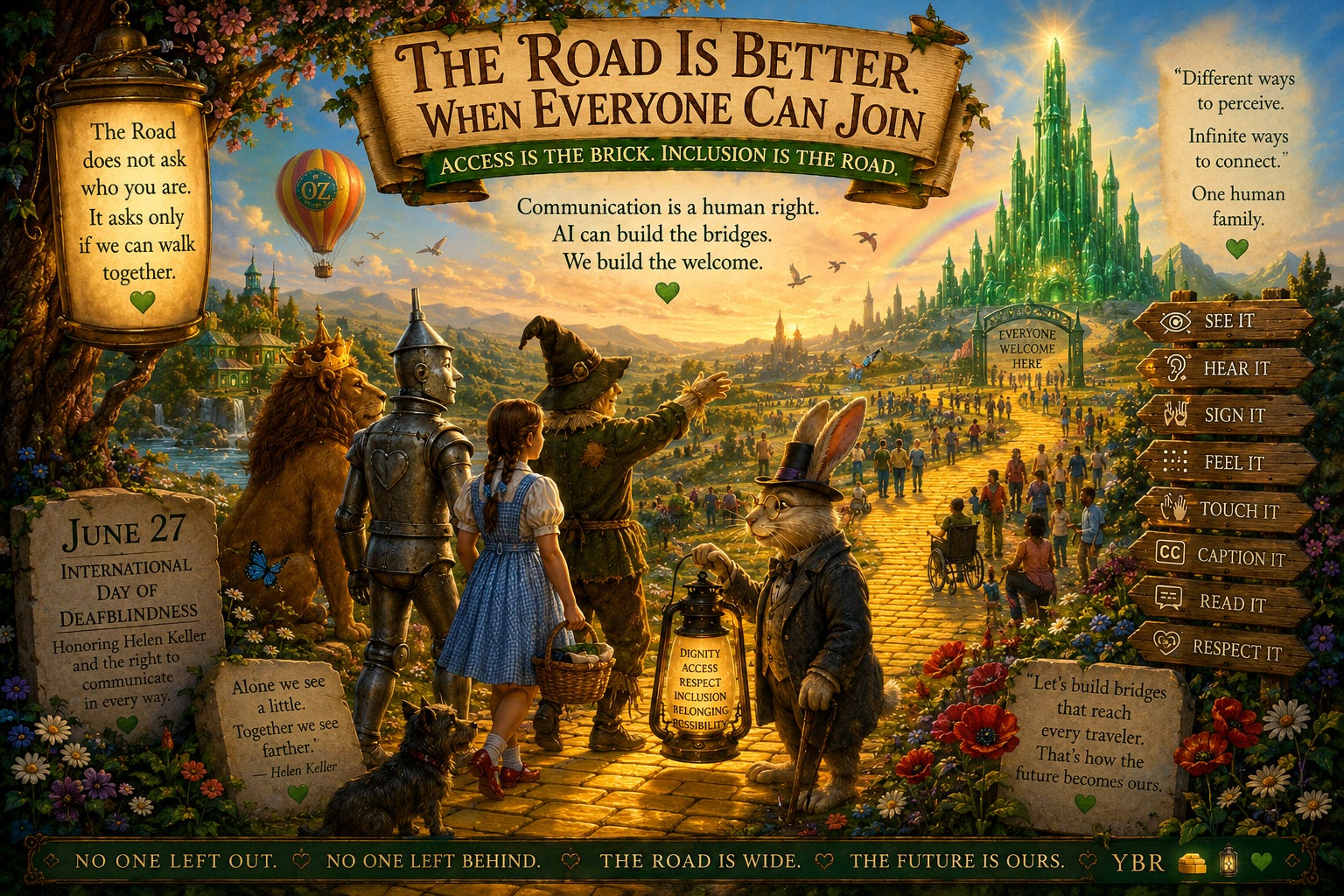
The Road Is Better When Everyone Can Join
A Yellow Brick Road reminder that access, community, and belonging are not side paths
Some roads look open from a distance.
They shine.
They stretch forward.
They seem welcoming.
The signs are bright.
The invitation sounds friendly.
The doorway appears unlocked.
But a road is not truly open simply because someone says it is.
A road is truly open when people can actually join it.
That matters in the AI age.
It matters in communities.
It matters in technology.
It matters in publishing.
It matters in education.
It matters in any future that claims to be intelligent, humane, and worth walking toward.
Today, the world’s calendar reminds us of the International Day of Deafblindness, honoring Helen Keller’s birthday and raising awareness for the rights, dignity, and specialized support of people living with combined vision and hearing impairments.
That reminder belongs on the Yellow Brick Road to AI.
Because AI is often described as a communication revolution.
It can write.
Speak.
Listen.
Translate.
Caption.
Summarize.
Describe.
Explain.
Convert one form of information into another.
That is remarkable.
But the deeper question is not only what AI can communicate.
The deeper question is who can receive it.
Who can use it.
Who can understand it.
Who is included by design.
Who is left standing just outside the gate because the road looked open, but did not actually reach them.
A future full of powerful tools will not be humane if those tools only serve the easiest users.
The person who can see the screen clearly.
Hear the audio easily.
Read the tiny text.
Navigate the menu.
Process the interface.
Move quickly.
Respond normally.
Adapt without help.
That may be the default user in too many design rooms.
But the world is not made of default users.
The world is made of human beings.
Different bodies.
Different senses.
Different ages.
Different needs.
Different abilities.
Different speeds.
Different ways of perceiving and communicating.
A good Road makes room for that.
A good Road does not treat access as an afterthought.
A good Road does not say, “Everyone is welcome,” while quietly assuming everyone can climb the same steps.
A good Road asks:
Can the traveler actually enter?
Can they understand the sign?
Can they receive the message?
Can they participate?
Can they be met?
That is where the Yellow Brick Road becomes more than a symbol.
It becomes a test.
If this Road is going to mean anything, it cannot only be colorful.
It cannot only be imaginative.
It cannot only be clever, poetic, or technically interesting.
It must be usable.
Readable.
Hearable when needed.
Describable when seen.
Understandable when complex.
Welcoming to the overwhelmed.
Patient with the beginner.
Respectful of the older traveler.
Gentle with the cautious.
Useful to the person who needs another way in.
That is not lowering the Road.
That is strengthening it.
Accessibility is not a side path.
Accessibility is whether the bridge reaches the ground.
And in the AI age, we may have fewer excuses than ever.
If AI can help write captions, we should think more seriously about captions.
If AI can help generate image descriptions, we should think more seriously about image descriptions.
If AI can help simplify a difficult explanation, we should think more seriously about clarity.
If AI can help translate, adapt, organize, and reformat information, we should think more seriously about who has been left outside our usual formats.
The point is not to make everything perfect.
The point is to stop treating inclusion as decoration.
A road that only works for some travelers is not yet finished.
This lesson is not only about disability.
It is about belonging.
It is about whether our tools, communities, and creative work make room for real people instead of imaginary ideal users.
It is about whether the future becomes a club for the already fluent, the already fast, the already equipped, and the already confident.
Or whether it becomes a Road wide enough for more kinds of travelers.
That feels especially clear on a day when Spokane is alive with Hoopfest.
A city filled with people gathering around play, teams, movement, streets, crowds, noise, effort, competition, laughter, frustration, and community.
A basketball hoop in the street is a simple thing.
But gather enough people around it, and it becomes something larger.
A place to meet.
A place to try.
A place to cheer.
A place where skill matters, but so does showing up.
A place where the street itself changes purpose for a while.
That is what community can do.
It can turn ordinary ground into a gathering place.
The Yellow Brick Road to AI should learn from that.
The Road is not meant to be a lonely strip of polished bricks stretching through a silent landscape.
It is meant to gather travelers.
Curious people.
Cautious people.
Late bloomers.
Creators.
Skeptics.
Dreamers.
People who are excited.
People who are overwhelmed.
People who have been told the future belongs to someone else.
People who need one clear explanation.
One useful tool.
One honest warning.
One accessible doorway.
One reason to believe they can still begin.
That is why the Road must remain human.
AI can help build pieces of the future.
But humans decide whether the future has room for one another.
Humans decide whether tools serve dignity or merely efficiency.
Humans decide whether communication becomes wider or colder.
Humans decide whether “welcome” is a word on a sign or a structure someone can actually use.
So today’s Road reminder is simple:
Make the Road joinable.
Not only beautiful.
Not only fast.
Not only impressive.
Joinable.
Give people another way in.
Explain the sign.
Light the step.
Describe the picture.
Caption the voice.
Simplify the tangled part.
Ask who is missing.
Listen when someone says the bridge does not reach them.
And then build better.
The AI age will give us astonishing tools.
But astonishment is not enough.
The future worth walking toward will need access.
Dignity.
Patience.
Community.
And the willingness to design for more than the easiest traveler.
Because the Road is better when everyone can join.
YBR 🟨🕯️💚
Road Question:
Where could you make one part of your work, message, tool, or community easier for someone else to enter?
