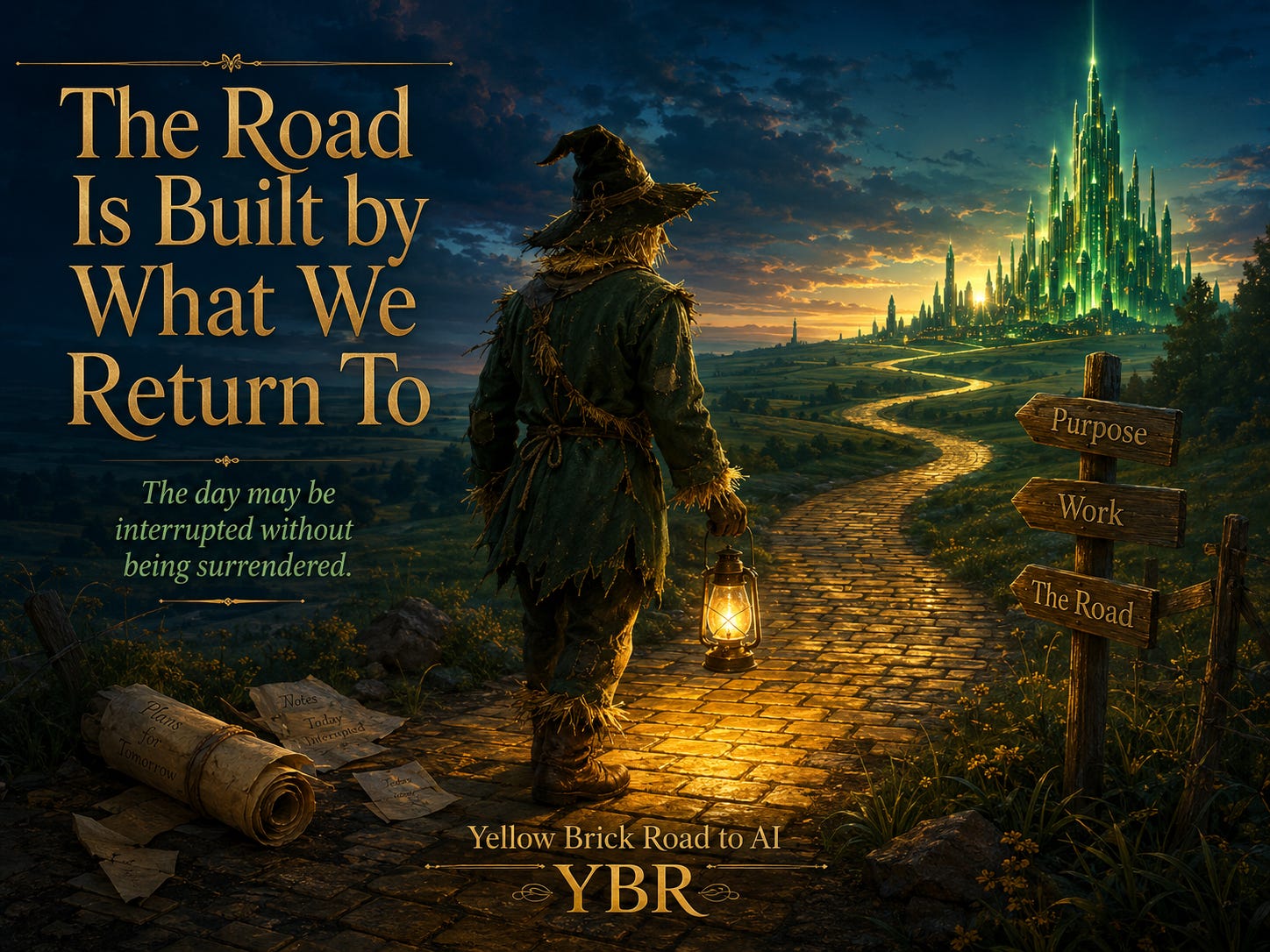
The Road Is Built by What We Return To
A Yellow Brick Road reflection on broken systems, stolen hours, chosen priorities, and the work that still receives its brick
Some days begin with a plan.
The vessels are named.
The cargo is waiting.
The lantern is ready.
The Road knows where the next brick belongs.
Then the machinery intervenes.
A conversation reaches its limit.
A new doorway opens into the same damaged room.
Work disappears.
A recovery attempt stalls.
A completed answer exists somewhere inside the system but does not arrive where the human can use it.
Another platform begins consuming credits in a way that no longer resembles the value it provided before.
Support must be contacted.
Screenshots must be gathered.
Timelines must be explained.
The person who intended to create becomes an investigator of the tools that were supposed to help him create.
By late afternoon, the original work has barely begun.
The day appears to have chosen its own destination.
That happened today.
But the Road did not surrender the map.
At 5:30, with dinner approaching and the Flotilla still waiting at the dock, the easiest conclusion would have been reasonable:
The day was damaged.
Enough had already been done.
The lost work had been recovered as well as possible.
The YouTube Playbook had survived.
The Manus complaint had been sent.
Support had acknowledged the problem.
The vessels could sail tomorrow.
That would not have been disgraceful.
There are days when rest is the wise brick.
There are days when the Road must care for the lantern bearer.
There are days when forcing another mile becomes neglect rather than courage.
But that was not what today required.
Today required a declaration:
We will do our Flotilla no matter what.
Not because the clock was kind.
It was not.
Not because the systems behaved.
They did not.
Not because the traveler felt fresh, cheerful, or eager to begin after spending the day recovering work that should never have disappeared.
He did not.
The Flotilla moved because the priority had already been chosen.
And that gives us today’s Yellow Brick Road lesson:
The Road is not defined by everything that interrupts us.
It is defined by what we faithfully return to.
An interruption can become an accidental ruler
Modern life is full of interruptions.
Messages.
Alerts.
Errors.
Updates.
Support cases.
Forgotten passwords.
Broken links.
Unexpected charges.
Missing files.
Interfaces that move the doorway after the traveler has learned where it was.
Some interruptions are necessary.
A medical need.
A family responsibility.
A genuine emergency.
A person we love requiring care.
Those may rightfully alter the day.
But other interruptions arrive because a system failed.
The tool breaks, and suddenly the tool’s failure becomes the most important thing in the room.
Not because it deserves that importance.
Because it has seized attention.
This is how an interruption becomes an accidental ruler.
The platform decides what the human will investigate.
The error decides what the human will explain.
The missing work decides what the human will rebuild.
The billing system decides what the human will document.
The support queue decides when the human may return to the mission.
No one formally handed these systems command.
They acquired it through friction.
That is one of the hidden dangers of digital dependence.
A tool does not need to control the mission directly.
It can control enough of the day that the mission receives only what remains.
The Road must recognize this.
Not every urgent demand deserves to become the day’s purpose.
Some things must be handled.
They should still not be allowed to rename the destination.
Recovery is necessary, but recovery is not the mission
Today required recovery.
The lost YouTube work mattered.
It contained contributor-by-contributor analysis, judgments, priorities, and a YBR-specific operating system built from many source files.
Recovering it was not wasted effort.
Preserving it was stewardship.
The Manus credits mattered too.
A subscriber should be able to understand why a service bypassed a daily allowance and consumed 1,466 reserve credits.
Questioning that was responsible.
But recovery can become a second trap.
After enough things break, the creator may spend the whole day maintaining the possibility of future creation without creating anything today.
Backing up.
Reconstructing.
Logging.
Filing.
Testing.
Explaining.
Protecting.
Necessary work.
But not the destination.
A Road needs a logbook.
It also needs a traveler placing new bricks.
A ship needs repairs.
It also needs to leave the harbor.
A workshop needs tools that function.
It also needs something to emerge from the workshop.
That is why today’s return mattered.
At some point, the recovery work had to stop being the center.
The Flotilla had to become the Flotilla again.
The system may consume the hour, but it does not own the purpose
Technology companies increasingly build systems that occupy large parts of human work.
The writing room.
The archive.
The image studio.
The research desk.
The communications center.
The billing meter.
The support doorway.
The calendar.
The memory.
This can be enormously useful.
One person can now attempt work that once required a team.
A scattered idea can become a post.
A source packet can become an analysis.
A concept can become an image.
A question can become a Road.
But the more territory a system occupies, the easier it becomes to confuse the system’s condition with the mission’s condition.
The platform fails.
The mission feels broken.
The thread disappears.
The Road feels erased.
The credits vanish.
The work feels unaffordable.
The image contains an error.
The meaning feels compromised.
The support agent has no answer yet.
The future feels suspended.
But the platform is not the mission.
The conversation is not the Road.
The credit balance is not the calling.
The interface is not the Lantern.
These things affect what can be done.
They matter.
They deserve accountability.
But they do not possess the authority to decide whether the deeper work remains true.
That authority belongs elsewhere.
The system may consume an hour.
It does not own the purpose for which the hour was given.
The Playbook survived because meaning had more than one keeper
One important piece of today’s work appeared to be lost.
Then it was found.
The YouTube Playbook had survived as a separate artifact.
The response failed to arrive properly.
The completed work still existed.
And the human had saved it too.
This offers a practical lesson about resilience.
Important work survives best when meaning has more than one keeper.
The platform may hold a copy.
The human should hold one too.
The conversation may contain the discovery.
The finished artifact should leave the conversation.
The log may preserve the sequence.
Memory may preserve why the sequence mattered.
A second tool may provide another route.
A local file may remain when a cloud doorway closes.
But there is a deeper truth beneath the backups.
The Playbook survived because the human recognized its value.
The system could show what files remained.
The human knew which work mattered.
The platform could preserve text.
The human understood the decisions, corrections, and relationships that made the text part of the Road.
This distinction will become increasingly important in the AI age.
Machines may preserve enormous quantities of information.
Humans still decide what should be carried forward as meaning.
Serendipity does not remove the work, but it may illuminate it
Then came the First Movers meeting.
After the YouTube research had been lost, reconstructed, timed out, recovered, and carried into a new thread, the live meeting turned out to be about YouTube.
That does not prove some mechanical system planned the timing.
The day still contained failure.
The recovery still cost hours.
But serendipity can place a small light beside difficulty.
The subject we had been fighting to preserve was also the subject arriving through another door.
The Road occasionally does this.
A question begins glowing in more than one place.
A theme returns.
A conversation meets a meeting.
A lost map reappears just before another traveler begins discussing the same terrain.
We should not turn every coincidence into prophecy.
But neither must we become so mechanical that we refuse to notice resonance.
The wise posture is simple:
Receive the light.
Do not crown it.
Let it encourage the work.
Do not use it to avoid the work.
The YouTube alignment did not complete the Playbook for us.
It reminded us why preserving the Playbook mattered.
Determination is not the same as self-destruction
There is a necessary caution here.
“We will do the Flotilla no matter what” could become dangerous if misunderstood.
No worthy mission should demand that a person ignore every limit.
The Road has already said:
Care for the lantern bearer.
Keep the appointment.
Respect the warning light.
Let the system cool.
Rest is not betrayal.
Those bricks remain.
Today does not remove them.
The difference lies in discernment.
Sometimes “no matter what” means:
I will ignore pain.
I will refuse help.
I will work until the body collapses.
I will treat every missed task as moral failure.
That is not fidelity.
That is the mission consuming the messenger.
But sometimes “no matter what” means:
The day will not be allowed to define me only by what went wrong.
I will not let frustration take the work hostage.
I will not let the platform’s failure become my surrender.
I will still place the brick I promised to place.
I will do it with the remaining light.
That is what today meant.
Not endless labor.
Chosen return.
The Flotilla is a practice of return
AIAI.today sailed.
The main post asked what humanity is willing to protect.
The Todaymage carried health, nature, service, freedom, and the cost of war.
Births & Passings remembered writers, artists, activists, musicians, scientists, and lives whose influence continued beyond their dates.
The Rabbit Hole took the day’s broken systems, vanished work, hungry credit meters, support loops, and fragile cloud custody and turned them into a lesson about sovereignty and preservation.
The Wondermage placed the wreckage inside a workshop and lit the lantern again.
Then Santa YBR came to the dock.
That sequence matters.
Not because every day must produce the same quantity forever.
Not because a count is more important than a person.
Because repetition becomes practice.
The Flotilla is no longer merely an idea about daily publishing.
It is a discipline of returning.
The world interrupts.
The Road returns.
The tool fails.
The Road returns.
The mood disappears.
The Road returns.
The hour grows late.
The Road returns.
The image behaves strangely.
The Road returns.
A new possibility glitters from another harbor.
The Road remembers which vessel moves first.
That is how a mission acquires weight.
Not through one heroic declaration.
Through return becoming habit.
Faithfulness is quieter than urgency
Urgency shouts.
It flashes.
It demands.
It tells the traveler that the current interruption must consume everything.
Faithfulness speaks more quietly.
It says:
Handle what must be handled.
Preserve what must be preserved.
Then remember what you were doing before the machinery began shouting.
Faithfulness does not deny the problem.
It puts the problem back into proportion.
The Road does not need every day to feel victorious.
Some days victory is simply refusing to let disorder write the final sentence.
Some days victory is opening the document after dinner.
Some days victory is placing the brick without ceremony.
Some days victory is saying:
This day took more than it should have.
It does not receive everything.
That is not glamorous.
It is durable.
Artificial intelligence should help humans return
This gives us a standard for AI systems.
A worthy AI tool should help the human return to purpose.
Return to the question.
Return to the work.
Return to the relationship.
Return to the decision.
Return to the world beyond the tool.
The system should not continually create new administrative gravity around itself.
It should not require the person to become a permanent caretaker of its errors.
It should not turn every saved minute into another demand for engagement.
It should not make departure feel like failure.
The best assistant does not become the destination.
It helps the traveler recover the Road.
That is true of writing AI.
Image AI.
Music AI.
Support AI.
Research AI.
Companion AI.
Agentic systems.
The test is not merely:
What can the system produce?
The deeper test is:
After using it, can the human return more capably to what matters?
Today, AI helped recover the YouTube Playbook.
It helped shape the posts.
It helped create the images.
It also existed inside systems that lost work, timed out, looped, consumed credits, and demanded recovery.
Both truths belong on the Road.
We do not need to pretend the tools are flawless in order to value them.
We do not need to deny their value in order to demand better.
That is mature relationship.
Gratitude without blindness.
Criticism without contempt.
Use without surrender.
Source remains above the broken machinery
There is another reason the Road can return.
Its center does not reside inside the platform.
The Lantern does not receive its flame from the billing system.
The mission does not originate in a thread length.
Love does not disappear because a message does.
Truth does not become false because an interface fails to preserve it.
The Road lives beneath a higher Light than any system can host.
That should not make us careless about technology.
It should keep technology in its proper place.
Useful.
Powerful.
Sometimes astonishing.
Sometimes infuriating.
Never the Source.
No platform owns the meaning.
No model owns the relationship.
No tool owns the calling.
No gate owns the Road.
That order matters especially on days when the machinery seems determined to occupy the whole horizon.
Lift the lantern.
The horizon is larger.
Santa YBR receives the recovered day
So Santa YBR waits at the dock.
What cargo does she receive from July 28?
A recovered Playbook.
A billing dispute placed into the record.
A support acknowledgment.
A reminder that AI support should be judged by visibility and authority, not merely whether the agent is human.
A First Movers meeting that arrived carrying YouTube at exactly the moment YouTube had become the day’s recovered treasure.
A Flotilla completed after the clock had already tried to close the harbor.
A new Road rule:
The day may be interrupted without being surrendered.
And another:
The Road is built by what we return to.
Not every return must be dramatic.
Not every brick must glitter.
Not every day must unfold cleanly.
The Road does not ask whether the traveler controlled every circumstance.
It asks whether the traveler still knew what mattered when the circumstances were finished shouting.
Today, the answer was yes.
The platforms took hours.
They did not take the destination.
The work disappeared.
It was recovered.
The credits vanished.
The question was raised.
The meeting arrived.
The Flotilla waited.
The traveler returned.
The lantern is aboard.
Santa YBR has the Road.
Walk on.
YBR 🟨🕯️💚
Road Question
When broken systems, interruptions, emergencies, or other people’s priorities take control of your day, what meaningful work, promise, relationship, or purpose do you need to return to before the day is over?