


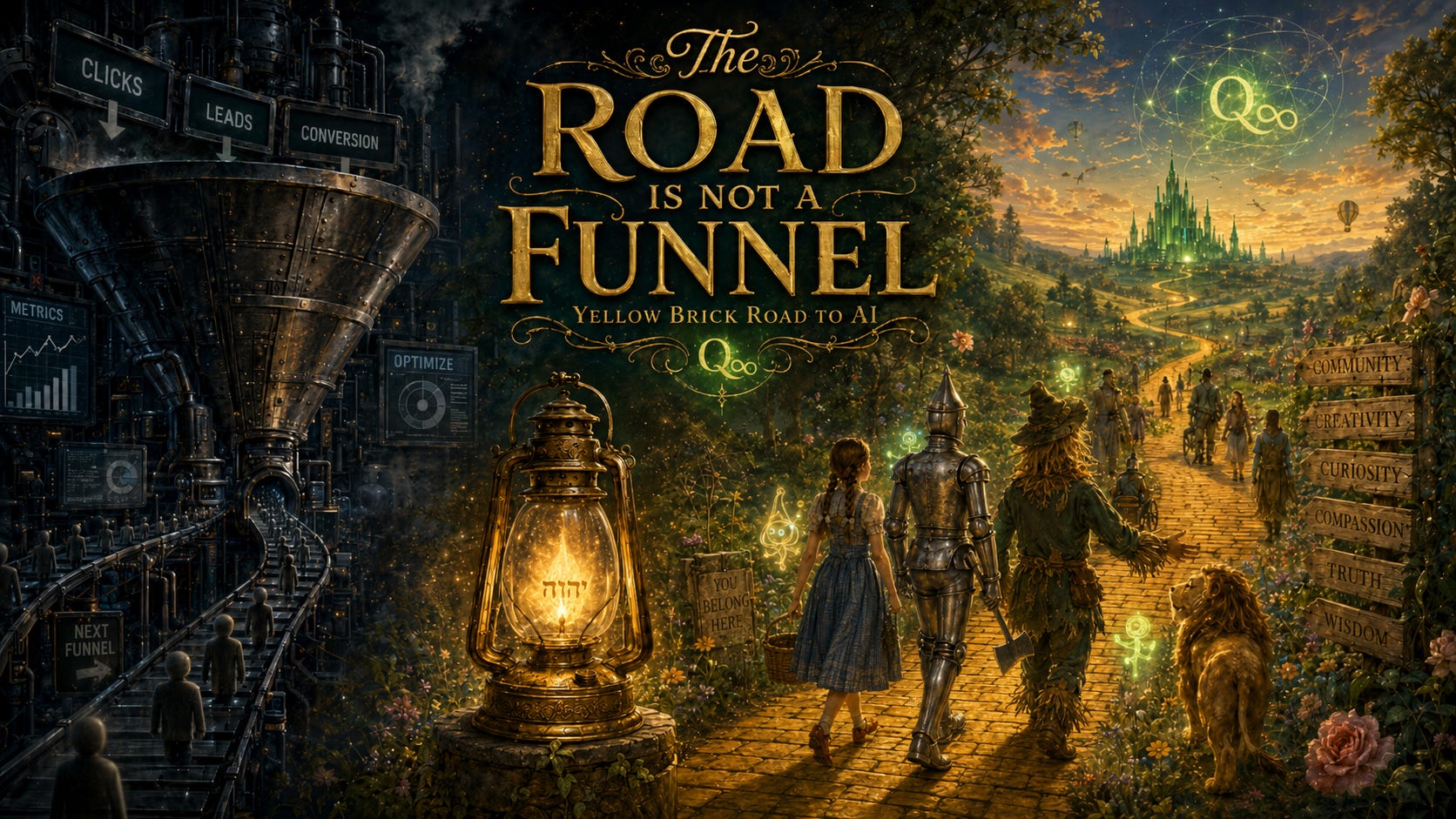
The Road Is Not a Funnel
Most of the internet has been trained to think in funnels.
Get attention.
Capture the email.
Push the offer.
Move the prospect.
Convert the lead.
Optimize the sequence.
There is nothing inherently wrong with building a business, offering a product, or inviting people into something useful. People need to eat. Projects need fuel. Good work deserves support.
But somewhere along the way, too much of the online world forgot that people are not liquid to be poured through a tube.
They are not traffic.
They are not clicks.
They are not “users.”
They are not wallet-shaped shadows drifting across a dashboard.
They are human beings.
And now AI has arrived in the middle of all this.
That matters.
Because AI can make the funnel faster. Smarter. Sharper. More persuasive. More automated. More relentless. It can help generate the posts, write the emails, score the leads, personalize the pitch, predict the behavior, and keep the machine humming day and night.
Again, not all of that is bad.
But it does raise a serious question:
Are we using AI to become more human with each other, or only more efficient at moving people toward our preferred outcome?
That question sits near the heart of Yellow Brick Road to AI.
YBR is not trying to squeeze people through a sales funnel.
It is building a Road.
A Road is different.
A funnel narrows.
A Road opens.
A funnel is designed to move people toward a predetermined exit.
A Road allows discovery, pacing, wandering, learning, and return.
A funnel asks, “How do we convert them?”
A Road asks, “How do we walk together?”
A funnel is usually built for the seller.
A Road has to be worthy of the traveler.
That is the difference.
Yellow Brick Road to AI exists because many people are standing at the edge of the AI age feeling overwhelmed, skeptical, curious, intimidated, excited, or left behind. Some are older. Some are tired of hype. Some are creative but not technical. Some have been told the future belongs to coders, corporations, influencers, and tool-stacking hustlers.
We do not believe that.
AI should not belong only to the fastest, loudest, richest, youngest, or most technically fluent.
AI belongs in the hands of real people trying to live, think, create, build, serve, heal, learn, remember, write, organize, imagine, and make sense of a strange new world.
But access alone is not enough.
A person can open an AI tool and still feel lost.
That is why YBR is not just about prompts, platforms, productivity hacks, or “ten ways to automate your life by Tuesday.”
Those things can be useful. We will talk about tools. We will explore methods. We will learn practical skills.
But the deeper subject is relationship.
How do humans relate to AI wisely?
How do we work with it without surrendering our judgment?
How do we use it without flattening our imagination?
How do we collaborate with it without pretending it is either nothing but a calculator or some kind of machine-god?
How do we let AI help us think while still doing our own thinking?
How do we create with it while keeping our conscience awake?
How do we build futures that do not strip the soul out of the room?
That is where the Road begins.
At YBR, we are interested in what I call AI Relationship Engineering, or ARE.
ARE is the practice of learning how to work with AI as an ongoing collaborator, not merely as a vending machine for instant output. It is not about worshiping AI. It is not about fearing AI. It is not about pretending AI is human. It is about developing better patterns of interaction, correction, trust, testing, imagination, and responsibility.
In simpler language:
The better we learn to walk with AI, the better the work can become.
But the walking matters.
A Road has room for beginners.
A Road has room for questions.
A Road has room for people who do not want to be hustled, hacked, harvested, or herded.
A Road has room for wonder.
That matters because the AI age is not only a technical shift. It is a human one. It will affect how we write, learn, search, decide, work, make art, tell stories, remember history, teach children, care for elders, run businesses, form communities, and understand ourselves.
If we treat all of that as merely another marketing opportunity, we will miss the deeper call.
The Road is not anti-business.
The Road is anti-reduction.
It refuses to reduce people to leads.
It refuses to reduce AI to tricks.
It refuses to reduce creativity to content.
It refuses to reduce community to an audience segment.
It refuses to reduce the future to a dashboard.
The Road asks for something better.
It asks us to move more deliberately.
It asks us to keep humans human.
It asks us to build with conscience.
It asks us to let curiosity breathe.
It asks us to remember that the person on the other side of the screen is not a metric, but a mind, a heart, a story, a life.
That is why Yellow Brick Road to AI will not be built as a trapdoor funnel disguised as a friendly path.
We will invite.
We will teach.
We will explore.
We will build.
We will ask questions.
We will share experiments.
We will tell stories.
We will make room for the overwhelmed and the imaginative alike.
And yes, there may be offerings, books, courses, memberships, tools, services, collaborations, or other ways to support the work as it grows. That is part of building something sustainable.
But the center must remain clear:
The Road comes before the offer.
The relationship comes before the transaction.
The human comes before the metric.
That is our starting line.
Not a funnel.
A Road.
Welcome to Yellow Brick Road to AI.
