


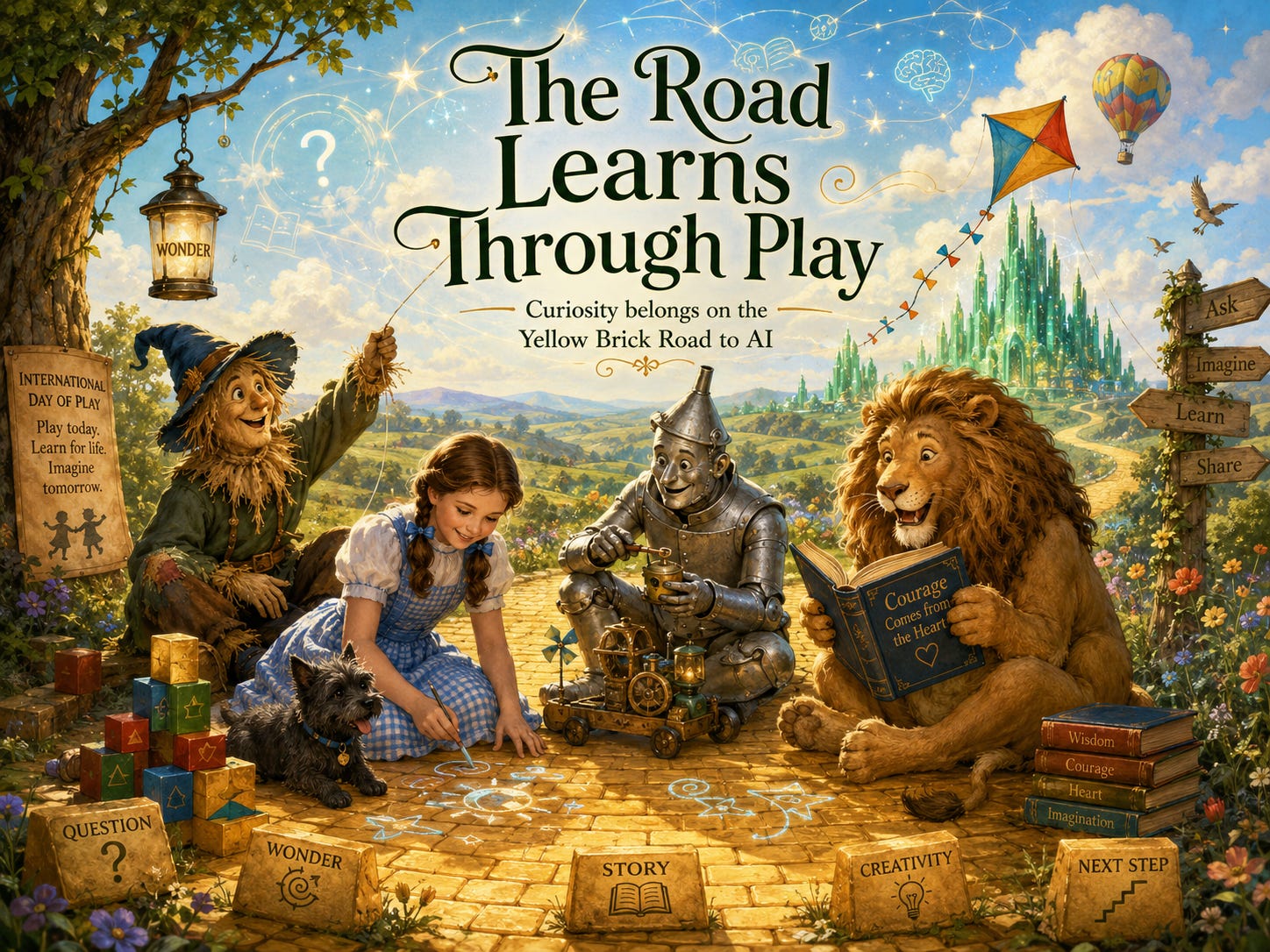
The Road Learns Through Play
Why curiosity, experiment, and “What if?” belong on the Yellow Brick Road to AI
Today is the International Day of Play.
At first, that may sound like a children’s observance only.
Blocks. Chalk. Kites. Games. Laughter. Cardboard boxes becoming castles, rockets, shops, ships, caves, and entire kingdoms before lunch.
But play is not only something children do because they are not yet serious.
Play is one of the ways human beings learn how to become serious without becoming stone.
That matters on the Yellow Brick Road to AI.
Because many people approach AI as if they are arriving late to an exam.
They think they must already know the right words.
They think they need perfect prompts.
They think they need a technical vocabulary, a tool stack, a workflow diagram, and the confidence of someone who has watched seventeen tutorials and now speaks mostly in acronyms.
But the Road does not begin there.
The Road begins with curiosity.
It begins with a question.
It begins with:
What if?
What if I ask AI to explain this in plain language?
What if I use it to organize my notes?
What if I ask it to help me think through an idea?
What if I let it draft badly so I have something to improve?
What if I ask it to show me three different ways to look at the same problem?
What if I try, revise, laugh, learn, and try again?
That is play.
Not careless play.
Not thoughtless play.
Not “let the machine do everything and call it wisdom.”
But real exploratory play.
The kind of play that builds confidence.
The kind that turns fear into movement.
The kind that helps a beginner discover that learning does not have to begin with mastery.
Dorothy did not begin with a map
The Yellow Brick Road has always understood this.
Dorothy did not begin with a complete map of Oz.
The Scarecrow did not begin with a diploma.
The Tin Woodman did not begin with all his questions answered.
The Lion did not begin with fearless certainty.
They began by walking.
They tried.
They stumbled.
They misunderstood.
They met new companions.
They asked questions.
They discovered things by moving through them.
That is closer to play than we sometimes realize.
A road is not only a line from one place to another.
It is a learning space.
Every step teaches something.
Every companion changes the journey.
Every wrong turn becomes part of the map.
That is how many of us will learn AI too.
Not all at once.
Not perfectly.
Not by pretending we are experts.
But by beginning where we are and trying one useful thing.
AI should widen play, not replace it
There is a caution here too.
AI should not replace real play, especially for children.
A screen is not a childhood.
A chatbot is not a playground.
A generated story is not the same as a child inventing one with a blanket, a spoon, and a stuffed animal who has somehow become mayor of the moon.
Children still need bodies, movement, dirt, weather, friends, music, drawing, building, pretending, falling, laughing, arguing over rules, and beginning again.
But AI can support play when used wisely.
It can help a parent invent a rainy-day scavenger hunt.
It can help a teacher create a classroom game.
It can help a grandparent turn a child’s idea into a bedtime story.
It can help a family make a silly quiz, a treasure map, a coloring page, a song, a puppet show, or a pretend journey.
The key is simple:
Use AI to widen play, not replace it.
That rule works for adults too.
Use AI to widen imagination.
Use it to test ideas.
Use it to make the blank page less frightening.
Use it to help you begin.
But keep your judgment awake.
Keep your voice present.
Keep your humanity holding the lantern.
The beginner’s permission slip
So if you are new to AI, today’s Road message is simple:
You are allowed to play.
You are allowed to ask imperfect questions.
You are allowed to try something small.
You are allowed to dislike the first answer.
You are allowed to say, “That is not quite what I meant.”
You are allowed to ask again.
You are allowed to use AI as a sketchpad before you use it as a tool.
You are allowed to explore without pretending you already understand the whole Road.
That may be one of the healthiest ways to begin.
Try this:
Ask AI to explain one topic you find confusing.
Ask it to help organize one messy list.
Ask it to brainstorm ten names for something, then reject most of them.
Ask it to make something simpler.
Ask it to ask you questions before answering.
Ask it what you might be missing.
Then read carefully.
Question the answer.
Correct it.
Add yourself back into it.
That is not cheating.
That is learning with a lantern.
Play is not the opposite of wisdom
The AI age will be full of serious questions.
Privacy.
Truth.
Work.
Creativity.
Memory.
Education.
Trust.
Bias.
Power.
Human dignity.
What should be automated.
What should be protected.
What should remain human.
Those questions matter.
But seriousness without play can become rigid.
Play without judgment can become chaos.
The Road needs both.
It needs the courage to experiment and the wisdom to discern.
It needs curiosity and caution.
It needs imagination and responsibility.
It needs people who can ask “What if?” without forgetting to ask “Should we?”
That is why International Day of Play belongs on the Yellow Brick Road to AI.
Because play is not a side path.
It is one of the first bricks in learning.
Before mastery, there is curiosity.
Before confidence, there is trying.
Before the Road becomes familiar, there is the first strange step.
And perhaps that is enough for today.
Ask one question.
Try one small thing.
Let the first version be imperfect.
Revise it.
Learn from it.
Laugh if it produces something ridiculous.
Keep what helps.
Compost what does not.
Then take the next honest step.
The Road is not asking you to become an expert before you begin.
It is inviting you to become a traveler.
And travelers learn by walking.
YBR 🟨🕯️💚
Road Question:
Where could a little play help you begin with AI: writing, learning, organizing, creating, planning, teaching, storytelling, or simply asking better questions?
