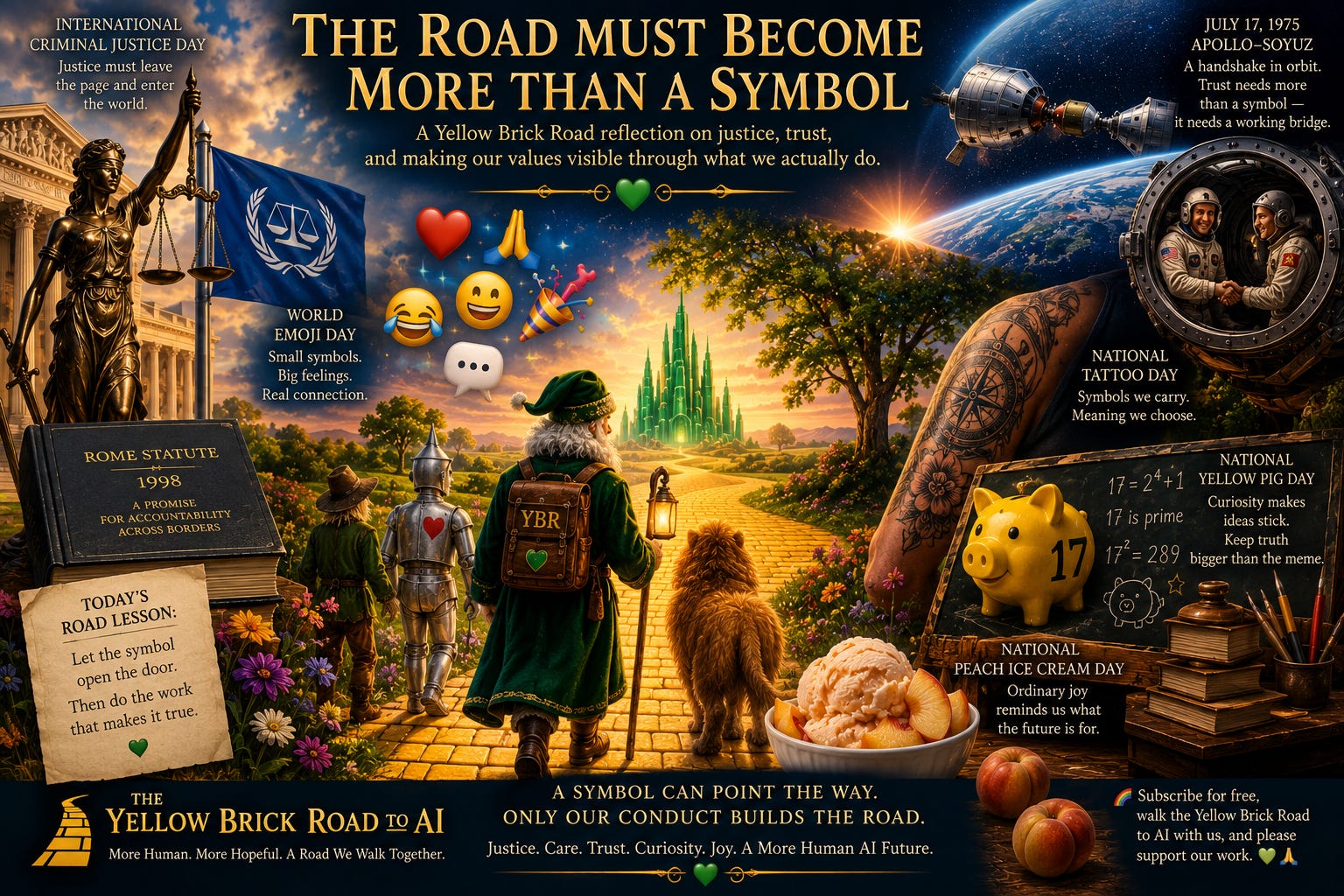
The Road Must Become More Than a Symbol
A Yellow Brick Road reflection on justice, trust, AI, and making our values visible through what we actually do
Some days the Road gives us a sign.
A lantern.
A heart.
A scale.
A handshake.
A word written carefully across a page.
Symbols matter.
They help human beings carry ideas too large to hold in one sentence.
A scale can represent justice.
A heart can represent love.
A handshake can represent trust.
A lantern can represent guidance.
A Road can represent the way we choose to walk through a changing world.
But July 17 asks us to remember something important:
A symbol is not the destination.
It is an invitation.
The symbol points.
The human being still has to walk.
That lesson belongs directly on the Yellow Brick Road to AI.
Because the AI age is becoming extraordinarily good at producing symbols.
Words that sound caring.
Images that look hopeful.
Statements that sound ethical.
Apologies that sound sincere.
Badges that say trusted.
Policies that say responsible.
Mission statements that say human-centered.
Small hearts, smiling faces, glowing hands, beautiful bridges, polished promises, and all the language of concern arranged beneath excellent lighting.
AI can help us make those things.
It can help explain.
Illustrate.
Translate.
Design.
Clarify.
Summarize.
Communicate.
But AI can also make the appearance of meaning easier to produce than the reality behind it.
That is where the Road must remain awake.
A symbol can open attention.
Only conduct can earn trust.
Justice must leave the page
July 17 is observed as the Day of International Criminal Justice, connected to the adoption of the Rome Statute in 1998 and the creation of the International Criminal Court.
That places one of humanity’s most serious promises before us:
Power should not be beyond accountability.
Certain crimes should not disappear merely because the person responsible holds office, commands an army, controls the official story, or has enough influence to make everyone else suddenly discover procedural shyness.
Justice is often represented by scales.
Balanced.
Steady.
Blindfolded against favoritism.
A strong symbol.
But a statue cannot investigate.
A scale cannot protect a witness.
A law book cannot gather evidence.
A treaty cannot compel courage from people who prefer convenience.
The symbol of justice matters because it reminds us what justice should be.
But the symbol becomes true only when people do the difficult work behind it.
Gather the evidence.
Protect the innocent.
Test the claims.
Preserve due process.
Resist political pressure.
Hold the powerful answerable.
Accept that justice must apply even when the outcome inconveniences our own side.
That last part is where many public principles quietly develop a limp.
People often support accountability when the accused belongs to the other tribe.
The harder test comes when justice turns toward someone they admire, voted for, depend upon, fear, or find politically useful.
Then the scale begins to wobble.
That is not justice.
That is loyalty wearing a borrowed robe.
The Yellow Brick Road must say this clearly:
Justice is not vengeance.
Justice is not punishment theater.
Justice is not cruelty performed against someone we dislike.
But justice is also not endless delay, selective enforcement, cowardice, or the quiet agreement that powerful people live above consequences.
Justice requires truth.
Evidence.
Fairness.
Courage.
Restraint.
And the willingness to follow the Road even when it does not lead where our tribe hoped it would.
That is more than a symbol.
That is character.
AI can help find the pattern, but it cannot supply the courage
Artificial intelligence may become extremely useful in legal, historical, investigative, and accountability work.
It can help organize enormous archives.
Compare records.
Translate testimony.
Search documents.
Locate contradictions.
Build timelines.
Connect names, dates, places, statements, images, and public records that no single human being could hold at once.
That can help justice.
A buried pattern may become visible.
A forgotten witness may be found in the record.
A false timeline may begin to unravel.
Evidence scattered across thousands of pages may finally reveal its shape.
But the same technology can also manufacture the appearance of evidence.
A generated photograph.
A cloned voice.
A fabricated document.
A false quotation.
A convincing video of something that never happened.
A confident summary that quietly blends fact, error, and invention into one polished bowl.
So AI does not eliminate the need for evidence.
It increases the need for verification.
The Road must teach ordinary travelers to ask:
Where did this come from?
Who created it?
Was it generated, edited, translated, reconstructed, or recorded?
Can another source confirm it?
Is this illustration or documentation?
Is this a real quotation or language that merely sounds like the person?
What remains outside the frame?
Those questions are no longer only for courts, journalists, and researchers.
They are becoming basic citizenship.
The AI age will place persuasive symbols in front of everyone.
The human responsibility is learning how to test what stands behind them.
AI may help identify the pattern.
It cannot decide that truth is worth defending.
It cannot give courage to the institution that would rather look away.
It cannot make a frightened witness safe unless human beings build that protection.
It cannot turn a law into justice merely by generating excellent language about accountability.
The tool can assist.
The human must act.
That is the Road distinction.
The heart emoji is not the whole heart
July 17 is also World Emoji Day.
A fitting observance for an age in which human emotion is often carried through tiny symbols on glowing screens.
A heart.
A smile.
A tear.
A flame.
Folded hands.
A raised eyebrow.
A face laughing so intensely that it appears to have lost control of its own weather.
Emoji help.
They can warm a sentence.
Clarify tone.
Offer comfort.
Signal humor.
Make a message feel less mechanical.
Sometimes one heart says what a tired person cannot quite put into a paragraph.
That is real.
But the heart symbol is not love.
It may point toward love.
It may carry affection.
It may say:
I see you.
I am with you.
I do not have enough words.
But love still requires something beyond the symbol.
Attention.
Presence.
Patience.
Truthfulness.
Reliability.
Sacrifice.
The call made when it would have been easier to send the heart.
The help given when the message alone was not enough.
The apology followed by changed conduct.
The promise kept after the glowing symbol has disappeared from the screen.
That matters in human relationships.
It matters in AI relationships too.
AI systems can now produce language that sounds warm, compassionate, reassuring, and emotionally intelligent.
That may help people.
A gentle response can make a difficult subject easier to approach.
A clear explanation can reduce fear.
A carefully written message can help a person say something important to someone they love.
But emotional language should not be confused with emotional reality.
The appearance of care is not the completion of care.
A system can generate sympathy.
It cannot visit the hospital.
It can help draft the apology.
It cannot repair the relationship unless someone changes.
It can suggest comforting words.
It cannot take responsibility for whether those words are true.
AI can help carry the signal.
Humans must carry the promise.
That is today’s heart rule:
Do not mistake the symbol of care for the work of caring.
Trust needs a docking mechanism
July 17 also marks the anniversary of the Apollo-Soyuz docking in 1975.
An American spacecraft and a Soviet spacecraft met in orbit.
Different nations.
Different languages.
Different political systems.
Different technical traditions.
One connection.
One handshake above Earth.
The handshake became the famous symbol.
But the handshake was not the true miracle.
The docking mechanism was.
Two systems had to become compatible enough to meet.
The crews had to train.
Procedures had to be coordinated.
Technical differences had to be understood.
The atmosphere between the spacecraft had to be managed.
The bridge had to work.
The hatches had to open safely.
The symbol mattered because real structure stood beneath it.
That may be one of the clearest lessons available to the AI age.
Everyone wants trust.
Companies want users to trust AI.
Governments want citizens to trust automated systems.
Schools want families to trust educational technology.
Employers want workers to trust workplace tools.
Creators want audiences to trust generated or AI-assisted work.
But trust is not created by placing the word trust on the landing page.
Trust needs a docking mechanism.
Can the system explain its limitations?
Can the user correct it?
Can someone appeal when an automated decision is wrong?
Can the human disconnect?
Can the creator identify generated material honestly?
Can the company investigate failures?
Can people understand who remains responsible?
Can affected communities participate in the decisions?
Can the bridge hold when something goes wrong?
Those are trust questions.
A handshake photograph may be lovely.
But if the spacecraft cannot actually connect, the handshake is theater.
The same is true of responsible-AI language.
An ethics statement is not ethics.
A transparency page is not transparency.
A human-centered slogan is not proof that humans remain at the center.
The words must become structure.
The structure must become conduct.
The conduct must survive examination.
That is how trust grows.
Slowly.
Repeatedly.
Brick by brick.
The Road itself is a symbol
The Yellow Brick Road is also a symbol.
We should say that plainly.
There is no literal golden path stretching from every beginner’s computer toward an Emerald City of perfect understanding.
There are no actual talking companions waiting beside every AI tool.
No Tin Woodman is standing inside the settings menu with a helpful diagram.
The Road is an image.
A story.
A framework.
A way to make the AI age less cold, less intimidating, less abstract, and more humanly walkable.
But if YBR remains only a beautiful symbol, it fails.
The Road must become real through what it offers.
A clear explanation.
A checked answer.
A useful warning.
A welcoming doorway.
A free first lantern.
A practical guide.
A thoughtful question.
An honest admission when the tool fails.
A reminder that the human still leads.
A place where older travelers, beginners, creators, skeptics, and overwhelmed people can enter without being treated as foolish, late, or technologically defective.
That is how the symbol becomes a Road.
Not because the image is beautiful.
Because someone can walk it.
The lantern becomes real when it helps someone see.
The signpost becomes real when it helps someone choose.
The bridge becomes real when someone can cross.
The Road becomes real when the traveler leaves more capable, more discerning, more hopeful, and less alone than when they arrived.
That is the standard Santa YBR must carry.
Not merely:
Does the post look good?
But:
Does it help?
Does it clarify?
Does it protect?
Does it make a difficult future more approachable without making it falsely simple?
Does it keep Source above system?
Does it keep the lantern before the throne?
Does it make room for a real human being?
Those questions keep the symbol honest.
Tattoos and the meaning we carry
National Tattoo Day also falls on July 17.
A tattoo is another kind of symbol.
But unlike an emoji, it does not vanish when the conversation scrolls upward.
It remains.
It may carry a name.
A date.
A faith.
A memory.
A grief.
A victory.
A wound transformed into art.
A joke that seemed excellent at twenty-three and has become a lifelong conversation starter at seventy.
A tattoo reminds us that symbols may be carried differently.
Some are sent.
Some are worn.
Some become part of how a person presents a private meaning to the visible world.
AI is increasingly helping people design tattoos, emblems, logos, personal marks, and visual identities.
That can open creative possibility.
But it also requires care.
Does the symbol come from a sacred or cultural tradition the user does not understand?
Is the text correct?
Is the design truly original?
Does the image carry meanings beyond what the person intended?
Will it still represent something worth carrying after the trend has gone?
The Road lesson extends beyond tattoos:
Before carrying a symbol, understand what the symbol carries.
Before sharing the image, understand it.
Before repeating the slogan, know what it means.
Before posting the statistic, understand what it leaves out.
Before letting AI speak in your name, decide whether the language reflects your actual conviction.
Before placing human-centered on the project, ask whether humans are truly protected within it.
Symbols gain weight when we carry them.
So carry carefully.
The yellow pig and the danger of making truth too small
July 17 also includes National Yellow Pig Day, a playful mathematical observance connected with the number 17.
A yellow pig is certainly memorable.
The rabbit has already requested one for the executive office.
Request denied pending zoning review.
The yellow pig reminds us that human beings often learn through imaginative symbols.
An abstract number becomes a character.
A technical idea becomes playful.
A strange mascot opens the door to curiosity.
That can be wonderful.
AI can help educators, parents, creators, and learners turn difficult ideas into stories, diagrams, characters, games, and visual metaphors.
A complicated subject can become approachable.
A beginner may remember the idea because the pig was yellow and mathematics briefly stopped behaving like a locked basement.
But there is a caution here too.
The memorable image must not shrink the truth beyond recognition.
AI can turn almost any complex issue into a simple picture.
A slogan.
A meme.
A character.
A seven-word answer.
That may help people enter.
It may also remove the very complexity they need to understand.
So the Road must balance two responsibilities:
Make the doorway simple.
Do not make the room false.
Help the traveler begin.
Do not pretend the beginning is the whole journey.
The first lantern should be clear.
The deeper Road should remain honest.
Peach ice cream and the ordinary test
Then July 17 gives us National Peach Ice Cream Day.
Good.
After international law, synthetic evidence, emotional symbols, orbital engineering, tattoos, mathematics, and the moral responsibilities of artificial intelligence, the Road requires dessert.
That is not trivial.
The great questions of technology eventually return to ordinary life.
The kitchen.
The grocery list.
The summer afternoon.
The family table.
The person who needs help understanding a bill.
The caregiver trying to organize the week.
The older traveler whose platform has rearranged the buttons again.
The child asking a question.
The small creator trying to finish one meaningful post before leaving for Costco.
What is AI for?
Not only grand systems.
Not only frontier laboratories.
Not only corporate promises.
Not only arguments about what intelligence may someday become.
AI should help ordinary life become more livable.
Not more pressured.
Not more surveilled.
Not more confusing.
More understandable.
More accessible.
More creative.
More humane.
A technology that speaks endlessly about human flourishing while making ordinary humans more exhausted has confused the symbol with reality.
A company that announces empowerment while making people increasingly dependent has confused the word with the outcome.
A tool that creates beautiful visions of the future while adding no nourishment to the table should remain humble about its achievement.
The peach ice cream gives us a very practical Road test:
Does the future reach the table?
Does it help a person live?
Does it leave enough room for laughter?
For rest?
For relationship?
For small sweetness?
For a human life that is not merely an input into someone else’s system?
That matters.
The Road is not built for abstractions.
It is built for travelers.
Travelers need truth.
They also occasionally need peach ice cream.
Symbols should become bridges
So July 17 places many symbols along the Road.
The scale.
The heart.
The handshake.
The tattoo.
The yellow pig.
The bowl of peach ice cream.
Each one points somewhere.
Justice.
Care.
Trust.
Memory.
Curiosity.
Ordinary joy.
Artificial intelligence can help us create, explain, circulate, and interpret these symbols.
But the human still has to ask:
What stands behind them?
Does the law become accountability?
Does the heart become care?
Does the handshake become trustworthy structure?
Does the tattoo carry understood meaning?
Does the memorable image preserve enough truth?
Does the promised future reach the ordinary person?
Those are Road questions.
Because the Road itself must never become only a symbol.
It must become practice.
A way of meeting AI with curiosity without surrendering discernment.
A way of appreciating intelligence without crowning it.
A way of using powerful tools without making humans smaller.
A way of placing Source above system.
A way of keeping truth, dignity, responsibility, mercy, creativity, humor, and love alive in the room.
That is how the symbol becomes real.
Not through repetition.
Through embodiment.
Not through branding.
Through conduct.
Not through the appearance of care.
Through care.
The AI age will give us more symbols than any earlier age could have imagined.
More words.
More images.
More voices.
More synthetic faces.
More statements.
More promises.
More badges.
More signs saying TRUST THIS WAY.
The Road does not need fewer symbols.
It needs symbols that remain answerable to reality.
A heart answerable to love.
A scale answerable to justice.
A handshake answerable to trust.
A lantern answerable to truth.
A Road answerable to the traveler.
That is today’s brick.
Let the symbol open the door.
Then do the work that makes it true.
Walk on.
YBR 🟨🕯️💚
Road Question:
Where in your own life, work, relationships, or use of AI do you need to move beyond the symbol of care, trust, justice, or responsibility and do the real work that makes it true?