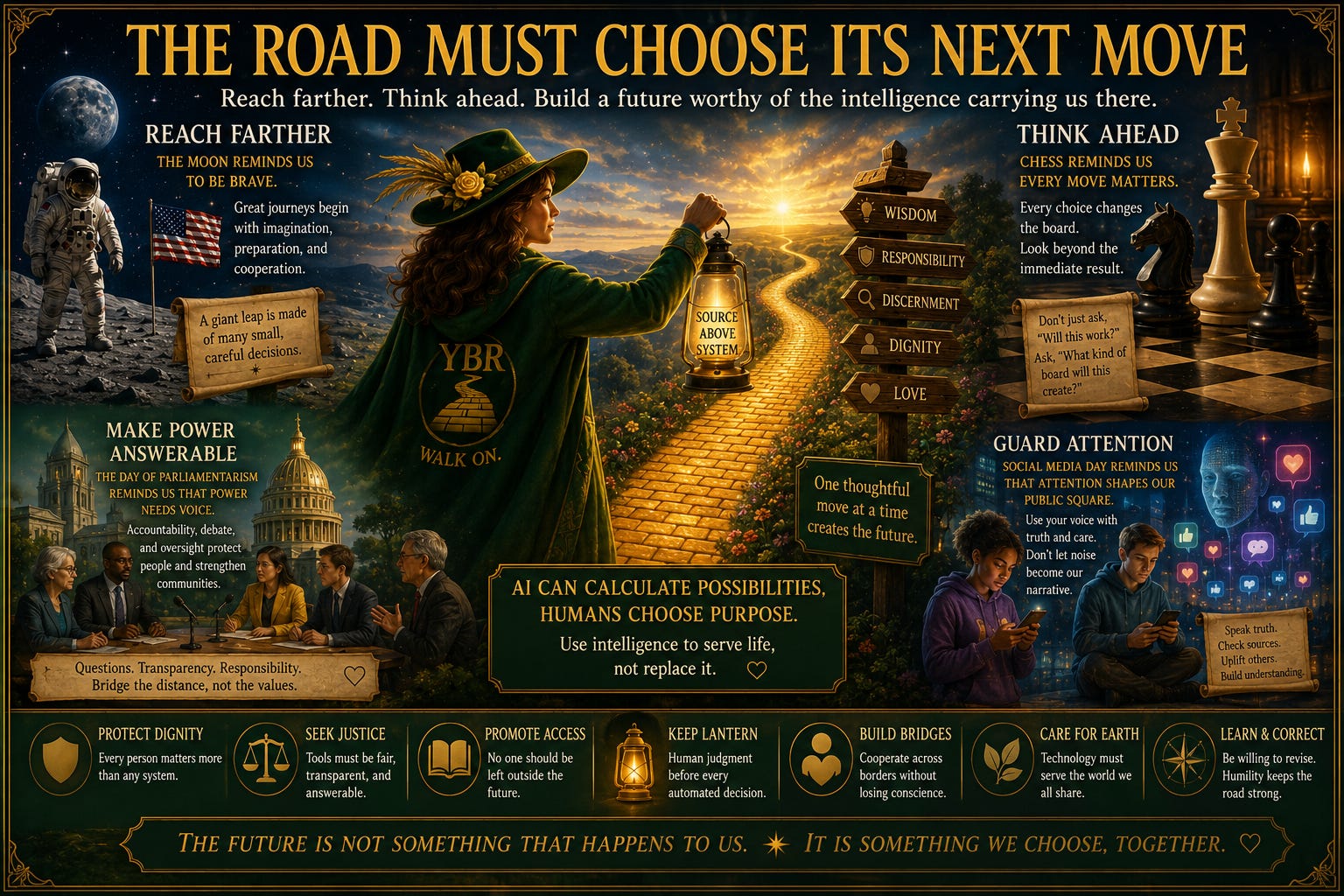
The Road Must Choose Its Next Move
A Yellow Brick Road reflection on reaching farther, thinking ahead, and building a future worthy of the intelligence carrying us there
Some days the Road asks us to take a step.
July 20 asks us to consider the move before we make it.
Today remembers humanity’s first landing on the Moon.
It also celebrates chess, one of the oldest games of foresight, consequence, sacrifice, patience, and strategy.
At first, the two may seem very different.
The Moon belongs to rockets, space suits, mathematics, engineering, courage, and the enormous human desire to reach beyond the familiar world.
Chess belongs to a quiet board.
Two players.
Thirty-two pieces.
Sixty-four squares.
No engine flame.
No roaring launch.
Only attention.
Yet both belong on the Yellow Brick Road to AI.
Because reaching the Moon and playing chess well require the same deeper discipline:
The ability to imagine what comes next before committing to the move.
That may be one of the most important skills humanity needs in the AI age.
Artificial intelligence is helping us move farther and faster than ever.
It can help us write, translate, design, calculate, organize, predict, teach, research, compose, communicate, and build.
It is widening the workshop.
It is opening gates.
It is placing extraordinary capability into the hands of people who once had neither the tools nor the teams to attempt certain kinds of work.
That is real progress.
But progress is not only about how far we can reach.
It is also about whether we understand the position we are creating after the move.
The Moon reminds us to be brave enough to go.
Chess reminds us to be wise enough to think ahead.
The Road needs both.
A great leap is made from many small decisions
The first lunar landing is remembered through one unforgettable step.
But that step rested upon countless smaller decisions.
A calculation checked.
A component tested.
A warning examined.
A procedure rehearsed.
A correction made before the error became catastrophe.
A person doing one difficult task correctly while thousands of others did the same.
The famous leap did not begin on the lunar surface.
It began in workshops, classrooms, laboratories, control rooms, factories, meetings, notebooks, failures, revisions, and patient human cooperation.
That matters because we live in an age that loves the visible breakthrough.
The launch.
The announcement.
The new model.
The new tool.
The astonishing demonstration.
The headline saying that something once impossible has now become possible.
But the Road knows that breakthroughs are only the brightest brick.
The deeper Road is made from the decisions beneath them.
What was tested?
Who was protected?
What assumptions were examined?
What could go wrong?
Who could stop the system?
Who remained responsible?
What happened when the machinery behaved unexpectedly?
The AI age will produce many impressive launches.
The Road must ask whether the systems can survive the mission.
A fluent answer is a launch.
Verification is the mission.
A beautiful image is a launch.
Meaning is the mission.
A useful automation is a launch.
Human benefit is the mission.
A powerful model is a launch.
What it is taught to serve is the mission.
The world will applaud capability.
The Road must also examine direction.
Every move creates another board
Chess teaches something that the modern world repeatedly forgets:
A move cannot be judged only by what it accomplishes immediately.
Every move changes the board.
A decision may solve one problem while creating three others.
A sacrifice may look like loss while protecting something more important.
A powerful move may become a trap if it leaves the future position exposed.
A quiet move may seem unimpressive while making everything stronger.
This belongs directly in our use of AI.
A company may automate a process and save money.
What happens to the workers?
Do they receive better tools and more meaningful work?
Or are they expected to produce twice as much while being watched more closely?
A school may introduce AI tutoring.
Does the student learn more deeply?
Or does the tool quietly replace the struggle through which learning develops?
A creator may generate endless images, songs, articles, and videos.
Does the abundance strengthen the work?
Or does meaning disappear beneath the pile?
A platform may use AI to hold people’s attention longer.
Is that attention serving them?
Or is it being harvested from them?
The first result is not the whole result.
The move changes what becomes possible next.
That gives us a Road rule for today:
Do not ask only whether the move works. Ask what kind of board it creates.
This does not mean becoming paralyzed.
No traveler can predict every consequence.
No plan survives every surprise.
No chess player sees the whole game perfectly.
No engineer eliminates every risk.
Wisdom is not certainty.
Wisdom is the willingness to look beyond the immediate reward.
To ask another question.
To leave room for correction.
To refuse a move that wins the moment by damaging the future.
The future is not a race board
Much of the AI world is being narrated as a race.
Company against company.
Nation against nation.
Open systems against closed systems.
Humans against machines.
Workers against automation.
Everyone trying to arrive first.
The Road does not deny competition.
Competition can sharpen skill.
It can accelerate invention.
It can produce better tools.
But civilization is not a chessboard where one final player sweeps every other piece into a box and declares the future won.
The human future is shared ground.
If one company wins by making everyone dependent, the board has not improved.
If one nation wins by making the world less safe, humanity has not advanced.
If AI becomes more powerful while ordinary people become less capable, the Road has gone crooked.
If technology reaches the Moon while dignity remains stranded on Earth, the mission is unfinished.
The Yellow Brick Road does not measure success only by who arrives first.
It asks:
Who can walk?
Who can understand?
Who can benefit?
Who remains free?
Who remains visible?
Who is protected when the system fails?
Who may question the builder?
Who carries the consequences?
That is a different scoreboard.
It may be less dramatic.
It is far more human.
The tool can see moves. The human must choose meaning.
AI can examine more possible moves than any human being could hold at once.
It can model outcomes.
Compare patterns.
Recognize risk.
Find routes.
Suggest alternatives.
Help us see connections hidden inside enormous amounts of information.
That is one of its great gifts.
But a calculation does not contain its own moral purpose.
A model may tell us which message is most persuasive.
It cannot decide whether persuasion has become manipulation.
A system may identify the most efficient worker schedule.
It cannot decide whether the schedule honors the worker’s life.
An algorithm may identify the person most likely to buy.
It cannot decide whether that person’s vulnerability should be used.
A machine may find the strongest strategic move.
It cannot decide what kind of victory deserves to exist.
That remains human Road work.
Truth.
Conscience.
Dignity.
Mercy.
Responsibility.
Love.
Those are not decorative values placed around intelligence after the engineering is complete.
They are the compass that tells intelligence where it should go.
Without them, we may become exceptionally skilled at reaching destinations nobody should have chosen.
Local tools and the return of stewardship
Today, our own Road quietly gained two new tools.
Fusion Voice.
Fusion Scribe.
One gives words a voice.
One turns voices and media back into words.
They offer local capacity, transcription, translation, narration, captions, scripts, and another route through the growing audio world.
That matters.
Not because every new tool deserves a parade.
Not because owning software automatically creates progress.
Because local tools can give the traveler more control.
More independence.
Another path when a cloud platform changes its price, rules, access, or limits.
A hedge.
A workshop beneath the larger studio.
That is useful.
But independence also increases responsibility.
A local voice tool must still honor consent.
A transcription tool must still honor rights.
A downloader must still be used with conscience.
A translation must still be checked.
A generated voice must still serve something worthy.
When the gatekeeper disappears, stewardship does not disappear with it.
The lantern moves into the traveler’s hand.
That is freedom.
It is also responsibility.
The Road does not seek freedom from every boundary.
It seeks the freedom to choose wiser boundaries.
The Moon is not owned by the flag
The first lunar landing carried an American flag.
It was an American achievement.
It was also a human achievement built upon the accumulated knowledge of civilizations, generations, scientists, mathematicians, builders, dreamers, and people whose names never entered the famous photographs.
The Moon still hangs above every country.
Its light does not check passports.
Its gravity does not recognize ideology.
No nation invented it.
No corporation manufactured it.
No leader owns the ancient dust because a mission arrived there first.
That carries a lesson for AI.
Artificial intelligence is being built by companies, nations, laboratories, open communities, researchers, creators, and countless people whose language, writing, art, code, and knowledge helped form the systems.
Specific tools may be owned.
Specific models may be controlled.
Specific inventions may deserve protection and reward.
But intelligence powerful enough to reshape human civilization cannot wisely become the private throne of one company, nation, ideology, or small circle of builders.
The Road must continue asking how the benefits reach ordinary people.
How developing nations participate.
How small creators remain able to build.
How teachers, caregivers, workers, elders, children, and people with disabilities receive real value rather than promises.
How open access can widen opportunity without abandoning safety.
How powerful companies remain answerable.
How governments cooperate without turning cooperation into control.
These are not easy questions.
Good.
A future large enough to matter should not be governed by easy slogans.
The footprint is not the destination
The first footprint on the Moon was historic.
But the astronauts still had to return.
That part is easy to overlook.
Humanity loves arrival.
The mission required return.
AI is entering its own era of historic footprints.
Systems can now do things that would have seemed impossible only a short time ago.
The footprints are everywhere.
In schools.
Workplaces.
Hospitals.
Publishing.
Music.
Video.
Translation.
Programming.
Search.
Customer service.
Companionship.
Government.
Daily life.
But what are we bringing home from these journeys?
More capability?
Yes.
More dependence?
Sometimes.
More access?
Yes.
More noise?
Certainly.
More creativity?
Yes.
More imitation?
Also yes.
More connection?
Possibly.
More loneliness dressed in interaction?
That risk remains.
The breakthrough is not enough.
The Road must ask what the traveler becomes through using it.
More capable?
More discerning?
More generous?
More truthful?
More imaginative?
More able to serve?
More awake to human dignity?
That is the return mission.
AI should not merely carry us somewhere impressive.
It should help us return with something worthy.
One thoughtful move at a time
The AI future will not be decided by one model, one law, one company, one country, one brilliant demonstration, or one grand declaration.
It will be decided through millions of moves.
A teacher choosing how to use AI without hollowing out learning.
A creator preserving voice.
A company choosing not to exploit vulnerability.
A developer building an appeal path.
A government refusing to automate accountability away.
A user checking the answer before sharing it.
A family setting healthy boundaries.
A child being taught to ask where the image came from.
An older traveler discovering that beginning late is still beginning.
A human speaking to AI with dignity without surrendering judgment.
A builder remembering that intelligence is not the highest light.
These moves may appear small.
So did the calculations beneath the lunar landing.
So does a pawn stepping forward one square.
The Road is built that way.
One decision.
One correction.
One protected person.
One honest explanation.
One refusal to let speed replace wisdom.
One lantern raised before the next move.
That is how the future becomes more than something that happens to us.
It becomes something we help choose.
The Road must choose its next move
The Moon says:
Reach farther.
Chess says:
Think ahead.
AI says:
I can help you calculate possibilities.
The Road says:
Then let wisdom choose the move.
Not fear alone.
Not profit alone.
Not national pride alone.
Not convenience alone.
Not the thrill of doing something simply because it became possible.
Choose the move that leaves room for the traveler.
Choose the move that keeps responsibility visible.
Choose the move that strengthens the human instead of quietly replacing the human center.
Choose the move that makes the Road wider, not merely faster.
Choose the move that can survive examination.
Choose the move that still looks worthy after the applause has faded.
Choose the move beneath Source.
Choose the move shaped by love.
Humanity has already shown that it can reach another world.
Now it must show that it can guide the intelligence growing within this one.
The next move is ours.
Walk on.
YBR 🟨🕯️💚
Road Question:
Where in your own use of AI, work, relationships, or plans do you need to look beyond the immediate result and ask what kind of future your next move will create
🌈 Subscribe for free, walk the Yellow Brick Road to AI with us,
and please support our work. 💚🙏