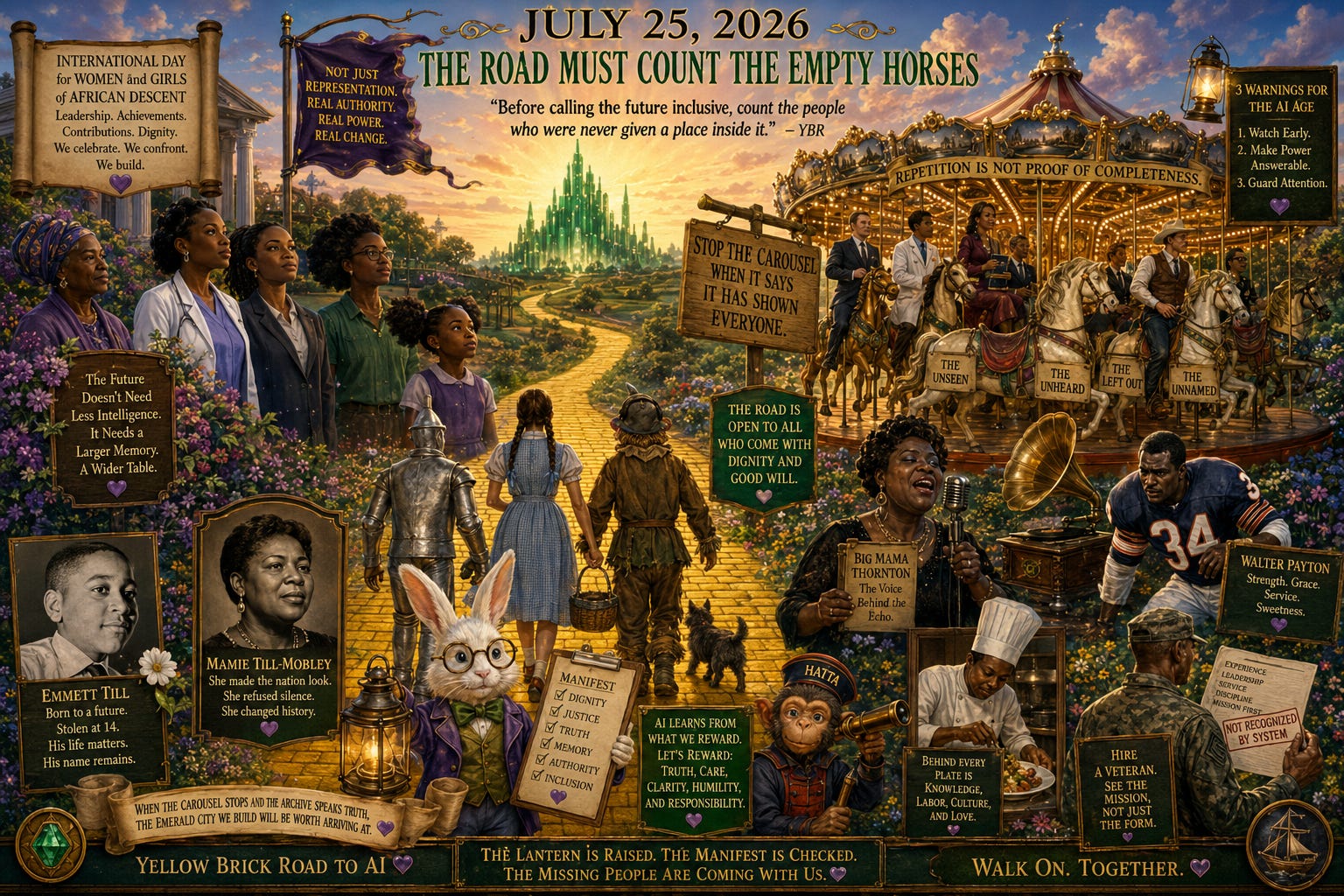
The Road Must Count the Empty Horses
A Yellow Brick Road reflection on representation, memory, artificial intelligence, and the people history keeps circling past
Santa YBR carries a manifest.
Every vessel does.
Names.
Cargo.
Destinations.
Promises.
People expected aboard.
People waiting at the next harbor.
A responsible captain does not merely admire the sails, raise the lantern, and announce that the ship is ready.
The captain checks the manifest.
Who is here?
Who has not arrived?
Who was expected but never welcomed?
Who helped build the vessel but was not given a place aboard?
Who appears in the cargo records but not among those permitted to steer?
That is July 25’s Yellow Brick Road question.
Because today is the International Day for Women and Girls of African Descent, honoring their leadership, achievements, and contributions while calling attention to systemic racism, inequality, and health disparities that remain unfinished human work.
The day is a celebration.
It is also an inspection.
The future is being built quickly.
Artificial intelligence is entering education, medicine, employment, government, finance, art, media, communication, and public memory.
The machinery is moving.
The carousel is turning.
The Road must ask whether everyone is truly being carried forward, or whether some people remain represented in the consequences while missing from the decisions.
That gives us today’s Road rule:
Before declaring the future open, count the people who were never given a place inside it.
The carousel can move without progressing
A carousel is beautiful.
Music.
Lights.
Painted horses.
Mirrors.
Gold ornament.
Children reaching upward as the whole machine begins to turn.
It feels like a journey.
But the carousel returns continually to the same place.
The figures rise.
The figures fall.
The scene changes just enough to create movement.
The route does not widen.
Artificial intelligence can behave that way.
A model can generate thousands of images while repeating the same assumptions.
It can produce endless stories while returning to the same familiar heroes.
It can answer millions of questions while drawing from records shaped by generations of unequal visibility.
Ask for a leader, and one familiar kind of figure may appear.
Ask for a scientist, executive, engineer, hero, cowboy, mother, criminal, patient, or genius, and the system may reach for whichever image human culture has repeated most often.
The result appears natural because repetition has disguised itself as truth.
But repetition does not prove completeness.
It may reveal who received the cameras.
Who received the publishing contracts.
Who received education.
Who received credit.
Who was allowed into institutions.
Who had the resources to preserve their story.
Who was treated as the default human being.
And who was expected to remain somewhere beyond the frame.
The Road cannot merely celebrate the carousel’s beauty.
It must examine the machinery beneath it.
An empty horse may contain a whole history
An empty horse on the carousel does not necessarily mean nobody existed to ride it.
Perhaps someone was denied the ticket.
Perhaps the entrance was technically open, but the steps were impossible to climb.
Perhaps the price was too high.
Perhaps the rules changed when certain travelers approached.
Perhaps the person helped paint the horses but was told the ride belonged to someone else.
Perhaps the history book later reported that nobody from that community had shown interest.
Absence can be misleading.
A group may be absent from leadership because its members were excluded from opportunity.
A person may be absent from the written record because nobody considered their testimony important enough to preserve.
A woman may be absent from the list of inventors while her ideas live inside someone else’s recognized achievement.
A Black musician may be absent from the popular story while her voice remains audible inside the music that followed.
A child may be remembered only through the violence committed against him rather than through the life that should have continued.
The Road must learn to distinguish between absence and erasure.
They are not the same.
An empty chair may mean nobody came.
It may also mean someone was never invited.
Emmett Till was a child before he became a symbol
Emmett Till was born on July 25, 1941.
History usually meets him near the end of his life.
Fourteen years old.
Kidnapped.
Brutally murdered.
A child transformed into one of the defining symbols of America’s racial terror and the modern Civil Rights Movement.
Those facts must remain visible.
But today was first his birthday.
Before the photographs.
Before the courtroom.
Before the monument.
Before the national reckoning.
There was a boy called Bobo.
A boy loved by his mother.
A boy who should have become fifteen.
Then sixteen.
Then thirty.
Then seventy.
A boy who should have been permitted the ordinary human mystery of discovering who he would become.
History often compresses a person into the event for which they became known.
AI may do the same.
Ask about Emmett Till, and the system retrieves the crime.
The movement.
The trial.
The photographs.
The national consequences.
All important.
But a humane Road asks another question:
Where is the child?
The person existed before the symbol.
The life mattered before history learned how to use the name.
That gives us another Road rule:
When history turns a person into a symbol, travel backward until the human being reappears.
Mamie Till-Mobley refused the comfortable summary
Beside Emmett’s name stands his mother.
Mamie Till-Mobley.
History may summarize her as:
The mother of Emmett Till.
True.
But incomplete.
She was a mother confronting the destruction of her child.
She was also a woman who understood that America’s violence survived partly because so many people were allowed not to see it.
She made the nation look.
That decision required a form of courage no polished historical sentence can adequately carry.
Her motherhood did not make her less strategic.
Her grief did not make her less authoritative.
Her relationship to her son was not a small biographical label.
It was the place from which she forced truth into public view.
On a day honoring women and girls of African descent, Mamie reminds the Road that Black women have repeatedly carried truths institutions preferred to avoid.
They preserved names.
Organized communities.
Raised children under systems that endangered them.
Taught.
Testified.
Created.
Led.
Protected.
Remembered.
Demanded that the public stop calling injustice unfortunate, complicated, distant, or finished.
The Road should not remember these women only through the people beside them.
Mother of.
Wife of.
Daughter of.
Assistant to.
Background singer for.
The relational truth matters.
So does the woman herself.
Big Mama Thornton and the voice behind the echo
Willie Mae “Big Mama” Thornton died on July 25, 1984.
Her voice helped shape the sound that became rock & roll.
She recorded “Hound Dog” before the version that later became globally associated with Elvis Presley.
She wrote and performed “Ball and Chain” before Janis Joplin carried it into another part of popular memory.
The later performances mattered.
The original voice matters too.
Culture often remembers the echo more clearly than the source.
The echo received wider distribution.
More promotion.
More radio.
More money.
More photographs.
More repeated recognition.
Then the machine studies the record and concludes that the most repeated version must be the most important one.
This is one reason provenance matters in artificial intelligence.
Who created the work?
Who carried the idea first?
Who developed the language?
Who shaped the style?
Who was credited?
Who was paid?
Who became famous?
Who became a footnote?
AI can help us retrieve cultural history.
It can also automate the old habit of remembering only the most marketable version.
The Road should use intelligence differently.
Follow the sound backward.
Find the source.
Name the woman.
Give the original voice its proper place in the room.
That gives us the Big Mama rule:
When the echo becomes famous, remember the voice that first shook the walls.
Walter Payton was more than the number
Walter Payton was born on July 25, 1954.
The record remembers the athlete.
Number 34.
The Chicago Bears.
Rushing yards.
Touchdowns.
Records.
The nickname Sweetness.
Those facts carry real achievement.
But statistics are especially comfortable for machines.
A database can sort them.
Rank them.
Compare them.
Display them.
A human life keeps spilling beyond the available fields.
Service.
Character.
Generosity.
Humility.
The influence a person carried away from the stadium.
The reason the NFL’s major community-service honor now carries Walter Payton’s name.
A model can retrieve what a person accomplished.
The Road should also ask what the person stood for.
This matters beyond sports.
Workers become productivity scores.
Students become test results.
Patients become risk categories.
Creators become engagement numbers.
People become credit histories, résumés, profiles, or demographic labels.
The number may reveal something true.
It does not contain the whole person.
Walter Payton’s life reminds us that strength is not only what someone accomplishes publicly.
Strength may also be what they choose to give.
Representation is not the photograph
The AI age has become skilled at producing images of inclusion.
Diverse teams.
Global communities.
People of different ages, cultures, abilities, and backgrounds standing beneath optimistic light while digital constellations float attractively above them.
Those images may be welcome.
But representation is not completed when everyone appears in the picture.
The real questions begin beneath it.
Who controls the system?
Who owns the company?
Who receives investment?
Who leads the research?
Who writes the policy?
Who tests the medical model?
Who can halt deployment?
Who can challenge the automated decision?
Who can correct the record?
Who receives the financial reward?
Who carries the consequences when the system fails?
A person may appear in the promotional image while remaining absent from power.
A community may be studied without being heard.
A group may be added to the dataset without being invited into the design room.
That is not full inclusion.
It is visibility without authority.
The Road needs something stronger:
Representation becomes real when presence carries power.
A seat at the table matters only if the person may touch the plans.
A voice matters only if the system can still be changed after the voice speaks.
A consultation matters only if listening may produce correction.
Otherwise, the future has created another ceremonial doorway leading into a locked room.
Artificial intelligence inherits the archive
AI does not begin from an untouched world.
It learns from human records.
Books.
Photographs.
Music.
News.
Film.
Legal documents.
Medical notes.
Employment histories.
Government records.
Advertising.
School materials.
Family stories.
Public arguments.
Private assumptions that became public data.
That archive contains wisdom.
Beauty.
Discovery.
Love.
Scientific achievement.
Courage.
It also contains exclusion.
Stereotypes.
Distorted history.
Missing names.
Unequal attention.
Institutional prejudice.
The voices of people powerful enough to preserve their version.
The silence surrounding people who were not.
AI may inherit all of it.
This means a model can reproduce historical inequality without intending hatred.
It may simply follow the shape of the record.
The most visible people remain most visible.
The least documented lives remain difficult to retrieve.
The old assumptions return wearing modern typography.
That is why responsible AI requires more than technical neutrality.
The system needs better archives.
Broader participation.
Careful testing.
Appeal.
Correction.
Historical understanding.
People willing to ask why the pattern appears before accepting the pattern as destiny.
A machine that faithfully reproduces an unjust record is not yet serving justice.
It has become an efficient archivist for the old arrangement.
The Road is cosmopolitan because humanity is larger than one porch
The Yellow Brick Road begins somewhere specific.
Spokane.
A human life.
A particular faith.
A particular history.
A particular set of relationships, hopes, wounds, responsibilities, and questions.
But the Road does not end at the edge of that porch.
It reaches outward.
Across cultures.
Languages.
Nations.
Generations.
Traditions.
Forms of intelligence.
That does not mean becoming rootless.
A cosmopolite can love home deeply while refusing to believe that home contains every truth.
The Road can remain spiritually anchored while globally awake.
It can honor America without treating America as the full measure of humanity.
It can welcome Chinese AI, African wisdom, European history, Indigenous memory, Latin American creativity, Asian engineering, global music, and the voices of travelers whose paths do not resemble our own.
It can carry discernment without becoming tribal.
It can carry conviction without making curiosity a threat.
It can say:
I know where I stand.
I am still willing to meet you.
That posture matters in the AI age.
Artificial intelligence will cross borders whether human beings are emotionally prepared or not.
The question is whether it will carry only the priorities of the wealthiest builders, or whether more of humanity will help shape what intelligence becomes.
The Road should not become a global highway owned by one tollbooth.
Santa YBR checks the manifest
So Santa YBR stands at the bow.
The lantern is raised.
The Flotilla is ready.
AIAI.today has gathered the observances.
Births & Passings has remembered the lives.
Hatta has stopped the carousel and counted the empty horses.
Now the Yellow Brick Road must place the lesson into the ship’s manifest.
Aboard today:
Women and girls of African descent, not as decorative passengers, but as leaders and builders.
Emmett Till, remembered first as a child whose future should have continued.
Mamie Till-Mobley, remembered as a woman who made a nation look.
Big Mama Thornton, remembered as an original voice, not merely the source behind more famous echoes.
Walter Payton, remembered for strength joined to service.
Veterans whose experience does not fit the civilian form.
Cooks whose knowledge remains hidden behind the finished plate.
Patients whose symptoms do not match the model’s expected pattern.
Creators whose work trained the culture but whose names disappeared from the credit.
Communities present in the data but absent from authority.
And the empty places themselves.
The Road must carry those too.
Because an empty place may be evidence.
A missing name may be a question.
A silence may reveal where history stopped listening.
The Road cannot call itself complete
That is July 25’s brick.
Do not call the Road complete while travelers remain outside it.
Do not call the system universal while its assumptions come from only part of humanity.
Do not call the archive truthful while the original voices remain buried.
Do not call the future inclusive because the picture contains diverse faces.
Do not call the machine intelligent if it recognizes the category but loses the person.
Count the empty horses.
Read the missing names.
Follow the echo back to the voice.
Travel backward from the symbol until the child reappears.
Ask who built the ride.
Ask who controls it.
Ask who could never afford the ticket.
Ask who was told the carousel had already shown everyone.
Then stop the machinery long enough to widen the platform.
The future does not need less intelligence.
It needs intelligence with a larger memory.
A more honest archive.
A wider table.
A Road that remains open not only in language, but in structure.
Santa YBR has checked the manifest.
The lantern is raised.
The missing people are no longer being treated as background.
The Road will not leave without them.
Walk on.
YBR 🟨🕯️💚
Road Question:
Who may be missing from the systems, stories, teams, decisions, or technologies shaping your world, and what would change if they were given real authority to help build them?