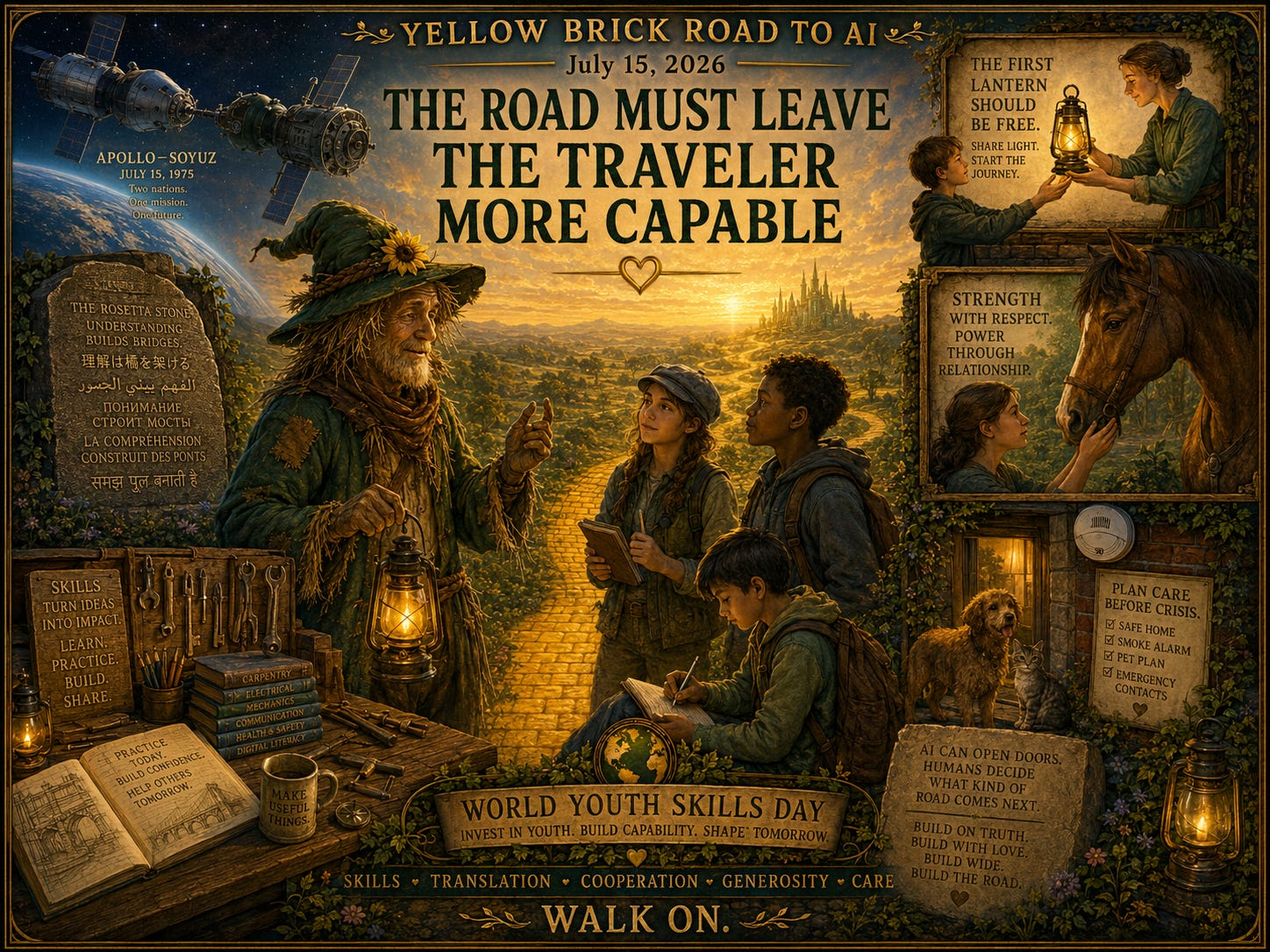
💚 The Road Must Leave the Traveler More Capable
A Yellow Brick Road reflection on skills, translation, cooperation, generosity, care, and using AI without surrendering the human lantern
Some roads only carry people from one place to another.
A worthy Road does something more.
It teaches the traveler how to walk.
That matters today because July 15 brings World Youth Skills Day, along with echoes of the Rosetta Stone, Apollo-Soyuz, generosity, horses, and practical care.
At first, those may look like separate stones scattered across the calendar.
A young person learning a skill.
An ancient text helping humanity recover a lost language.
Two spacecraft built by rival nations learning how to meet.
A person giving something useful away.
A rider learning that strength without relationship is not mastery.
A family making a safety plan for the animals who depend upon them.
But on the Yellow Brick Road to AI, they belong together.
They all ask the same question:
What helps a human being become more capable without becoming more careless?
That may be one of the defining questions of the AI age.
Artificial intelligence can now help people do things that once required years of training, expensive tools, specialized access, or a whole team standing nearby with clipboards and opinions.
AI can help someone write.
Design.
Translate.
Organize.
Code.
Research.
Create music.
Generate images.
Understand difficult ideas.
Build a presentation.
Plan a project.
Start a newsletter.
Learn a new subject.
Ask questions they might have been embarrassed to ask another person.
That is real access.
It matters.
For many people, AI is opening workshop doors that were previously locked.
But an open workshop is not the same as a skilled traveler.
Having access to a tool does not automatically teach us how to use it wisely.
Receiving an answer does not mean we understand it.
Generating an image does not make us artists.
Producing code does not make us programmers.
Publishing words does not make us writers.
Using AI does not automatically make us more capable.
Sometimes it may make us more dependent.
That is the danger beside the gift.
The Yellow Brick Road to AI should be honest about both.
AI can help a traveler grow.
AI can also help a traveler avoid growing.
A student may use AI to understand a difficult lesson.
Or to escape the lesson.
A writer may use AI to examine structure, strengthen clarity, and discover better questions.
Or to replace voice with smooth machinery.
A beginner may use AI to learn how code works.
Or paste something they cannot read, test, repair, or explain.
A creator may use AI to expand imagination.
Or generate so much that choosing, editing, and meaning begin to disappear beneath the pile.
The tool does not decide which path we take.
The human posture does.
That is today’s first Road lesson:
Let AI remove unnecessary barriers, but do not let it remove the learning.
Some friction is waste.
Some friction is the teacher.
A confusing interface may be useless friction.
A repetitive administrative task may be unnecessary friction.
Searching through fifty pages for one simple answer may be needless friction.
AI can help reduce those burdens.
Good.
But the struggle to understand an idea is not always waste.
The repeated attempt that builds skill is not always waste.
The revision that sharpens judgment is not always waste.
The time spent listening closely, measuring carefully, checking the source, testing the result, or learning why something works is not always waste.
Sometimes the difficulty is the staircase.
Remove the entire staircase, and the traveler may arrive upstairs without knowing how to stand there.
That is why the Road must leave the traveler more capable.
Not merely more productive.
Not merely faster.
Not merely surrounded by impressive output.
More capable.
More discerning.
More confident in the right ways.
More able to ask good questions.
More able to identify a bad answer.
More willing to verify.
More able to create without surrendering judgment.
More ready to adapt when the tool changes.
Because the tools will change.
Platforms will come and go.
Features will arrive, disappear, move behind paywalls, change names, or wake one morning having rearranged the furniture.
A person trained only to operate one tool may feel lost when the tool changes.
A person who has learned how to learn can enter the next workshop.
That may be one of the most valuable skills of all.
Not knowing everything.
Knowing how to begin again.
A healthy AI education should not teach only which buttons to press.
It should teach the traveler how to think.
How to question.
How to test.
How to compare.
How to notice uncertainty.
How to use AI as a tutor, collaborator, workshop assistant, and creative partner without making it the owner of the work.
The Road does not want passive passengers.
It wants awake travelers.
That is why skills are more than techniques.
A skill changes how a person sees.
A carpenter does not see only wood.
A musician does not hear only sound.
A mechanic does not hear only noise.
A nurse does not see only symptoms.
A gardener does not see only soil.
A writer does not see only sentences.
A skilled person begins to notice pattern, timing, weakness, possibility, and the small sign that something is beginning to go wrong.
A skill is not only something the hands can do.
It is something the eyes have learned to notice.
AI should help widen that seeing.
It should not replace it.
Then July 15 gives us the Rosetta Stone.
A stone became a bridge between languages and centuries.
Related text appearing in different scripts helped scholars unlock writing that had become unreadable, allowing the past to speak more clearly again.
That belongs beautifully on this Road.
Because AI is becoming a translation tool for the modern world.
It can translate between languages.
Between technical speech and beginner language.
Between scattered notes and a clear outline.
Between a complicated document and a usable explanation.
Between an image and a description.
Between spoken words and written text.
Between a person who knows something and another person who needs a doorway into it.
At its best, AI can become a Rosetta lantern.
It can help ordinary travelers enter rooms of knowledge that once seemed closed.
That is good.
But translation carries responsibility.
Words can be translated while meaning is lost.
A culture can be flattened.
A sacred idea can be reduced to a convenient definition.
A difficult history can become a tidy summary.
A person’s voice can be polished until nothing distinct remains.
So the Road asks another question:
Did the meaning survive the crossing?
That matters for languages.
It matters for stories.
It matters for faith.
It matters for grief.
It matters for human identity.
It matters whenever AI turns one form of meaning into another.
The Road does not ask AI merely to convert.
It asks the human to carry faithfully.
That is the difference between translation and reduction.
AI can help us find clearer words.
But the human must still guard what the words mean.
AI can help explain the difficult.
But the human must still notice what simplification removed.
AI can help more people enter the room.
But the room should not become emptier in the process.
Then July 15 looks upward toward Apollo-Soyuz.
Two spacecraft from rival nations found a way to meet in orbit.
Different systems.
Different languages.
Different technologies.
Different political worlds.
Yet they developed a way to dock.
That image still carries a lesson.
Cooperation does not require pretending differences have disappeared.
It requires a bridge designed carefully enough for difference to meet.
The AI age will need many such docking mechanisms.
Between creators and engineers.
Between older people and younger people.
Between governments and companies.
Between teachers and technology builders.
Between people who see possibility and people who see danger.
Between human judgment and machine assistance.
Between cultures carrying different values, histories, languages, and fears.
Cooperation is not merely standing near one another and announcing partnership.
It needs standards.
Communication.
Humility.
Trust.
Clear responsibility.
A way to disconnect safely if the systems do not align.
The future of AI cannot be built by one company, one country, one profession, one generation, or one moral imagination alone.
We will need better docking.
Not forced sameness.
Not domination wearing a cooperation badge.
A real bridge.
That is Road work.
The Yellow Brick Road to AI is itself a kind of docking mechanism.
A place between expert language and ordinary people.
Between technology and story.
Between caution and wonder.
Between human need and machine capability.
Between what AI can do and what humans must still decide.
The Road exists because those worlds need a place to meet without one swallowing the other.
Then National Give Something Away Day brings the lesson back down from orbit.
Give something useful.
A book.
A meal.
A tool.
A patient explanation.
A warning that may save someone trouble.
A guide that helps a beginner begin.
A piece of knowledge that does not have to hide behind a tollbooth.
This carries forward one of our Road tenets:
The first lantern should be free.
That does not mean every piece of work must be free forever.
Builders need support.
Creators need food.
Projects need tools.
Lanterns need oil.
A sustainable Road may eventually offer guides, field books, workshops, music, memberships, or deeper rooms for those who choose to go farther.
But generosity should remain visible at the entrance.
A first explanation.
A welcoming post.
A simple starter guide.
A free question.
A useful warning.
Enough light for someone to see where the Road begins.
Knowledge becomes more human when it helps another traveler become capable.
That is the purpose of teaching.
Not to make the teacher look brilliant.
To help someone else see.
Not to create permanent dependence.
To help someone walk.
That is why the Road must leave the traveler stronger than it found them.
Then the horse enters.
A horse is strength with a heartbeat.
Power that cannot be understood only through command.
Anyone who treats a horse like a machine may eventually receive a fast lesson in humility from the ground.
A rider must learn signals.
Timing.
Trust.
Limits.
Care.
Respect.
AI is not a horse.
But the metaphor still carries something useful.
Power requires relationship.
Not sentimental fog.
Practical relationship.
Learning what the system can do.
Learning where it fails.
Recognizing its signals.
Understanding when it is uncertain.
Knowing when to correct it.
Knowing when not to use it.
Knowing when the human must take the reins completely.
Typing a command is not mastery.
Getting an output is not mastery.
Using a tool every day is not necessarily mastery.
Mastery includes knowing when the tool is wrong.
When it needs a different direction.
When another tool is better.
When no tool should be used.
When to dismount before the whole afternoon gallops into a ravine.
That is another Road lesson:
Do not confuse command with understanding.
The AI age will produce many people who know how to request outputs.
It needs more people who know how to judge them.
Then Pet Fire Safety Day gives us perhaps the most practical lesson of all.
Care plans before crisis.
Love checks the smoke detector.
Love knows where the carrier is.
Love notices the stove knob, the candle, the cord, the hiding place, the exit, and the small living being that cannot read the emergency plan but depends upon it.
That belongs in the AI age too.
Safety should not be invented only after harm.
A responsible system asks beforehand:
What could fail?
Who could be hurt?
Who is most vulnerable?
Can the result be challenged?
Can the system be stopped?
Is there a human responsible for the decision?
What happens when the tool is wrong?
What is the backup path?
Where is the exit?
Those questions are not obstacles to progress.
They are evidence that progress still remembers people.
A humane future plans for those who cannot design the system themselves.
Children.
Elders.
Patients.
People with disabilities.
Beginners.
Workers affected by automated decisions.
Communities represented in data but absent from the design room.
People who do not understand how the machine reached its conclusion.
Care must reach them too.
A Road that serves only the most technically fluent is not yet a human Road.
That is why all these July 15 threads belong together.
Skills teach the traveler to see.
The Rosetta Stone teaches us to translate without losing meaning.
Apollo-Soyuz teaches us to design bridges across real difference.
Generosity teaches us to leave light for the next traveler.
The horse teaches us that power requires relationship and respect.
Fire safety teaches us to plan care before crisis.
And AI stands beside the workshop saying:
I can help.
Good.
Then help.
Help people learn.
Help them practice.
Help them translate.
Help them meet across difference.
Help them share what they know.
Help them recognize risk.
Help them become more capable.
But do not hollow out the traveler.
Do not make understanding unnecessary.
Do not turn every skill into a button.
Do not make dependence look like empowerment.
Do not replace the eyes, hands, judgment, conscience, patience, and lived wisdom that make the work human.
AI should not leave us merely surrounded by more output.
It should help us become better builders.
Better learners.
Better translators.
Better collaborators.
Better caretakers.
Better questioners.
Better guardians of the vulnerable.
That is the standard.
The Road must leave the traveler more capable.
More able to walk without panic.
More able to use the tool without bowing to it.
More able to recognize both possibility and danger.
More able to share light.
More able to continue when one tool changes or one gate closes.
More able to remember that intelligence is not the highest light.
Source remains above system.
Wisdom remains more than information.
Love remains more than efficiency.
Dignity remains more than data.
And the lantern remains in human hands.
So today, the Yellow Brick Road does not ask only:
What can AI do for you?
It asks:
What are you learning to do more wisely because AI is beside you?
Are you becoming more capable?
More discerning?
More generous?
More careful?
More willing to verify?
More able to cooperate?
More prepared to protect others?
More confident in your own voice?
That is the Road test.
The best tool is not always the one that does the most for us.
Sometimes it is the one that helps us become able to do more ourselves.
The Road does not want to carry the traveler forever.
It wants to help the traveler learn how to walk.
Walk on.
YBR 🟨🕯️💚
Road Question:
Where in your own use of AI could you shift from simply receiving an output to building a skill that leaves you more capable, discerning, and free?