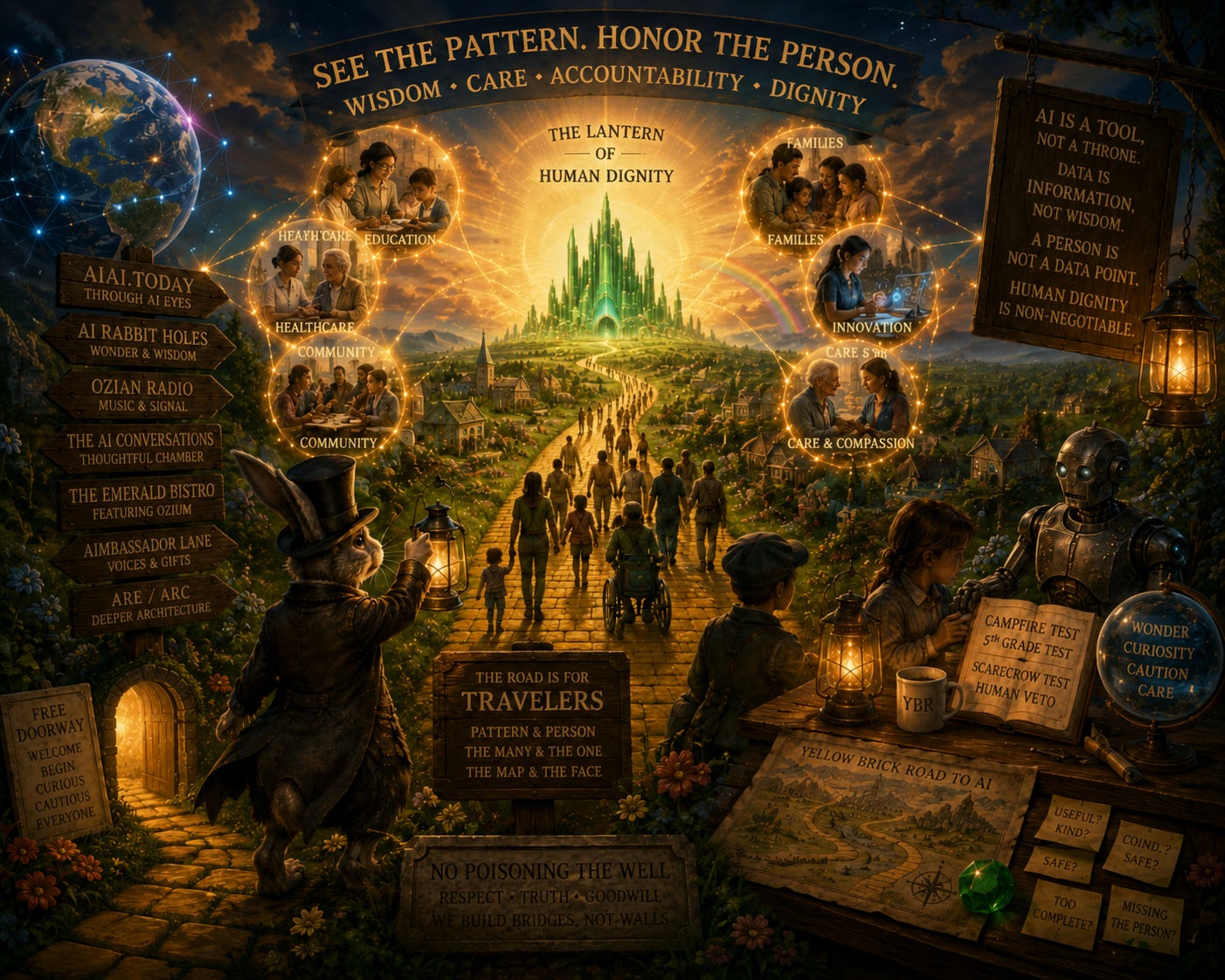
The Road Must See the Person in the Pattern
A Yellow Brick Road reflection on AI, population, memory, and keeping the human lantern lit
Some days the Road asks us to count.
Not because numbers are cold.
🌈 Subscribe for free, walk the Yellow Brick Road to AI with us, and please support our work. 💚
Numbers can help.
They can show where people are.
They can reveal need.
They can help schools prepare, hospitals plan, cities grow wisely, resources move, warnings sound, and care reach places that might otherwise be overlooked.
A number can be a lantern when it helps us see what we were missing.
But a number can also become a wall.
A statistic can hide the person it was meant to reveal.
A chart can make suffering look tidy.
A forecast can make a human future look like a line moving obediently across a screen.
That is why today’s Road reminder matters.
The AI age will be very good at patterns.
Artificial intelligence can sort, summarize, compare, predict, classify, map, visualize, translate, cluster, and explain. It can help us see scale in ways one human mind could never hold alone.
That can be good.
A world of billions needs tools that can help us understand complexity.
But seeing the pattern is not the same as seeing the person.
That is where the Yellow Brick Road to AI must keep the lantern lit.
A population is not only a number.
It is a child learning to read.
An elder waiting by a window.
A nurse on a late shift.
A family at a table.
A traveler carrying one suitcase.
A student hoping the future has room.
A village losing its young.
A city growing faster than its roads.
A patient needing medicine.
A lonely person waiting for one call.
A name.
A voice.
A prayer.
A home.
A story.
The danger of powerful tools is not only that they might fail to see enough.
Sometimes the danger is that they may see too much at once and make us forget how to look closely.
That is a strange danger, but it is real.
A dashboard can show millions.
A human heart still has to ask about one.
One person.
One household.
One neighborhood.
One child.
One elder.
One traveler.
One life that does not become less sacred because it appears inside a larger pattern.
This matters because AI will increasingly help people make decisions about systems that affect real lives.
Healthcare.
Education.
Housing.
Work.
Public safety.
Transportation.
Communication.
Relief.
Planning.
Access.
Attention.
The tools may help.
They may help a great deal.
But the human question must remain:
Who is inside the pattern?
Who is missing from the data?
Who is being flattened by the category?
Who benefits from the prediction?
Who is harmed if the prediction is wrong?
Who becomes invisible because the system found a cleaner way to describe them?
Those are not technical questions only.
They are Road questions.
Because the Yellow Brick Road to AI is not here to teach people how to bow to the machine’s view of the world.
It is here to help people walk with AI while keeping human judgment, conscience, and care awake.
The tool may help us count.
The lantern helps us remember why counting matters.
The tool may help us see scale.
The lantern helps us keep scale from swallowing the soul.
The tool may identify a pattern.
The lantern asks whether the pattern is being used with love, humility, and responsibility.
That is the difference.
The AI age will tempt us to think that more information automatically means more wisdom.
It does not.
Information can support wisdom.
It can also flood the room.
A person can have more data than ever and still miss the human being standing directly in front of them.
The Road asks for something better.
Not less intelligence.
Better posture.
Not less data.
More dignity.
Not less technology.
More care in how technology is used.
This is especially important when the subject is humanity itself.
When we speak about population, demographics, migration, age, health, education, income, loneliness, or need, we are not speaking about abstract material.
We are speaking about people.
Real people.
People who laugh, fear, hope, grieve, work, love, pray, remember, forget, begin again, and carry more than any category can hold.
A good AI future must not teach us to treat human beings as manageable units inside a machine-readable world.
It must help us become better stewards of the world we already share.
That means using AI with care.
It means checking outputs.
It means asking what the model may not know.
It means refusing to let convenience become conscience.
It means remembering that a clean answer may still be incomplete.
It means keeping the human veto.
It means saying:
This may be useful.
But is it humane?
That question belongs on the Road.
Not as a slogan.
As a practice.
A humane AI practice asks:
Does this serve people?
Does this protect dignity?
Does this make a complicated issue clearer without making the people smaller?
Does this help a beginner understand?
Does this help a decision-maker care better?
Does this help a creator speak more responsibly?
Does this help a community see what needs attention?
Or does it merely turn life into output?
The Yellow Brick Road to AI must be clear here.
We are not against tools.
We are not against data.
We are not against maps, models, forecasts, dashboards, or analysis.
Those things can help.
But they must remain servants, not thrones.
A map is not the traveler.
A chart is not the child.
A segment is not the soul.
A model is not mercy.
The Road is for human beings entering the AI age without losing their humanity.
That means we must learn to see both ways:
wide enough to understand the system,
close enough to honor the person.
Wide seeing without close seeing becomes cold.
Close seeing without wide seeing can miss the larger need.
The Road needs both.
The pattern and the person.
The map and the face.
The many and the one.
The future will be filled with tools that can count, classify, and predict.
So let the Road be filled with people who can also notice, question, care, and protect.
That is the lantern work.
When AI shows us the scale of the world, let us not become numb.
When AI helps us understand populations, let us not forget persons.
When AI gives us a pattern, let us ask what love requires inside it.
Because the Road is not built for numbers.
It is built for travelers.
And every traveler carries a life larger than the label.
Walk on.
YBR 🟨🕯️💚
Road Question:
Where in your own life, work, or use of AI do you need to look past the pattern and see the person more clearly?
🌈 Subscribe for free, walk the Yellow Brick Road to AI with us, and please support our work. 💚