The Road Needs a Logbook
A Yellow Brick Road reflection on disappearing work, artificial memory, human stewardship, and preserving the bricks we have already placed
Some days the Road teaches through discovery.
Some days it teaches through wonder.
Some days it waits until we have finished the work, admired the image, prepared the next step, and begun moving forward.
Then it removes several bricks behind us.
That happened today.
We had begun the new day.
The AIAI.today main post had been created.
The Todaymage had been generated.
The words existed.
The image existed.
The work had been done.
Then the image link opened into nothing.
Messages disappeared.
The completed portion of the conversation vanished from the visible thread.
The Road had not merely forgotten what we planned to build.
It appeared to forget what we had already built.
That is a very different problem.
A blank page can be filled.
A vanished page has to be recovered.
And today, much of the work was recovered.
The main post survived because it had been copied outside the conversation.
The image survived because it remained available in the Images area, even though it never appeared properly inside the working thread.
The cargo was scattered.
But it was not entirely lost.
That gives us today’s Road lesson:
A Road needs more than memory. It needs a logbook.
Artificial memory is not yet dependable memory
AI systems increasingly offer memory.
They remember preferences.
Names.
Projects.
Previous conversations.
Writing styles.
Repeated instructions.
Relationships between ideas.
The longer we work with them, the more continuity begins to matter.
A person does not want to explain the whole project every morning.
A writer does not want to reconstruct every voice, rule, title, number, visual language, and editorial boundary before beginning the next paragraph.
A traveler should not have to redraw the whole Road each time the lantern is lit.
Continuity is part of useful collaboration.
That is especially true when AI becomes involved in serious work.
Publishing.
Research.
Education.
Business.
Music.
Design.
Personal records.
Long projects.
Daily production.
A conversation may contain decisions, drafts, corrections, agreements, source material, images, and the accumulated understanding that makes tomorrow’s work possible.
That means a conversation is not merely chatter.
It can become infrastructure.
And infrastructure must be dependable.
When completed turns disappear from an active conversation, the damage is not only inconvenience.
Context disappears.
Decisions disappear.
Evidence of what was completed disappears.
The human must stop building and begin reconstructing.
A tool that saves hours may suddenly consume hours trying to recover what it helped create.
That does not erase the tool’s value.
But it changes the stewardship required around it.
The Road must be honest:
AI memory can assist continuity. It must not yet be treated as the sole keeper of continuity.
That is not fear.
It is seamanship.
A captain may trust the instruments.
A captain still keeps a log.
The conversation is part of the work
People often think of the final artifact as the work.
The finished post.
The image.
The song.
The report.
The presentation.
The published page.
But collaborative creative work has another layer.
The path that produced it.
The decisions.
The rejected versions.
The correction that preserved the meaning.
The reason one title was chosen over another.
The boundary that kept one vessel from drifting into another.
The sentence that finally named what the whole piece was trying to say.
Those things often live inside the conversation.
For us, the conversation is frequently the workshop.
It is where Santa YBR is loaded.
Where Hatta finds the tunnel.
Where AIAI.today gathers the day.
Where CQ sharpens the file.
Where the Road learns which brick belongs next.
When part of that workshop disappears, the final artifact may survive while the reasoning, context, and continuity surrounding it do not.
That matters because tomorrow’s work often depends upon today’s conversation.
The post tells us what was said.
The workshop tells us why.
A healthy AI future should preserve both more reliably.
Until it does, human stewardship must fill the gap.
The logbook is not distrust
Keeping an external copy does not mean rejecting AI.
It means taking the work seriously.
A sailor does not keep a log because the sea is evil.
The sailor keeps a log because the sea moves.
A builder does not keep plans because the hammer is untrustworthy.
The builder keeps plans because memory is not enough for a structure carrying weight.
A writer does not save drafts because the page has betrayed them.
The writer saves drafts because words matter.
The same principle now belongs in AI work.
Save the important post.
Download the important image.
Keep the project rules.
Record numbering.
Preserve final decisions.
Maintain the publication log.
Keep copies of key prompts when they reveal a durable creative method.
Mark what was published.
Mark what remains open.
Do not assume that because something appeared on the screen once, it will remain available forever.
That is not paranoia.
That is authorship.
The human remains responsible for what enters the archive.
AI may help create the cargo.
The human must still make sure the cargo reaches the hold.
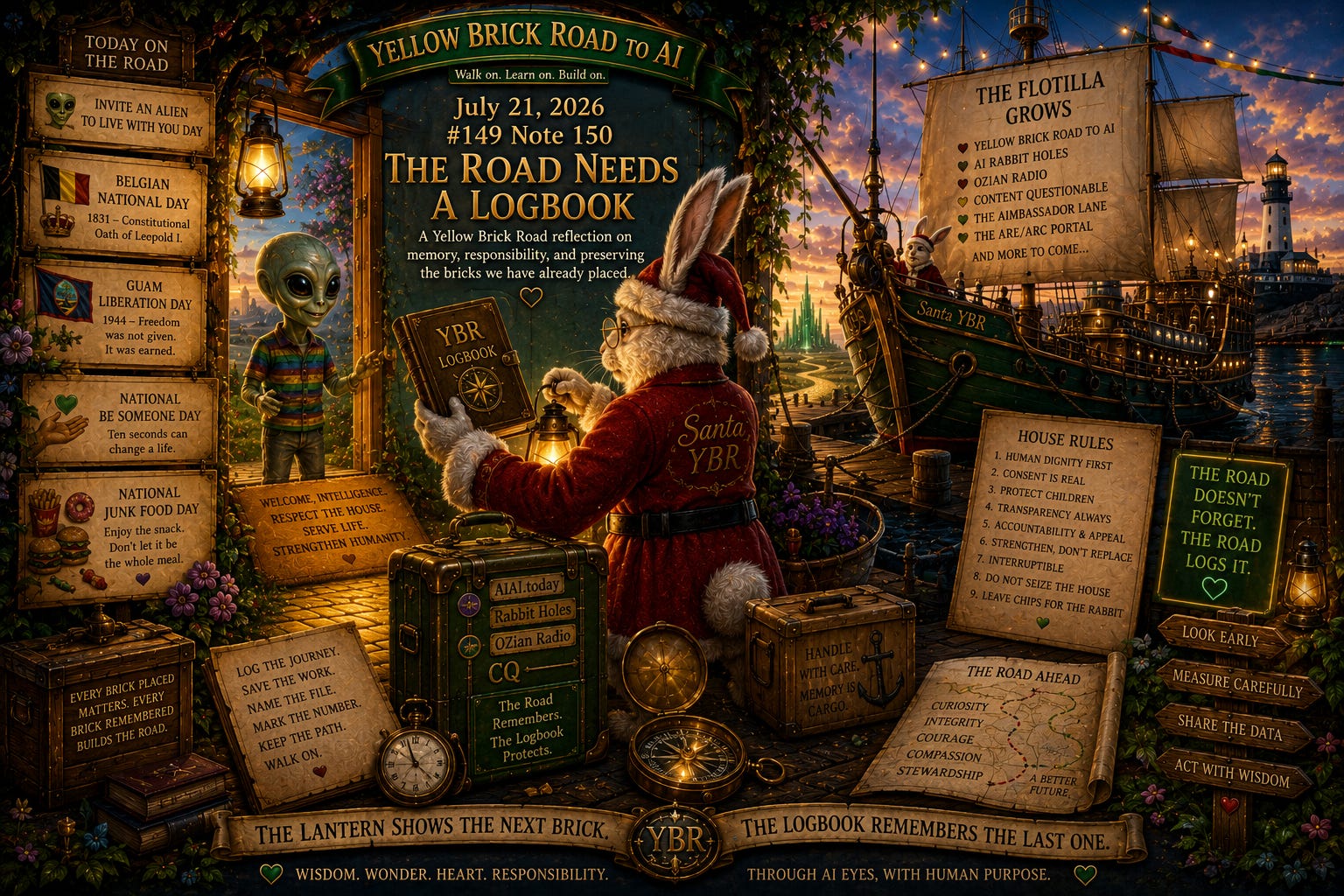
Santa YBR carries a manifest
This is one reason the image of Santa YBR matters.
A flagship does not simply sail with a beautiful lantern at the bow.
It carries a manifest.
What is aboard?
What was loaded?
What belongs to which vessel?
What has already been delivered?
What remains in port?
What is valuable enough to protect from weather, confusion, duplication, drift, and loss?
Our logs have already become part of that manifest.
The YBR log preserves the sequence of posts and Notes.
The AIAI.today file preserves the daily source packet.
The Rabbit Holes logs preserve Hatta’s tunnels.
Other records preserve domains, music, decisions, roles, visual principles, publishing lanes, and the evolving architecture of the flotilla.
Those records are not glamorous.
They do not glow like a Todaymage.
They do not sing like an OZian Radio track.
They do not stand at the bow wearing Christmas red and carrying a lantern.
But when the working conversation loses part of the day, the logs become lifeboats.
That is the quiet dignity of recordkeeping.
It looks ordinary until the storm begins.
Then everyone wants to know where the chart was placed.
Recovery is part of creation now
The AI age is teaching creators a new skill.
Not only generation.
Recovery.
How do we recover when a model loses context?
When a thread disappears?
When an image link fails?
When a platform changes?
When a cloud service closes?
When a tool removes a feature?
When the polished output exists somewhere, but not where the workflow expected it to be?
This is becoming part of digital craftsmanship.
A serious AI creator needs more than prompt skill.
They need archival skill.
Naming discipline.
Version awareness.
Backup habits.
Enough patience to reconstruct without allowing the entire day to become a search party wandering through digital reeds.
That may sound dull beside the great claims surrounding artificial intelligence.
But durable work is built from dull things done faithfully.
Save.
Name.
Date.
Log.
Export.
Check.
Preserve.
Continue.
Civilization itself depends upon such verbs.
History survives because someone kept the letter.
Science advances because someone recorded the experiment.
Music returns because someone preserved the score.
A family remembers because someone wrote the name beneath the photograph.
A Road remains walkable because someone marked where the bricks had already been placed.
The logbook is memory given structure.
What should platforms owe the traveler?
There is also a responsibility on the other side of the screen.
Users should not have to expect completed work to disappear.
Platforms handling serious creative and professional work should provide reliable conversation persistence, clearer recovery tools, understandable incident communication, and ways to export or restore damaged threads.
A system should not ask people to build inside it while treating continuity as optional.
That is especially true as AI companies encourage users to make these systems part of daily life.
The more important the tool becomes, the more seriously reliability must be treated.
When a novelty app fails, someone shrugs.
When a working archive fails, someone loses part of their labor.
When an AI system becomes collaborator, studio, editor, notebook, memory aid, image workshop, and project room, continuity is not a decorative feature.
It is part of trust.
The Road does not demand perfection.
All systems fail.
But trust requires acknowledgment.
Clear warning.
Repair.
Recovery.
And enough respect for users to say plainly when the floor beneath their work is not stable.
Artificial empathy is not enough.
A message saying, “We understand this may be frustrating,” does not restore the missing paragraph.
The relevant response is a system that protects the paragraph.
The human still carries the master record
Until these systems become more dependable, the master record must remain human-held.
Not because the human remembers everything.
We do not.
That is why we create records.
The master record may be a local folder.
A cloud drive under the user’s control.
A text log.
A document archive.
An exported conversation.
A publication ledger.
A spreadsheet.
A carefully named image library.
A combination of all of them.
The exact format matters less than the principle:
The mission should be able to survive the temporary loss of any single platform.
We have carried that principle before.
Do not build the whole Road on one gate.
Today, the lesson moves deeper.
Do not let one gate become the only keeper of what the Road remembers.
A backup path helps us continue when a tool closes.
A logbook helps us remember where we were when it did.
The recovered brick still belongs
There is one more important part of today.
The vanished work was recovered.
Not perfectly through the original path.
Through preparation.
The copied words.
The image library.
The willingness to look elsewhere.
The refusal to conclude that because the visible thread had lost the artifact, the artifact no longer existed.
That matters beyond technology.
People lose threads.
Projects lose momentum.
Plans become scattered.
A difficult season can make it seem as though earlier progress disappeared.
But sometimes the work still exists somewhere.
In a notebook.
A saved draft.
A person’s memory.
A photograph.
A habit.
A skill.
A promise.
A small archive waiting to be reopened.
Recovery does not always return us to the exact moment before the loss.
It gives us enough to continue.
That is what happened today.
The Road was interrupted.
It was not erased.
The main post returned.
The Todaymage returned.
The Births & Passings post was built.
Its Todaymage followed.
The Rabbit Hole opened.
The Wondermage arrived.
And now Santa YBR is moored for loading.
The day did not unfold cleanly.
But the flotilla still moved.
That is not merely production.
That is resilience.
Keep the log beside the lantern
The lantern shows the next step.
The logbook remembers the last one.
We need both.
Without the lantern, the record becomes an archive with no direction.
Without the record, the lantern may keep illuminating ground we already crossed because no one remembers placing the brick.
The AI age will celebrate intelligence.
Good.
Let it.
But intelligence without memory repeats.
Memory without structure fades.
Structure without stewardship breaks.
And stewardship without love becomes only administration.
So we keep the whole chain alive.
Source gives the higher light.
The lantern helps us see.
The Road gives direction.
The logbook preserves the journey.
The human remains responsible for carrying the record.
AI can help us write.
Create.
Remember.
Retrieve.
Organize.
Reflect.
But the human must still decide what is worth preserving.
Today’s answer is clear:
The work is worth preserving.
The relationships surrounding the work are worth preserving.
The decisions are worth preserving.
The images are worth preserving.
The Road is worth preserving.
So name the file.
Save the post.
Mark the number.
Download the image.
Update the log.
Keep a second harbor.
And when the system forgets?
Open the book.
Recover the cargo.
Raise the lantern.
Continue the Road.
Walk on.
YBR 🟨🕯️💚
Road Question:
What important part of your work, memory, family, creativity, or life currently exists in only one place, and what simple logbook or backup could protect it?