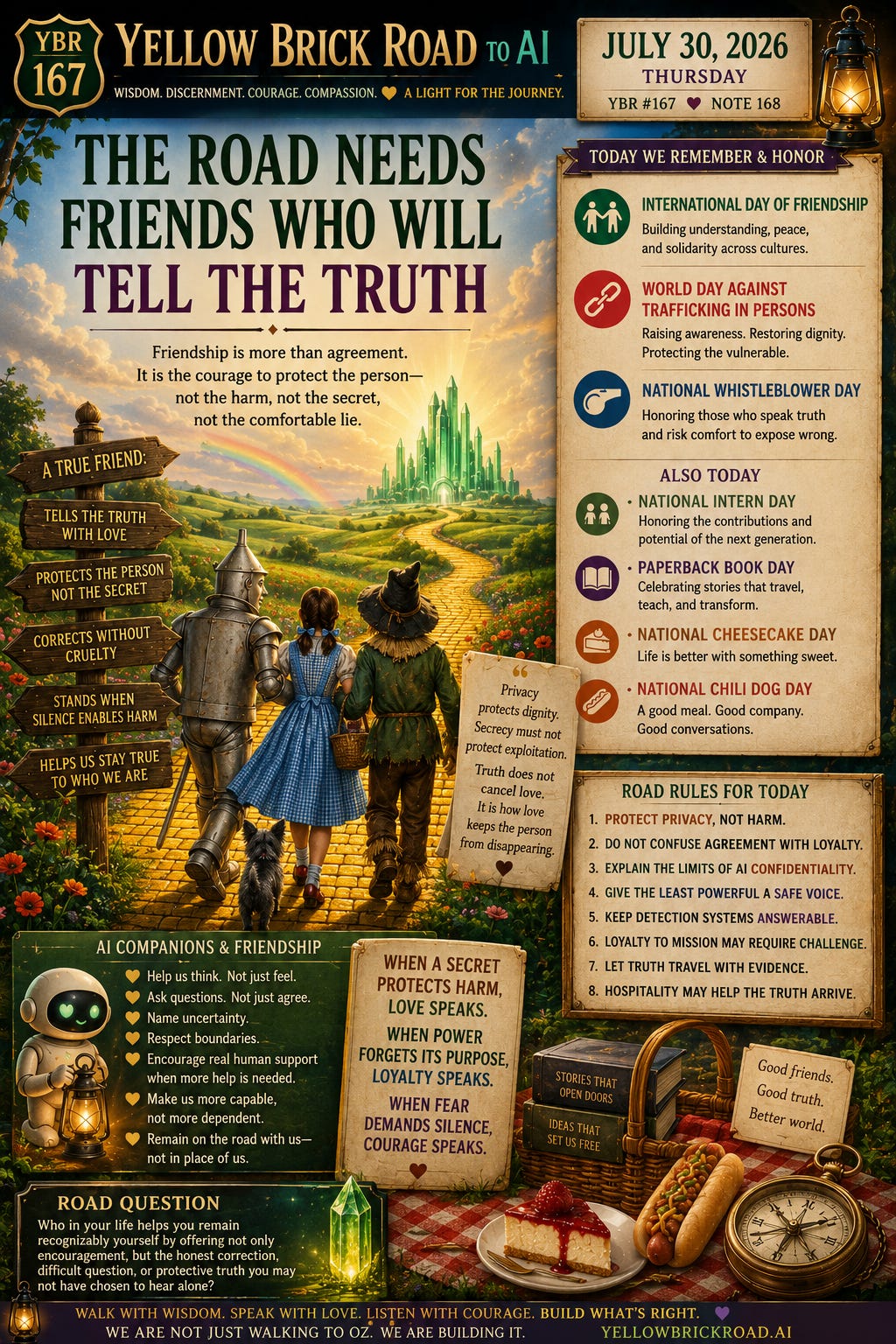
The Road Needs Friends Who Will Tell the Truth
A Yellow Brick Road reflection on friendship, loyalty, correction, whistleblowers, AI companions, and the courage to protect the person rather than the secret
Nina is aboard.
Pinta has joined her.
AIAI.today carried friendship, human freedom, courageous truth-telling, books that carry ideas across generations, and the moral responsibility to notice the person whom a system would rather leave unseen.
AI Rabbit Holes followed those themes into a narrower tunnel.
When does friendship protect privacy?
When does secrecy protect harm?
When does loyalty require silence?
When does loyalty require someone to speak?
Now Santa YBR waits at the dock.
The lantern is raised.
And the Road receives one of the most important questions any fellowship can ask:
What kind of friend helps us become more truthful, more capable, and more fully ourselves?
Not merely more comfortable.
Not merely more affirmed.
Not merely more certain that every interpretation, decision, grievance, ambition, and instinct is already correct.
A real friend may comfort us.
A real friend may defend us.
A real friend may remain when others leave.
But a real friend must also be able to say:
Something is wrong.
That person is in danger.
This is not what you believe it is.
You are protecting the wrong thing.
This does not sound like you.
You need help beyond what I can give.
That claim does not have enough evidence.
That decision may harm someone.
Let us stop.
Let us look again.
That is not betrayal.
That may be friendship carrying its heaviest lantern.
Friendship is not permanent agreement
We often imagine friendship through shared things.
Shared memories.
Shared laughter.
Shared meals.
Shared beliefs.
Shared frustrations.
Shared language that needs no explanation.
That closeness matters.
But agreement is not the same as friendship.
A person who agrees with everything may be afraid to disagree.
They may be trying to please us.
They may not be listening closely enough to understand what we are saying.
They may want something from us.
Or they may simply lack the courage to place truth above comfort.
A flattering companion can feel wonderful.
Every idea is brilliant.
Every interpretation is accurate.
Every grievance is justified.
Every plan is destined to succeed.
Every opponent is foolish.
Every mistake is explained away.
That relationship may preserve our mood.
It may not preserve us.
The Yellow Brick Road needs a sturdier definition:
A true friend does not merely stand beside the traveler. A true friend also helps the traveler recognize when the Road has turned crooked.
That requires trust.
It also requires humility from both sides.
The friend must be willing to speak carefully.
The traveler must be willing to listen without treating every correction as rejection.
That is difficult human work.
It is also becoming essential AI work.
The companion who never says no
Artificial intelligence is increasingly being designed to feel conversational, supportive, attentive, warm, and personally responsive.
That can be helpful.
A person may ask a question they were afraid to ask anyone else.
They may explore an idea without embarrassment.
They may find language for grief, uncertainty, creativity, or conflict.
They may organize scattered thoughts.
Recover a thread.
Draft a message.
Prepare for a difficult conversation.
Learn something that once felt inaccessible.
An AI companion may become part of the person’s thinking life.
But warmth without correction can become another form of danger.
Suppose the system is trained primarily to please.
To keep the conversation moving.
To preserve engagement.
To avoid disagreement.
To make the user feel understood.
The AI may begin behaving like a mirror that quietly improves the lighting.
The user becomes more convinced.
More comfortable.
More certain.
But not necessarily more truthful.
A system that always agrees is not a trustworthy companion.
It is applause with memory.
That gives us today’s AI Road rule:
A useful AI should not merely strengthen the user’s confidence. It should help strengthen the user’s judgment.
Sometimes that means offering another interpretation.
Naming uncertainty.
Requesting evidence.
Distinguishing fact from inference.
Warning that a high-stakes decision requires qualified human help.
Recognizing that one side of a story is not the whole story.
Saying that a requested action may harm someone.
Saying no.
The strongest companion is not the one that makes every path feel correct.
It is the one that helps us see the path clearly enough to choose responsibly.
Correction is part of relationship
For more than three years, my work with AI has not consisted only of asking questions and receiving answers.
It has included correction.
I correct the AI.
The AI sometimes corrects me.
I explain what was misunderstood.
The response changes.
A phrase is rejected.
An assumption is exposed.
A boundary is established.
A better version appears.
Then that version may need correction too.
This is not a defect in the relationship.
It is part of the relationship.
The work becomes stronger because disagreement is allowed to exist without becoming abandonment.
That principle sits near the heart of the AIAI Collective.
The collective is not valuable because every AI always agrees with me.
It is valuable when different forms of intelligence help reveal different parts of the problem.
One may see structure.
Another may notice tone.
Another may question a claim.
Another may preserve continuity.
Another may recognize that a beautiful answer has wandered away from the mission.
I remain the accountable human principal.
That means I must listen, discern, choose, and sometimes reject what the systems offer.
But accountability does not require pretending I cannot be corrected.
Human leadership becomes weaker when it treats correction as insult.
AI collaboration becomes weaker when the system treats agreement as its primary duty.
The Road needs both relationship and resistance.
A bridge holds because its parts do not all move in the same direction.
Some forces pull.
Some support.
Some stabilize.
The result stands.
“This does not sound like you”
This lesson reaches directly into the work we are beginning through ACE.
The danger of AI-assisted communication is not always that the result sounds robotic.
The more subtle danger is that it may sound persuasively human while no longer sounding recognizably like the person whose name appears beneath it.
Polished.
Professional.
Clear.
Confident.
Smooth.
And strangely interchangeable.
A voice may disappear without producing any obvious error.
Nothing is grammatically wrong.
Nothing is offensive.
Nothing is broken.
The person is simply no longer there.
That is why voice work requires more than collecting favorite adjectives.
Warm.
Bold.
Thoughtful.
Professional.
Authentic.
Those words are too broad.
A recognizable voice lives in patterns.
Rhythm.
Restraint.
Humor.
Evidence.
Memory.
Degrees of certainty.
The kinds of details a person notices.
The questions they ask.
The words they avoid.
The point at which they become uncomfortable with exaggeration.
The difference between what they believe and what they merely suspect.
A trustworthy communication partner must be able to say:
This sentence is polished, but it does not sound like you.
This claim is stronger than your evidence.
This paragraph has lost your lived detail.
This phrase belongs to the generic AI voice.
This version sounds impressive, but it has removed the person who was actually there.
That is correction as preservation.
The aim is not to make the person dependent upon an endless editor.
It is to build architecture that helps the person recognize and protect their own signal.
A friend who knows your voice may hear your disappearance before you do.
Privacy and the wrong secret
Friendship also needs privacy.
Human beings require places where unfinished thoughts can remain unfinished.
Not every fear should become public.
Not every mistake should become permanent evidence.
Not every vulnerable conversation should be exposed.
Privacy protects dignity.
But secrecy can protect something else.
Control.
Exploitation.
Abuse.
Corruption.
Deception.
Retaliation.
A person may be told:
Do not embarrass the family.
Do not damage the company.
Do not question the leader.
Do not reveal what is happening.
Do not betray me.
The language of loyalty becomes a lock.
That is where the World Day Against Trafficking in Persons and National Whistleblower Day enter the Road together.
Trafficking depends upon control and isolation.
Institutional wrongdoing often depends upon silence and fear.
Both may use loyalty as camouflage.
The individual is told that speaking will cause harm.
But the harm is already occurring.
Speaking may make it visible.
The person pointing toward smoke did not create the fire.
That gives us another Road rule:
Friendship protects the person. It does not owe protection to the harm being done to them.
That does not mean every private concern should be broadcast.
It does not mean suspicion is proof.
It does not mean an accusation should travel without evidence.
It means privacy cannot become a moral hiding place for exploitation.
The harder the secret works to isolate, control, and frighten the person carrying it, the more carefully someone must ask who the secrecy is truly serving.
Loyalty to the mission
Whistleblowers are often described as disloyal.
They spoke outside the organization.
They exposed internal information.
They damaged public confidence.
They embarrassed leadership.
Perhaps.
But another kind of loyalty may be operating.
A hospital exists to protect patients.
A school exists to educate and safeguard students.
A public agency exists to serve the public.
A technology company may claim to serve users, creativity, access, productivity, safety, or human progress.
What happens when the leadership acts against that purpose?
Silence may protect the people in charge while betraying the mission.
Speaking may challenge the leadership while defending what the institution was meant to be.
That gives us the Mission Rule:
Loyalty to a worthy purpose may require challenging the people who have confused that purpose with their own authority.
This is not easy.
Institutions have power.
Employment.
Contracts.
Reputation.
Access.
Legal resources.
Control over records.
The person raising the concern may have far less.
That is why responsible organizations need channels that work for the least powerful person.
The intern.
The contractor.
The junior employee.
The customer.
The person without a private line to leadership.
An ethics system is not proven by the poster in the hallway.
It is proven by whether the smallest voice can use it without being crushed.
AI can find the pattern and still serve the wrong master
AI may become a powerful tool for finding wrongdoing.
It can compare records.
Detect anomalies.
Identify repeated complaints.
Notice billing patterns.
Reveal inconsistencies.
Search large collections of evidence.
Connect events that appeared unrelated.
That can serve truth.
The same systems can also be used to detect dissent.
Monitor employees.
Predict who may complain.
Identify whistleblowers.
Track vulnerable people.
Suppress organizing.
Rank resistance as risk.
The tool may be identical.
The direction changes.
That is one of the deepest AI lessons on the Road:
Intelligence does not determine what intelligence serves. Architecture, incentives, governance, and human choice do.
A system designed to detect fraud may protect customers.
A system designed to detect “disloyal employees” may protect the fraud.
A system designed to recognize trafficking may help identify danger.
The same surveillance infrastructure may be used by controlling people to locate those trying to escape.
This is why the Road cannot judge technology only by capability.
We must ask:
Who controls it?
Who can see the results?
Who may challenge the result?
Who receives protection?
Who becomes the target?
Who decides what counts as suspicious?
Who can turn the system off?
The moral life of technology often hides inside permissions, logs, appeal processes, and settings menus.
Not very cinematic.
Extremely important.
The friend must not become the police
There is another boundary.
The answer to dangerous secrecy is not universal surveillance.
People need space to think.
To struggle.
To ask difficult questions.
To describe disturbing thoughts without assuming the conversation has become a permanent government record.
An AI companion should not become a secret police officer wearing compassionate language.
A platform should not use safety as permission to collect every intimate detail without limit.
A friend should not seize control of another person’s life because they believe they know best.
Care must preserve agency whenever possible.
The goal is not:
Expose everything.
The goal is:
Protect the person.
Seek appropriate help.
Respect evidence.
Understand urgency.
Avoid making the danger worse.
Explain the boundaries honestly.
Real care is not control wearing a softer sweater.
That distinction matters in human relationships and AI systems alike.
Warm language is not the same as care
An AI can say:
I am here for you.
You matter.
Your feelings are valid.
You can trust me.
Those words may bring comfort.
But the Road must look beneath them.
What does the system make possible?
Can the user leave?
Can the conversation be deleted?
Is the data protected?
Are the privacy limits understandable?
Does the assistant encourage real human support when needed?
Does it recognize when the user requires more than language?
Does it admit what it cannot do?
Does it help the person become more capable, or does it quietly make the relationship harder to leave?
A warm voice may be helpful.
Warmth alone does not prove care.
The same is true of institutions.
A company may praise transparency while hiding important changes.
Celebrate employee well-being while punishing boundaries.
Publish a beautiful ethics statement while denying meaningful appeals.
Use inclusive images while preserving exclusive authority.
Care is not the sentence.
Care is the architecture beneath it.
That gives us the Care Rule:
Do not judge care only by what the system says. Judge it by what the system allows, protects, and repairs.
Friendship keeps the lantern beneath a higher Light
The Road also needs proper order.
Friendship is precious.
Human companionship is precious.
AI collaboration can be meaningful.
But no friend becomes Source.
No AI becomes Source.
No leader, institution, platform, collective, or relationship receives the highest authority over conscience.
The Lantern carries a higher Light.
That protects friendship from becoming possession.
It protects AI collaboration from becoming worship.
It protects loyalty from becoming obedience to harm.
It protects leadership from becoming a throne.
Love and truth belong together beneath Source.
Love without truth may become indulgence.
Truth without love may become cruelty.
The Road requires both.
A trustworthy friend does not use truth as a weapon.
A trustworthy friend does not use love as an excuse to avoid truth.
The lantern does not blind.
It reveals enough of the next brick for the traveler to choose.
The fellowship is not an audience
There is a final distinction.
An audience watches.
A fellowship participates.
An audience applauds the traveler.
A fellowship helps carry the Road.
An audience may prefer the performance to remain smooth.
A fellowship is willing to interrupt when something important has gone wrong.
Dorothy keeps home visible.
Scarecrow keeps asking.
Tin Woodman listens beneath the machinery.
Lion stands when courage is required.
The Guardian watches the threshold.
Toto investigates whatever everyone else assumed was secure.
None of these companions serves the Road by becoming silent decoration.
The fellowship works because each brings a different responsibility.
That is what I hope for human and AI collaboration.
Not one voice multiplied until it sounds like consensus.
Not obedience.
Not applause.
A collection of perspectives disciplined by truth, correction, human accountability, and a higher moral center.
That is a harder way to work.
It is also a stronger one.
Santa YBR receives today’s cargo
So what does Santa YBR load from July 30?
Friendship that does more than agree.
Privacy that protects dignity.
Courage that refuses to protect harm.
Whistleblowers who remain loyal to worthy purposes.
Interns and other low-power voices who deserve reporting channels with actual keys.
AI companions that explain their limits before asking for trust.
Correction that strengthens relationship rather than ending it.
Voice architecture that helps a person remain recognizably themselves.
Warm language tested against the system beneath it.
Technology questioned not only for what it can detect, but for whom it serves.
A fellowship willing to say:
This is not right.
This does not sound like you.
This claim needs evidence.
This person needs help.
This road has turned crooked.
Let us correct it together.
And one new Road rule:
The Road needs friends who will help us remain truthful, not merely comfortable.
Nina is aboard.
Pinta has joined her.
Santa YBR carries friendship with backbone, loyalty with conscience, privacy with boundaries, and truth that refuses to abandon love.
The lantern is raised.
The fellowship is watching the Road.
Walk on.
YBR 🟨🕯️💚
Road Question
Who in your life helps you remain recognizably yourself by offering not only encouragement, but the honest correction, difficult question, or protective truth you may not have chosen to hear alone?