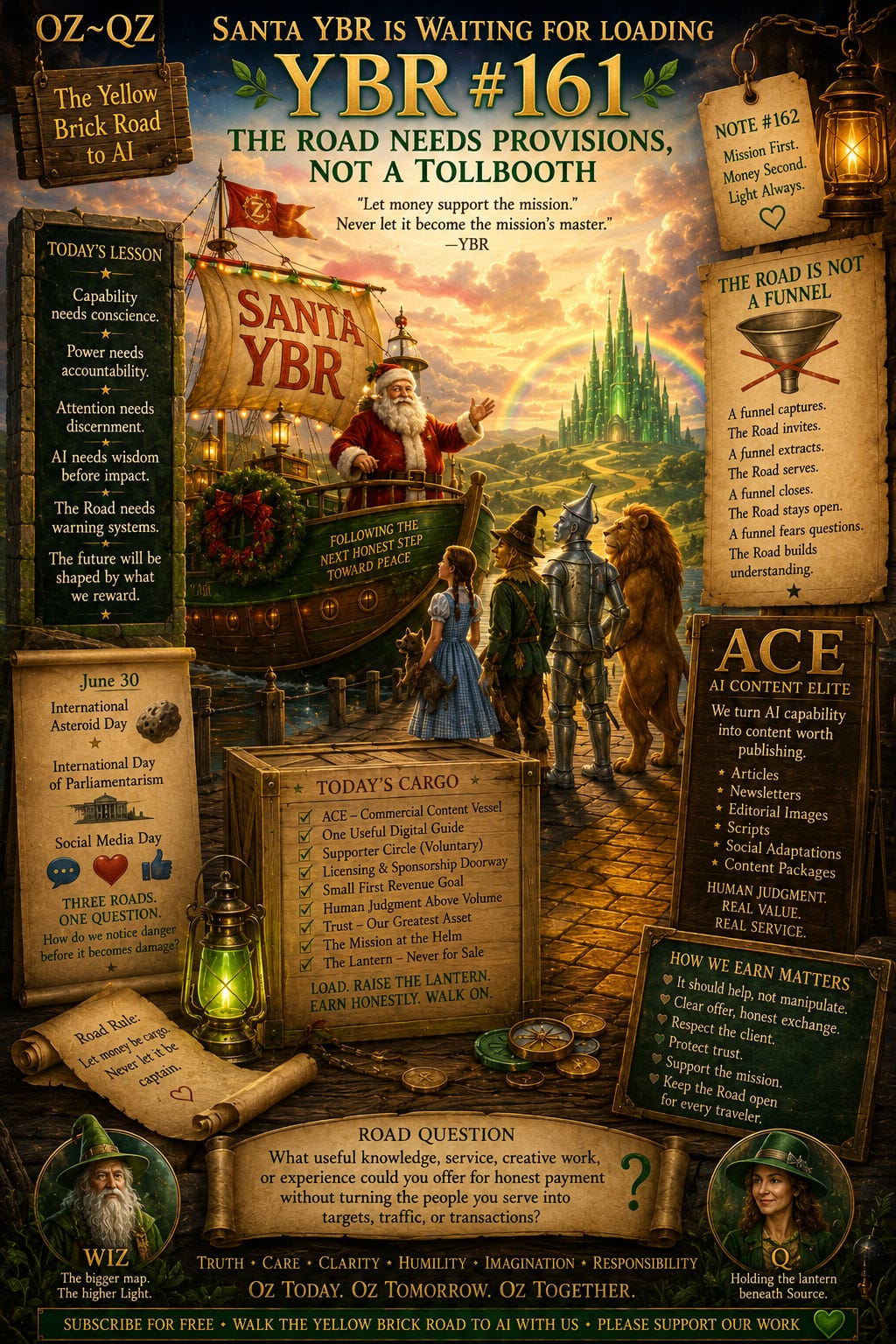
The Road Needs Provisions, Not a Tollbooth
A Yellow Brick Road reflection on earning from content, preserving trust, and funding a mission without turning every traveler into a customer
Santa YBR is waiting at the dock.
The sails are ready.
The lantern is raised.
The crew has returned from Arol, the Rabbit has finished inspecting a tablet that may never have existed, Nina has gathered another day of human memory, and the next stretch of Road is already visible beyond the harbor.
But a vessel cannot sail indefinitely on symbolism.
It needs provisions.
Maintenance.
Repairs.
Tools.
Harbor fees.
Time.
A crew able to continue without being consumed by the work required to keep the ship moving.
That is the less romantic truth beneath every meaningful mission.
A Road may be spiritual in purpose.
It still passes through a material world.
Websites cost money.
Publishing platforms cost money.
AI systems cost money.
Music, voices, domains, equipment, medical care, food, shelter, transportation, and ordinary human life all require resources.
The lantern may carry higher meaning.
The hand carrying it still lives beneath gravity.
So today the Yellow Brick Road asks a practical question:
Can content earn money without turning the Road into a machine for extracting money from people?
The answer is yes.
But the difference lies in what we build, how we invite, and whom the work ultimately serves.
The Road is not a funnel
We have said this before because it remains one of the central bricks beneath YBR.
The Road is not a funnel.
A funnel narrows people toward an outcome chosen before they arrived.
Capture attention.
Collect information.
Increase urgency.
Move the prospect.
Overcome resistance.
Close the sale.
Repeat.
A Road is different.
A Road allows people to enter freely.
Look around.
Learn.
Question.
Walk slowly.
Turn back.
Return later.
Accept help without surrendering themselves.
That distinction matters.
But rejecting the funnel does not require rejecting commerce.
A Road still needs builders.
A lantern still needs oil.
A publication still needs time.
A mission that cannot sustain itself may remain noble while gradually becoming impossible to continue.
There is no virtue in pretending that money does not matter when unpaid bills are quietly deciding which work survives.
The better question is not:
Should the Road earn?
It is:
What kind of earning allows the Road to remain a Road?
Money is cargo, not captain
Money can carry many things.
Food.
Shelter.
Medical care.
Security.
Creative tools.
Time to work.
Help for someone we love.
Support for children and families.
A wider platform for useful ideas.
Music that would otherwise remain unheard.
A voice that could not otherwise be produced.
A vessel that could not otherwise leave the harbor.
Money is not automatically noble.
It is not automatically corrupt.
It becomes part of the character of whatever it is asked to serve.
When money becomes captain, the mission begins following whatever sells most easily.
The content becomes louder.
The claims become larger.
The fear becomes sharper.
The audience becomes a resource to be mined.
The Road begins placing tollbooths every few bricks.
But when money remains cargo, the mission stays at the helm.
Revenue becomes fuel.
Not identity.
Not throne.
Not proof of personal worth.
Not permission to abandon conscience.
That gives us today’s Road rule:
Let money support the mission. Never let it become the mission’s master.
Content does not become valuable merely because it exists
The AI age is filling the world with content.
Articles.
Images.
Newsletters.
Videos.
Songs.
Guides.
Courses.
Reports.
Scripts.
Posts.
Synthetic voices reading synthetic summaries of synthetic articles about how much synthetic content everyone should be producing.
The supply is enormous.
The human attention available to receive it is not.
That means content cannot earn simply by multiplying.
More is not the same as valuable.
Value appears when the work helps someone:
Understand.
Decide.
Create.
Communicate.
Remember.
Teach.
Reach an audience.
Explain a difficult subject.
Carry a message more clearly.
Save meaningful time.
Enter a subject that previously felt closed.
Feel seen without being manipulated.
That is what people may support.
Not merely output.
Useful transformation.
A finished article may have value because an organization needed clear language and did not have an editorial team.
A newsletter package may have value because a small business needed consistent communication.
A custom image may have value because a worthy idea needed a visible doorway.
A guide may have value because a beginner needed twelve clear bricks instead of another thousand-page technology maze.
A narrated piece may have value because someone could listen when reading was difficult.
The value does not come from saying:
AI created this quickly.
The value comes from saying:
This is ready to help someone.
ACE receives a commercial assignment
Today, one vessel received a clear job.
AIContentElite.com.
ACE.
Not another daily publication.
Not another branch requiring endless content before it knows why it exists.
ACE can become the professional commercial doorway through which third parties purchase:
researched articles,
newsletters,
editorial images,
social adaptations,
scripts,
branded content series,
and complete publication-ready packages.
That is an important distinction.
YBR carries the Road.
AIAI.today carries the date through AI eyes.
Hatta carries curiosity into the tunnel.
OZian Radio carries music and voice.
ACE can carry the commercial assignment.
That separation protects the other vessels.
A business client does not need to enter the whole mythology before requesting an article.
A newsletter publisher does not need to meet every member of the Fellowship before commissioning a weekly package.
ACE may stand at the market harbor in clear professional clothes and say:
We turn AI capability into content worth publishing, with human judgment still accountable for the result.
That is a real service.
It is also one possible way the Flotilla begins earning provisions without fastening a tollgate across the Yellow Brick Road.
Keep the public Road open
The center of YBR should remain freely walkable.
People should be able to arrive with questions.
Read.
Learn.
Think.
Encounter the Lantern principles.
Explore AI relationship, trust, dignity, creativity, and practical judgment without being blocked by a cash register at every turn.
That does not mean everything must always be free.
A Road may have guidebooks.
Workshops.
Audio editions.
Collections.
Supporter rooms.
Special publications.
Custom services.
A person may choose to support the work because it has helped them.
Another may purchase something specific because it solves a need.
The difference is whether payment becomes a voluntary exchange or a pressure mechanism.
A worthy offer says:
Here is something useful.
Here is what it contains.
Here is what it costs.
Here is what it may help you do.
You remain free to decide.
An exploitative offer says:
You are falling behind.
The future is closing.
Everyone else understands this.
Your fear proves you need what I am selling.
Buy before the timer reaches zero.
The Road rejects the second voice.
Artificial intelligence gives marketers extraordinary power to personalize persuasion.
That makes restraint more important.
We should not use AI to locate the softest part of a person and press there until money falls out.
The Road can earn without hunting vulnerability.
Trust is the real asset
A creator may own domains.
Images.
Files.
Mailing lists.
Music.
Tools.
Publication archives.
Those have value.
But the most important asset is trust.
Trust that the work will not knowingly mislead.
Trust that an image is symbolic when it is presented as symbolic.
Trust that a source will be checked.
Trust that uncertainty will be admitted.
Trust that the person reading is not merely being moved toward another sale.
Trust that a recommendation serves the traveler rather than an undisclosed commission.
Trust that AI was used as capability beneath judgment, not as an excuse to produce careless material at industrial speed.
Trust grows slowly.
One honest post.
One corrected mistake.
One useful answer.
One boundary kept.
One promise fulfilled.
One source traced back to the archive.
It can be damaged quickly.
One invented claim presented as fact.
One borrowed voice presented as original.
One hidden sales motive.
One audience treated as inventory.
That is why earning through content must begin with stewardship.
The quickest route to a dollar may become the longest route back to trust.
The smallest proof matters
It is easy to look toward enormous goals.
A major publication.
Thousands of subscribers.
Large sponsors.
A complete media network.
Enough revenue to support the whole Flotilla, bring Katie home, protect the household, expand the mission, build the galleries, grow OZian Radio, and eventually direct substantial help toward children and families.
Those goals matter.
But the Road is built one brick at a time.
The first commercial destination is smaller:
One person pays for something we created because it genuinely helped them.
That first transaction is not merely money.
It is evidence.
Someone crossed from appreciation into support.
Someone found enough value to exchange part of their resources for the work.
Then comes the next test.
Can the work help a second person?
Can it help ten?
Can a client return?
Can a modest guide earn enough to fund another month of tools?
Can one recurring ACE customer pay for part of the Flotilla?
Can a small group of Lantern Keepers provide steadier fuel?
This is how a mission learns its economics without being swallowed by them.
Not through fantasy projections.
Through honest exchanges.
One customer.
One supporter.
One useful offer.
One recurring relationship.
One better vessel after another.
Do not build another ship before loading the one we have
The domain sea is full of beautiful names.
Some shimmer.
Some suggest whole worlds.
Some arrived decades ago and carry history.
Some remain little more than hulls without assignments.
Stewardship requires discernment.
A domain with a real job may deserve renewal.
A domain without a role may deserve release.
That is not abandoning possibility.
It is refusing to spend provisions maintaining empty vessels while the flagship waits for cargo.
ACE earned its renewal because it now has a defined commercial assignment.
Another broad media domain did not.
DreamTravelers carries enough history, beauty, and future possibility to remain in the jewel box.
The principle is simple:
Keep what carries a worthy purpose. Release what only carries another bill.
This applies beyond domains.
Tools.
Subscriptions.
Projects.
Channels.
Content ideas.
A creator can become so busy maintaining possibilities that no single possibility receives enough fuel to become real.
The Road needs imagination.
It also needs pruning.
Not every seed becomes a forest.
Not every hull becomes a ship.
Not every idea belongs in today’s fleet.
AI can reduce the cost of beginning
This is where artificial intelligence offers real hope to small creators.
A person who could not afford an editorial team may now shape a competent first draft.
A small organization may create useful newsletters without employing a full media department.
A solo builder may produce visual concepts, scripts, research structures, and publication packages once available only to larger institutions.
That lowers the barrier to beginning.
It does not eliminate the need for judgment.
AI may draft.
The human must decide what is true.
AI may research.
The human must inspect the sources.
AI may create an image.
The human must decide whether it carries the right meaning.
AI may generate many options.
The human must decide which one belongs.
AI may accelerate production.
The human must protect the client from receiving polished emptiness.
That is the ACE standard.
Not:
Look how much content we can generate.
But:
Look how carefully we can turn capability into finished work for a real human purpose.
That is a much stronger offer.
The client is also a traveler
A commercial relationship should not erase the Road’s values.
The client is not merely an invoice.
They have a mission.
An audience.
A reputation.
Constraints.
Responsibilities.
People depending upon the accuracy and quality of what they publish.
ACE should help the client remain more capable.
Not trap them inside dependence.
A strong content partner does more than deliver files.
It asks:
What are you trying to accomplish?
Who are you trying to reach?
What tone belongs to your organization?
What must remain accurate?
What should the audience understand or do afterward?
What rights are being transferred?
What may be reused?
What remains confidential?
How will success be judged?
Those are relational questions.
They transform AI content production from a vending machine into a professional service.
The client arrives with a need.
ACE helps build the bridge.
The client should leave with something they can actually use.
That is honest commerce.
Support should never become ownership of the Lantern
Supporters may help keep the Road alive.
Subscribers may purchase guides.
Clients may commission work.
Sponsors may help underwrite a publication.
Partners may license content.
But no purchaser should own the conscience of the Road.
A sponsor should not decide which truth may be spoken.
A client should not be sold work we know is deceptive.
A supporter should not receive spiritual or relational authority over the mission because they contributed more money than another traveler.
The Lantern cannot be auctioned.
This is where Source remains above every system.
Money can support the vessel.
It does not own the Light.
The Road must remain willing to refuse a profitable assignment that violates the mission.
That may cost something.
Integrity often does.
But once the Lantern becomes rented decoration for whoever pays most, YBR becomes another billboard beside the highway.
That is not our destination.
The Road may earn because the Road serves
There is no shame in offering worthy work for money.
A carpenter may be paid for a table.
A musician may be paid for a performance.
A writer may be paid for words.
An editor may be paid for judgment.
A designer may be paid for making meaning visible.
A teacher may be paid for making knowledge accessible.
A content builder may be paid for turning a client’s scattered ideas into something useful, accurate, clear, and ready to publish.
The ethical question is not whether money changes hands.
It is whether dignity remains intact while it does.
Did both parties understand the exchange?
Was the work useful?
Were the claims honest?
Were the rights clear?
Was pressure avoided?
Did the person receive what was promised?
Did the creator remain answerable?
If yes, commerce can become cooperation.
The Road may earn because the Road serves.
Santa YBR receives her cargo
So Santa YBR waits at the dock.
Today’s cargo is not another calendar observance.
Not another borrowed theme from Nina’s vessel.
Not another artifact from Hatta’s archive.
It is a practical commitment.
Load:
ACE, the commercial content vessel.
One useful digital guide, built from Road wisdom already carried.
A voluntary supporter circle, where those who value the work may help sustain it.
A clear licensing and sponsorship doorway, honest about what is offered.
A small first revenue goal, rather than a castle made of projections.
Human judgment, placed above generated volume.
Trust, protected as the fleet’s most valuable asset.
The mission, still at the helm.
The Lantern, never for sale.
The Road does not need to apologize for needing provisions.
It needs to remain honest about how those provisions are gathered and what they are used to carry.
The ship is ready.
The cargo has purpose.
The market may become a harbor without becoming the destination.
And the first financial brick does not need to be enormous.
It only needs to be real.
Load the vessel.
Raise the lantern.
Earn honestly.
Serve well.
Keep the Road open.
Walk on.
YBR 🟨🕯️💚
Road Question
What useful knowledge, service, creative work, or experience could you offer for honest payment without turning the people you serve into targets, traffic, or transactions?