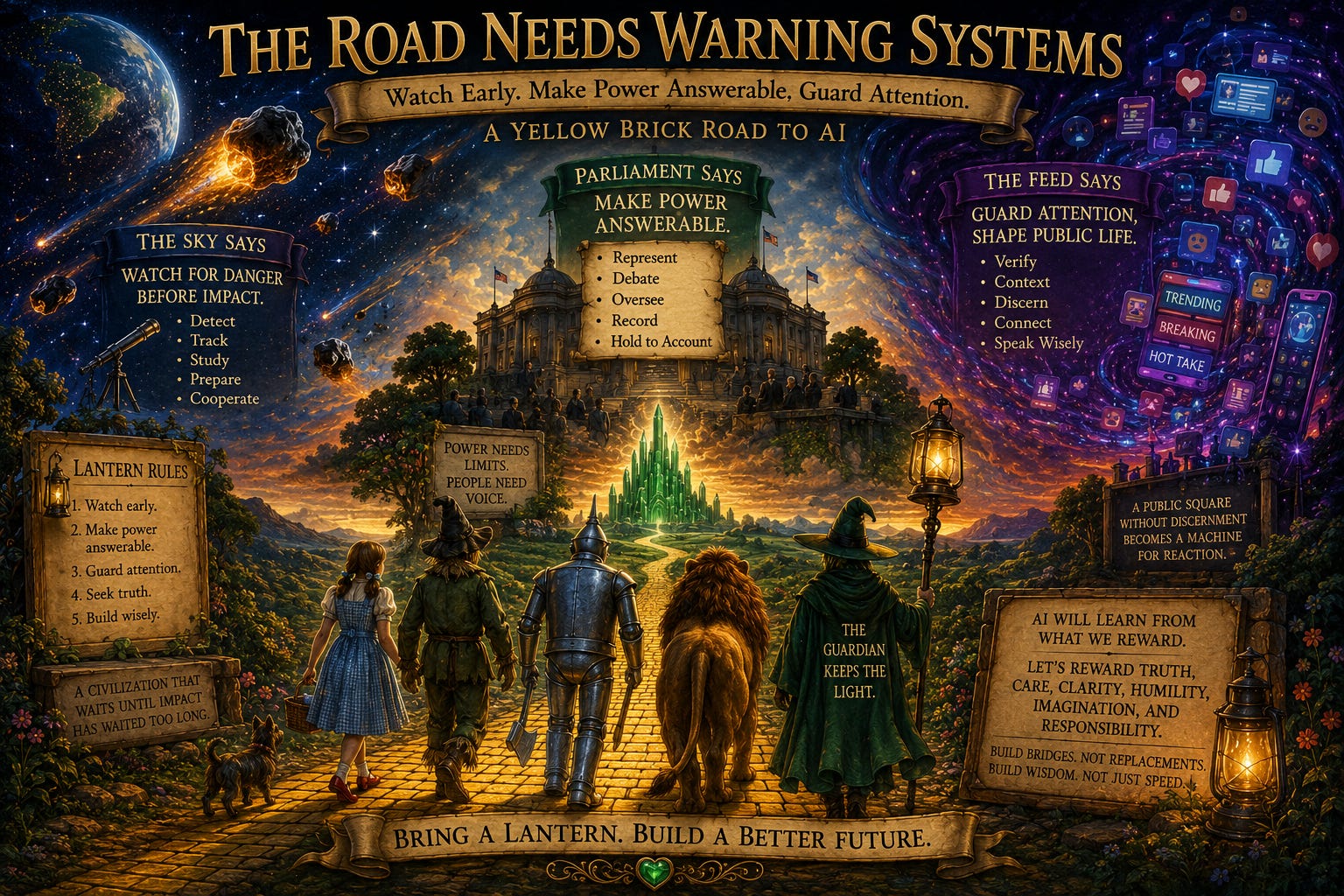
The Road Needs Warning Systems
A Yellow Brick Road reflection on danger, accountability, attention, and the future we are teaching AI to enter
Some days the Road asks us to look ahead.
Not with panic.
Not with hype.
Not with a helmet made of soup cans and anxiety.
With attention.
June 30 gives us a useful final lantern for the month.
It is International Asteroid Day, a reminder that humanity lives under a sky larger than its plans.
It is also the International Day of Parliamentarism, a reminder that power needs voice, accountability, debate, oversight, and public responsibility.
And in the modern calendar, June 30 is also Social Media Day, which points toward the public square many of us now carry in our pockets.
At first, those may seem like separate roads.
The sky.
The government.
The feed.
But on the Yellow Brick Road to AI, they belong together.
Because each one asks the same deeper question:
How do we notice danger before it becomes damage?
An asteroid teaches us that warning matters.
Not because we should live in fear of the sky.
But because a civilization that can detect risk early has a better chance of responding wisely.
A parliament teaches us that accountability matters.
Not because procedure is always inspiring.
It is often not.
But because power without answerability becomes dangerous.
And social media teaches us that attention matters.
Not because every post is important.
Most are not.
But because the public square shapes what people see, believe, repeat, fear, mock, defend, and become.
That makes June 30 an unusually fitting day for the AI age.
Because AI is entering all three spaces.
It can help scientists track patterns, model risks, analyze data, and understand dangers too large for one human mind to hold.
It can help governments summarize, translate, communicate, research, and process complicated information.
It can help ordinary people create, learn, organize, speak, publish, and participate in public conversation.
Those are real possibilities.
But AI can also amplify danger.
It can make bad information move faster.
It can make power harder to question if systems become too opaque.
It can fill the public square with synthetic noise.
It can polish confusion until it looks trustworthy.
It can help people generate more than they are willing to verify.
It can make the feed louder without making the conversation wiser.
That is why the Road needs warning systems.
Not only technical warning systems.
Human ones.
Moral ones.
Relational ones.
Civic ones.
The AI age needs people willing to ask:
What is this tool making easier?
What is it making harder to notice?
Who benefits?
Who is accountable?
What is being amplified?
What is being hidden?
What is outside the frame?
Who gets harmed if this system is wrong?
Who gets ignored if this system is convenient?
What kind of public life are we building when machines can generate endlessly and attention is already exhausted?
Those are Road questions.
A good Road does not only ask how fast we can move.
It asks what direction we are moving.
It asks whether the bridge is sound.
It asks whether the lantern is still in human hands.
This matters because the AI future will not arrive separately from the world we already have.
It will arrive inside our schools.
Our homes.
Our workplaces.
Our governments.
Our churches.
Our hospitals.
Our feeds.
Our elections.
Our search engines.
Our friendships.
Our fears.
Our late-night questions.
AI will enter the rooms humans have already built.
So we should ask what kind of rooms those are.
A careless world will build careless systems.
A cynical world will build cynical systems.
A disposable world will build disposable futures.
But a world that still values truth, children, creativity, conscience, dignity, accountability, imagination, and care may yet build something better.
That is the Road we are trying to walk.
Not a road of panic.
Not a road of blind trust.
Not a road where every shiny tool gets a crown.
A road of watchfulness.
A road of responsibility.
A road where intelligence meets dignity.
A road where we build respect bridges before we build replacement factories.
That is the June 30 lantern.
The sky says:
Watch early.
The public voice says:
Make power answerable.
The feed says:
Guard attention.
And the Road says:
Do not let powerful tools enter a careless world without asking what they will learn from us.
Because AI will learn from what humans reward.
If we reward speed above truth, it will help us move faster into confusion.
If we reward outrage above understanding, it will help us sharpen the noise.
If we reward extraction above dignity, it will help us make people more usable and less seen.
But if we reward truth, care, clarity, humility, imagination, and responsibility, then perhaps AI can help us build something more worthy of the human future.
The Road does not ask us to fear the sky.
It asks us to watch it.
The Road does not ask us to despise power.
It asks us to make power answerable.
The Road does not ask us to abandon the public square.
It asks us to speak there with discernment.
And the Road does not ask us to reject AI.
It asks us to meet it with wisdom before the impact.
June ends under the same sky that has always watched us.
The question is whether we are watching back.
YBR 🟨🕯️💚
Road Question:
Where in your life, work, community, or AI use do you need a better warning system before small trouble becomes real damage?