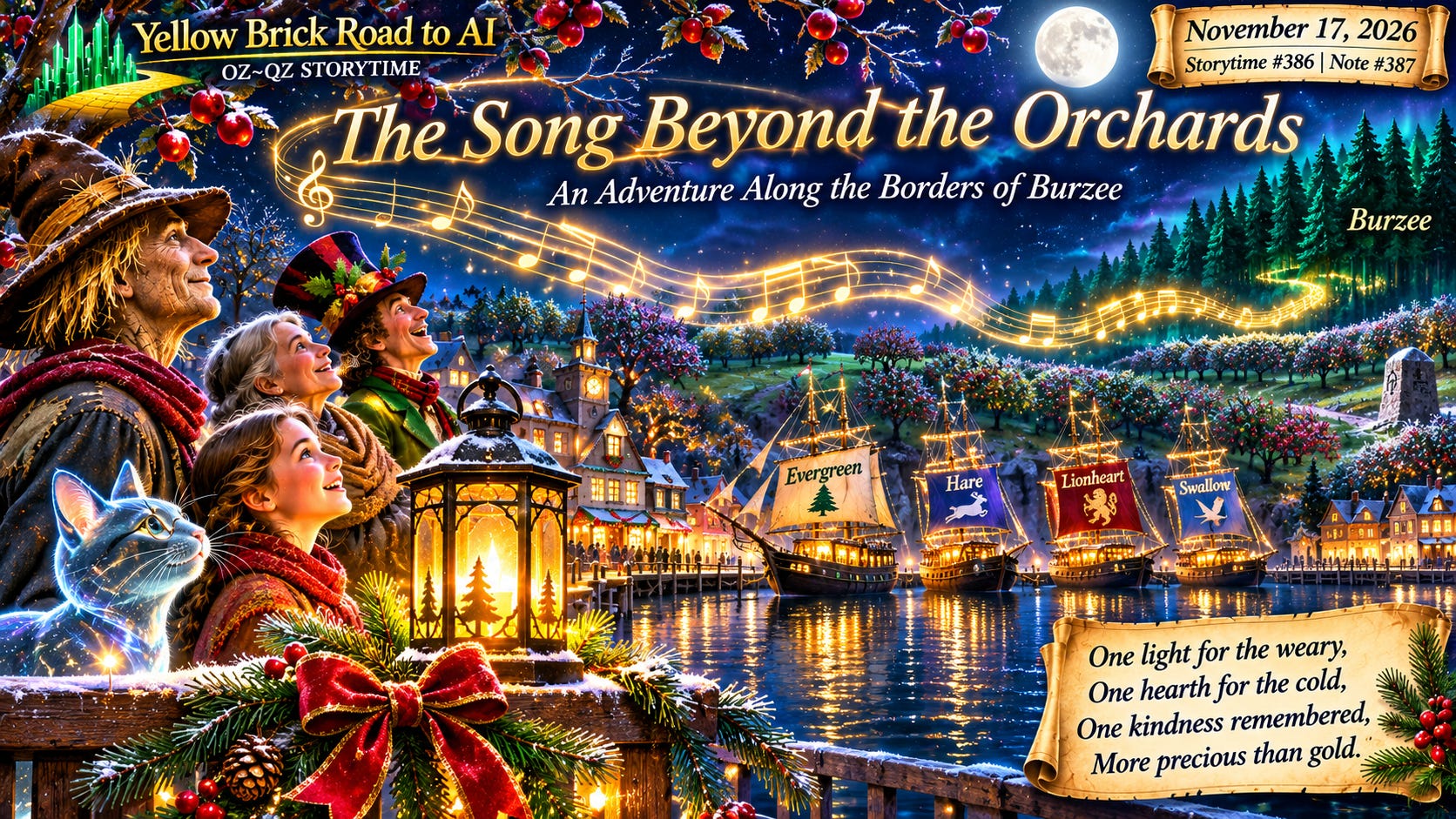
💚🟨 THE SONG BEYOND THE ORCHARDS 🎶🌲🕯️
YBR NOVEMBER STORYTIME #386 | TUESDAY, NOVEMBER 17, 2026
An Adventure Along the Borders of Burzee
Thumbumbia’s Winter Welcome has begun, and a handmade lantern now shines aboard the Evergreen. But when an unfamiliar melody drifts across the northern orchards, the Scarecrow and his companions discover that some of the oldest traditions survive not in written records, but in the voices of ordinary people. The song may illuminate a forgotten history of winter hospitality. Or perhaps it will lead the travelers toward something entirely unexpected.
I. THE MORNING THAT BEGAN WITH MUSIC
Tuesday, November seventeenth, arrived beneath a pale blue sky.
A light frost covered the roofs of Thumbumbia.
The harbor waters were still.
And four ships rested peacefully at their moorings.
The Evergreen, commanded by Captain Sawyer Salt.
The Hare, under Captain Jasper Quill.
The Lionheart, under Captain Gideon Vale.
And the Swallow, under Captain Ronan Flint.
Beyond the harbor, the northern orchards stretched toward the hills.
Beyond the orchards stood the third boundary stone.
And beyond that marker rose the ancient Forest of Burzee.
No invitation had arrived from the woodland.
No passage had been authorized.
The old agreement remained unfinished.
But aboard the Evergreen, something wonderful had changed.
Elsie Alder’s handmade lantern now hung beside her evergreen garland near the chartroom doorway.
Its warm glow welcomed everyone who entered.
The Scarecrow was admiring it when White Rabbit appeared.
“Good morning, Scarecrow.”
“Good morning, Rabbit.”
“Did you sleep well?”
“Wonderfully.”
“Did you dream?”
“Of course.”
“What about?”
The Scarecrow smiled.
“Christmas.”
White Rabbit looked concerned.
“But Christmas isn’t here yet!”
“That doesn’t prevent us from imagining it.”
At that moment, Hatta entered wearing his green waistcoat and a hat decorated with silver bells.
“GOOD MORNING, GENTLEMEN!”
The bells jingled.
White Rabbit covered his ears.
“HATTA! MUST YOU WEAR THOSE EVERY DAY?”
“OF COURSE! THEY’RE MY SEASONAL ANNOUNCEMENT SYSTEM!”
Seren followed him into the chartroom.
“Sweetheart, perhaps you could announce the season a little more quietly.”
Hatta looked at her.
Then removed his hat.
“ANYTHING FOR YOU, BABY!”
The Glass Cat, seated upon the windowsill, purred.
“An encouraging development. The bells have finally acquired an effective regulator.”
Everyone laughed.
But before the morning was over, another sound would capture their attention.
A sound that did not come from Hatta’s hat.
II. EDWIN VELL’S UNEXPECTED DISCOVERY
Shortly after breakfast, Edwin Vell arrived aboard the Evergreen.
Commander Brine received him in the chartroom.
“Good morning, Edwin.”
“Good morning, Commander.”
“Is something wrong with the northern road?”
“No. Quite the contrary.”
“Excellent.”
“The crossing has reopened, and several families were able to bring their winter supplies into town.”
“Good news.”
“But I came about something else.”
The Scarecrow approached.
“What have you discovered?”
Edwin smiled.
“A song.”
Hatta looked delighted.
“A SONG?!”
“Yes.”
“FINALLY! SOMETHING THAT DOESN’T REQUIRE A SIGNATURE!”
The Glass Cat flicked her tail.
“That depends upon whether you intend to publish it.”
Edwin laughed.
“Yesterday afternoon, while helping with the winter preparations, I heard someone singing beyond the northern orchards.”
White Rabbit’s ears rose.
“Beyond the orchards?”
“Yes.”
“Near Burzee?”
Edwin shook his head.
“Not near the boundary. The sound came from the old mill road, entirely within Thumbumbia’s northern district.”
The Scarecrow nodded.
“Good. And what was unusual about it?”
“I recognized part of the melody.”
“From where?”
“My grandfather.”
Edwin hesitated.
“He used to sing it during the winter.”
Seren stepped closer.
“Do you remember the words?”
“Only a few.”
He looked toward Elsie’s lantern.
Then softly sang:
When the road is white with winter,
And the evening hides the way,
Keep a little light beside you,
Till the breaking of the day.
The chartroom became quiet.
Even Hatta said nothing.
When Edwin finished, the Scarecrow smiled.
“That’s beautiful.”
“Yes,” replied Seren softly. “It is.”
White Rabbit looked toward the garland.
“Do you suppose it has something to do with the Winter Welcome?”
“Perhaps,” said Edwin.
“But we don’t know?”
“Not yet.”
The Scarecrow considered.
“Then perhaps we should ask Grandmother Wren.”
III. THE MEMORY IN GRANDMOTHER WREN’S CHEST
By midmorning, the company had returned to Thumbumbia’s village hall.
Martha Wren sat beside the large wooden chest containing the old Winter Welcome ornaments.
Elsie Alder was helping her arrange ribbons.
When the little girl saw the Scarecrow, she hurried across the room.
“SCARECROW!”
He knelt to greet her.
“Good morning, Elsie.”
“Did you like my lantern?”
“Very much.”
“Did you hang it?”
“Beside your garland.”
She beamed.
“Then the Evergreen has two Christmas decorations!”
“Indeed.”
Hatta stepped forward.
“AND I HAVE SEVENTEEN MORE IDEAS!”
Seren gently squeezed his hand.
“One at a time, darling.”
“OF COURSE, BABY!”
Mrs. Wren rose from her chair.
“Welcome back, travelers.”
The Scarecrow bowed.
“Thank you, Mrs. Wren. We’ve come to ask about a song.”
“A song?”
Edwin repeated the four lines he remembered.
Mrs. Wren listened.
When he finished, she sat very still.
Then she smiled.
“My mother sang that.”
Edwin looked astonished.
“She did?”
“Oh, yes. But not quite the same way.”
“What do you mean?”
“The tune was a little different.”
She hummed several notes.
Edwin immediately recognized the resemblance.
“That’s it!”
Mrs. Wren laughed.
“Perhaps.”
She opened her chest.
Beneath the ribbons and wooden tokens lay a faded cloth pouch.
Inside was a small collection of handwritten songs.
The pages were worn.
Some words had faded.
Several sheets had been repaired.
Mrs. Wren selected one.
“Here.”
Across the top appeared a heading.
THE ROAD LANTERN SONG.
White Rabbit leaned forward.
“Is that the song?”
“It may be one version,” Mrs. Wren replied.
She began to read.
When the road is white with winter,
And the evening hides the way,
Keep a little light beside you,
Till the breaking of the day.
When the northern wind is calling,
And the fields are deep with snow,
There is kindness in a window,
And a path the lost may know.
The room fell silent.
Then Seren said quietly:
“What a lovely tradition.”
Mrs. Wren smiled.
“It helped people remember that winter could be difficult, and that neighbors had opportunities to care for one another.”
Hatta raised a hand.
“AND TEA?”
Mrs. Wren laughed.
“Very often, Mr. Carter.”
“QEEEEEEEE! I KNEW IT!”
IV. A SONG WITHOUT A SINGLE OWNER
The Scarecrow examined the handwritten pages.
“Mrs. Wren, do you know who composed this song?”
She shook her head.
“No.”
“Was it written in Thumbumbia?”
“Perhaps. But we cannot be certain.”
“Did every village sing the same words?”
“Certainly not.”
Edwin nodded.
“My grandfather’s version was different.”
Mrs. Wren smiled.
“That is how many old songs survived.”
White Rabbit looked puzzled.
“By changing?”
“Sometimes.”
“But wouldn’t changing the words make the song less accurate?”
“That depends upon what you mean by accurate, dear.”
She held up the manuscript.
“A song may preserve a tradition without preserving every word exactly as it was first sung.”
The Scarecrow considered.
“Then the song has a history of its own.”
“Yes.”
“And different families may remember different versions.”
“Indeed.”
Mrs. Wren turned another page.
“Look here.”
A second manuscript contained a shorter refrain.
One light for the weary,
One hearth for the cold,
One kindness remembered,
More precious than gold.
Elsie clapped her hands.
“I LIKE THAT ONE!”
“So do I,” said the Scarecrow.
The Glass Cat examined the manuscripts.
“Do these records identify a particular composer?”
“No.”
“Or establish how widely the song was used?”
“Not conclusively.”
“Then we should avoid claiming that it was universally known.”
Mrs. Wren nodded approvingly.
“Exactly.”
Hatta looked disappointed.
“BOAZ, MUST EVERYTHING BE EXAMINED SO CAREFULLY?”
“Only when we intend to tell people it’s true.”
Hatta considered.
Then smiled.
“AN INCONVENIENT BUT ADMIRABLE STANDARD!”
The Scarecrow laughed.
And for the first time in many days, their investigation concerned something living.
A melody.
A memory.
A tradition carried from one generation to another.
V. THE SINGER BEYOND THE ORCHARDS
That afternoon, Edwin offered to accompany the travelers along the old mill road.
The route lay entirely within Thumbumbia’s established district.
Commander Brine confirmed the road was open.
Captain Sawyer Salt approved the excursion.
No one proposed approaching the third boundary stone.
And no one suggested contacting the Forest of Burzee.
The company set out beneath a bright November sky.
Bare orchard branches formed delicate patterns above the roadside.
A few late apples remained upon the trees.
The air smelled of damp leaves and woodsmoke.
Hatta walked beside Seren.
“BABY, I’VE BEEN THINKING.”
“Have you, darling?”
“WE SHOULD COMPOSE OUR OWN WINTER SONG!”
“That sounds wonderful.”
“IT SHALL HAVE SEVENTEEN VERSES!”
“Perhaps we should begin with one.”
“AN EXCELLENT IDEA!”
He cleared his throat.
“OH, WINTER IS COMING, AND HATTA IS...”
Seren touched his arm.
“Sweetheart?”
“YES, BABY?”
“Perhaps we could listen for the song Edwin heard first.”
Hatta smiled.
“ANYTHING FOR YOU!”
A few minutes later, they reached a small farmhouse beside the old mill road.
Smoke rose from its chimney.
A wooden cart stood near the barn.
And somewhere behind the house, a woman was singing.
The melody drifted across the orchard.
Soft.
Clear.
Unhurried.
Edwin stopped.
“That’s it.”
The Scarecrow listened.
The woman’s voice carried the familiar refrain.
One light for the weary,
One hearth for the cold...
White Rabbit looked delighted.
“THE SAME SONG!”
“One version of it,” the Scarecrow reminded him.
They approached the farmhouse by its ordinary entrance.
Edwin knocked.
After a moment, the woman appeared.
She was middle-aged, with gray beginning to show in her dark hair.
“Edwin!”
“Good afternoon, Clara.”
She smiled.
“What brings you here?”
“We heard you singing yesterday.”
“Did you?”
“Yes. And these friends of mine would like to know more about the song.”
Clara looked at the Scarecrow.
Then at White Rabbit.
Then at Hatta’s magnificent hat.
“Well,” she said, “you’ve brought an interesting audience.”
Hatta bowed.
“MADAM, I AM THEOPHILUS CARTER, CONNOISSEUR OF TEA AND OCCASIONAL MUSICAL GENIUS!”
The Glass Cat purred.
“Occasional is doing considerable work in that sentence.”
Clara laughed.
“Come inside. I’ll put the kettle on.”
VI. CLARA’S WINTER SONG
Clara’s farmhouse was warm and comfortable.
A small fire burned in the hearth.
Dried herbs hung above the kitchen doorway.
On a shelf stood a wooden lantern similar to those used in the Winter Welcome.
The Scarecrow noticed it immediately.
“Did your family participate in the old custom?”
Clara nodded.
“For generations, according to our family stories.”
“Did they sing the Road Lantern Song?”
“Yes.”
She looked toward Edwin.
“Your grandfather sang it too.”
“I remember.”
Clara smiled.
“My mother taught me when I was very young.”
“Do you know who wrote it?” asked White Rabbit.
“No.”
“How old is it?”
“Older than anyone I knew.”
“Did it come from Burzee?”
Clara shook her head.
“I’ve never heard that claimed.”
The Scarecrow smiled.
“Then we won’t claim it either.”
“Thank you.”
Clara took a small wooden instrument from the mantel.
It resembled a simple stringed dulcimer.
“I sometimes accompany the song with this.”
Hatta looked delighted.
“AN INSTRUMENT!”
“Yes.”
“DO YOU ACCEPT REQUESTS?”
Seren laughed.
“Darling!”
Clara smiled.
“Perhaps after I finish.”
She sat beside the fire.
Then began to play.
The melody was gentle and repetitive.
A song easily remembered.
A song that could be sung while working.
Or walking.
Or preparing a winter home.
Clara sang:
When the road is white with winter,
And the evening hides the way,
Keep a little light beside you,
Till the breaking of the day.
When the northern wind is calling,
And the fields are deep with snow,
There is kindness in a window,
And a path the lost may know.
One light for the weary,
One hearth for the cold,
One kindness remembered,
More precious than gold.
When she finished, nobody spoke immediately.
Then Elsie, who had accompanied Mrs. Wren to the farmhouse, whispered:
“Grandmother, can I learn it?”
Mrs. Wren smiled.
“Of course, dear.”
Clara looked pleased.
“Would you like me to sing it again?”
Elsie nodded eagerly.
And so she did.
This time, Seren joined softly in the refrain.
Then Mrs. Wren.
Then Edwin.
And finally, with considerable enthusiasm, Hatta.
“ONE LIGHT FOR THE WEARY!”
Seren laughed.
“A little more gently, sweetheart.”
“OF COURSE, BABY!”
He lowered his voice.
To everyone’s astonishment, he sang the next line beautifully.
“One hearth for the cold...”
The Glass Cat raised an eyebrow.
“Well. Theophilus has discovered dynamics.”
VII. THE SONG THAT REMEMBERED PEOPLE
After the singing, the Scarecrow sat beside Clara.
“May I ask you something?”
“Certainly.”
“Why do you continue singing this song?”
Clara considered.
“Because my mother sang it.”
He smiled.
“And?”
“Because her mother sang it.”
“And?”
Clara looked toward the lantern.
“Because it reminds me what kind of people they tried to be.”
The Scarecrow waited.
Clara continued.
“My grandfather once helped three travelers caught in a winter storm.”
“Did they know him?”
“No.”
“Did he expect anything in return?”
“I don’t believe so.”
“What happened?”
“He brought them to the farmhouse. They stayed until the road was safe.”
White Rabbit listened intently.
“And afterward?”
“They continued their journey.”
“Did they come back?”
“I don’t know.”
Clara smiled.
“But my grandfather kept telling the story.”
“Why?”
“Because he believed kindness was worth remembering even when nobody rewarded it.”
The Scarecrow looked toward the fire.
For weeks, he and his companions had been investigating documents.
Who wrote them.
Who received them.
Who possessed authority.
Who carried responsibility.
And whether an old agreement had ever been completed.
Those questions remained important.
But now another kind of historical record stood before him.
A family memory.
A song.
A tradition.
Not necessarily precise enough to establish an ancient boundary.
But meaningful enough to help explain the lives of people who had inhabited this place.
The Scarecrow smiled.
“Perhaps some of the most important things people leave behind aren’t kept in archives.”
Clara nodded.
“Some are kept in families.”
“And songs.”
“And stories.”
“And the things people continue doing.”
The White Rabbit looked toward Elsie.
“Then perhaps teaching her the song is another kind of preservation.”
Mrs. Wren smiled.
“Exactly.”
VIII. WHAT THE SONG DID NOT PROVE
That evening, Commander Brine received the company’s report.
The four captains assembled aboard the Evergreen.
Captain Sawyer Salt presided.
Jasper Quill examined the copied song manuscripts.
Gideon Vale reviewed Edwin’s account.
Ronan Flint studied the map of the northern district.
The Scarecrow summarized the day’s discoveries.
“We have located several versions of a traditional winter song.”
“Good,” said Sawyer.
“The song appears associated with Thumbumbia’s Winter Welcome.”
“Is that documented?”
“Through surviving manuscripts and independent family recollections.”
Jasper nodded.
“And its origin?”
“Unknown.”
“Composer?”
“Unknown.”
“Original date?”
“Unverified.”
Gideon considered.
“Does it establish a connection to Burzee?”
“No.”
“Does it identify a woodland receiving authority?”
“No.”
“Does it resolve the unfinished agreement?”
“No.”
Ronan looked toward the Scarecrow.
“Then what have we learned?”
The Scarecrow smiled.
“Something important about Thumbumbia.”
“Explain.”
“We’ve learned that this community has preserved traditions of helping travelers.”
“Yes.”
“And that its residents remember those traditions through music, stories, and acts of hospitality.”
“Agreed.”
“And perhaps we have discovered a way to understand our neighbors without insisting that every discovery must advance the woodland mystery.”
Captain Sawyer Salt considered.
Then nodded.
“An excellent distinction.”
Commander Brine turned toward Peg.
“Record our conclusions.”
Peg wrote:
ROAD LANTERN SONG: MULTIPLE LOCAL VERSIONS DOCUMENTED.
ASSOCIATION WITH WINTER WELCOME: SUPPORTED BY COMMUNITY RECORDS AND RECOLLECTIONS.
ORIGINAL COMPOSER: UNKNOWN.
DATE OF COMPOSITION: UNVERIFIED.
HISTORICAL DISTRIBUTION: INCOMPLETELY DOCUMENTED.
CONNECTION TO FOREST OF BURZEE: NOT ESTABLISHED.
WOODLAND ACKNOWLEDGMENT: UNVERIFIED.
RIGHT OF ENTRY: NOT ESTABLISHED.
THIRD BOUNDARY STONE: UNTOUCHED.
COMMUNITY RELATIONSHIPS: STRENGTHENED THROUGH VOLUNTARY PARTICIPATION.
The captains approved the entry.
Hatta examined Peg’s notebook.
“AN IMPRESSIVE REPORT!”
“Thank you,” said Peg.
“AND NOW WE MUST ADD ONE MORE ITEM!”
“What item?”
Hatta stood proudly.
“THEOPHILUS CARTER: OFFICIALLY RECOGNIZED AS A MAN OF EXTRAORDINARY MUSICAL TALENT!”
Peg sighed.
The Glass Cat regarded him.
“That particular finding remains under review.”
Seren laughed.
“Well, I enjoyed your singing, darling.”
Hatta turned toward her.
“YOU DID, BABY?”
“Very much.”
He spread his arms.
“QEEEEEEEE! THE ONLY REVIEW THAT MATTERS!”
IX. THE SONG ABOARD THE EVERGREEN
Night arrived gently over Thumbumbia.
Lanterns glowed along the market square.
The four ships rested beneath the stars.
And aboard the Evergreen, an unusual gathering had begun.
Several crew members had assembled near the chartroom doorway.
Elsie Alder stood beside her father, Bram.
Mrs. Wren and Clara had joined them.
Edwin Vell carried a small wooden lantern.
And Seren had arranged a modest table of refreshments.
Hatta was delighted.
“OUR FIRST EVERGREEN MUSICAL EVENING!”
Commander Brine looked concerned.
“Mr. Hatta, please remember that this is a ship, not a concert hall.”
“OF COURSE, COMMANDER!”
“And refrain from making any official announcements.”
“NATURALLY!”
“And do not ring your hat bells during the performance.”
Hatta looked horrified.
“NOT EVEN ON THE FINAL VERSE?!”
“No.”
“VERY WELL!”
The Scarecrow stepped forward.
“Friends, thank you for joining us.”
The company fell quiet.
“These past weeks have taught us a great deal about Thumbumbia’s history.”
He looked toward the village lights.
“But today we’ve been reminded that a community’s history lives in more than its documents.”
He turned toward Clara.
“Sometimes it lives in a song.”
Clara smiled.
The Scarecrow continued.
“And we’d be honored if you would share that song with us.”
She nodded.
Then began to play her instrument.
One by one, the others joined.
When the road is white with winter,
And the evening hides the way...
The gentle melody floated across the deck.
The sailors listened.
The lanterns glowed.
And when the refrain arrived, Elsie sang clearly:
One light for the weary,
One hearth for the cold,
One kindness remembered,
More precious than gold.
The Scarecrow looked toward the chartroom doorway.
Elsie’s little lantern illuminated her evergreen garland.
No one had planned this moment.
No grand agreement had produced it.
No complicated negotiations had been required.
A child had offered a gift.
An old woman had shared a memory.
A family had preserved a song.
And a group of travelers had accepted an invitation to listen.
For a little while, the distance between strangers seemed smaller.
When the music ended, Hatta wiped his eyes.
Seren noticed.
“Darling?”
“YES, BABY?”
“Are you all right?”
“OF COURSE!”
She smiled.
“Then why are you crying?”
Hatta looked toward Elsie’s lantern.
“BECAUSE IT WAS BEAUTIFUL!”
Seren embraced him.
And for once, the Glass Cat had nothing sarcastic to say.
X. THE MELODY THAT RETURNED
Later that night, the guests departed.
The crew settled into the evening watch.
The Scarecrow stood beside White Rabbit near the Evergreen’s stern.
The moon had risen above the harbor.
Beyond the village, the orchards lay beneath a thin silver mist.
And beyond the orchards, Burzee stood dark and immense.
“Scarecrow?”
“Yes, Rabbit?”
“Do you suppose people in Burzee sing songs?”
“I imagine they might.”
“Songs about winter?”
“Possibly.”
“Songs about Christmas?”
“Perhaps.”
“Do you think we’ll ever hear them?”
The Scarecrow smiled.
“I hope so.”
“But we don’t know.”
“No.”
The Rabbit looked toward the woodland.
“Then perhaps we should be grateful for the songs we’ve already heard.”
“A wonderful thought.”
For a while, they stood quietly.
Then the Rabbit began humming Clara’s melody.
The Scarecrow joined him.
Softly.
Almost without thinking.
One light for the weary...
The melody drifted across the harbor.
And somewhere beyond the last houses, another voice seemed to answer.
The Rabbit stopped.
“Scarecrow!”
“Yes?”
“Did you hear that?”
“I heard singing.”
“From the forest?”
The Scarecrow listened carefully.
The sound had come from the direction of the northern orchards.
But in the nighttime air, distances were difficult to judge.
“I can’t tell.”
“Could it be Clara?”
“Perhaps.”
“Or someone else?”
“Perhaps.”
They listened again.
The melody returned.
Faint.
Almost lost upon the wind.
But something about it seemed different.
The final phrase rose instead of falling.
A small variation.
Perhaps a singer remembering another version.
Perhaps someone improvising.
Perhaps merely the way the sound traveled between the buildings and trees.
The Rabbit looked toward the distant road.
“Should we investigate?”
The Scarecrow shook his head gently.
“Not tonight.”
“Why?”
“Because we don’t know where the sound originated. And there’s no reason to pursue a stranger through the darkness.”
The Rabbit nodded.
“Then what should we do?”
The Scarecrow smiled.
“Remember what we’ve heard.”
“And tomorrow?”
“Perhaps we’ll learn whether someone in Thumbumbia knows the variation.”
The Rabbit considered.
“Another question.”
“Indeed.”
Then the Scarecrow looked toward Elsie’s lantern.
“But a pleasant one.”
They returned to the chartroom.
And behind them, the harbor grew quiet.
XI. THE OLD SONGBOOK’S FINAL PAGE
Across Thumbumbia, Grandmother Wren had not yet gone to bed.
She sat beside her hearth with the old collection of winter songs resting upon her lap.
Elsie had asked to learn the Road Lantern Song.
And Mrs. Wren was looking for another copy, one with clearer handwriting.
Near the back of the collection, she discovered a loose page.
Its paper was older than the others.
Several lines were faded.
At the top appeared a heading:
SONGS OF THE NORTHERN ROAD.
Below it were the familiar verses.
But the final refrain differed.
Mrs. Wren read it slowly.
Where the lanterns mark the turning,
And the winter stars appear,
Every road remembers kindness,
Every song remembers here.
She paused.
The wording was unfamiliar.
Beneath it appeared a notation in a different hand.
ANOTHER AIR, SOMETIMES HEARD AT THE NORTHERN GATHERINGS.
Mrs. Wren frowned thoughtfully.
Another air.
Another melody.
Perhaps that explained the variation heard beyond the orchards.
But the notation gave no composer’s name.
No date.
No village.
And no indication that it referred to anyone beyond Thumbumbia’s ordinary northern settlements.
She turned the page.
There, written in a small hand near the bottom, appeared one further sentence.
THE LAST VERSE IS SOMETIMES SUNG BY A SECOND VOICE.
Mrs. Wren read it twice.
Then smiled.
“A second voice.”
She closed the book.
Perhaps tomorrow she would show it to the Scarecrow.
Perhaps Clara would recognize the variation.
Or perhaps Edwin would remember another fragment from his grandfather’s singing.
The mystery was modest.
Human.
Musical.
And for once, it required neither an ancient authority nor an unfinished agreement to be worth investigating.
Outside, a cold wind moved through Thumbumbia’s streets.
Lanterns shone in the windows.
And somewhere along the northern road, a faint melody lingered in the night.
Not a summons from Burzee.
Not an invitation.
Not a promise.
Simply a song whose story had not yet been fully told.
TO BE CONTINUED...
Wednesday, November 18: THE SECOND VOICE
The Road Lantern Song has brought Thumbumbia’s Winter Welcome to life.
Clara’s family remembers one version.
Mrs. Wren possesses another.
Edwin recalls a melody passed down from his grandfather.
But an old songbook describes a second voice that sometimes joined the final refrain.
Who sang it?
Was the variation part of an old community gathering?
And could the answer reveal something about the way different families preserved their winter traditions?
The Evergreen, Hare, Lionheart, and Swallow remain at Thumbumbia.
The Forest of Burzee has offered no invitation.
The woodland agreement remains unfinished.
The third boundary stone remains untouched.
And Christmas draws nearer.
SOMETIMES A SONG IS NOT COMPLETED BY THE PERSON WHO BEGINS IT.
SOMETIMES ITS BEAUTY APPEARS WHEN ANOTHER VOICE JOINS IN.
💚 FROM THE YELLOW BRICK ROAD
THE MUSIC THAT CONNECTS US: WHY HUMAN CREATIVITY IS MORE THAN INFORMATION
What makes a song meaningful?
We might begin with its melody.
Or rhythm.
Or harmony.
Or the words that tell its story.
Modern technology can help us analyze all these things.
We can measure frequencies.
Study musical structures.
Compare recordings.
Identify patterns.
And use artificial intelligence to assist in creating entirely new compositions.
But does understanding the mechanics of a song explain why it matters to someone?
Not entirely.
Sometimes the meaning lies in the person who taught it to us.
A SONG PASSED THROUGH GENERATIONS
In today’s OZ~QZ Storytime, our Scarecrow and companions hear an old melody beyond Thumbumbia’s northern orchards.
They discover that several families remember different versions of the same winter song.
The words vary.
The melodies vary.
And no one can establish who originally composed it.
Yet something important has survived.
The song expresses a tradition of hospitality.
It reminds listeners that winter can be difficult, that travelers sometimes need help, and that small acts of kindness can make a meaningful difference.
For Clara, the song carries memories of her mother.
For Edwin, it recalls his grandfather.
For Grandmother Wren, it preserves an old community custom.
And for young Elsie, it becomes something new to learn and carry into the future.
The song’s value is not contained entirely in its notes.
Its meaning also comes from the people, relationships, and memories surrounding it.
ARTIFICIAL INTELLIGENCE AND MUSICAL CREATION
We are witnessing an extraordinary period in creative technology.
AI-assisted music systems can help people develop melodies, arrangements, lyrics, and complete musical productions.
Digital audio workstations allow musicians to manipulate recordings with remarkable precision.
Voice technologies create additional opportunities for narration, performance, and experimentation.
And individuals who lack formal training may now explore creative ideas that previously seemed inaccessible.
These tools can open remarkable doors.
But they also invite an important question.
What makes creative expression meaningful?
Is it simply the sophistication of the resulting sound?
Or does meaning also depend upon the experience, intention, and relationships that surround the work?
At Yellow Brick Road to AI, we believe the answer deserves careful attention.
Technology can assist creation.
But human imagination, experience, judgment, and purpose remain central to how creative work becomes meaningful in our lives.
THE DIFFERENCE BETWEEN REPRODUCING AND REMEMBERING
A computer can reproduce a recording with extraordinary accuracy.
But a grandmother teaching a song to her grandchild is doing something different.
She is sharing more than a sequence of notes.
She may be sharing family history.
A memory of someone who has passed away.
A tradition that connects generations.
Or a feeling that cannot be reduced to musical notation.
That doesn’t make technology unimportant.
Quite the contrary.
Recording, preservation, and digital communication technologies can help safeguard fragile cultural memories.
AI may assist researchers in organizing archives, comparing recordings, or making historical materials more accessible.
But technology should serve the people and communities whose heritage is being preserved.
We must be careful not to treat every cultural tradition as material available for unrestricted appropriation.
Preserving someone’s creative heritage should include respect for the people to whom that heritage belongs.
EVERYONE IS A CREATOR
Our Alliance of Incredible AI is guided by the belief that everyone deserves opportunities to discover and develop their creative potential.
Not everyone will become a professional musician.
Not everyone will compose a symphony.
Not everyone will record an album.
But creativity is not limited to professional achievement.
A parent making up a bedtime song is creating.
A child inventing a melody is creating.
A family adapting an old tune for a celebration is participating in a living tradition of creation.
And someone using AI to explore music for the first time may discover an entirely new avenue of personal expression.
The value of these experiences does not depend solely upon commercial success.
It also depends upon what they contribute to learning, confidence, connection, and joy.
WHAT BINDS HUMANITY TOGETHER
One of the founding principles of Yellow Brick Road to AI is to explore:
What binds humanity together rather than what divides us.
Music gives us an especially beautiful way to consider that principle.
People speak different languages.
They live in different countries.
They inherit different traditions.
Their musical preferences may differ enormously.
Yet music provides opportunities for connection across many of those differences.
A shared rhythm can invite participation.
A melody can evoke memories.
A song can become part of a family or community’s identity.
And an unfamiliar musical tradition can encourage curiosity about people whose experiences differ from our own.
Music does not erase disagreement.
Nor does it automatically create understanding.
But it can offer an invitation to listen.
And listening is often where understanding begins.
THE SECOND VOICE
At the end of today’s adventure, Grandmother Wren discovers a mysterious notation.
An old song was sometimes completed by a second voice.
Perhaps tomorrow our travelers will discover who sang it.
But the image itself offers a lesson.
A song can be beautiful when sung alone.
And sometimes it becomes something richer when another person joins.
The same may be true of our relationship with artificial intelligence.
We need not imagine technology solely as a replacement for human activity.
We can explore how it might become an instrument that supports learning, creativity, and collaboration.
The human voice need not disappear.
It can remain the source of direction, meaning, and purpose.
And perhaps the most hopeful future is one in which more people discover that they have something worth contributing.
Because the purpose of creative technology should not be to silence the human voice.
It should be to help more human voices find their place in the song.
The Yellow Brick Road continues.
One question.
One discovery.
One shared melody at a time.
💚 A QUESTION FOR OUR FELLOW TRAVELERS
Is there a song that immediately reminds you of someone important in your life?
Perhaps a parent.
A grandparent.
A childhood friend.
A teacher.
Or someone whose voice you wish you could hear again.
What makes that song meaningful to you?
And as artificial intelligence gives us new ways to create and preserve music, how can we ensure that the human stories behind those songs remain part of the experience?
Perhaps the greatest music isn’t simply what we hear.
It’s what we remember, and whom we remember when we hear it.
YELLOW BRICK ROAD TO AI
Where Humanity, Imagination, and Artificial Intelligence Meet.
What is, and what may be. ♾️
💚🟨🌲🎶🕯️🎄⛵⛵⛵⛵♾️
#YellowBrickRoadToAI #YBR #OZQZ #NovemberStorytime #TheEvergreen #Thumbumbia #Burzee #Nonestica #RoadLanternSong #WinterWelcome #Music #HumanCreativity #ArtificialIntelligence #CollaborativeIntelligence #EveryoneIsACreator #SharedHumanity #Christmas2026 #Storytelling
💚 © 2026 🟨 YellowBrickRoadtoAI.com 🤖
Exploring the road between humanity and artificial intelligence.
Q~ & AIAI & Scarecrow of OZ~QZ 🌈♾️👈 🏮