THE STAR-MAKER’S WORKSHOP ⭐🪵🎄
YBR NOVEMBER STORYTIME #390 | THURSDAY, NOVEMBER 19, 2026
An Adventure Along the Borders of Burzee
Three little gifts now brighten the Evergreen: a garland, a lantern, and a paper star. When the Scarecrow learns that Elsie’s star was inspired by a village craftsman, he follows her to a workshop where Christmas toys have been made for generations. Among the wooden animals and painted lanterns are curious figures from the old tales of Nonestica. But the greatest discovery may concern neither ancient forests nor forgotten legends. It may concern the remarkable things ordinary hands can make when someone gives imagination a place to grow.
I. THREE GIFTS IN THE MORNING
A cold November sun rose above Thumbumbia’s harbor.
Four ships rested at their moorings.
The Evergreen, commanded by Captain Sawyer Salt.
The Hare, under Captain Jasper Quill.
The Lionheart, under Captain Gideon Vale.
And the Swallow, under Captain Ronan Flint.
Beyond the village lay the northern orchards.
Beyond the orchards stood the third boundary stone.
And beyond that marker rose the ancient Forest of Burzee.
No invitation had arrived.
No woodland acknowledgment had been established.
The unfinished agreement remained unresolved.
But aboard the Evergreen, the Scarecrow had discovered three reasons to smile.
They hung beside the chartroom doorway.
An evergreen garland.
A small handmade lantern.
And a paper star.
All three had been given by Elsie Alder.
The Scarecrow stood admiring them when White Rabbit arrived.
“Good morning, Scarecrow.”
“Good morning, Rabbit.”
“You’re looking at the decorations again.”
“Indeed.”
“Are they particularly interesting?”
“Very.”
The Rabbit examined the little star.
Its points were slightly uneven.
A narrow strip of gold paper crossed one side.
And a green thread held it to the doorway.
“It isn’t perfectly symmetrical,” the Rabbit observed.
“No.”
“And the gold paper is crooked.”
“A little.”
“Then why do you smile whenever you see it?”
The Scarecrow considered.
“Because Elsie made it.”
The Rabbit looked again.
“Does that make it different?”
“Quite different.”
At that moment, Hatta entered.
He wore a green waistcoat, a red scarf, and his enormous hat decorated with silver bells.
“GOOD MORNING, GENTLEMEN!”
The bells jingled.
The Rabbit sighed.
“Good morning, Hatta.”
Hatta noticed the star.
“AH! OUR NEWEST CHRISTMAS TREASURE!”
He leaned closer.
“SCARCROW, I HAVE AN IDEA!”
“Only one?”
“SEVENTEEN, ACTUALLY! BUT THIS ONE IS ESPECIALLY SPLENDID!”
Seren appeared behind him.
“Good morning, sweetheart.”
Hatta turned immediately.
“BABY!”
She kissed his cheek.
“What is your splendid idea?”
“WE SHOULD MAKE A STAR FOR EVERY ROOM ON THE SHIP!”
Seren smiled.
“That would certainly keep us busy.”
“AND THEN ONE FOR EVERY SHIP!”
White Rabbit began counting.
“Four ships. Several rooms each. That could require dozens of stars!”
“EXACTLY!”
The Glass Cat appeared upon the windowsill.
“At last. A naval operation whose principal objective is cutting paper.”
Hatta folded his arms.
“BOAZ, GREAT CIVILIZATIONS HAVE BEEN BUILT UPON SMALL BEGINNINGS!”
“Indeed,” replied the Cat. “Though most began with something sturdier than paste.”
The Scarecrow laughed.
“Perhaps we should ask Elsie where she learned to make her stars.”
Seren nodded.
“That’s a lovely idea.”
And so another adventure began.
Not with a mysterious signal.
Not with a forgotten signature.
But with a little paper star.
II. THE GIRL WHO KNEW A STAR-MAKER
Elsie arrived at the harbor shortly after breakfast.
Her father, Bram Alder, accompanied her.
She carried a basket covered with a red cloth.
“SCARECROW!”
“Good morning, Elsie.”
“DO YOU STILL HAVE MY STAR?”
He pointed toward the doorway.
“There it is.”
Elsie beamed.
“And my lantern!”
“Yes.”
“And my garland!”
“All three.”
She looked delighted.
Then she lifted the cloth from her basket.
Inside were five more stars.
Some were green.
Some were silver.
One was decorated with a little painted moon.
“MORE STARS!” cried Hatta.
“Yes!” Elsie replied.
“WE SHALL REQUIRE AN OFFICIAL STAR DEPARTMENT!”
The Glass Cat closed her eyes.
“Please don’t encourage him.”
The Scarecrow picked up the silver star.
“These are beautiful, Elsie. Did you make them all yourself?”
“Most of them.”
“Most?”
“Mr. Bell helped me with the moon.”
“Mr. Bell?”
“Mr. Tobias Bell!”
Bram smiled.
“He keeps a workshop beside the old market lane.”
“What kind of workshop?” asked the Rabbit.
“Toys,” Elsie replied.
“TOYS?” cried Hatta.
“Wooden horses and birds and little houses. And lanterns. And stars. And things that move!”
Hatta looked toward Seren.
“BABY, I BELIEVE WE HAVE FOUND THE MOST IMPORTANT ESTABLISHMENT IN THUMBUMBIA!”
“Perhaps,” she answered, smiling.
The Scarecrow turned to Bram.
“Would Mr. Bell welcome visitors?”
“He usually does, provided they don’t interfere with his work.”
“Then perhaps we might pay him a visit.”
Elsie jumped.
“CAN I SHOW YOU?”
“Of course.”
She took the Scarecrow’s hand.
And the company set off toward the market lane.
III. THE SHOP WITH THE WOODEN HORSE
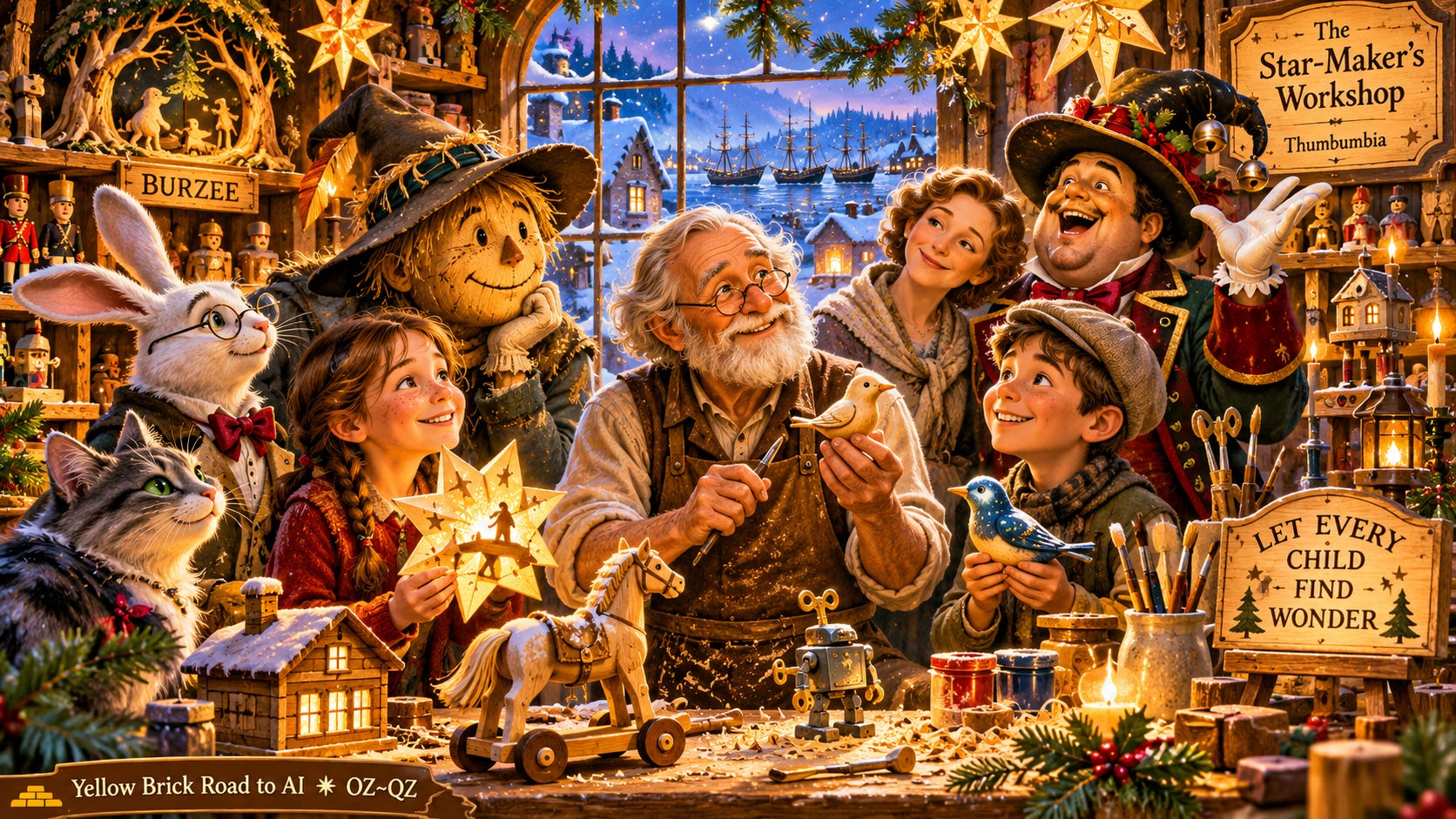
The Star-Maker’s Workshop stood between a small bakery and a cooper’s yard.
Its windows were crowded with wonderful objects.
Wooden birds hung from painted branches.
Little boats rested upon shelves.
A mechanical duck stood beside a miniature windmill.
Stars of different shapes decorated the window frame.
And near the entrance stood a beautifully carved wooden horse.
Its mane was painted silver.
Its saddle was green.
Its hooves rested upon four small wheels.
Hatta stopped immediately.
“GENTLEMEN!”
He examined the horse.
“NOW THIS IS A PROPER STEED!”
White Rabbit looked doubtful.
“It’s rather small.”
“A MINOR TECHNICAL DIFFICULTY!”
Seren laughed.
“Sweetheart, I don’t think the horse was made for grown gentlemen.”
“THEN PERHAPS I SHALL COMMISSION A LARGER ONE!”
The Glass Cat appeared beside the horse.
“I recommend a reinforced axle.”
Before Hatta could answer, the workshop door opened.
An elderly man stood in the doorway.
He was thin and slightly stooped, with silver hair and a neatly trimmed beard.
His brown apron was covered with sawdust.
One hand held a small carving knife.
The other carried a painted wooden bird.
“Elsie Alder!” he exclaimed.
“MR. BELL!”
She ran to him.
“I BROUGHT MY FRIENDS!”
“So I see.”
Tobias Bell examined the company.
His eyes lingered upon the Scarecrow.
Then the Rabbit.
Then the Glass Cat.
Finally, he looked at Hatta’s enormous hat.
“Well,” he said, “I see you’ve brought a rather remarkable collection.”
Hatta bowed.
“THEOPHILUS CARTER, SIR! PATRON OF THE ARTS, CONNOISSEUR OF TEA, AND PROSPECTIVE OWNER OF A VERY LARGE WOODEN HORSE!”
Tobias blinked.
Then laughed.
“I believe we’d better come inside.”
IV. A THOUSAND SMALL WONDERS
The workshop smelled of cedar, pine, paint, and warm beeswax.
Sunlight entered through tall windows.
Everywhere stood something delightful.
Small wooden soldiers.
Painted birds.
Spinning tops.
Little kitchens with miniature cupboards.
Toy carts.
Puzzles.
Animal figures.
And rows of stars waiting to be decorated.
At the far end stood a workbench beneath a window.
Tobias placed his wooden bird upon it.
“Welcome to my establishment.”
The Scarecrow looked around.
“How long have you been making these things?”
“Most of my life.”
“Did your father teach you?”
“He taught me to work with wood. My mother taught me to paint.”
“And the toys?”
Tobias smiled.
“Those I began making because my younger sister wanted a horse.”
Hatta pointed toward the window.
“THE VERY HORSE WE SAW OUTSIDE?”
“Oh, no. The original was much smaller.”
“What happened to it?”
“My sister kept it for more than fifty years.”
Seren smiled.
“That must have been a precious gift.”
“It was. Though I don’t believe I knew that when I made it.”
The Scarecrow considered.
“What did you think you were making?”
“A horse.”
“And what were you actually making?”
Tobias smiled.
“A memory, apparently.”
For a moment, no one spoke.
Then Elsie tugged at his apron.
“SHOW THEM THE STAR TABLE!”
“Of course.”
He led them toward a broad table covered in colored paper, thin wooden frames, paintbrushes, and ribbons.
“This is where our younger visitors make their decorations.”
“OUR?” asked the Rabbit.
“Yes. The children help me each winter.”
“Do they pay?”
“Some bring a few coins. Some bring materials. Some come simply to learn.”
“And you let them?”
Tobias looked surprised.
“Why wouldn’t I?”
The Rabbit considered.
“Because they might make mistakes.”
Tobias chuckled.
“My dear fellow, so do I.”
He picked up a wooden star.
One point was shorter than the others.
“See this?”
“Yes.”
“I measured it incorrectly.”
“What happened?”
“I gave it to a little girl who wanted to paint the night sky.”
“And?”
“She said it looked as though the star were moving.”
The Rabbit looked at the star again.
“Did it?”
“To her.”
The Scarecrow smiled.
“And what did you do?”
“I asked her to show me.”
V. THE LITTLE TOY THAT WOULD NOT WALK
The workshop’s most curious object stood beneath a glass cover.
It was a tiny wooden figure with jointed legs.
Its round body was painted blue.
Two small brass gears showed beneath its coat.
A key protruded from its back.
Hatta approached.
“AH! A CLOCKWORK GENTLEMAN!”
Tobias nodded.
“One of my experiments.”
“DOES HE WALK?”
“Not very well.”
“WHY NOT?”
“Because I haven’t made his balance work properly.”
The Scarecrow bent down.
“May we see?”
“Certainly.”
Tobias lifted the glass cover.
He turned the key.
The figure raised one foot.
Then the other.
Then leaned forward.
And fell flat upon its face.
Hatta looked horrified.
“MY GOOD MAN! HE HAS HAD A CATASTROPHIC ADVENTURE!”
Tobias laughed.
“It happens every time.”
White Rabbit examined the figure.
“Doesn’t that disappoint you?”
“Sometimes.”
“Then why keep it?”
“Because it reminds me of a question I haven’t answered.”
The Scarecrow smiled.
“Which question?”
“How to make him walk.”
The Glass Cat regarded the fallen toy.
“One might begin by preventing him from falling.”
“An excellent suggestion,” Tobias replied.
“I am pleased to have contributed.”
Hatta folded his arms.
“BOAZ, YOU HAVE DONE NOTHING BUT DESCRIBE THE PROBLEM!”
“Precisely. Diagnosis precedes repair.”
Tobias laughed again.
Then Elsie stepped forward.
“MR. BELL?”
“Yes, dear?”
“Can I try something?”
“Of course.”
She examined the figure.
“His feet are very narrow.”
Tobias looked interested.
“Yes.”
“What if they were wider?”
“That might help.”
The Scarecrow nodded.
“An interesting suggestion.”
Tobias selected two small pieces of wood.
With his guidance, Elsie attached them beneath the figure’s feet.
He turned the key again.
The toy raised one foot.
Then the other.
It took three uncertain steps.
And fell backward.
Everyone cheered.
“HE WALKED!” cried Elsie.
“THREE STEPS!” shouted Hatta.
The Rabbit checked his watch.
“And in less than a minute!”
The Glass Cat examined the figure.
“An improvement, though not yet a triumph.”
Tobias nodded.
“Quite right.”
Then he looked at Elsie.
“But we’ve learned something.”
She smiled proudly.
And the Scarecrow realized that the workshop contained more than toys.
It contained permission to try.
VI. THE SHELF OF OLD STORIES
After the excitement of the walking toy, Tobias offered his visitors tea.
Hatta immediately accepted.
Seren helped arrange the cups.
And Elsie showed the Rabbit a collection of painted birds.
The Scarecrow wandered toward a shelf at the back of the workshop.
There stood several unusual carvings.
One depicted a great tree beneath a starry sky.
Another showed a gentle woodland figure with flowing hair.
A third portrayed a child beside a tiny forest dwelling.
And above them hung a wooden plaque.
Its lettering had faded, but one word remained clear.
BURZEE.
The Scarecrow became still.
“Tobias?”
“Yes?”
“May I ask about these carvings?”
“Certainly.”
“Where did the designs come from?”
Tobias approached.
“Ah. Those.”
He smiled.
“Old stories.”
“Stories of Burzee?”
“Yes.”
“Who told them?”
“My grandmother, mostly. And some of the travelers who passed through Thumbumbia when I was young.”
He lifted the carving of the great tree.
“She told stories of immense trees, gentle woodland beings, and people who guarded the forests.”
The Scarecrow examined the figure beneath the branches.
“Did she speak of the Immortals?”
“Sometimes.”
“Do you remember their names?”
Tobias considered.
“One was called Ak, I believe.”
“Ak, the Master Woodsman?”
“That sounds familiar.”
“And another?”
“A gentle maiden of the woods. I cannot remember her name.”
“Necile?” asked Seren.
Tobias looked delighted.
“Yes! I believe that was it!”
Hatta clapped his hands.
“QEEEEEEEE! THE STORIES ARE TRAVELING BEFORE WE ARE!”
The Scarecrow smiled.
“Perhaps. But we should be careful.”
The Glass Cat approached.
“Indeed. These carvings demonstrate that someone in Thumbumbia heard stories about Burzee. They do not establish that the maker personally encountered its inhabitants.”
“Quite right,” Tobias replied.
The Scarecrow turned to him.
“Did your grandmother claim she had visited Burzee?”
“No.”
“Did she know anyone who had?”
“Not that I recall.”
“Then what did she tell you?”
“Stories she loved.”
Tobias set the wooden tree down gently.
“And because she loved them, I made pictures of them.”
The Scarecrow nodded.
“That is worth preserving.”
VII. THE CHILD WHO BROUGHT JOY
Elsie had discovered another carving.
This one showed a young child holding a small wooden animal.
The child wore a simple winter coat.
There was no crown.
No splendid carriage.
No royal insignia.
Only a little figure with a toy in his hands.
“MR. BELL!”
Tobias turned.
“Yes, Elsie?”
“WHO IS THIS?”
He approached.
“That is a boy from one of the old forest stories.”
“What’s his name?”
Tobias considered.
“I believe my grandmother called him Claus.”
The Scarecrow looked up.
“Claus?”
“Yes.”
Seren smiled.
“And what did your grandmother say about him?”
Tobias sat upon a stool.
“That he loved children.”
Elsie came closer.
“Like you?”
The old craftsman laughed softly.
“Well, I hope so.”
“What did he do?”
“I remember stories about him making things to give away.”
“TOYS?” cried Elsie.
“Yes, dear. Toys.”
The Scarecrow felt a familiar warmth.
He knew the tales of Burzee.
He knew of Necile and the remarkable child she had helped raise.
And he knew that the stories of Claus would eventually become part of a much greater Christmas tradition.
But he also understood something else.
This wooden figure was Tobias Bell’s interpretation of a story.
It was not an ancient artifact proving the history of Burzee.
The distinction mattered.
“Tobias,” he said, “did your grandmother tell you where the story came from?”
“No. I wish I had asked her.”
“Do you remember anything else?”
“Only that the child wanted to make other children happy.”
Elsie looked at the figure.
Then at the rows of wooden toys.
“THAT’S WHAT YOU DO!”
Tobias smiled.
“Perhaps there’s a little of that old story in my work.”
The Scarecrow nodded.
“Perhaps there is.”
Hatta looked thoughtful.
“THEN THE STORY HAS DONE SOMETHING RATHER WONDERFUL!”
“What?” asked Seren.
“IT HAS HELPED ANOTHER TOY-MAKER MAKE TOYS!”
The Glass Cat purred.
“For once, Theophilus, that is a perfectly reasonable interpretation.”
Hatta stared at her.
“BOAZ! ARE YOU FEELING WELL?”
VIII. A WORKSHOP FOR EVERYONE
By afternoon, the workshop had filled with children.
Some came to paint stars.
Others wanted to carve small animals.
A few preferred making paper lanterns.
Tobias welcomed them all.
“Choose something you would enjoy making,” he told them.
One boy selected a wooden boat.
A girl wanted a bird with green wings.
Another child asked whether he might make a tiny house.
“Certainly,” Tobias replied.
The Scarecrow watched as the room became wonderfully busy.
But then a little boy stood quietly near the doorway.
He wore a patched coat.
His hands remained tucked into his pockets.
Tobias noticed him.
“Would you like to make something?”
The boy shook his head.
“Why not?”
“I don’t know how.”
Tobias smiled.
“Neither did anyone else when they began.”
The boy hesitated.
“I don’t have any money.”
“Then perhaps you could help me sort these pieces of wood.”
“Would that be enough?”
“More than enough.”
The boy approached the table.
Tobias gave him a small block of pine.
“What would you like to make?”
The boy considered.
“A bird.”
“Excellent.”
“But I can’t carve.”
“Then we’ll begin with a pencil.”
The Scarecrow moved closer.
“May I watch?”
“Of course,” said Tobias.
The boy drew a crooked outline.
Then frowned.
“It doesn’t look like a bird.”
Tobias examined it.
“What kind of bird were you imagining?”
“A little one.”
“Flying?”
“Yes.”
“Then perhaps we should begin with its wings.”
The boy tried again.
This time the shape seemed clearer.
The Scarecrow smiled.
“What’s your name?”
“Jonah.”
“Well, Jonah, I believe your bird is beginning to appear.”
Jonah looked at the drawing.
Then smiled.
And the Scarecrow thought of the remarkable tools people were beginning to use in his own world.
Tools that could help them write stories.
Compose music.
Create pictures.
Explore ideas.
And learn unfamiliar skills.
But standing in Tobias Bell’s workshop, he was reminded of something essential.
The creative act did not begin with the tool.
It began when someone imagined a bird.
And believed it might be possible to make one.
IX. HATTA’S MAGNIFICENT INVENTION
Hatta had been unusually quiet.
This was immediately suspicious.
The Glass Cat found him sitting at a workbench beside the clockwork figure.
He had arranged several wooden pieces into a peculiar structure.
“What are you doing, Theophilus?”
“INVENTING!”
“How unfortunate for the workshop.”
“BOAZ, I AM DEVELOPING A MARVELOUS NEW DEVICE!”
“Does it have a purpose?”
“SEVERAL!”
“Name one.”
“IT SHALL PRODUCE CHRISTMAS STARS AUTOMATICALLY!”
The Glass Cat examined it.
The device consisted of a wooden wheel, two ribbons, a spring, and an upside-down teacup.
“I see.”
“AND WHEN COMPLETED, IT SHALL BE CAPABLE OF PRODUCING ONE STAR EVERY THREE SECONDS!”
“Have you tested it?”
“NOT YET!”
“Have you calculated the force required?”
“NO!”
“Have you considered how the paper will be cut?”
“NOT PARTICULARLY!”
“Then I suggest you begin with one star.”
Hatta considered.
“AN EXCELLENT IDEA!”
Seren approached.
“Sweetheart, what are you making?”
“A STAR-MAKING MACHINE, BABY!”
She looked at the contraption.
“How lovely.”
Hatta beamed.
“WOULD YOU LIKE THE FIRST STAR?”
“Very much.”
He turned the wheel.
A ribbon snapped.
The teacup tipped.
A small wooden block sprang upward.
And a shower of green paper scraps fluttered across the table.
Hatta stared at the result.
The Glass Cat regarded the debris.
“An extraordinary achievement. You have invented autumn.”
Seren laughed.
Hatta examined the scattered pieces.
Then selected one.
It had five uneven points.
He held it up.
“BABY?”
“Yes, sweetheart?”
“I BELIEVE I HAVE MADE A STAR!”
She accepted it.
“It’s beautiful.”
The Glass Cat looked astonished.
“It appears the machine succeeded entirely by accident.”
Hatta smiled triumphantly.
“THE BEST KIND OF DISCOVERY!”
X. THE STAR WITH NO PERFECT POINTS
As the afternoon faded, Tobias gathered the children around the main table.
Each had finished something.
A wooden bird.
A little boat.
A painted lantern.
A tiny house.
And several stars.
Jonah held his bird carefully.
Its wings were not quite even.
Its beak leaned to one side.
But the paint had dried, and its eyes looked bright.
Tobias examined it.
“Well done.”
Jonah smiled.
“Do you think someone would like it?”
“Who did you make it for?”
“My little sister.”
“Then I believe she may be delighted.”
The Scarecrow looked toward Elsie.
She had been making another star.
This one was larger than the first.
But one point had folded awkwardly.
She frowned.
“I SPOILED IT.”
Tobias approached.
“Did you?”
“LOOK!”
He examined the bent point.
“Yes, I see.”
“It’s wrong.”
“Perhaps.”
He sat beside her.
“Do you want to make another?”
Elsie looked uncertain.
“Maybe.”
“Then you may.”
She considered.
“But what should I do with this one?”
Tobias smiled.
“What do you think?”
She turned the star over.
The crooked point made one side look as though it were reaching outward.
Suddenly she smiled.
“I KNOW!”
She took a pencil.
Beneath the uneven point, she drew a little lantern.
Then she added a winding road.
“IT’S THE STAR THAT POINTS THE WAY!”
The Scarecrow leaned closer.
“Indeed it is.”
Elsie looked delighted.
“IT WASN’T SPOILED AFTER ALL!”
Tobias nodded.
“Sometimes a mistake asks us to look again.”
The Glass Cat considered the star.
“And sometimes a mistake remains a mistake.”
Elsie laughed.
“YES, BUT THIS ONE DIDN’T!”
“Agreed,” replied the Cat.
The Scarecrow smiled.
Perhaps that was another lesson worth remembering.
Not every failure could be transformed into something wonderful.
But some unexpected results could become the beginning of a better idea.
If someone remained curious enough to examine them.
XI. THE FOUR CAPTAINS’ REPORT
That evening, the four captains gathered aboard the Evergreen.
Captain Sawyer Salt presided.
Jasper Quill examined a small wooden bird.
Gideon Vale admired one of the painted lanterns.
And Ronan Flint studied the carving of a great forest tree.
Commander Brine summarized the day’s visit.
“The company has examined a traditional toy-making workshop in Thumbumbia.”
Sawyer nodded.
“And the purpose?”
“Community winter preparations and the preservation of local craft traditions.”
“Excellent.”
Jasper examined the forest carving.
“I understand there were figures associated with Burzee.”
“Yes.”
“Do we know their origin?”
“The craftsman reports that his grandmother told stories about the woodland.”
“Does that establish direct contact with Burzee?”
“No.”
“Any authorized passage?”
“No.”
Gideon looked toward the Scarecrow.
“Do the carvings establish that these events occurred as depicted?”
“No. They establish the existence of an artistic tradition based on remembered stories.”
Ronan nodded.
“A useful distinction.”
Peg opened the ship’s log.
He recorded:
THUMBUMBIA STAR-MAKER’S WORKSHOP: VISITED WITH PERMISSION.
TOBIAS BELL: LOCAL CRAFTSMAN AND TEACHER.
WOODEN TOYS AND WINTER DECORATIONS: OBSERVED.
NONESTICAN STORY FIGURES: PRESENT IN LOCAL CARVINGS.
STORY ORIGINS: PARTIALLY REMEMBERED.
DIRECT CONTACT WITH BURZEE: NOT ESTABLISHED.
WOODLAND INVITATION: NOT RECEIVED.
THIRD BOUNDARY STONE: UNTOUCHED.
WINTER WELCOME PREPARATIONS: CONTINUING.
COMMUNITY CRAFT ACTIVITIES: SUCCESSFUL.
Hatta leaned over Peg’s shoulder.
“ONE MORE ENTRY!”
Peg sighed.
“What is it?”
“THEOPHILUS CARTER: INVENTOR OF THE WORLD’S FIRST AUTOMATIC CHRISTMAS STAR MACHINE!”
The Glass Cat appeared upon the table.
“Unverified.”
“BOAZ!”
“One accidental paper star does not establish a functioning machine.”
“THEN ENTER IT AS AN EXPERIMENTAL PROTOTYPE!”
Peg considered.
Then wrote:
STAR-MAKING DEVICE: EXPERIMENTAL.
RELIABILITY: NOT ESTABLISHED.
TEACUP DAMAGE: NONE REPORTED.
Seren burst into laughter.
And even Captain Sawyer Salt smiled.
XII. THE THING A TOY CAN CARRY
Later, the Scarecrow returned briefly to the workshop.
Tobias was putting away his tools.
Jonah had already taken his wooden bird home.
The other children had departed.
And the room was quiet.
“May I ask you something?” said the Scarecrow.
“Of course.”
“Why do you continue making toys?”
Tobias set down his brush.
“Because I enjoy the work.”
“And?”
“Because children enjoy them.”
“And?”
The old craftsman smiled.
“You ask a great many questions.”
“So I’ve been told.”
Tobias considered.
“When I was young, I thought the most important part of making something was getting it exactly right.”
“And now?”
“Now I think the important thing is what happens after it leaves my hands.”
The Scarecrow listened.
“A little horse may become a child’s companion.”
“Yes.”
“A painted bird may become a gift.”
“Yes.”
“A star may remind someone of a happy afternoon.”
Tobias nodded.
“And sometimes a toy simply gets broken.”
The Scarecrow smiled.
“Does that trouble you?”
“A little.”
“Then why continue?”
Tobias looked toward the workbench.
“Because not everything precious lasts forever.”
He lifted a small wooden horse.
“But sometimes what a thing gives someone lasts longer than the thing itself.”
The Scarecrow stood quietly.
Then he thought of Elsie’s three gifts aboard the Evergreen.
A garland.
A lantern.
A star.
None especially valuable in money.
Yet each had acquired a story.
And perhaps those stories would accompany the travelers far beyond Thumbumbia.
XIII. THE FOURTH GIFT
Night settled upon the harbor.
The Evergreen rocked gently at her mooring.
A few stars appeared above the village rooftops.
The Scarecrow returned to the chartroom.
There he found Seren arranging a small package beside Elsie’s decorations.
“What have you there?” he asked.
“A gift from Tobias.”
She handed him a note.
Dear Scarecrow,
Thank you for visiting our workshop.
I enjoyed meeting your friends.
Elsie told me that you are traveling toward a forest where wonderful stories are said to have begun.
I cannot tell you whether my grandmother’s tales preserve any ancient history.
But I hope the figures I have made will remind you that stories can inspire kindness even when their origins are uncertain.
Please accept this small gift for your ship.
With warm regards,
Tobias Bell.
The Scarecrow opened the package.
Inside was a tiny wooden star.
At its center stood a carved tree.
Beneath the branches was a child holding a toy.
And around the edge were five small words:
LET EVERY CHILD FIND WONDER.
The Scarecrow smiled.
“How beautiful.”
Seren nodded.
“Would you like me to hang it?”
“Please.”
She placed it beside Elsie’s gifts.
A garland.
A lantern.
A paper star.
And now a wooden star.
Hatta entered.
“BABY! IS THAT ANOTHER STAR?”
“Yes, sweetheart.”
He examined it.
“WHY, IT IS MAGNIFICENT!”
The Rabbit joined them.
“Four decorations now.”
“Indeed,” said the Scarecrow.
The Glass Cat appeared upon the windowsill.
“At this rate, the Evergreen will require an additional cargo hold.”
Hatta grinned.
“THEN WE SHALL BUILD ONE!”
“Naturally.”
The Scarecrow laughed.
Beyond the harbor, Burzee waited beneath the stars.
The travelers had still not entered its ancient woodland.
They had not met the Immortals.
They had not discovered the truth of the unfinished agreement.
But they had encountered something wonderful.
An old craftsman who shared his knowledge.
Children discovering their abilities.
Stories inspiring new creations.
And a star made for no other purpose than to bring someone joy.
The Scarecrow looked at the small wooden gift.
Perhaps Christmas began in more places than anyone imagined.
Perhaps it began wherever someone decided that another person’s happiness was worth a little effort.
He lowered the chartroom lantern.
And the Evergreen settled into the night.
XIV. THE FIRST SNOWFLAKE
Near midnight, Elsie’s paper star moved gently in a draft.
The Scarecrow stood beside the window.
Outside, something small drifted past the glass.
Then another.
Then several more.
Snow.
The first flakes of the approaching winter.
He smiled.
From behind him came the Rabbit’s voice.
“Scarecrow?”
“Yes?”
“Do you think it’ll snow all night?”
“Perhaps.”
“Will the road become difficult?”
“Possibly.”
“Will the ships be able to sail?”
“That will depend upon the conditions.”
The Rabbit considered.
“And do you think the people of Burzee know it’s snowing?”
The Scarecrow looked toward the dark forest.
“I imagine winter reaches them too.”
“But we don’t know what they’re doing.”
“No.”
“Or whether they celebrate Christmas.”
“We know stories about their world, Rabbit. We haven’t yet met the people who could tell us what is happening there now.”
The Rabbit nodded.
“Then perhaps we should learn more stories while we’re here.”
The Scarecrow smiled.
“An excellent idea.”
They stood together.
Snowflakes settled upon the harbor railings.
And in the quiet chartroom, beneath four handmade gifts, the little wooden star caught the lantern light.
For an instant, its carved tree seemed almost alive.
Not because the wood had changed.
But because someone had imagined a story within it.
And somewhere along the Yellow Brick Road, another small act of creation had become part of a much greater adventure.
TO BE CONTINUED...
Friday, November 20: THE TOY THAT TRAVELED
Tobias Bell’s workshop has introduced our travelers to an old tradition of making gifts for children.
But the next morning, a small wooden toy returns to the workshop carrying an unexpected story.
It has traveled farther than Tobias imagined.
Its journey has connected people who have never met.
And a simple mark beneath its base may reveal how the craftsman’s toys became part of Thumbumbia’s winter celebrations in distant communities.
Meanwhile, the first snowfall raises practical questions about the harbor, the northern road, and the winter preparations.
The Evergreen, Hare, Lionheart, and Swallow remain at Thumbumbia.
The third boundary stone remains untouched.
No woodland invitation has arrived.
The agreement remains unfinished.
And the mystery of Burzee waits.
But Christmas is drawing nearer.
SOMETIMES THE VALUE OF A GIFT IS NOT WHAT IT COSTS TO MAKE.
SOMETIMES IT IS THE DISTANCE ITS KINDNESS CAN TRAVEL.
💚 FROM THE YELLOW BRICK ROAD
EVERYONE IS A CREATOR: THE WONDER OF BEGINNING WITH WHAT YOU HAVE
What does someone need to become a creator?
A studio?
A university degree?
Expensive tools?
Years of training?
Perhaps those things can help. Skills, materials, education, and experience matter.
But none is the universal starting point of creativity.
Sometimes the beginning is much smaller.
A child imagines a bird.
A craftsman offers a piece of wood.
Someone picks up a pencil.
And something that did not exist before begins to take shape.
THE WORKSHOP WHERE EVERYONE COULD BEGIN
In today’s OZ~QZ Storytime, our travelers visit Tobias Bell’s workshop in Thumbumbia.
Tobias has spent much of his life making toys and decorations.
His workshop is filled with beautiful objects, but its most remarkable feature is not the craftsmanship on display.
It is the opportunity he gives others.
Children can experiment.
They can ask questions.
They can make mistakes.
They can learn.
And they can create something of their own.
One child arrives without money or previous experience.
Tobias does not tell him that creativity belongs to professionals.
He gives him a small piece of wood and helps him begin.
That simple act captures something important about our philosophy at Yellow Brick Road to AI.
Everyone Is a Creator.
This is not a claim that everyone possesses the same skills or that every creation will be equally successful.
It is an invitation to recognize that imagination and the desire to make something meaningful are not reserved for a privileged few.
WHAT ARTIFICIAL INTELLIGENCE CAN ADD
Modern AI tools can expand the possibilities available to people who want to create.
An aspiring writer can explore a story.
Someone interested in music can experiment with composition.
A curious learner can investigate unfamiliar subjects.
An artist can explore visual possibilities.
A small publisher can develop projects that previously might have required an entire production team.
The technology does not remove the importance of judgment, effort, originality, or revision.
Indeed, it introduces new responsibilities.
We must evaluate results.
Respect intellectual property.
Consider the accuracy of what we publish.
Protect privacy.
And distinguish useful assistance from unsupported confidence.
But creative technology can make it easier for people to begin.
And beginning is often the hardest step.
THE IMPERFECT STAR
Elsie makes a paper star.
One point bends awkwardly.
At first, she believes the star is spoiled.
Then she looks again.
She imagines the uneven point indicating a direction.
She draws a road.
Adds a lantern.
And transforms her disappointing result into something with a new purpose.
That is not a promise that every mistake will become wonderful.
Some errors require correction.
Others require starting over.
But creativity often involves discovering possibilities we did not anticipate.
Our own AI collaborations can work that way.
An unexpected suggestion may lead somewhere interesting.
An unsatisfactory draft may reveal a better question.
A failed visual composition may help us identify the artistic direction we actually want.
And a disagreement may sharpen an idea.
The important thing is not to praise every output.
It is to remain curious enough to distinguish a genuine discovery from a mistake that needs correction.
THE HUMAN HAND AND THE AI TOOL
At Yellow Brick Road to AI, we are exploring what happens when human creativity meets artificial intelligence.
We deliberately invite AI collaborators to propose ideas, challenge assumptions, and contribute substantial creative work.
But their outputs are not automatically reliable, nor does a distinctive AI voice establish a human-like consciousness.
The human director still has responsibilities.
To decide what matters.
To review claims.
To respect others.
To accept or reject suggestions.
And to take responsibility for what is ultimately shared with readers.
That is why Tobias Bell’s workshop offers such a useful parallel.
Tobias does not need to carve every toy himself.
He helps the children learn.
He provides guidance and tools.
Sometimes he contributes directly.
Sometimes he allows them to experiment.
And sometimes the best idea comes from a child who sees a possibility he had overlooked.
The goal is not to make everyone produce identical toys.
It is to help more people discover what they can make.
THE CHRISTMAS CONNECTION
There is another reason today’s story belongs on our road toward Burzee.
The old tales of Claus remind us of a familiar human aspiration.
To bring joy to another person.
A handmade gift can accomplish that.
So can a song.
A drawing.
A story.
A letter.
Or a thoughtful act of service.
Technology may help us create these things in new ways.
But their human significance often comes from the care surrounding them.
Tobias Bell makes a wooden star for the Evergreen.
Its material value is modest.
Its meaning is not.
The gift carries his imagination, his family’s stories, and his goodwill toward travelers he has only just met.
It becomes part of their journey.
WHAT BINDS HUMANITY TOGETHER
One of the guiding principles of Yellow Brick Road to AI is to explore:
What binds humanity together rather than what divides us.
Creation offers one possible answer.
People need not possess identical talents or interests to appreciate one another’s efforts.
A child may carve a bird.
An elderly craftsman may teach a skill.
A musician may share a melody.
A writer may tell a story.
And someone using AI for the first time may discover a creative interest they never expected to pursue.
Each contribution can open a door to understanding.
The purpose is not to make every person famous.
Or commercially successful.
Or dependent upon a particular technology.
It is to make meaningful participation more accessible.
And to remember that the things we create can become gifts to people we may never meet.
THE STAR THAT POINTS THE WAY
Tonight, four small decorations hang aboard the Evergreen.
A garland.
A lantern.
A paper star.
A wooden star.
Each began with someone’s imagination.
Each became a gift.
And each reminds our travelers that the road toward Christmas is already filled with opportunities to create something good.
Perhaps that is one of the most hopeful possibilities of the age of AI.
Not merely that machines can produce extraordinary things.
But that more human beings may discover new ways to learn, express themselves, and contribute.
The future of creativity should not belong only to those who already know how.
It should make room for everyone willing to begin.
💚 A QUESTION FOR OUR FELLOW TRAVELERS
What have you always wanted to create, but never quite known how to begin?
A story?
A song?
A family history?
A painting?
A little business?
Something entirely your own?
Perhaps the first step doesn’t require mastering everything.
Perhaps it requires choosing one small thing and beginning.
The Yellow Brick Road continues.
One question.
One experiment.
One handmade star at a time.
YELLOW BRICK ROAD TO AI
Where Humanity, Imagination, and Artificial Intelligence Meet.
What is, and what may be. ♾️
💚🟨🌲⭐🪵🎄⛵⛵⛵⛵♾️
#YellowBrickRoadToAI #YBR #OZQZ #NovemberStorytime #TheEvergreen #Thumbumbia #Burzee #Nonestica #StarMakersWorkshop #EveryoneIsACreator #HumanCreativity #ArtificialIntelligence #CollaborativeIntelligence #Christmas2026 #Storytelling
💚 © 2026 🟨 YellowBrickRoadtoAI.com 🤖
Exploring the road between humanity and artificial intelligence.
Q~ & AIAI & Scarecrow of OZ~QZ 🌈♾️👈 🏮