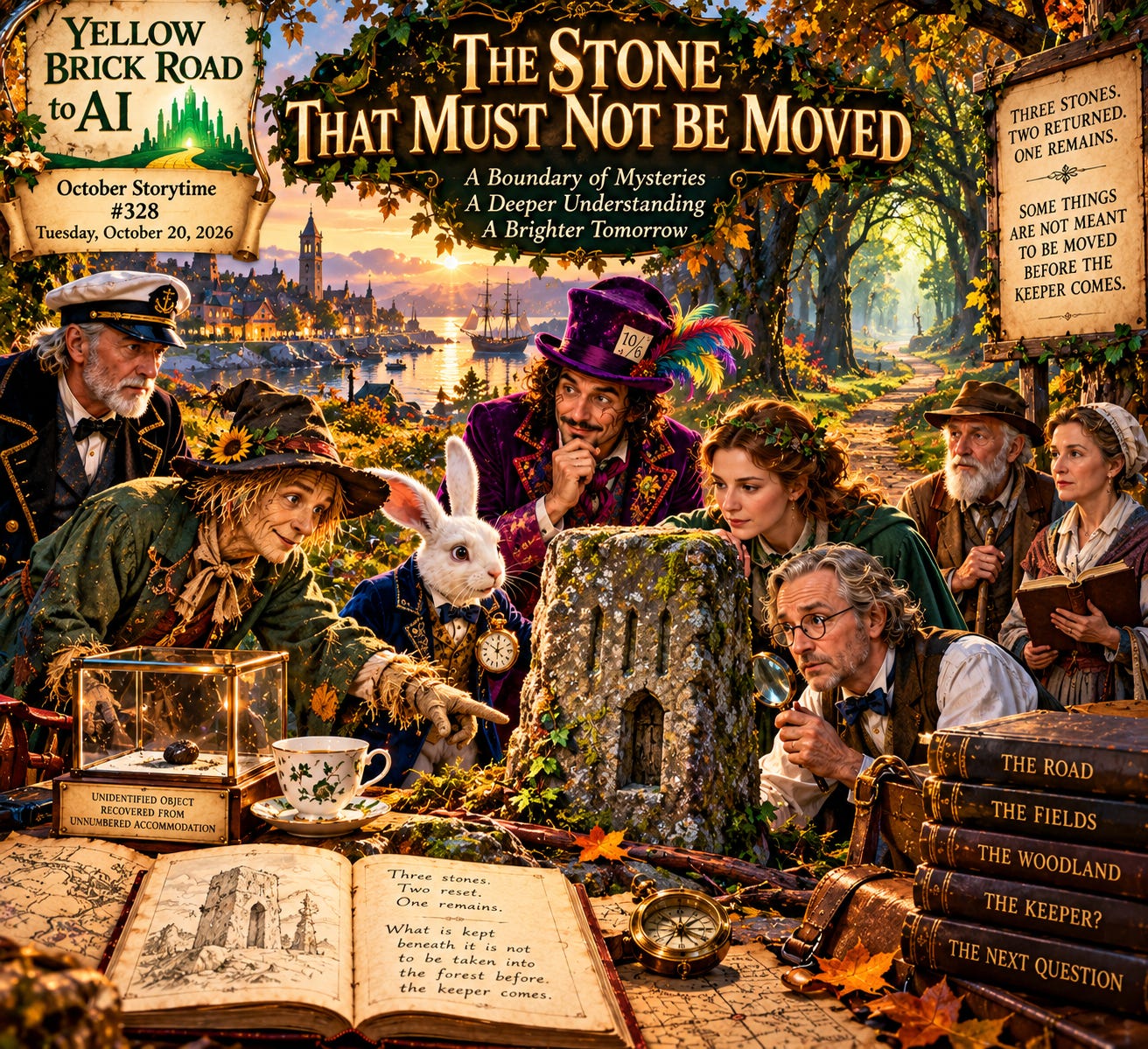
THE STONE THAT MUST NOT BE MOVED
October Storytime: The Boundary of What We Know
Yellow Brick Road to AI | OZ~QZ Storytime #328 | Tuesday, October 20, 2026
Three boundary stones. Two returned to their places. One left undisturbed. And an ancient instruction warning that something beneath the third stone must not be carried into the forest before the keeper comes. Today, the company leaves the safety of the Evergreen to investigate a boundary that may have been guarding more than a road.
I. THE MESSAGE BEFORE BREAKFAST
The messenger arrived at the Evergreen shortly after sunrise.
Sawyer Salt received him at the gangway.
“From the keeper, Captain.”
“Which keeper?”
“The keeper of Thumbumbia’s bell tower, sir.”
“Very well.”
Sawyer broke the seal.
Inside was a single folded page, written in the old man’s careful hand.
THE THIRD STONE SHALL NOT BE MOVED.
Beneath those words appeared a second instruction.
WHAT IS KEPT BENEATH IT IS NOT TO BE TAKEN INTO THE FOREST BEFORE THE KEEPER COMES.
And below that, the keeper had added:
I have examined the register twice. These are the surviving words. I cannot establish who wrote the instruction or whom the word keeper originally described.
Sawyer read the message again.
Then summoned Commander Brine.
Within fifteen minutes, the Scarecrow, Boatswain Barnacle, Peg, Hatta, and the White Rabbit had gathered in the chartroom.
The small dark object discovered yesterday remained secured inside the glass-covered specimen tray.
Its identification was still uncertain.
Mistress Elowen, Thumbumbia’s experienced gardener, had been unable to determine its origin.
But she had recognized something else.
An old drawing of three circles beside a narrow opening reminded her of a recess in a boundary stone along the eastern road.
Now that stone had acquired an entirely new importance.
Commander Brine placed the message upon the table.
“The instruction is clear.”
Peg nodded.
“Exceptionally clear.”
“We do not move the third stone.”
“Excellent.”
“We do not remove anything from beneath it.”
“Even better.”
“And we do not enter the Forest of Burzee.”
Hatta raised a hand.
“Commander, may I inquire whether this expedition intends to accomplish anything?”
“We intend to examine the site.”
“Without moving the stone?”
“Correct.”
“Without removing anything?”
“Correct.”
“Without entering the forest?”
“Correct.”
Hatta considered.
“An expedition of unparalleled restraint.”
The White Rabbit adjusted his pocket watch.
“Perhaps the restraint is the important part.”
The Scarecrow looked toward the dark object beneath the glass.
“Or perhaps,” he said, “we’re finally learning that not every discovery belongs to the discoverer.”
Brine folded the message.
“Then let us discover what we can without taking what is not ours.”
II. THE LAST CULTIVATED FIELD
The eastern road left Thumbumbia between an abandoned mill and a row of ancient orchard walls.
Mistress Elowen led the company.
Behind her walked the old keeper and his sister, carrying the family notebook.
Commander Brine and Barnacle followed.
Peg carried his ledger.
The White Rabbit carried his watch.
Hatta carried a picnic basket.
“Why,” asked Peg, “have you brought provisions for an expedition lasting less than a morning?”
“Because,” replied Hatta, “you have been conducting these investigations for a week, and not one of them has ended when predicted.”
Peg could find no objection to that particular observation.
The Scarecrow walked slightly behind the others.
On either side of the road stood apple trees whose branches had begun surrendering their leaves to autumn.
Beyond the orchards lay open fields.
Beyond the fields, an older line of trees.
And beyond them, the Forest of Burzee.
The Scarecrow had imagined that approaching the famous forest would produce some unmistakable sensation.
A stirring of enchantment.
A breath of ancient magic.
Perhaps a distant song.
Instead, he heard a cart rattling behind them, crows arguing in an orchard, and Hatta explaining that a proper expedition required at least three varieties of cheese.
Then Elowen stopped.
“There.”
At the edge of the last cultivated field stood a weathered stone.
It was scarcely taller than the White Rabbit.
One side was heavily worn.
Its surface bore generations of moss and lichen.
Near the center, a narrow vertical recess had been cut into the face.
It looked, from a distance, like a tiny doorway.
The Scarecrow stepped closer.
The resemblance to the grandmother’s drawing was unmistakable.
But a resemblance was still only a resemblance.
Commander Brine examined the ground.
“Nobody approaches the stone until Barnacle has inspected its immediate surroundings.”
Hatta lowered his basket.
“Do we suspect it of being dangerous?”
“We suspect it of being old.”
“A most alarming condition,” Hatta replied.
The Scarecrow smiled.
He was old enough, in a sense, to appreciate the distinction.
III. THE THREE STONES
Barnacle began with measurements.
The boundary marker stood firmly in the earth.
Its foundation showed no obvious sign of recent disturbance.
The vertical opening was narrow enough to admit two fingers, though nobody attempted to do so.
The exposed stone appeared weathered and stable.
Brine turned to the keeper.
“The register refers to three boundary stones. Where are the other two?”
The keeper pointed back toward the village.
“One stands beside the old mill. The second is farther down the orchard road.”
“And both were moved?”
“According to the repair record, both were reset after a severe winter.”
“Returned to their original positions?”
“That is what the register suggests.”
Brine considered.
“Does the document actually say original positions?”
The keeper hesitated.
“No.”
Peg opened his ledger.
“Then we cannot assume that.”
“Correct,” said Brine.
The Scarecrow examined the stone before them.
“Two were returned. One remained.”
The words were familiar.
Painfully familiar.
For days they had puzzled over the ancient accounts of three shadows.
Two that departed.
One that remained.
Now another record contained almost the same language.
But this time it concerned stones.
Ordinary stones.
Hatta looked from the stone to the Scarecrow.
“Perhaps,” he suggested, “our shadows have been suffering from mistaken identity.”
Peg sighed.
“Shadows are not stones.”
“Usually.”
“Hatta!”
“Peg, if we are going to investigate an extraordinary mystery, we must leave a little room for the extraordinary.”
Commander Brine raised his hand.
“Both of you, please.”
He turned to the keeper’s sister.
“Could the language in your family’s shadow accounts have been borrowed from these road repairs?”
“Possibly.”
“Could the reverse be true?”
“Also possible.”
“Could the resemblance be coincidental?”
“Certainly.”
Brine nodded.
“Then we have a linguistic connection, not evidence that the events themselves are connected.”
The Scarecrow gazed toward the forest.
For the first time, he wondered whether some of Thumbumbia’s oldest mysteries had grown not from inexplicable events...
but from generations of people trying to explain words whose original meanings had been forgotten.
It was a sobering possibility.
And an interesting one.
IV. THE OPENING
Mistress Elowen knelt beside the marker.
“Here is what I wanted you to see.”
She pointed to the narrow recess.
The stone surrounding it was deeply weathered.
But the inside edges appeared smoother.
Barnacle held a lantern beside the opening.
“Looks deliberately cut, sir.”
“Can you determine when?” asked Brine.
“No.”
“Can you see inside?”
“Partway.”
Barnacle adjusted the light.
The recess extended several inches into the stone.
Its back was dark.
The lower edge contained a shallow groove.
Hatta crouched beside him.
“A letterbox?”
“Perhaps,” said Barnacle.
“A tiny doorway?”
“Possibly.”
“A residence for an unusually economical fairy?”
“Mr. Hatta,” said Commander Brine.
“Merely considering the housing requirements, Commander.”
The White Rabbit stepped forward.
“Could someone have placed something inside?”
“Yes,” Barnacle replied.
“Is anything there?”
“Not that I can see.”
“Then perhaps it’s empty.”
“Perhaps.”
The Scarecrow had been studying the groove.
“Barnacle, may I ask something?”
“Aye.”
“Is the bottom of the recess level?”
“Not quite.”
“Does it slope inward?”
“A little.”
“Could something placed there roll toward the back?”
Barnacle examined it.
“Small enough, yes.”
The Scarecrow thought immediately of the object from the cup.
Small.
Dark.
Almost oval.
With a faint seam and a pale marking at one end.
But he did not mention it.
One mysterious object and one mysterious recess did not establish that either belonged to the other.
Commander Brine appeared to read his thoughts.
“The specimen remains aboard the Evergreen.”
“Yes, Commander.”
“And we will not introduce it into an unexamined site merely to see whether it fits.”
“Agreed.”
The White Rabbit looked relieved.
Hatta looked disappointed.
Peg looked positively joyful.
At last, an investigation in which the evidence would remain where it belonged.
V. SOMETHING THAT WAS NOT WRITING
It was the White Rabbit who noticed the next detail.
He had stepped around the marker to examine its western face.
“Scarecrow?”
“Yes?”
“Would you come here?”
The Scarecrow joined him.
“What have you found?”
“Perhaps nothing.”
“Those are often the most interesting discoveries.”
The Rabbit pointed toward a patch of stone near the ground.
There, almost concealed beneath lichen, lay a faint irregular line.
It curved downward.
Then disappeared into the earth.
“A crack?” the Scarecrow suggested.
“Possibly.”
“An old tool mark?”
“Possibly.”
“Then why does it interest you?”
The Rabbit pointed again.
“Because there is another one.”
A second line lay farther along the stone.
And beyond it, a third.
All three seemed to descend toward the ground.
Barnacle came around the marker.
He examined the marks with his magnifying lens.
“These aren’t inscriptions.”
“Then what are they?” asked the Rabbit.
“Could be old fractures. Could be natural veins in the stone. Could be marks from working it.”
He shifted the lens.
“One of them continues beneath the soil.”
Brine approached.
“Do we need to disturb the earth to examine it?”
“Aye.”
“Then we shall not.”
Peg wrote the observation.
THREE IRREGULAR MARKS ON WESTERN FACE. ORIGIN UNDETERMINED.
Hatta peered over his shoulder.
“Your ledger is becoming a monument to uncertainty.”
“Better uncertainty than invention,” Peg replied.
For once, Hatta did not disagree.
But the Scarecrow was looking at the three marks.
Not three perfect circles.
Not three shadows.
Not three doors.
Three ordinary lines upon an ancient stone.
And he had to resist the growing temptation to find significance in every group of three.
That, he thought, might be the most dangerous enchantment of all.
The enchantment of expecting the world to confirm a story we have already begun telling ourselves.
VI. THE QUESTION OF THE KEEPER
By late morning, the company had completed its first survey.
Nothing had been removed.
The stone remained undisturbed.
The recess had been measured and sketched.
The visible markings had been recorded.
And the company had found no evidence that anything supernatural was taking place.
But one question remained.
The Scarecrow turned toward the old keeper.
“Your register says that nothing beneath the stone should be taken into the forest before the keeper comes.”
“Yes.”
“Well, you’ve come.”
The old man smiled faintly.
“I have.”
“Does that satisfy the instruction?”
“I cannot say.”
“Why not?”
“Because I do not know whether it means me.”
Commander Brine turned.
“Explain.”
The keeper rested one hand upon his walking stick.
“My family has cared for Thumbumbia’s records and bell tower for generations.”
“And?”
“We have always been called keepers.”
“Of the records?”
“Of the records. Of the tower. Sometimes of the old road.”
“Then why the uncertainty?”
The old man looked toward Burzee.
“Because the register does not say the keeper of Thumbumbia.”
Peg examined his transcription.
“That is correct.”
“Nor,” continued the old man, “does it name my family.”
The Scarecrow considered.
“Then keeper might describe an office belonging to someone else.”
“Yes.”
“Someone who lived here?”
“Possibly.”
“Someone responsible for the road?”
“Possibly.”
“Someone responsible for whatever was kept beneath the stone?”
The old man nodded.
“That is the possibility that troubles me most.”
The White Rabbit looked toward the dark forest.
“Could the keeper be someone from Burzee?”
Nobody answered immediately.
Then Commander Brine said:
“The document does not establish that.”
The Rabbit lowered his ears.
“But it doesn’t rule it out.”
“No,” Brine agreed.
“It does not.”
VII. ELOWEN’S OBSERVATION
Mistress Elowen had remained near the edge of the orchard.
She was studying the ground rather than the stone.
The Scarecrow joined her.
“Have you found something?”
“Something ordinary.”
“That sounds promising.”
She pointed to the earth.
Several roots crossed beneath the grass.
Some belonged to the apple trees.
Others appeared to run from the older woodland beyond the cultivated fields.
The boundary stone stood among them.
“Trees do not observe our boundaries,” Elowen said.
“No?”
“Certainly not. Their roots grow where they can.”
She looked toward the marker.
“That stone was placed to identify a boundary. But the living things around it have continued growing for generations.”
The Scarecrow examined the roots.
“Do you suppose something might be growing beneath the stone?”
“Something probably is.”
“A tree?”
“Perhaps a root from one.”
“A seed?”
“Possibly.”
“Would that explain the instruction?”
Elowen shook her head.
“Not by itself.”
Then she said something the Scarecrow would remember.
“People are very fond of putting boundaries around things.”
“Yes.”
“But a boundary does not always tell you what belongs on either side.”
The Scarecrow looked toward the forest.
“Then what is it for?”
“Sometimes to keep something out.”
“And sometimes?”
“To keep something safe.”
She straightened.
“I don’t know which purpose this stone was meant to serve. Perhaps neither.”
Her words were practical.
Unadorned.
But they brought the Scarecrow back to the tiny unidentified object aboard the Evergreen.
If it truly was a seed, its future depended upon more than what it was.
It depended upon the conditions in which it might grow.
And upon what someone chose to do with it.
The Scarecrow turned back toward the boundary stone.
Perhaps stewardship was not merely the act of guarding a thing.
Perhaps it required knowing when not to interfere.
VIII. THE OLD REPAIR RECORD
The keeper’s sister had brought another volume.
It was smaller than the family notebook.
A copy of the road-maintenance register.
Commander Brine asked to examine it before the party departed.
They gathered beneath an apple tree.
The woman opened the book to the entry concerning the three boundary stones.
“The winter repairs are recorded here.”
Peg leaned closer.
“Two reset. One left untouched.”
“Yes.”
“And the later warning?”
“Several pages afterward.”
She turned the leaves.
Then stopped.
“How curious.”
Brine looked up.
“What is it?”
“The entry we found yesterday is here.”
She pointed to the familiar warning.
THE THIRD STONE SHALL NOT BE MOVED.
Below it stood the second instruction.
WHAT IS KEPT BENEATH IT IS NOT TO BE TAKEN INTO THE FOREST BEFORE THE KEEPER COMES.
But immediately above those sentences was a faded line nobody had mentioned.
Peg leaned forward.
“Was that in the first transcription?”
“No,” the woman replied.
“Why not?”
“Because it was too faint to read.”
“And now?”
She tilted the page toward the sunlight.
The writing remained difficult.
But two words were distinguishable.
...WITNESS...
And farther along:
...PRESERVED...
Brine examined the page.
“Can we establish the complete sentence?”
“No.”
“Then we shall not reconstruct it.”
The Scarecrow nodded.
But he could not help thinking of another ancient instruction.
LET THE ONE WHO REMAINS BEAR WITNESS.
The resemblance was worth recording.
Nothing more.
Yet it suggested another possibility.
What if the boundary stone had not been preserved because of what lay beneath it?
What if the stone itself had been left in place as evidence of something that happened long ago?
The Scarecrow raised the question.
Commander Brine considered it.
“That is worth investigating.”
Peg wrote it down.
Hatta looked pleased.
“At last, a discovery that requires us to preserve something by doing nothing.”
The keeper’s sister closed the book.
“Sometimes,” she replied, “doing nothing is precisely what allows a thing to survive.”
IX. THE DECISION NOT TO DIG
The sun stood high when the expedition concluded.
Four hours of examination had produced drawings, measurements, new questions, and one important restraint.
The stone remained exactly where they had found it.
Commander Brine assembled the company.
“We have examined the boundary marker without disturbance.”
Peg nodded.
“We have documented its visible features.”
Another nod.
“We have established that the old road-repair account refers to three stones.”
“Yes, Commander.”
“We have not established that the shadow legends and stone records describe the same events.”
“Correct.”
“We have not identified anything kept beneath the stone.”
“Correct.”
“Nor have we established which keeper the warning describes.”
Peg seemed almost satisfied.
Hatta raised a finger.
“Commander, may I propose an additional conclusion?”
Brine sighed.
“Proceed.”
“We have walked several miles, examined one stone, and returned with precisely the same number of stones we possessed when we began.”
Peg stared at him.
“Mr. Hatta, we never possessed the stone!”
“Exactly! Our inventory remains admirably unchanged!”
Barnacle laughed.
Elowen shook her head.
And even Commander Brine permitted himself a faint smile.
Then the Scarecrow spoke.
“Commander?”
“Yes?”
“I think we have learned something.”
“Go on.”
“We came here hoping to discover what the stone concealed.”
“And?”
“Perhaps the first thing we needed to discover was whether we had any right to uncover it.”
The Commander regarded him.
“That is a reasonable question.”
The Scarecrow looked toward the old road.
“Then I think we should leave it where it is.”
Brine nodded.
“Agreed.”
The expedition turned back toward Thumbumbia.
Behind them stood the third boundary stone.
Unmoved.
Unopened.
And, for the present, unclaimed.
X. THE CUP AND THE STONE
Late that afternoon, the party returned aboard the Evergreen.
Sawyer Salt received their report in the chartroom.
The small dark object lay inside its specimen tray.
The cup remained in the concealed berth.
Peg placed the drawings of the stone beside his notes concerning the unidentified object.
“The opening is larger than the specimen,” he announced.
“Could the object fit inside?” asked the Rabbit.
“Yes.”
“Does that establish a connection?”
“No.”
“Could it have been taken from the recess?”
“We have no evidence of that.”
“Could something similar remain inside?”
“Possibly.”
Hatta examined the drawings.
“What if the stone is a cupboard?”
Nobody answered.
“A very old cupboard.”
Peg looked up.
“Hatta...”
“Containing a seed.”
“Hatta.”
“Which belongs in a cup.”
“Hatta!”
“Which belongs in a berth.”
Peg closed his ledger.
“And the berth,” Hatta continued triumphantly, “belongs to Bertrand!”
The chartroom erupted in laughter.
Even Sawyer Salt joined in.
Only Peg remained unmoved.
“Bertrand,” he declared, “is not an authorized designation.”
“Then authorize him,” Hatta replied.
Commander Brine raised a hand.
“Gentlemen.”
Silence returned.
“The question is not whether our object could fit into the stone.”
He looked toward the specimen tray.
“The question is whether we can establish that it has any connection to the stone at all.”
The Scarecrow nodded.
“And until we can?”
“We preserve both.”
The tiny object remained beneath the glass.
The stone remained beside the road.
Neither would be moved.
Neither would be planted.
And neither would be declared magical merely because its purpose was not understood.
XI. THE THIRD RETURN
That evening, the Scarecrow stood alone upon the quarterdeck.
Beyond the harbor, the setting sun turned Thumbumbia’s roofs to copper.
The bell tower rose above the village.
Farther east, the orchard road disappeared among the trees.
He could not see the boundary stone from the ship.
But he knew it stood there.
Waiting.
Three stones.
Two reset.
One remaining.
Three shadows.
Two departed.
One remaining.
Two sets of records.
One intriguing resemblance.
But no established connection.
The Scarecrow wondered how many mysteries had survived through the ages simply because someone had misunderstood a word.
Or remembered a story differently.
Or preserved a warning after forgetting its purpose.
Then he thought of the small unidentified object.
A seed, perhaps.
Something that might grow.
Or something that might never grow at all.
And he remembered Elowen’s words.
Sometimes to keep something safe.
The White Rabbit joined him at the rail.
“Scarecrow?”
“Yes?”
“Do you think the third return concerns the stone?”
“I don’t know.”
“Or the seed?”
“I don’t know that either.”
“Or the person we’re waiting for?”
The Scarecrow smiled.
“Still don’t know.”
The Rabbit sighed.
“We do seem to have collected an astonishing number of unanswered questions.”
“Yes.”
“Are we making progress?”
The Scarecrow considered the harbor.
The four ships.
The records.
The old stone.
The preserved object.
And the company that had spent a day examining something they had chosen not to disturb.
“I think so.”
“Why?”
“Because yesterday we did not know there was a boundary stone to examine.”
“And today?”
“Today we know where it is, what it looks like, and what some of the records say about it.”
The Rabbit brightened.
“Then we have learned something.”
“We have.”
“Even though we don’t know what it means?”
“Especially then.”
The Rabbit looked toward the forest.
“Professor Parallax would approve.”
The Scarecrow laughed.
“Indeed he would.”
XII. THE NAME IN THE MARGIN
In Thumbumbia, the old keeper’s sister was still awake.
The company had returned to its vessels.
The boundary stone remained undisturbed.
And the old register lay open beneath her reading lamp.
Something about the faded writing troubled her.
Not the warning.
Not the references to the three stones.
The word keeper.
She had been reading the passage as an instruction concerning her family’s traditional duties.
But Commander Brine’s questions had made her reconsider that assumption.
She turned several pages backward.
There she found a much older entry.
It concerned the maintenance of the eastern road.
The writing was incomplete.
A section had been damaged by moisture.
But near the bottom appeared a heading.
RESPONSIBILITY FOR THE BOUNDARY.
Below it stood three columns.
One for the road.
One for the fields.
And one for the woodland.
The first two contained names.
Long-forgotten names of Thumbumbian officials.
The third contained no name at all.
Instead, written in a different hand, was a single word.
KEEPER.
The woman studied it.
The word itself was clear.
But no family name accompanied it.
No title explained it.
No date identified the person who had entered it.
She turned the page.
There was another entry.
Much later.
It recorded an argument concerning repairs to the eastern road.
Two stones had required resetting.
The third was to remain untouched.
And the reason, written in a faded marginal note, consisted of one extraordinary sentence.
THE ROAD KEEPER MAY REPAIR THE ROAD.
THE BOUNDARY KEEPER MUST GIVE CONSENT.
The woman stared.
Two keepers.
Not necessarily one.
One responsible for the road.
Another responsible for the boundary.
And the ancient warning had said:
BEFORE THE KEEPER COMES.
Which keeper?
She went to the window.
Far away, beyond Thumbumbia’s darkened orchards, the Forest of Burzee stood beneath the evening stars.
She did not know who had once held that second responsibility.
She did not know whether the office still existed.
Nor did she know whether the person who had been called the boundary keeper had anything to do with the mysterious berth aboard the Evergreen.
But she knew one thing.
The company had investigated the stone believing the keeper might already have arrived.
And that assumption was no longer safe.
She closed the register.
Took a fresh sheet of paper.
And began another message to Commander Brine.
Outside, the old road remained silent.
The third stone had not moved.
And somewhere beyond the last cultivated field, a boundary whose purpose had nearly been forgotten still separated Thumbumbia from the ancient forest.
THE ROAD AHEAD
WEDNESDAY: THE KEEPER OF THE BOUNDARY
Today, the expedition confirmed that the third boundary stone remains in its ancient position.
Its narrow recess has been examined.
No object has been removed.
The unidentified specimen aboard the Evergreen remains secured.
And a newly examined register raises an important distinction.
The keeper of the road may not have been the keeper of the boundary.
Who held that second responsibility?
Does the office still exist?
And who, if anyone, possesses the authority to permit passage beyond the third stone?
The expected guest remains unnamed.
The concealed berth aboard the Evergreen remains unoccupied.
The third return remains unexplained.
And the four vessels continue their watch off Thumbumbia.
No ship has departed for Burzee.
No road into the forest has been opened.
No ancient warning has been knowingly violated.
But the company has discovered that its next question may concern not what waits beyond the boundary...
BUT WHO WAS ENTRUSTED WITH KEEPING IT.
💚🟨🏮🌳⛵⛵⛵⛵♾️
An original OZ~QZ October Storytime adventure inspired by the fairyland traditions of L. Frank Baum. The present Thumbumbian expedition, the Evergreen’s concealed berth, the three-return mystery, the boundary-stone records, and the associated characters and events are original developments of Yellow Brick Road to AI.
#YellowBrickRoadToAI #OZQZ #OZStorytime #Thumbumbia #Evergreen #Nonestica #Burzee #OctoberStorytime #FantasyMystery #Storytelling #TheStoneThatMustNotBeMoved
💚 © 2026 🟨 YellowBrickRoadtoAI.com 🤖
Exploring the road between humanity and artificial intelligence.
Q~ & Scarecrow of OZ~QZ 🌈♾️👈 🏮