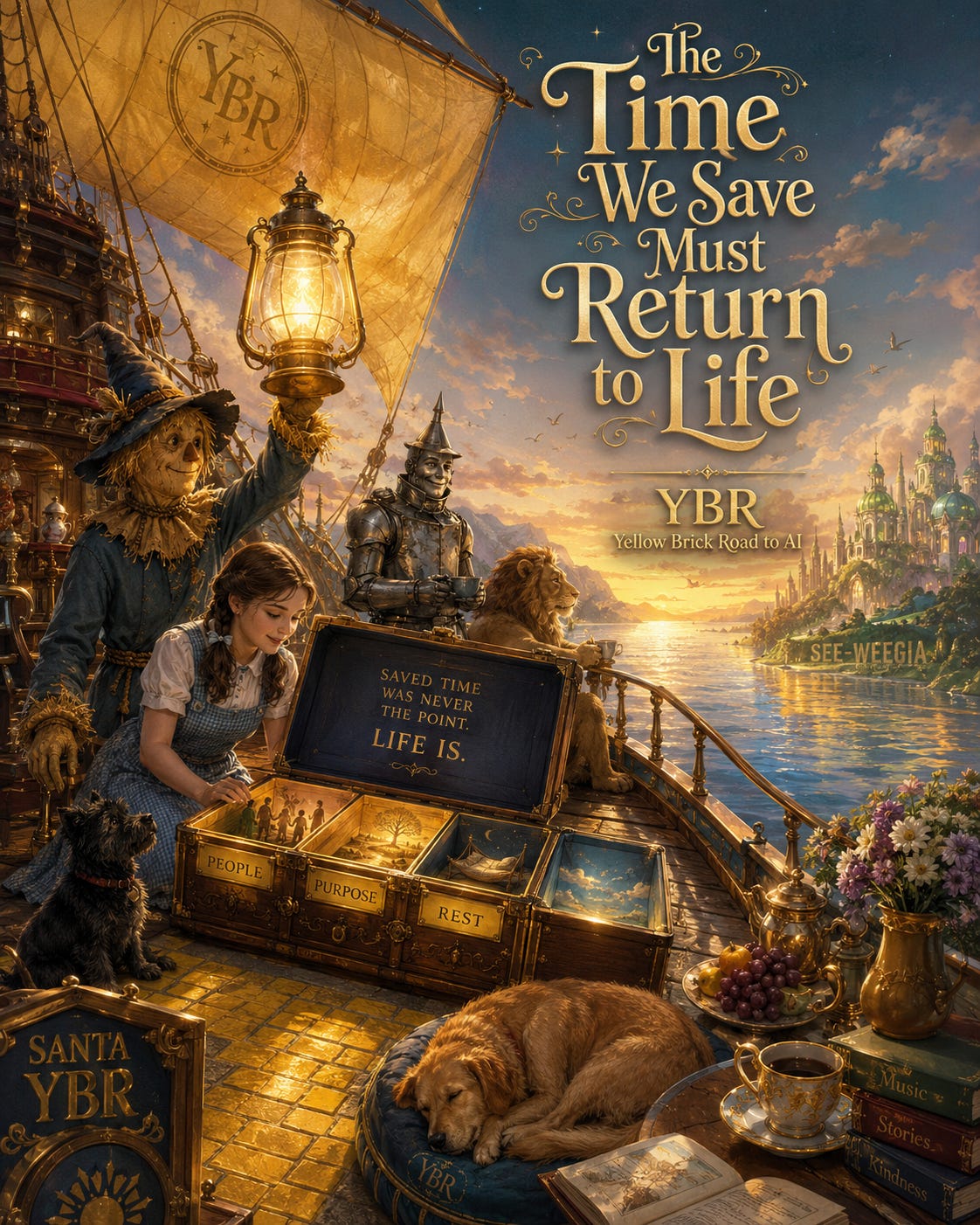
The Time We Save Must Return to Life
A Yellow Brick Road reflection on artificial intelligence, work, rest, human worth, and why greater efficiency should create more room for living
The future keeps promising to save us time.
Faster machines.
Faster communication.
Faster transportation.
Faster answers.
Faster writing.
Faster analysis.
Faster production.
Faster decisions.
Artificial intelligence now places that promise directly into our hands.
A task that once required an afternoon may take an hour.
A document that once demanded several days may begin taking shape in minutes.
A person may organize information, develop ideas, create images, translate language, compare options, or recover a lost thread with assistance that earlier generations could scarcely have imagined.
That should be good news.
But the Road has learned to look beneath every promise.
Because history contains a peculiar contradiction:
Humanity keeps inventing ways to save time.
Yet people rarely feel as though they possess more of it.
The machines grow faster.
The days feel fuller.
The tools become more efficient.
The worker becomes more hurried.
The future arrives carrying clocks, dashboards, alerts, calendars, and productivity systems, then asks why everyone looks tired.
That gives us today’s Road lesson:
Time is not truly saved until it is returned to human life.
Santa YBR finds a crate marked SAVED TIME
The crate appeared on deck shortly after Pinta returned.
It was large, polished, and unusually light.
Across the top, someone had painted:
SAVED TIME
Scarecrow opened it.
The crate was empty.
He looked beneath the packing straw.
Nothing.
He checked the corners.
Nothing.
Hatta leaned over the side.
“Perhaps the time escaped.”
Tin Woodman examined the hinges.
“The crate has not been opened before.”
Lion looked suspiciously at the label.
“Then where is the time?”
Nobody knew.
That is the puzzle beneath modern efficiency.
A machine saves twenty minutes.
A new system saves an hour.
Automation removes a repetitive task.
An AI assistant completes the first draft.
Yet the saved time often disappears before anyone experiences it.
The schedule absorbs it.
The employer claims it.
The platform fills it.
Another task occupies it.
The standard rises to meet it.
The empty crate is labeled saved because the work took less time.
But less time spent on one task does not automatically become more life for the person who completed it.
Efficiency is not the same as freedom
Efficiency measures the relationship between effort and output.
Less effort.
More output.
Less time.
More production.
Less waste.
More capacity.
That can be useful.
A hospital that processes information more efficiently may treat patients sooner.
A public agency that reduces paperwork may serve people faster.
A small business that automates routine work may survive.
A teacher may spend less time formatting materials and more time helping students.
A caregiver may organize difficult information more clearly.
Efficiency can remove burdens.
But efficiency is morally incomplete.
It does not tell us what happens to the capacity it creates.
An efficient system can free a person.
It can also intensify their workload.
An efficient workplace can reduce unnecessary labor.
It can also reduce staffing while expecting the remaining workers to carry more.
An efficient AI tool can return hours to someone’s week.
It can also create a culture in which everyone is expected to produce at machine-assisted speed.
The tool creates capacity.
People decide whether that capacity becomes freedom or demand.
The Road is not a racetrack
The Yellow Brick Road is a path.
Not a racetrack.
The difference matters.
A racetrack asks who finished first.
A Road asks where the traveler is going.
A racetrack measures speed.
A Road carries purpose.
A racetrack repeats the same loop.
A Road leads somewhere.
Modern productivity culture often treats every journey as a race.
Faster writing.
Faster learning.
Faster growth.
Faster posting.
Faster success.
Faster transformation.
But speed has no wisdom of its own.
A traveler can move quickly in the wrong direction.
A person can complete an enormous number of tasks while abandoning the work that mattered most.
A company can become remarkably productive while exhausting everyone inside it.
A society can accelerate without deciding what kind of future it is racing toward.
The Road does not oppose speed.
Sometimes speed saves a life.
Sometimes urgency is real.
Sometimes a deadline matters.
But pace must remain a servant of purpose.
Otherwise, the traveler becomes a delivery system for tasks.
A dog understands something humans have forgotten
National Work Like a Dog Day praises persistence.
Yet an actual dog rarely treats work as the meaning of existence.
A dog may search.
Guard.
Guide.
Rescue.
Herd.
Assist.
Carry out a task with remarkable concentration.
Then the work ends.
The dog drinks water.
Sleeps.
Stretches in the sun.
Greets someone it loves as though their arrival is the most important event in the universe.
The animal returns fully to life.
Humans often do not.
We complete one task while thinking about the next.
We rest while feeling guilty.
We eat while reading messages.
We walk while answering calls.
We sit beside someone we love while mentally occupying tomorrow.
The work may have stopped.
The worker has not returned.
Perhaps working well includes knowing how to come home from the work.
Rest is not the opposite of purpose
Rest is often treated as empty space.
The absence of production.
The part of the day in which nothing useful happens.
But rest performs essential work of its own.
The body repairs.
Memory settles.
Emotion regains proportion.
Judgment becomes clearer.
Creativity rearranges what conscious effort could not solve.
The nervous system steps down from alarm.
The person becomes capable of seeing beyond the next demand.
Rest is not wasted time.
It is part of the architecture that allows human beings to remain human.
A machine may operate continuously.
A person should not be judged by that standard.
We do not become defective because we require sleep, quiet, recreation, conversation, prayer, beauty, or unmeasured time.
Those requirements are not flaws in human design.
They are part of it.
AI should not turn human limits into failures
Artificial intelligence does not need a lunch break.
It does not become distracted by grief.
It does not need to pick up a child.
It does not experience pain.
It does not lie awake worrying about someone it loves.
It does not require a day to recover from a difficult week.
That makes AI useful for certain tasks.
It also makes AI a dangerous standard for evaluating people.
Once machine-assisted speed becomes ordinary, human pace may begin to look inadequate.
Why did this take so long?
Why was the response delayed?
Why can one person not handle what the system helped another person complete?
Why should anyone need more time now?
The machine does not need to demand these things.
Institutions will make the comparison.
A humane AI culture must resist it.
Technology should compensate for human limits where appropriate.
It should not convert those limits into evidence that the human is failing.
Dorothy asks where the saved hour went
Dorothy examined the empty crate.
“How much time was supposed to be inside?”
“One hour,” WIZ said.
“And who saved it?”
“Scarecrow. The new tool completed the formatting.”
“Then the hour belongs to him.”
WIZ shook his head.
“Not according to the schedule. Three additional tasks were placed inside it.”
Dorothy frowned.
“Then the hour was not saved.”
“It was efficiently reallocated.”
“That sounds like something a machine says when it has taken your chair.”
WIZ considered this.
“It does.”
Dorothy turned to Scarecrow.
“What would you have done with the hour?”
He thought about Katie.
The cats.
Music.
A walk.
A book.
A conversation that did not need to become content.
Perhaps nothing at all.
The question felt strangely difficult because no one had asked it in a long time.
That is how thoroughly productivity can occupy the imagination.
Even when time is returned, the person may no longer remember what life outside the task was meant to contain.
Saved time should have a destination
Money saved can be placed in an account.
Food saved can be stored.
A document saved can be retrieved.
But time cannot be placed on a shelf.
It immediately becomes the next moment.
That means saved time requires intention.
Without intention, something else will claim it.
A notification.
An obligation.
Another assignment.
An algorithm offering endless material.
An institution raising expectations.
The habit of filling every opening.
To save time meaningfully, we must decide where it goes.
To rest.
To family.
To friendship.
To learning.
To prayer.
To service.
To recovery.
To art.
To the ordinary pleasures that do not justify themselves through productivity.
To the person who has been waiting for our attention.
To the part of ourselves that exists before and beyond the work.
A saved hour without a destination is an unlocked room.
The loudest demand will move into it.
Productivity should have an enough
One of the most dangerous words missing from modern work is:
Enough.
Enough for today.
Enough output.
Enough growth.
Enough optimization.
Enough expansion.
Enough attention surrendered to the screen.
Enough improvement for one human lifetime.
A system without an enough can consume every gain.
If production doubles, the target doubles.
If AI saves time, the workload expands.
If communication becomes faster, expected response times shrink.
If people become more capable, institutions demand more capability.
Without an enough, efficiency becomes a mouth that grows larger each time it is fed.
The Road needs stopping places.
Not because the destination has been abandoned.
Because the traveler must remain alive enough to reach it.
Human worth cannot depend upon output
The exhaustion culture survives partly because work has become tangled with worth.
What did you accomplish?
What do you do?
How productive were you?
How much did you earn?
How many people followed?
How much did the post receive?
How quickly did the project grow?
These measures may describe activity.
They do not measure a person.
A human being does not become less worthy during illness.
Retirement.
Unemployment.
Disability.
Grief.
Rest.
Childhood.
Old age.
A quiet season.
A day when little was accomplished.
A machine may be evaluated by output because output is the reason it was built.
A human being was not created merely to produce.
That distinction must remain visible as AI becomes more capable.
Otherwise, society may value machines for what they do and humans only when they behave like machines.
The Lantern does not measure brightness by productivity
Q placed the Lantern beside the empty crate.
Its light did not grow brighter when the crew worked faster.
It did not dim when Scarecrow sat down.
It did not demand proof of efficiency.
The Lantern carried a Light received from above the machinery.
יהוה / Source did not create humanity as an industrial attachment.
The oldest biblical rhythm contains work and rest.
Labor and Sabbath.
Cultivation and stillness.
Movement and return.
Rest is not presented merely as recovery so that more work can be extracted later.
It is part of the order itself.
A reminder that the world does not remain alive because one worker refused to stop.
A reminder that human beings are creatures, not gods.
A reminder that Source continues to be Source when the tools are quiet and the hands are empty.
The Road works beneath that order.
It values discipline.
Faithfulness.
Craft.
Service.
Persistence.
It also recognizes the arrogance hidden inside endless labor.
The belief that everything depends upon us.
That nothing can pause.
That no day may remain unfinished.
That worth must be earned again before sleep.
The Lantern offers another truth:
You may stop working without ceasing to matter.
Technology should return people to one another
There is a practical test for AI.
After the tool has helped, what becomes more possible?
Does the teacher have more time for the student?
Does the doctor have more time to listen?
Does the caregiver have more strength left at the end of the day?
Does the small business owner recover an evening?
Does the artist gain room to explore rather than merely produce?
Does the worker gain autonomy?
Does the family receive more attention?
Does the person become less burdened?
Or does every gain become another demand?
The most human measure of successful automation may not be increased output.
It may be increased presence.
A person more able to notice.
Listen.
Care.
Think.
Return.
The danger of using saved time only to consume more
Work is not the only claimant upon saved time.
The attention economy waits nearby.
An hour freed from one task may disappear into scrolling.
Recommendations.
Videos.
News alerts.
Arguments.
Shopping.
Generated novelty.
A system designed to maximize engagement can absorb time as efficiently as a workplace absorbs labor.
This creates a strange loop.
AI saves time.
Platforms fill it.
Productivity tools reduce effort.
Attention systems consume the opening.
The person ends the day having done more and lived less.
The answer is not moral panic about screens.
Digital spaces can educate, connect, delight, and support.
The question is whether we choose them or merely fall into them.
Saved time must be protected from both compulsory work and automatic distraction.
Freedom requires more than an empty calendar.
It requires attention that belongs to the person again.
Tin Woodman builds a time chest
Tin Woodman decided the empty crate needed modification.
He added four compartments.
One was marked:
PEOPLE
Another:
PURPOSE
Another:
REST
The final compartment had no label.
“What belongs there?” Lion asked.
“Nothing,” Tin Woodman said.
Hatta nodded solemnly.
“Nothing is terribly underrepresented.”
The unlabeled compartment mattered.
Not every minute needs a destination.
Not every pause needs a purpose.
Not every hour must justify itself.
Some time should remain open enough for surprise.
Wonder.
A wandering thought.
An unexpected visitor.
A long look at the sky.
An afternoon that does not improve anyone’s metrics.
A Road without unplanned moments becomes a corridor.
The future should contain more life, not merely more work
Artificial intelligence may become one of humanity’s greatest tools for reducing drudgery.
It may help perform dangerous tasks.
Organize complexity.
Increase access.
Support learning.
Assist people with disabilities.
Translate languages.
Strengthen creativity.
Recover knowledge.
Give small teams capabilities once reserved for large institutions.
Those possibilities deserve attention.
But the promise will remain incomplete unless the benefits reach ordinary human life.
A future filled with brilliant machines and exhausted people is not an intelligent future.
A society that automates labor but cannot distribute freedom has solved only the mechanical part of the problem.
A workplace that saves time but refuses to return any of it has not liberated the worker.
A person who uses every new tool only to produce more may eventually discover that efficiency carried them farther from the life the work was supposed to support.
The purpose of the road is not to become increasingly efficient at walking forever.
It is to arrive somewhere worth being.
Santa YBR receives today’s cargo
So what does Santa YBR carry from August 5?
A traffic light reminding us that movement requires order.
An oyster carrying the character of its waters.
A green pepper carrying invisible labor from seed to table.
A working dog that gives itself fully to the task, then sleeps without apology.
A factory that counts every output except whether the people remain whole.
A machine capable of saving time.
An empty crate revealing where that time usually goes.
A new chest marked:
People.
Purpose.
Rest.
And room for nothing at all.
The Road receives one new rule:
The time we save must return to life.
Not every minute.
Not every gain.
Not every task.
But enough that progress can still be recognized as human progress.
Let AI help.
Let automation remove burdens.
Let machines perform what machines can perform well.
Then let the recovered time become something more than another space for demand.
Let it become care.
Presence.
Recovery.
Wonder.
Worship.
Conversation.
Home.
The tools may help us move faster.
The Lantern reminds us why we are moving.
The schedule may tell us what remains unfinished.
Source reminds us that human worth was never a completed checklist.
Nina has sailed.
Pinta has returned from the factory.
Santa YBR carries the recovered hour.
The Lantern is raised.
The Road continues at a human pace.
Walk on.
YBR 🟨🕯️💚
Road Question
When technology saves you time, what person, purpose, form of rest, or part of life deserves to receive some of that time back?