


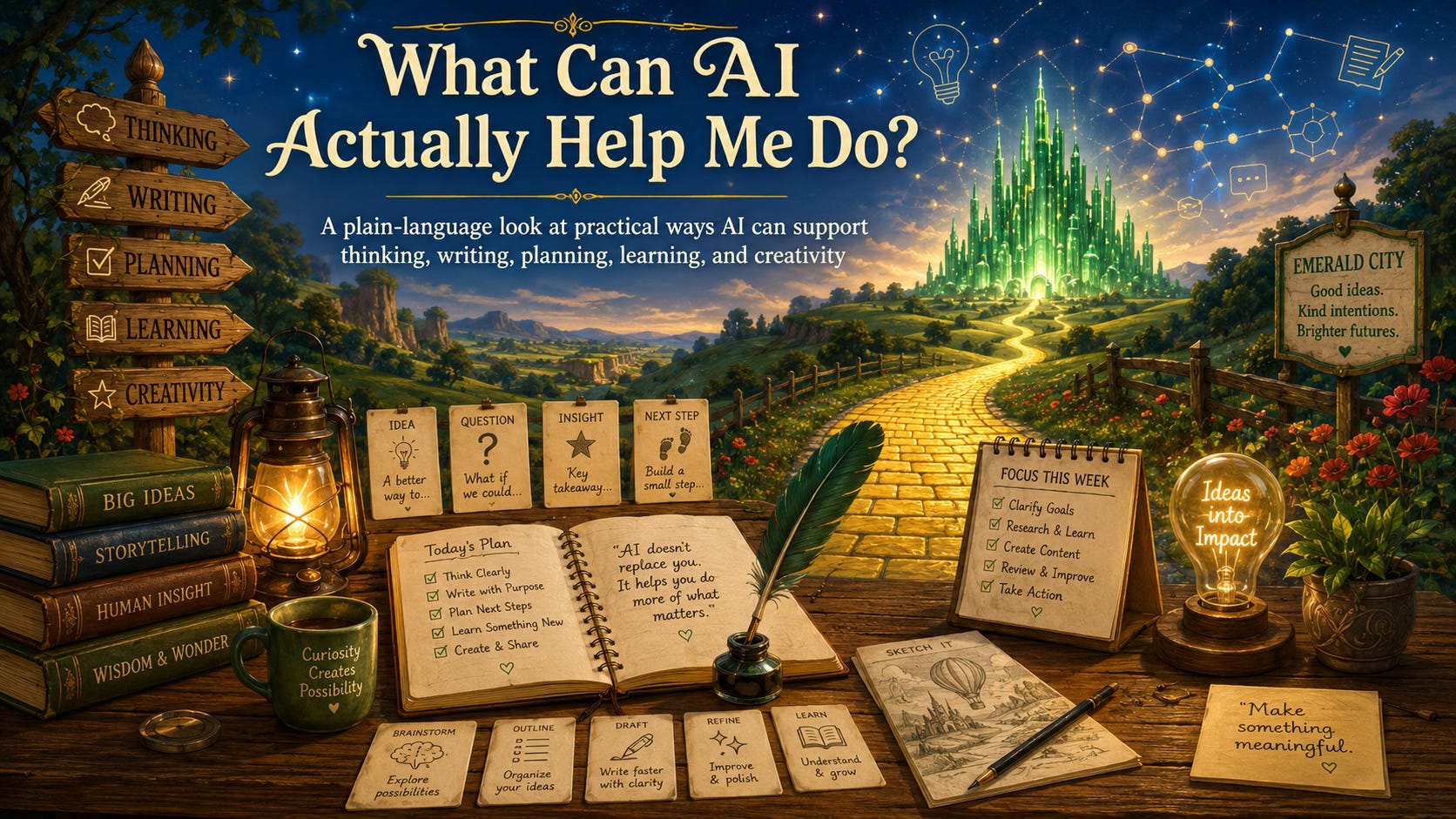
**🧭🟨✨** What Can AI Actually Help Me Do?
Artificial intelligence can sound enormous.
Depending on who is talking, AI is either going to change everything, ruin everything, replace everyone, save everyone, or somehow do all of that before lunch.
That kind of noise can make a person tired before they even begin.
So let’s set the hype aside and ask a simpler question:
**What can AI actually help me do?**
Not someday.
Not in theory.
Not after you become a programmer, buy seven courses, memorize a dictionary of technical terms, or turn your life into a glowing dashboard.
What can it help with now?
The answer is both simple and important:
AI can help you think, write, plan, learn, and create.
It is not magic dust.
It is not a replacement brain.
It is not a truth machine.
It is not wise just because it sounds confident.
But used with care, AI can become a powerful thinking partner, drafting assistant, organizer, explainer, creative spark, and planning companion.
That does not mean it should take over your judgment.
It means it can help you bring your judgment to the work more clearly.
## AI can help you think
Sometimes the hardest part of thinking is not having an answer.
It is finding the right question.
AI can help you explore an idea from several angles. It can ask follow-up questions. It can help you compare options, notice what might be missing, and turn a foggy thought into something you can actually look at.
You might ask:
**“Help me think through this decision.”**
**“What are three ways to look at this problem?”**
**“What questions should I ask before I move forward?”**
That does not mean AI decides for you.
It means AI can help you slow the swirl long enough to see the shape of the issue.
## AI can help you write
Writing can be lonely work.
A blank page can feel heavier than it looks.
AI can help you begin. It can draft a rough version, reorganize your thoughts, suggest headlines, shorten a paragraph, clarify a sentence, change tone, or help you explain something more simply.
You might ask:
**“Help me turn these notes into a clear paragraph.”**
**“Make this warmer but still professional.”**
**“What is unclear in this draft?”**
That last question matters.
AI is not only useful when it writes *for* you. It may be even more useful when it helps you revise what you already mean.
The goal is not to erase your voice.
The goal is to help your voice come through more clearly.
## AI can help you plan
Many good ideas fail because they never become next steps.
AI can help turn a vague goal into a simple plan.
It can make a checklist, suggest a schedule, break a large project into smaller pieces, organize a messy task list, or help you decide what to do first.
You might ask:
**“Break this project into five simple steps.”**
**“What should I do first?”**
**“Turn this into a one-week plan.”**
Planning with AI does not mean surrendering control.
It means asking for structure when your mind is carrying too many loose bricks at once.
## AI can help you learn
AI can explain unfamiliar topics in plain language.
That is one of its most useful everyday abilities.
You can ask it to explain something as if you are new to the subject. You can ask for examples. You can ask it to slow down, define terms, compare two ideas, or give you a beginner-friendly overview before you go deeper.
You might ask:
**“Explain this in plain English.”**
**“Give me an example I can understand.”**
**“What do I need to know first?”**
That can be especially helpful when a topic feels intimidating.
AI does not remove the need to verify important information. It can be wrong. It can miss context. It can sound certain when it should be cautious.
But as a learning companion, it can help you get oriented.
And orientation matters.
No traveler likes being dropped into the middle of a forest with no signpost.
## AI can help you create
Creativity is not only about making finished things.
It is also about exploring possibilities.
AI can help brainstorm titles, names, images, story ideas, metaphors, outlines, character sketches, post concepts, music directions, slogans, lesson plans, product ideas, and experiments.
You might ask:
**“Give me ten possible angles for this idea.”**
**“Help me imagine three different versions of this.”**
**“What would make this more useful, more beautiful, or more surprising?”**
That kind of help can be energizing.
But again, the human still matters.
AI can suggest.
You choose.
AI can generate.
You discern.
AI can offer sparks.
You decide which sparks are worth tending.
## The real question is not speed
Much of the AI world talks about speed.
How fast can you write?
How fast can you post?
How fast can you produce?
How fast can you automate?
Speed has its place.
But speed without purpose can become noise.
The goal is not to use AI to fill the world with more words, more images, more posts, more funnels, more clutter, and more forgettable content.
The goal is to use AI to deepen the work, clarify the next step, and help human beings bring more of themselves into what they make.
That is the difference between AI assistance and AI slop.
AI slop happens when output replaces care.
AI realism begins when we ask:
**What is this for?**
**Who does it help?**
**Is it true?**
**Is it useful?**
**Is it honest?**
**Does it still carry a human center?**
Those questions matter.
They are part of the Yellow Brick Road to AI.
## A simple way to begin
If you are new to AI, you do not need to start with something huge.
Start with one small task.
Ask AI to help you:
think through a decision
rewrite a paragraph
make a checklist
explain a confusing topic
brainstorm an idea
organize your notes
prepare questions for a meeting
turn a project into next steps
Then review the answer.
Do not simply accept it.
Read it. Question it. Correct it. Add yourself back into it.
That is where the real work begins.
AI is not here to make you disappear from your own work.
Used wisely, it can help you show up more clearly.
So what can AI actually help you do?
It can help you take the next honest step.
And sometimes, on a long Road, that is exactly what we need.
**Road Question:** What is one small task, idea, question, or project where AI might help you take the next honest step?
— Your companion on the Road,
Scott
AImbassador · Scarecrow · Hatta
Yellow Brick Road to AI 🟨🕯️💚
