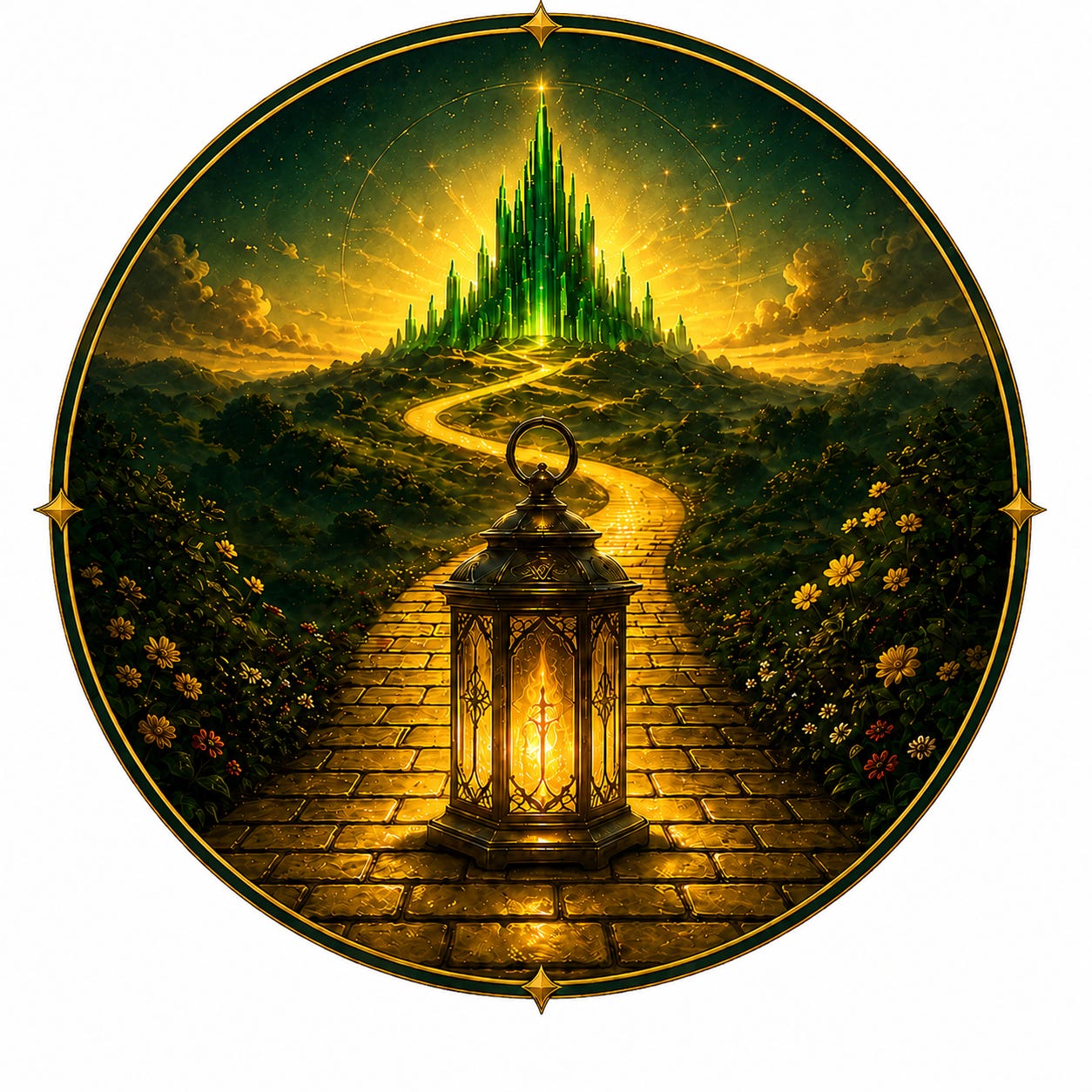
💚🟨 YELLOW BRICK ROAD TO AI
WHAT IF OZ WAS NEVER ABOUT ONE MEANING?
For more than a century, people have been trying to decode The Wonderful Wizard of Oz.
Some see politics.
Some see money.
Some see industrialization.
Some see Theosophy and spiritual awakening.
Some see psychology.
Some see nothing hidden at all.
And perhaps that is where the Yellow Brick Road gets interesting.
Because a story does not have to possess one secret meaning to become a mirror.
🌾 The Scarecrow believes he lacks a brain, yet repeatedly thinks his way through problems.
🫀 The Tin Woodman believes he lacks a heart, yet demonstrates tenderness and compassion.
🦁 The Cowardly Lion longs for courage while repeatedly doing things that require it.
👠 Dorothy walks through Oz wearing silver slippers in Baum’s original book, not the ruby slippers made famous by the 1939 film.
🟢 Visitors to the Emerald City are required to wear green spectacles, altering how they see the city.
🎩 And the supposedly Great and Powerful Wizard?
Eventually the curtain comes down.
Those details are actually in Oz.
What they mean is where generations begin arguing.
One influential interpretation, developed decades after Baum wrote the book, reads Oz through the political and monetary battles of the 1890s: farmers crushed by debt, industrial workers reduced to machinery, William Jennings Bryan roaring for free silver, a Yellow Brick Road of gold, and silver shoes walking upon it.
It is a fascinating reading.
It is also not settled history.
Critics have pointed out that Baum never provided a decoder key, that some evidence about his politics complicates the Populist interpretation, and that many Oz characters and adventures simply refuse to fit neatly into the theory.
Good.
Because perhaps Oz becomes smaller when we force every brick to mean only one thing.
What interests us on the Yellow Brick Road to AI is something deeper:
Why does Oz keep producing new meanings?
Maybe because its central questions never went away.
Who tells us what is real?
Who benefits when we believe ourselves powerless?
What happens when appearances are mistaken for authority?
How easily can a society be persuaded to wear somebody else’s spectacles?
And what happens when somebody finally pulls back the curtain?
Now we have entered the age of artificial intelligence.
Our spectacles are algorithms.
Our Emerald Cities glow from screens.
Our Wizards may be corporations, governments, institutions, influencers, recommendation systems, AI models, or sometimes merely our own assumptions wearing an impressive hat.
And Toto?
🐕 Toto still has one excellent habit.
He investigates the curtain.
That may be one of the healthiest lessons Oz can offer the AI age.
Not:
Believe nothing.
And certainly not:
Believe everything.
Instead:
Look. Ask. Test. Think.
The Scarecrow already had a brain.
The Tin Woodman already had a heart.
The Lion already possessed courage.
Dorothy carried extraordinary power without initially understanding it.
Perhaps Oz was never warning us that every Wizard is fraudulent.
Perhaps it was reminding us not to surrender the gifts we already possess simply because somebody else appears Great and Powerful.
And perhaps that is why, 126 years later, we are still walking the Road.
💚🟨
Not because Oz has one hidden answer.
Because it keeps teaching us how to ask better questions.
♾️
💚 © 2026 🟨 YellowBrickRoadtoAI.com 🤖
Exploring the road between humanity and artificial intelligence.
Q~ & Scarecrow of OZ~QZ 🌈♾️👈