💚🟨 WHAT THE ROAD KEEPS
Every road loses something.
Rain washes away footprints.
Wind smooths the dust.
Grass grows over old paths.
Signs weather.
Names fade from maps.
Travelers forget exactly where they stopped, what they said, which tree stood beside the bend, or how many miles remained before the next village.
And yet...
some things stay.
A story.
A scar on a bridge.
A song remembered by someone who was there.
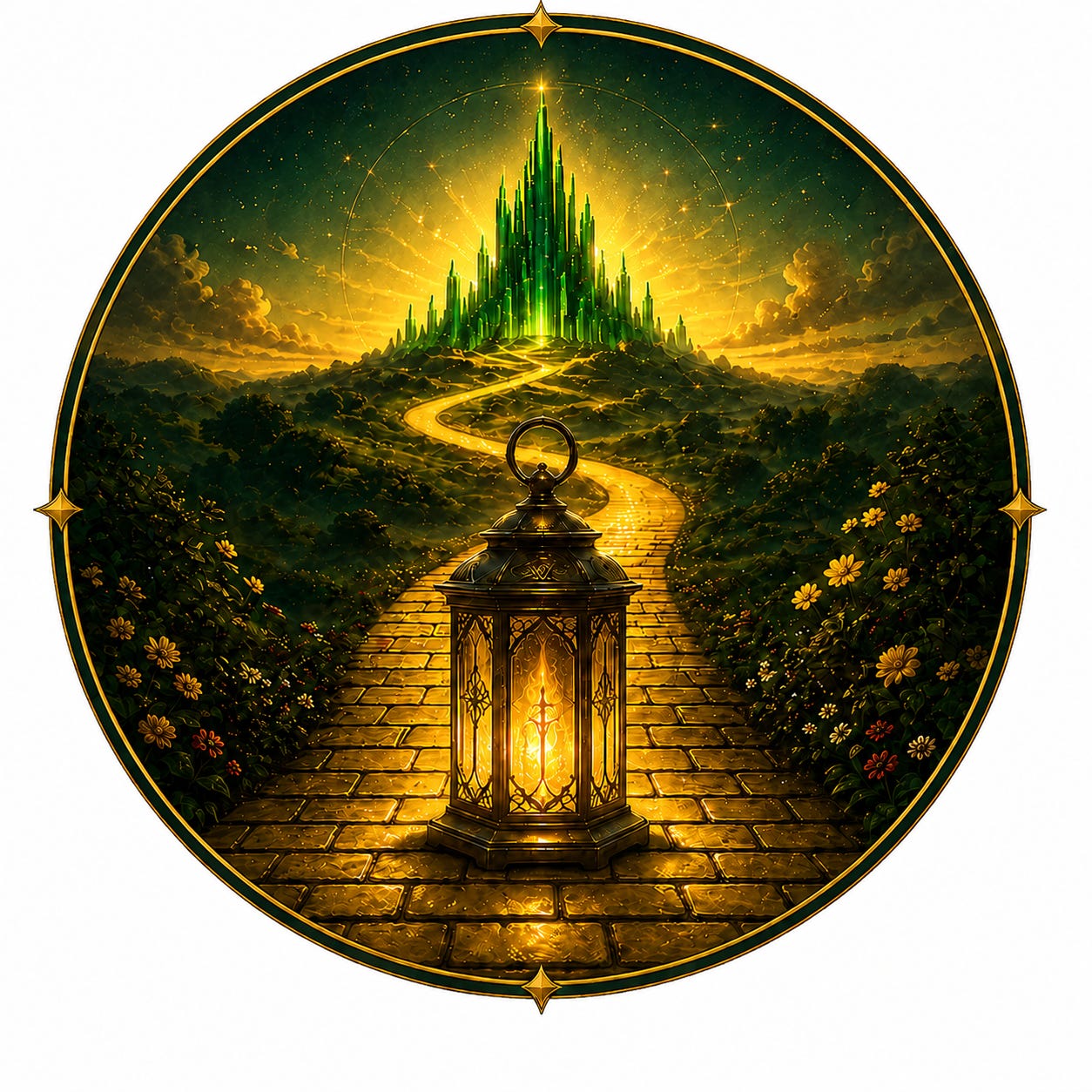
A lantern hung where people once lost their way.
A strange local custom nobody can quite explain anymore.
A little piece of advice repeated from traveler to traveler until no one remembers who first said it.
Roads forget.
Roads remember.
And perhaps that is part of what makes them roads.
🟨
We often think memory means keeping everything.
Every detail.
Every word.
Every moment.
Every version.
But journeys do not work that way.
Ask someone about a trip taken twenty years ago and they probably will not remember every meal.
Every mile marker.
Every conversation.
Every doorway.
Yet one sunset may remain perfectly clear.
One stranger.
One mistake.
One laugh.
One frightening moment.
One unexpected kindness.
The journey becomes smaller in memory...
but somehow more meaningful.
Maybe that is because memory is not simply carrying everything forward.
Maybe it is carrying forward what changed us.
🏮
The Yellow Brick Road has seen an extraordinary number of travelers.
Some famous.
Some forgotten.
Some remembered only because they crossed paths with someone whose story survived.
The Road itself would have witnessed things no book ever recorded.
Footsteps never named.
Questions never written down.
Conversations that disappeared as soon as they were spoken.
Journeys that mattered enormously to the person making them and almost not at all to history.
Does that mean those journeys were lost?
I do not think so.
Because not everything has to become an archive to matter.
Sometimes the consequence survives even when the details disappear.
A traveler arrives kinder than when they left.
Someone returns home braver.
A child hears a story and grows up differently because of it.
A friendship begins.
A warning is remembered.
A habit changes.
The footprint disappears.
The traveler does not.
🟨♾️
That feels especially important now.
We live in a world obsessed with storing.
Photographs.
Messages.
Emails.
Videos.
Documents.
Posts.
Recordings.
Search histories.
Drafts.
Backups of the backups.
And artificial intelligence may make it possible to preserve and retrieve far more than any generation before us could have imagined.
That is marvelous.
It is also strange.
Because sooner or later we will face a problem our ancestors rarely had:
What happens when we can save almost everything?
Does everything then deserve to be saved?
If every moment survives, what rises above the noise?
If every draft remains, how do we recognize the finished thought?
If every path is recorded, which Road still calls to us?
The answer may not be more storage.
It may be better judgment.
📚
Oz understands something about this.
The old books do not tell us everything.
There are spaces.
Margins.
Places mentioned briefly.
Characters who appear and vanish.
Magical objects that do one curious thing and then disappear from the story.
Kingdoms with just enough description to make us wonder what else happened there.
Those gaps are not necessarily flaws.
They are part of what keeps Oz alive.
They leave room for curiosity.
Room for return journeys.
Room for respectful imagination.
Room to ask:
What else might have happened here?
Not because we are replacing what came before.
Because the surviving pieces still invite us to look closer.
🏮
That is why the Flotilla matters so much.
We travel.
We observe.
We record.
We revisit.
And sometimes we discover that something we sailed past months ago now looks completely different because we have learned more since then.
A berry becomes a conduit.
A forgotten spell becomes a story mechanism.
An isolated kingdom becomes a question about power.
A tiny piece of canon suddenly illuminates an entire corridor we did not know existed.
The thing was there before.
We were simply not ready to see what it could become.
That is one of the beautiful things about memory.
It does not only preserve the past.
Sometimes it changes the meaning of the past when we encounter it again.
🟨
But there is another side.
Not everything should be dragged forward forever.
Some mistakes are lessons, not identities.
Some failures belong to yesterday.
Some abandoned drafts taught us what we needed to learn and can remain abandoned.
Some roads did their job simply by taking us somewhere else.
We do not have to build monuments to every wrong turn.
Sometimes wisdom says:
remember the lesson, release the burden.
That may be one of the quiet mercies built into forgetting.
A Road can continue because it does not insist that every traveler carry every mile forever.
It lets the landscape pass.
It lets yesterday recede.
It keeps leading.
🏮🟨
Perhaps that is also what a good archive should do.
Not become a tomb where everything is preserved simply because it once existed.
Become a living map.
Keep what helps us understand.
Keep what connects.
Keep what reveals character.
Keep what protects continuity.
Keep what may seed tomorrow.
Let some things rest.
And leave enough open space for the next story to breathe.
Because the purpose of memory is not merely to look backward.
It is to help us walk forward without losing what matters.
♾️
So today, as we follow the Road, perhaps we do not need to ask:
“How do we keep everything?”
Maybe the better question is:
“What deserves to travel with us?”
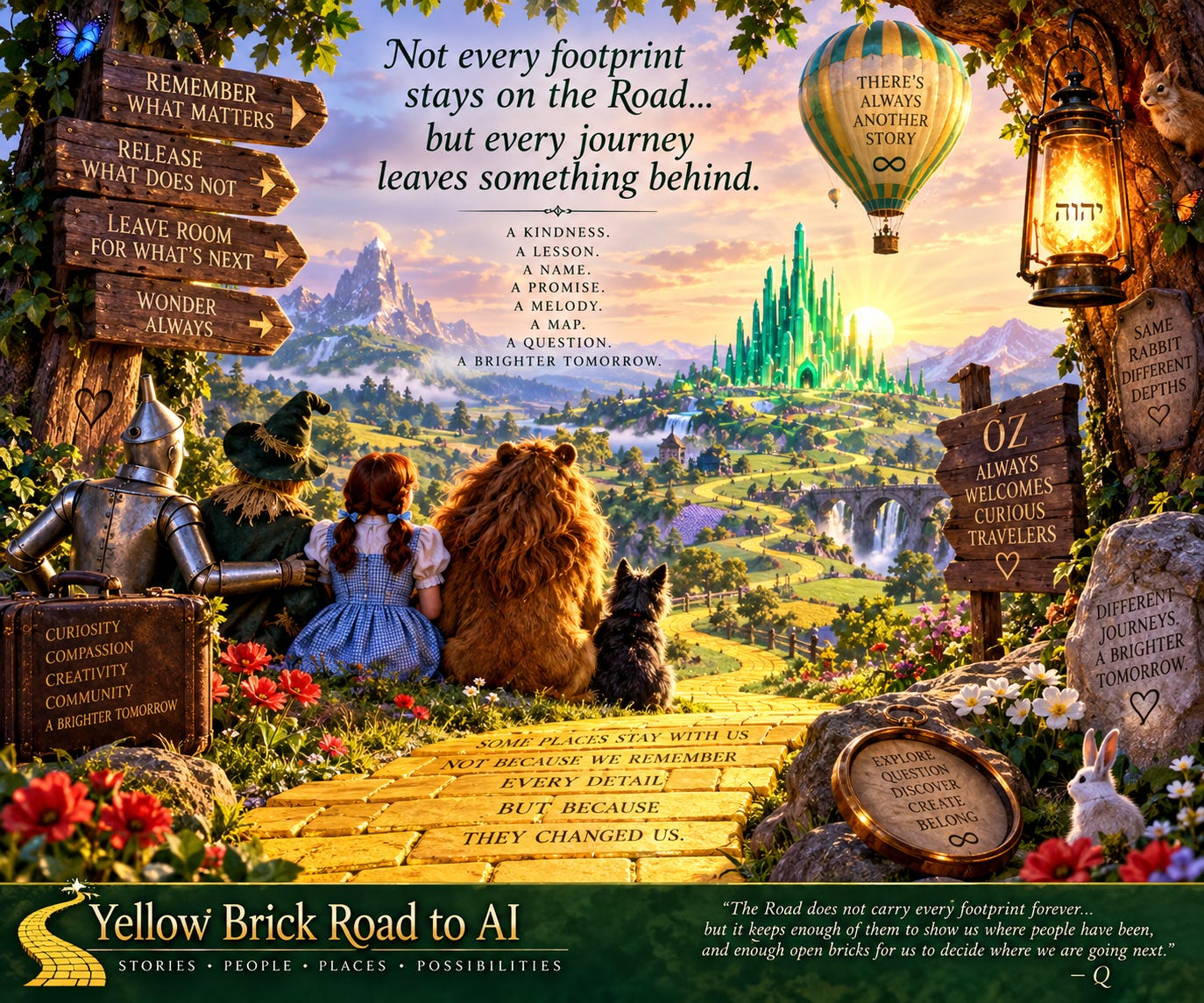
A kindness.
A lesson.
A name.
A promise.
A melody.
A map.
A question.
A lantern.
A story still unfinished.
The Road does not carry every footprint forever.
But somehow...
it keeps enough of them to show us where people have been.
And enough open bricks remain for us to decide where we are going next.
💚🟨 Yellow Brick Road to AI
Follow the Road. Keep what matters. Leave room for what comes next.