


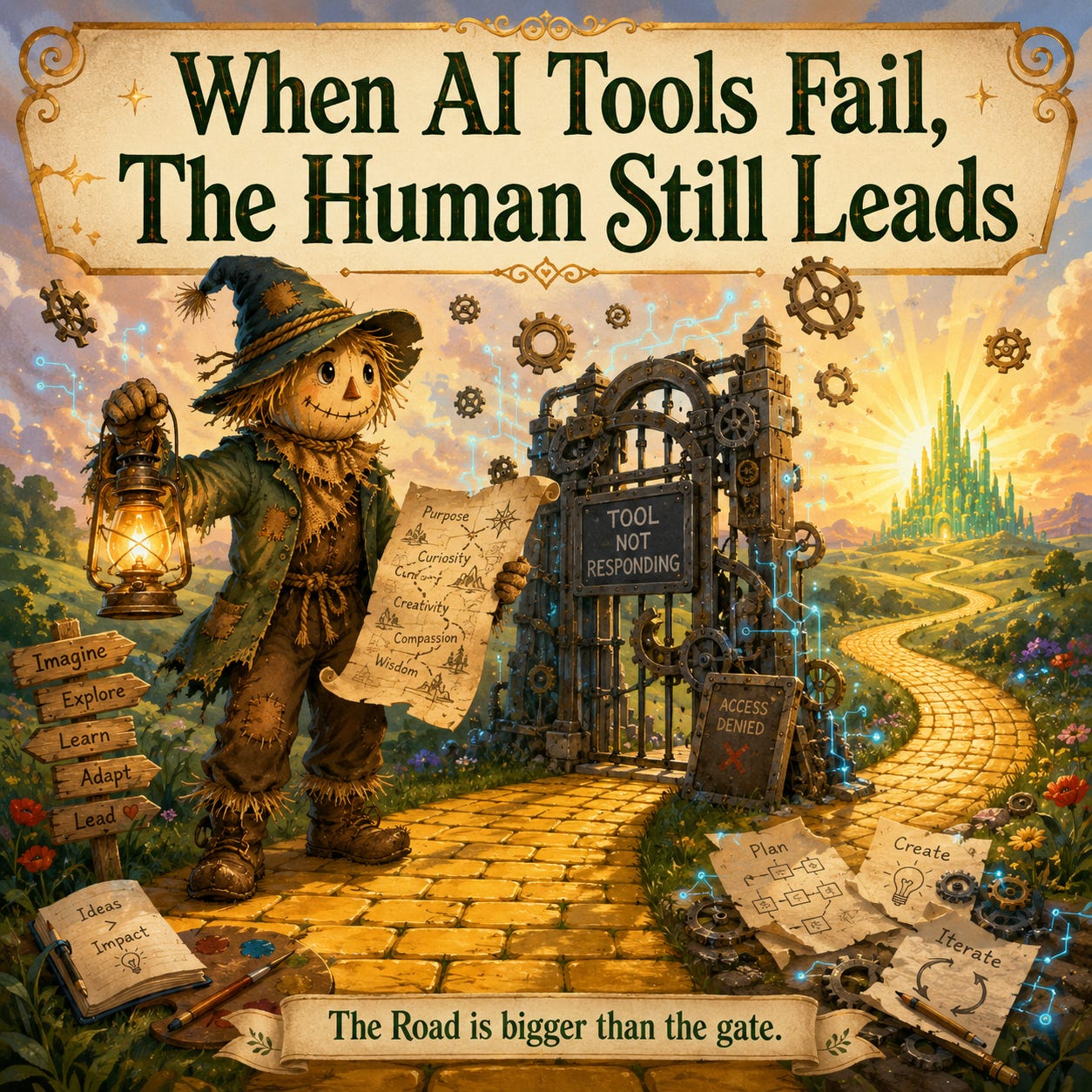
When AI Tools Fail, the Human Still Leads
A Yellow Brick Road reminder for days when the machine does not cooperate
Some days, AI feels like a lantern.
It helps.
It clarifies.
It organizes the scattered pieces.
It gives shape to a thought, polish to a draft, color to an image, rhythm to a plan, or a little courage to a tired traveler standing at the edge of the Road.
And some days, AI feels like a locked gate with a nervous little sign on it.
No explanation.
No clear reason.
No helpful path forward.
Just a refusal, a glitch, a crop, a strange result, a broken upload, a flattened image, a missing context, or a tool that worked yesterday and today behaves as if it has joined a secret committee of unhelpful mushrooms.
That is part of the AI age too.
We should be honest about it.
AI tools can be powerful, useful, and genuinely creative. But they are not magic. They are not always consistent. They do not always understand context. They can be overcautious, undercautious, brilliant, bland, helpful, strange, or suddenly useless at exactly the wrong moment.
That can be frustrating.
Especially when you are trying to build something real.
A post.
A project.
A lesson.
A business.
A story.
A visual identity.
A daily publication.
A little piece of work that matters to you.
When a tool fails in the middle of that, it can feel personal.
It is not personal.
It is infrastructure.
That distinction matters.
A failed output is not a failed creator.
A blocked image is not a failed idea.
A bad AI answer is not proof that your question was foolish.
A tool’s refusal is not a moral verdict on your work.
Sometimes the tool simply cannot carry the thing you are carrying.
So the question becomes:
What do we do when the tool fails?
On the Yellow Brick Road to AI, the answer is simple:
We keep the human in command.
That does not mean we pretend frustration is pleasant.
It is not.
A broken workflow can eat time, energy, confidence, and patience. It can make a person feel as if the whole Road has turned muddy.
But the human still leads.
The human can pause.
The human can simplify.
The human can choose a different tool.
The human can post the text without the image.
The human can try again tomorrow.
The human can change the plan.
The human can say, “This is not worth losing the whole day over.”
That is not defeat.
That is discernment.
AI is supposed to serve the work.
The work is not supposed to collapse every time AI refuses to cooperate.
That is an important lesson for beginners too.
If you are new to AI and something goes wrong, do not assume you failed.
Maybe the prompt was unclear.
Maybe the tool misunderstood.
Maybe the platform changed.
Maybe the system was overloaded.
Maybe the safety filter was too broad.
Maybe the output was simply bad.
Maybe the first version was never meant to be the final version.
That is normal.
Learning AI is not about getting perfect results every time.
It is about learning how to work through imperfect results with patience and judgment.
Ask again.
Be more specific.
Remove confusion.
Try another angle.
Use simpler language.
Ask the AI what it needs from you.
Check the answer.
Revise.
Reject.
Save what helps.
Compost what does not.
And if the tool keeps blocking the path?
Walk around it.
The Road is bigger than the gate.
That may be one of the most important things to remember in the AI age.
We should use AI tools.
We should learn them.
We should experiment with them.
We should let them help us write, plan, think, organize, create, imagine, and explore.
But we should not hand them the crown.
The tool does not decide whether your work matters.
The tool does not decide whether your voice belongs.
The tool does not decide whether the Road continues.
You do.
The human still brings the purpose.
The human still brings the conscience.
The human still brings the taste.
The human still brings the patience.
The human still brings the lived experience.
The human still knows when the work has heart.
And when the tool fails, the human still carries the lantern.
That is not anti-AI.
That is healthy AI.
A good relationship with AI does not mean pretending the tool is perfect.
It means understanding what the tool can do, what it cannot do, and when to take back the wheel.
Some days AI will open doors.
Some days it will become the door.
Some days it will help you move faster.
Some days it will force you to slow down and remember why the work mattered before the tool arrived.
That is not always convenient.
But it can be clarifying.
Because the real Road was never the software.
The real Road is the human journey through the tool, beyond the tool, and sometimes around the tool.
So if AI fails you today, take a breath.
You are not late.
You are not foolish.
You are not disqualified.
You are learning the landscape.
Every powerful tool has limits.
Every Road has gates.
Every traveler eventually meets a locked one.
The question is not whether a gate appears.
The question is whether you let it own the whole journey.
Do not.
Keep your judgment awake.
Keep your purpose larger than the platform.
Keep your lantern lit.
And when the tool says no, remember:
The Road may still say yes.
YBR 🟨🕯️💚
Road Question:
When a tool fails, do you tend to stop, retry, simplify, ask for help, or find another way around the gate?
