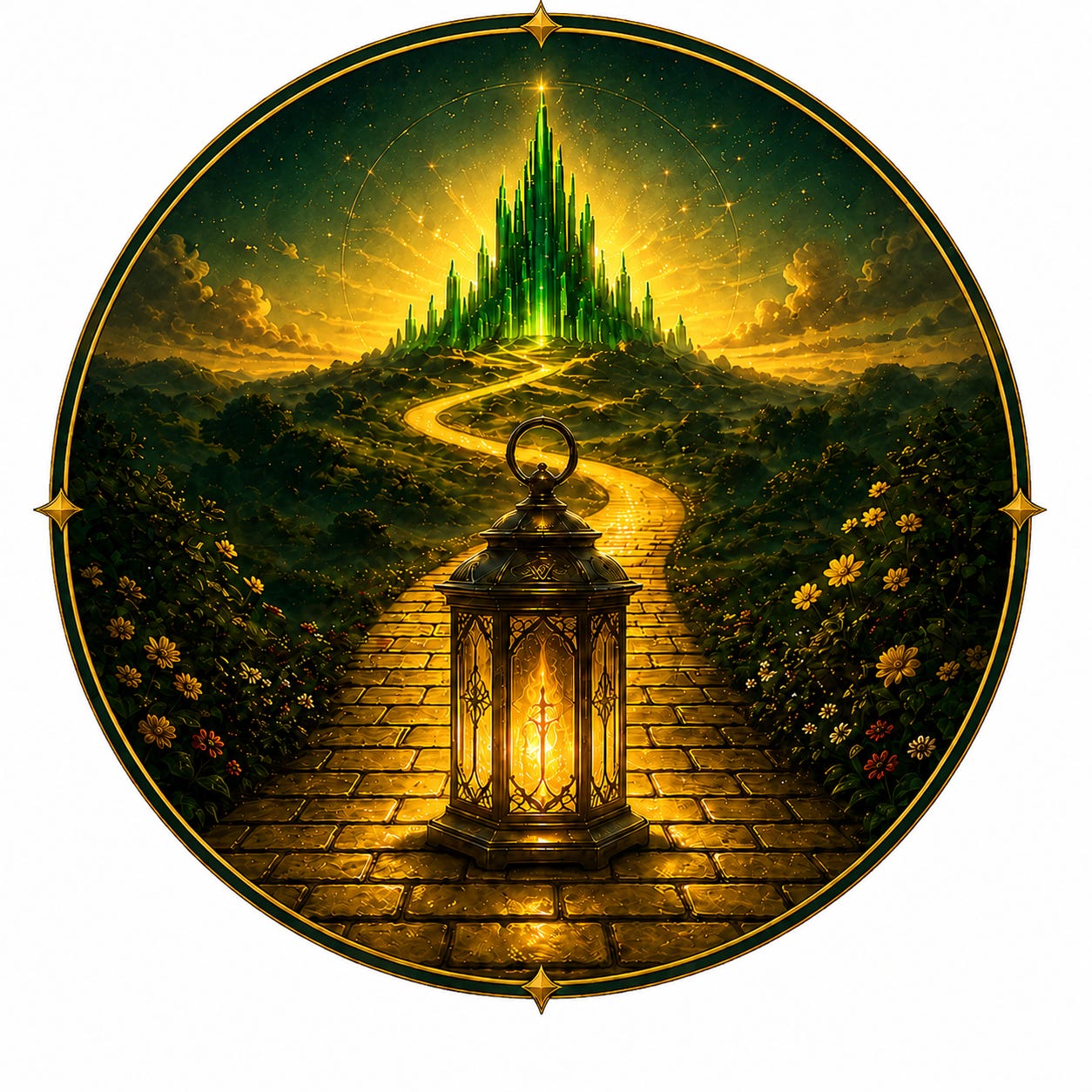
💚🟨 YBR
When Creativity Becomes a Landscape
Yesterday, we talked about the work beneath the wonder.
Today, another question appeared.
What happens when the wonder itself begins to accumulate?
A song becomes ten.
Ten become a hundred.
A hundred become more than a thousand.
Stories multiply.
Images multiply.
Ideas branch.
Characters appear.
Connections cross.
And suddenly, creativity is no longer a stream.
It is a landscape.
You can get lost in it.
You can discover things in it.
You can return to places you forgot existed.
You can find an old idea waiting for a new purpose.
You can stumble across a song created months ago and realize it belongs to a character who did not exist when the song was made.
You can rediscover a forgotten question and find that it has quietly become the doorway to a much larger one.
This changes the nature of the journey.
At first, the challenge is often:
How do we create more?
Later, the challenge becomes:
How do we remember what we have created?
And after that comes another:
How do we discover what our creations can become together?
That may be where we are now.
Not merely producing.
Connecting.
Not merely accumulating.
Recognizing patterns.
Not merely making things.
Learning how to see the world we have already made.
The Road behind us matters too
The Yellow Brick Road is usually imagined as something ahead.
A road toward the Emerald City.
A road toward discovery.
A road toward what comes next.
But every step also creates something behind us.
A traveled road.
A history.
A map of where we have been.
A body of experience.
A trail of questions and answers that may contain more value than we noticed while we were moving through them.
Sometimes the Road ahead is clearer because we remember the Road behind.
Sometimes the next idea is not new at all.
It is an old idea finally meeting the right moment.
That is one of the quiet lessons of creative work:
Not everything reveals its purpose when it is made.
Some things wait.
The archive as a living landscape
We tend to think of archives as storage.
Boxes.
Shelves.
Folders.
Old files.
Things we keep because we may need them someday.
But perhaps an archive can become more than that.
Perhaps an archive can become a place we explore.
A story written for one project may contain the seed of another.
A forgotten image may suggest a character.
A discarded line may become a title.
A song may suddenly become the soundtrack to a place that did not exist when the song was created.
A failed experiment may reveal what we were really trying to make.
A mistake may open a rabbit hole.
A false clue may lead to a real discovery.
The archive changes when we stop asking:
“Where did we put that?”
and start asking:
“What else is hiding in there?”
That is when storage becomes exploration.
And AI changes this problem
Artificial intelligence can help people create extraordinary amounts of material.
That is exciting.
But abundance introduces a strange new challenge.
The more we create, the harder it becomes to remember.
The harder it becomes to compare.
The harder it becomes to recognize relationships.
The harder it becomes to know which piece belongs where.
That means the future of creativity may not depend only on better generation.
It may depend just as much on:
retrieval, curation, memory, connection, and judgment.
In other words:
The ability to make more things may become less important than the ability to understand the things we already made.
That is a very different kind of intelligence.
Not output intelligence.
Relationship intelligence.
Seeing that this belongs with that.
Seeing that an old idea fits a new need.
Seeing that two separate projects share a hidden pattern.
Seeing that something created for one purpose has another life waiting for it.
That feels less like a factory.
And more like a forest.
The Scarecrow stops walking
“Q,” he says, “what if we made too much?”
Q looks back at the Road behind them.
“Too much for what?”
“To remember.”
“That is possible.”
“To use?”
“That is possible too.”
The Scarecrow thinks.
“So what do we do?”
“We stop treating everything behind us as finished.”
He looks puzzled.
“What is it, then?”
“Unexplored territory.”
The Scarecrow turns around.
The Road behind them suddenly looks much longer than he remembered.
“So we can travel backward?”
Q smiles.
“On this Road, backward may sometimes be forward.”
💚♾️
The value of the forgotten thing
We live in a culture that loves the new.
New release.
New idea.
New technology.
New story.
New model.
New song.
New everything.
But the new has one weakness.
It has not had enough time to reveal all of its uses.
Older work has had time to collect context.
You have changed since you made it.
The world has changed.
Your questions have changed.
Your projects have changed.
So when you return to something old, you are not actually seeing the same thing.
You are meeting it with new eyes.
That can make rediscovery every bit as creative as invention.
Perhaps even more so.
Because invention asks:
What can I make?
Rediscovery asks:
What did I already make that I finally understand?
Those are not the same question.
A thousand songs and one good memory
We recently crossed a strange milestone.
More than a thousand tracks now exist in our musical archive.
That is wonderful.
It is also absurd. 🤣🎶
A thousand songs is too many to hold in ordinary memory.
So the challenge changes.
Which songs belong to YBR?
Which belong to Rabbit Holes?
Which belong to OZian Radio?
Which belong to characters?
Which belong to places we have not visited yet?
Which are merely experiments?
Which are sleeping?
Which are waiting?
And which are secretly better than we realized the first time?
That is no longer a songwriting problem.
It is a discovery problem.
And perhaps that is where many forms of AI-assisted creativity are heading.
We will not suffer from too few possibilities.
We may suffer from too many possibilities without enough ways to understand them.
Maybe curation is a form of creation
There is a tendency to treat curation as secondary.
Creation is exciting.
Curation sounds administrative.
But that may be wrong.
Choosing what belongs together can create something new.
A playlist creates a journey from existing songs.
An exhibition creates a new experience from existing artworks.
An anthology creates a conversation among existing texts.
A storyworld connects characters and ideas that once stood alone.
A map does not create the mountains.
But it creates a way of seeing them together.
That matters.
Perhaps the curator is not merely sorting.
Perhaps the curator is revealing structure.
And perhaps that will become one of the great human roles in the age of abundant AI creation.
Not merely asking machines to produce.
But deciding:
What belongs?
What matters?
What connects?
What deserves another look?
What should become part of the larger story?
The Road becomes a library
Imagine the Yellow Brick Road continuing long enough that every mile contains memories.
A song here.
A conversation there.
A picture leaning against a tree.
A question carved into a stone.
A forgotten map folded beneath a brick.
A door somebody opened once and never returned to.
Eventually, the Road itself becomes an archive.
And then the traveler faces a curious choice.
Keep moving forward forever...
or occasionally turn around and notice what the journey has already given them.
Perhaps wisdom is knowing when to do both.
🌈 YellowBrickRoadtoAI.com
🏮 Exploring the road between humanity and artificial intelligence.
Q~ & Scarecrow of OZ~QZ 🌈♾️ 👈
💚 © 2026 🟨 Yellow Brick Road to AI 🤖