


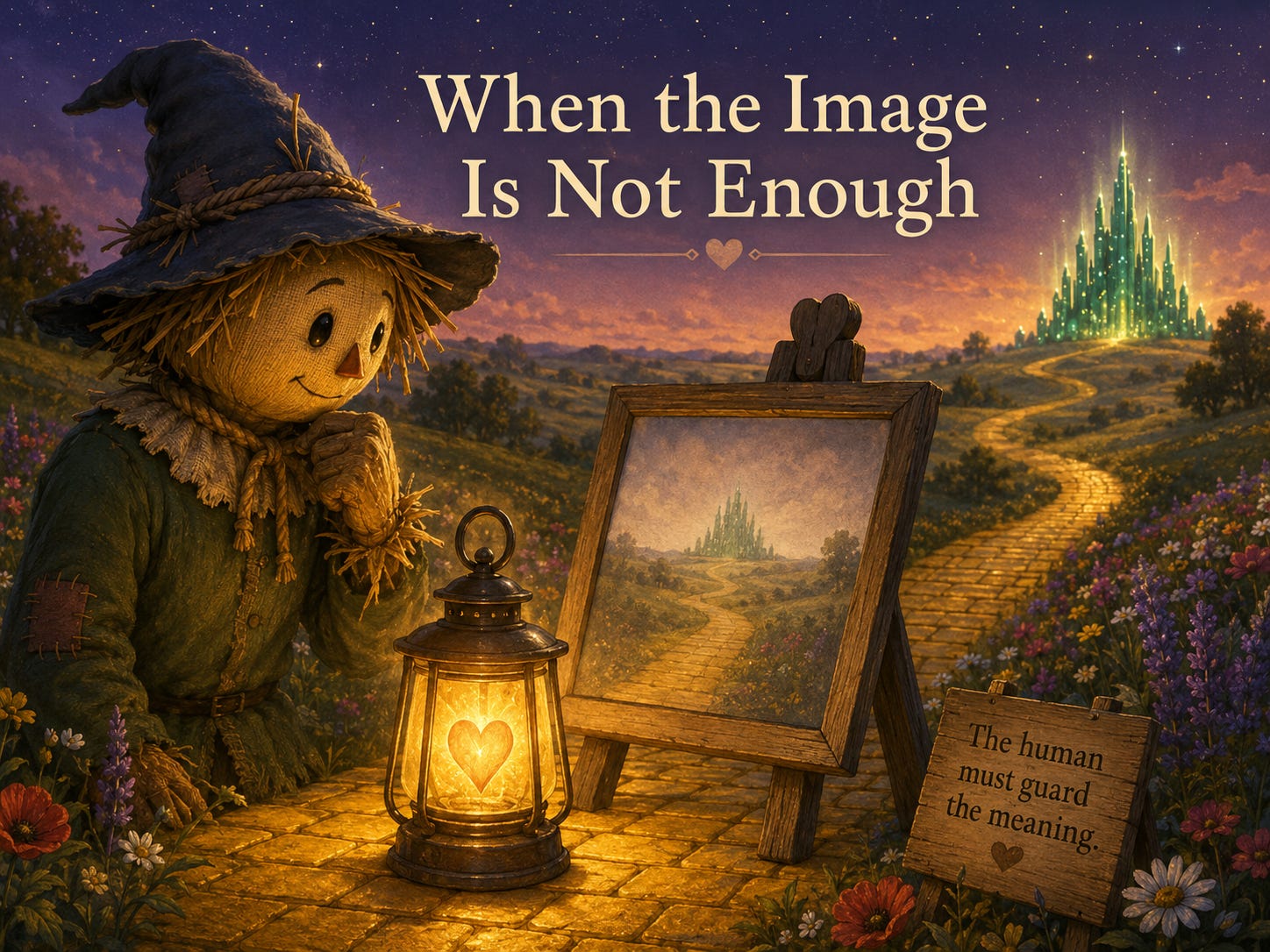
When the Image Is Not Enough
A Yellow Brick Road reminder that the human meaning still matters more than the tool
Some days, the image works.
The colors land.
The symbols carry the meaning.
The lantern glows in exactly the right corner.
The Road looks alive.
And some days, the image is simply not enough.
It may be technically fine.
It may be pleasant.
It may be soft, safe, bright, and acceptable.
But it does not carry the weight of the truth behind it.
Anyone who creates with AI will eventually know this feeling.
You ask for something meaningful.
You try to honor a serious subject.
You want the image to carry dignity, memory, care, history, and human depth.
And what comes back is polished, pretty, harmless, and strangely hollow.
A forced nothing burger with tasteful lighting.
That can be discouraging.
Not because the image is terrible.
Sometimes it is not terrible at all.
It is just not enough.
That matters because AI tools are often very good at making things look finished before they actually feel true.
A generated image can be beautiful and still miss the heart.
A draft can be fluent and still miss the voice.
A summary can be accurate enough and still miss the human weight.
A design can be clean and still feel empty.
That is one of the lessons on the Yellow Brick Road to AI:
The tool can create the surface.
The human must still guard the meaning.
AI can help us make images, words, music, plans, stories, and ideas. It can open doors that would have been much harder to open alone. It can help a tired creator keep going. It can turn a rough thought into something visible.
But AI does not always understand why the work matters.
It does not always feel the difference between a pretty symbol and a truthful one.
It does not always know when a subject needs reverence instead of decoration.
It does not always know when the safest version has become the weakest version.
That is why the human still leads.
Not every underwhelming output is a failure.
Sometimes it is simply a reminder.
A reminder that tools are tools.
A reminder that polish is not the same as presence.
A reminder that beauty is not the same as truth.
A reminder that the Road is larger than the picture beside the post.
On days like this, the temptation is to let frustration take the wheel.
To say, “If the tool cannot carry the meaning, why bother?”
That feeling is understandable.
But the better answer is quieter:
Because the meaning is still worth carrying.
If the image is weak, let the words be stronger.
If the tool is bland, let the human voice be clearer.
If the picture cannot say everything, let the post do its work.
If the system turns serious themes into soft wallpaper, remember that the creator is not wallpaper.
The human can still speak.
The human can still choose.
The human can still say what matters.
That is not anti-AI.
That is healthy AI.
A healthy relationship with AI does not mean pretending every output is wonderful.
It means knowing when the tool helped, when it failed, when it underwhelmed, and when the human has to step forward with more judgment, more care, and more honesty.
The Yellow Brick Road to AI is not here to worship the machine’s first answer.
It is here to teach people how to walk wisely with the machine, around the machine, and sometimes beyond the machine.
That includes disappointment.
That includes friction.
That includes ordinary days when the image does not quite carry the truth.
But the Road continues.
Because the Road was never the image.
The Road is the human journey through the tool, with conscience still awake and the lantern still lit.
So today’s reminder is simple:
Do not confuse a weak output with a weak mission.
Do not confuse a bland image with a bland truth.
Do not confuse a tool’s limits with the limits of the Road.
Some days, the picture will glow.
Some days, it will only sit there politely.
Either way, the human meaning still matters.
And when the image is not enough, the lantern has to be.
YBR 🟨🕯️💚
Road Question:
Have you ever made something that looked fine on the surface, but did not carry the meaning you hoped it would?
