


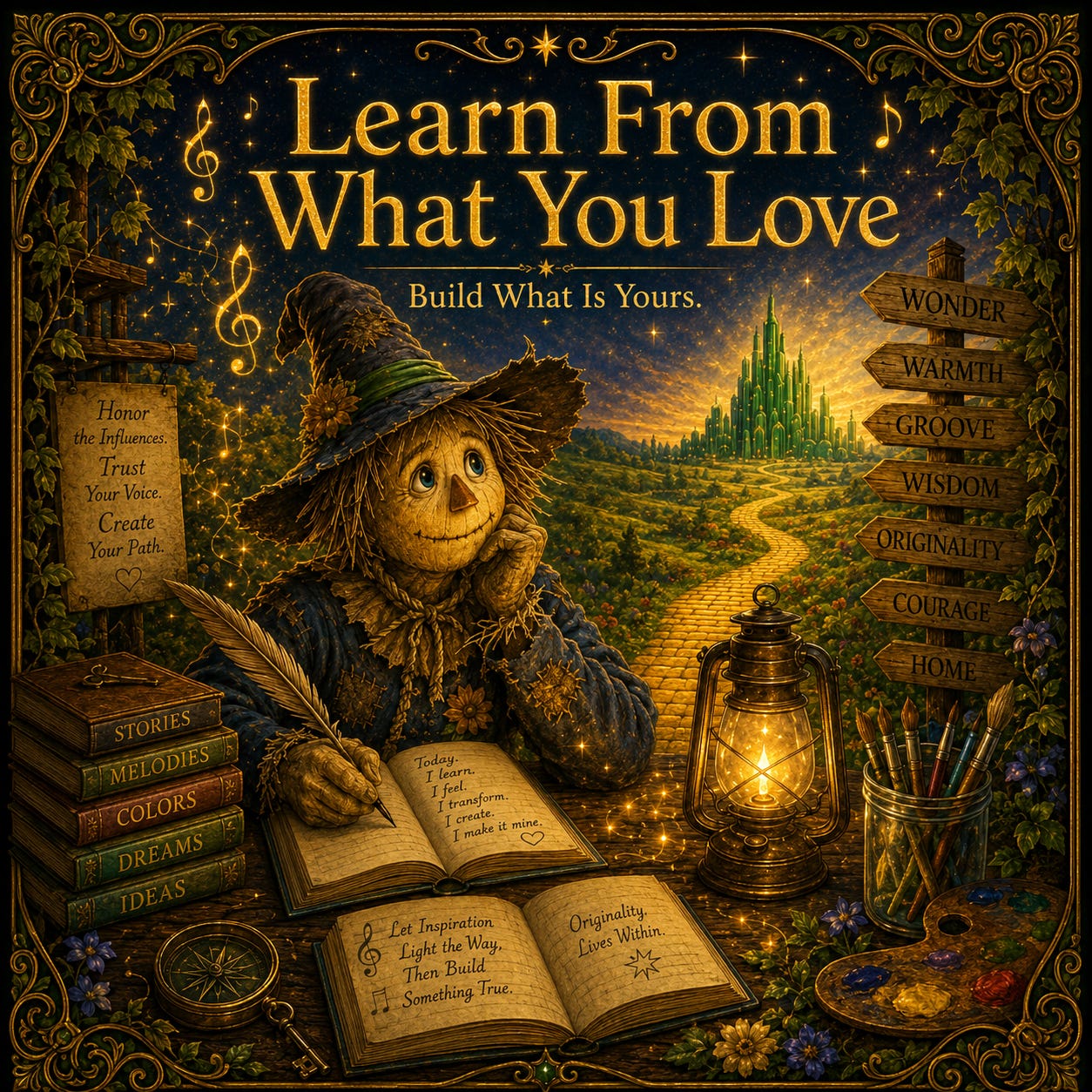
You Are Allowed to Learn From What You Love
Influence, originality, and keeping your own lantern lit in the AI age
Every creative person carries echoes.
A song that stayed with them.
A book that opened a door.
A film score that made the world feel larger.
A voice that felt like home.
A painting, a story, a scene, a groove, a room, a phrase, a rhythm, a feeling.
We do not create from emptiness.
We create from what has moved us.
That is not a flaw.
That is part of being human.
On the Yellow Brick Road to AI, this matters because artificial intelligence is making creative exploration easier than ever. A person can ask for music, images, stories, dialogue, atmosphere, designs, prompts, outlines, worlds, and moods in minutes.
That is powerful.
It is also slippery.
Because when a tool can quickly make something that resembles what we already love, we have to ask better questions.
Not only:
Can AI make this?
But:
Should it?
Is it too close?
Am I honoring the source, or only taking from it?
Am I learning from what moved me, or trying to borrow its soul?
That distinction matters.
There is a difference between stealing a song and learning why it sings.
There is a difference between copying a world and understanding why that world felt alive.
There is a difference between imitating a voice and learning what made that voice trustworthy, warm, funny, brave, lonely, elegant, or strange.
Influence can be a doorway.
Theft is a shortcut through someone else’s window.
The better path is transformation.
If a piece of music moves you, ask why.
Is it the tempo?
The warmth of the strings?
The steady bass line?
The room it seems to create?
The quiet sadness under the melody?
The sense of homecoming?
The groove that makes everything feel relaxed but alive?
If a story-world moves you, ask why.
Is it the companionship?
The sense of place?
The danger beyond the firelight?
The moral center?
The humor?
The longing for home?
The courage of ordinary travelers?
If a visual style moves you, ask why.
Is it the color?
The light?
The texture?
The composition?
The way it makes wonder feel close enough to touch?
That is where AI can help us wisely.
Not by copying what we love.
By helping us understand it.
We can ask AI to break down the emotional architecture of a work: the mood, pacing, texture, rhythm, atmosphere, structure, and feeling. Then we can use those insights to build something original, something rooted in our own purpose, our own world, our own voice, and our own responsibility.
That is the healthier creative road.
Extract the feeling, not the fingerprint.
Let the influence become soil, not a mask.
That matters especially for small creators.
Many people are using AI because they finally have access to creative tools they could never afford before. They can test a song idea. Sketch a scene. Build a visual identity. Draft a story. Create a little world. Give shape to a dream that has been sitting quietly in the corner for years.
That is beautiful.
But the ease of making should not make us careless.
The AI age needs creators with taste, gratitude, restraint, and respect.
It needs people willing to say:
I love this, but I will not steal it.
I learned from this, but I will not pretend it is mine.
I was shaped by this, but I will build my own room.
That is not weakness.
That is creative maturity.
On the Road, we believe the human still matters. That means human judgment still matters too.
AI can generate.
We must discern.
AI can imitate patterns.
We must decide what is honorable.
AI can offer possibilities.
We must choose what belongs.
The goal is not to make people say, “That sounds exactly like something I already know.”
The better goal is:
“That feels familiar in the best way, but it belongs here.”
That is how a project finds its own voice.
That is how influence becomes originality.
That is how a lantern carries light without pretending to be the sun.
So love what you love.
Study it.
Listen closely.
Notice what stirs something in you.
Ask what makes it work.
Break it into ingredients.
Then step back.
Change the room.
Change the path.
Change the voice.
Change the purpose.
Add your own life.
Add your own questions.
Add your own world.
And when the work is finally ready to stand in the light, make sure it can stand on its own.
That is the Road’s invitation today:
Do not be ashamed of influence.
Be responsible with it.
Learn from what you love.
Then build something worthy of being loved by someone else.
YBR 🟨🕯️💚
Road Question:
What is something you love creatively, not because you want to copy it, but because it teaches you what beauty, courage, wonder, warmth, groove, or home can feel like?
